Avalanche (AVAX) 2026: The Rise of Institutional L1s
Avalanche has reinvented itself in 2026. From "Avalanche L1s" to the ACP-77 subscription model, we analyze the tech powering Wall Street's favorite blockchain.
What is Avalanche (AVAX)?
- As of May 6, 2026, the Avalanche ecosystem has undergone its most significant transformation since its inception in 2020. The network has successfully transitioned into the Avalanche9000 era, a massive technological pivot that has rebranded "Subnets" into Avalanche L1s and dismantled the economic barriers to entry.
- With the recent launch of CME Group AVAX Futures (May 4, 2026) and the VanEck AVAX ETF trading on Nasdaq, Avalanche has solidified its position as the "Wall Street of Web3."
- While Bitcoin consolidates around the $80,000 mark, Avalanche is capturing the spotlight as the primary infrastructure for Real-World Asset (RWA) tokenization and bank-grade settlement.
1. The Core Architecture: The Three-Chain Model
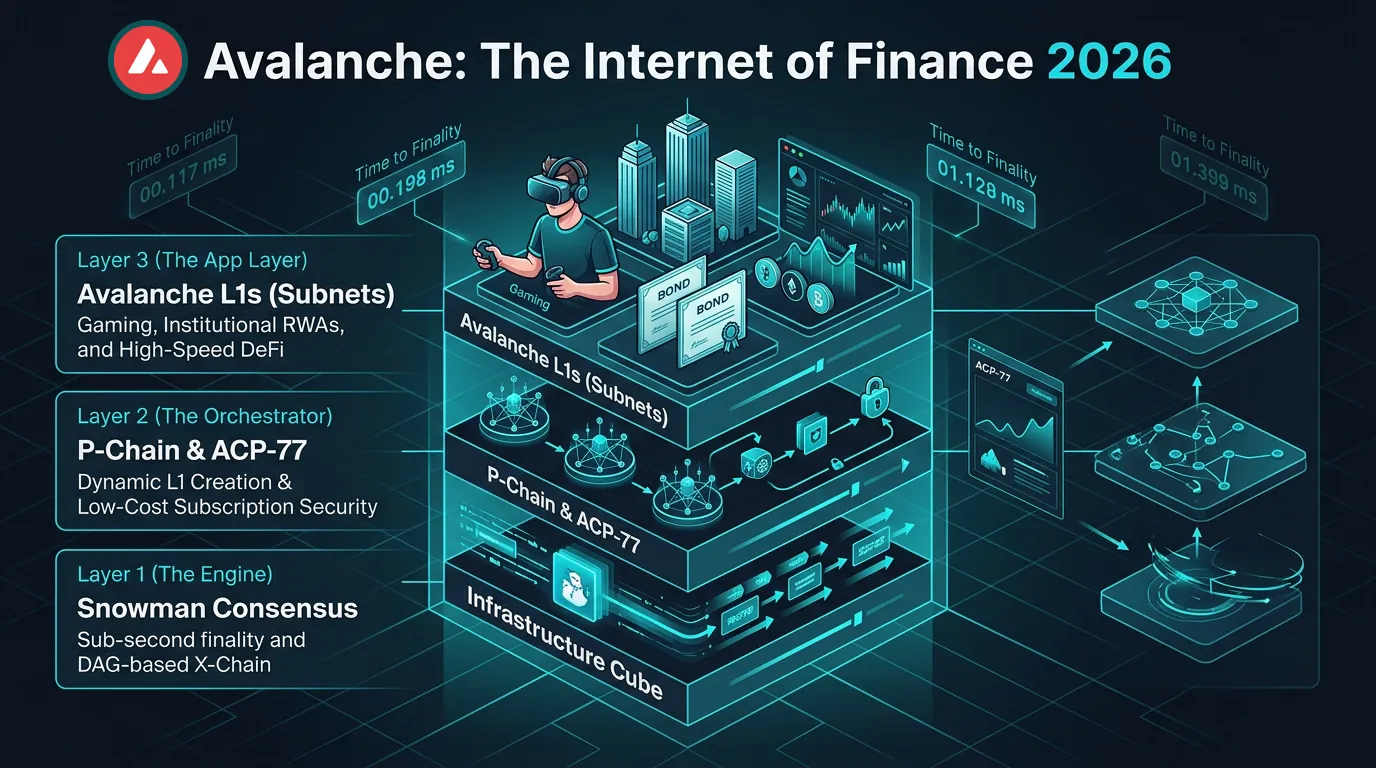
In a way, there are several avalanches, not just one: Avalanche remains unique for its heterogeneous network structure, separating different functions into three distinct, interoperable chains within its Primary Network.
X-Chain (Exchange Chain): A decentralized platform for creating and trading digital assets (like AVAX itself). It uses a Directed Acyclic Graph (DAG) for high-speed, parallel processing.
P-Chain (Platform Chain): The metadata chain that coordinates validators, tracks active Avalanche L1s, and enables the creation of new networks. In 2026, the P-Chain is the heart of the "Subscription Model" for security.
C-Chain (Contract Chain): An Ethereum Virtual Machine (EVM) compatible smart contract platform. It is the hub for DeFi and NFTs, benefiting from the Octane upgrade (2025) which reduced fees by over 40%.
2. Consensus: Snowman & The DAG
The "secret sauce" of Avalanche is its consensus mechanism, which differs fundamentally from both Proof of Work and Nakamoto-style Proof of Stake.
Optimized Sampling: Instead of all nodes talking to all nodes, a validator randomly samples a small subset of others to confirm a transaction. This "Snowball" effect leads to lightning-fast consensus.
Sub-Second Finality: In 2026, Avalanche continues to lead the market in time-to-finality (<0.8 seconds), a critical requirement for institutional trading and high-fidelity gaming.
3. The L1 Revolution: ACP-77
The most critical update in 2026 is the implementation of ACP-77 (Avalanche Community Proposal 77). This upgrade "reinvented" Subnets:
Lower Entry Barriers: Previously, launching a Subnet required a massive upfront stake of 2,000 AVAX. Today, Avalanche L1s use a "pay-as-you-go" subscription model, reducing launch costs by 99.9%.
Validator Sovereignty: L1s no longer need to validate the entire Primary Network, allowing for specialized, lightweight blockchains tailored for specific use cases (e.g., private banking or mobile gaming).
Evergreen Subnets: Used by giants like J.P. Morgan (Kinexys), Citi, and Visa, these permissioned environments allow institutions to maintain KYC/AML compliance while tapping into public liquidity.
4. The 2026 Ecosystem: DeFi, Gaming, and RWAs
- Avalanche's ecosystem has established a growing presence in blockchain gaming, with titles like Shrapnel and Off the Grid leveraging dedicated Avalanche L1s (subnets) to run game economies and assets without congesting the main network.
- However, the sector is still emerging, and adoption remains early rather than dominant. In parallel, Avalanche has seen strong traction in real-world asset (RWA) tokenization, highlighted by Japan’s Progmat migrating over $2 billion in tokenized securities to a dedicated Avalanche L1. Additional institutional players, including major asset managers, have also launched tokenized products on the network, reinforcing Avalanche’s position as a key infrastructure layer for on-chain finance.
Verification and Security via DEXTools
In the "Avalanche L1" era, where thousands of app-specific chains exist, verifying liquidity is paramount. DEXTools is the optimal tool for analyzing the market, finding early crypto gems, and avoiding scams.
Professional traders in 2026 use DEXTools to verify:
The DEXTscore: Ensuring that new L1-native tokens have verified contracts and decentralized liquidity.
Audit Status: Checking if a new L1 has undergone a CertiK or Quantstamp audit before deploying capital.
To monitor the DeFi market in an agile and secure way in real-time and trade Avalanche L1 assets with the help of the best crypto tools, you can access Avalanche on DEXTools here and start trading today.
Disclaimer: This article is for informational purposes only and does not constitute investment advice, financial advice, trading advice, or any other kind of advice. DEXTools does not recommend buying, selling, or holding any cryptocurrency or token. Users should conduct their own research and consult with a qualified financial advisor before making any investment decisions. Cryptocurrency investments are volatile and high-risk. DEXTools is not responsible for any losses incurred.
https://www.dextools.io/tutorials/what-is-tokenomics-in-crypto-guide-2026
https://www.dextools.io/tutorials/what-is-yield-farming-in-crypto-guide-2026
https://www.dextools.io/tutorials/what-is-macd-in-crypto-trading-guide-2026
Related Guides
- Best Telegram Bots for Avalanche 2026: Top 8 AVAX Sniper Bots
- Top 5 Bitcoin Layer 2 Solutions in 2026: The Rise of BTCFi
- What is Maple Finance? Institutional Lending Explained
- What Is Maple Finance? Institutional DeFi Lending Guide 2026
- How to Use Avalanche Subnets: Beginner's Guide
Frequently Asked Questions
What is the difference between a Subnet and an Avalanche L1?
In 2026, "Avalanche L1" is the new branding for what were formerly called Subnets. Under ACP-77, these networks are now more sovereign, cheaper to launch, and no longer require a 2,000 AVAX stake.
Why is Avalanche popular for institutions?
Because of Evergreen L1s. These allow banks to choose their own validators, maintain privacy, and comply with KYC/AML laws while still being able to communicate with the rest of the Avalanche ecosystem.
Does Avalanche still have 3 chains?
Yes. The X, P, and C chains remain the "Primary Network." However, most users now interact with the C-Chain for DeFi or specific App-specific L1s for gaming and RWAs.
How fast is the Avalanche network?
Avalanche is famous for its sub-second finality. Most transactions are irreversible in less than 800 milliseconds, which is significantly faster than Ethereum or even Solana's confirmation times.
What is the AVAX token used for in 2026?
AVAX remains the native utility token used for securing the Primary Network through staking, paying for transaction fees (which are burned), and as the "subscription currency" for Avalanche L1s under ACP-77.