BBC Report on Trump Trade Spikes Sparks Insider Trading Debate From Oil Futures to Crypto Markets
— By Tony Rabbit in Markets
A BBC investigation into suspicious trading spikes ahead of Trump announcements is reigniting debate over insider access, market integrity and the overlap between oil futures, prediction markets and crypto trading.
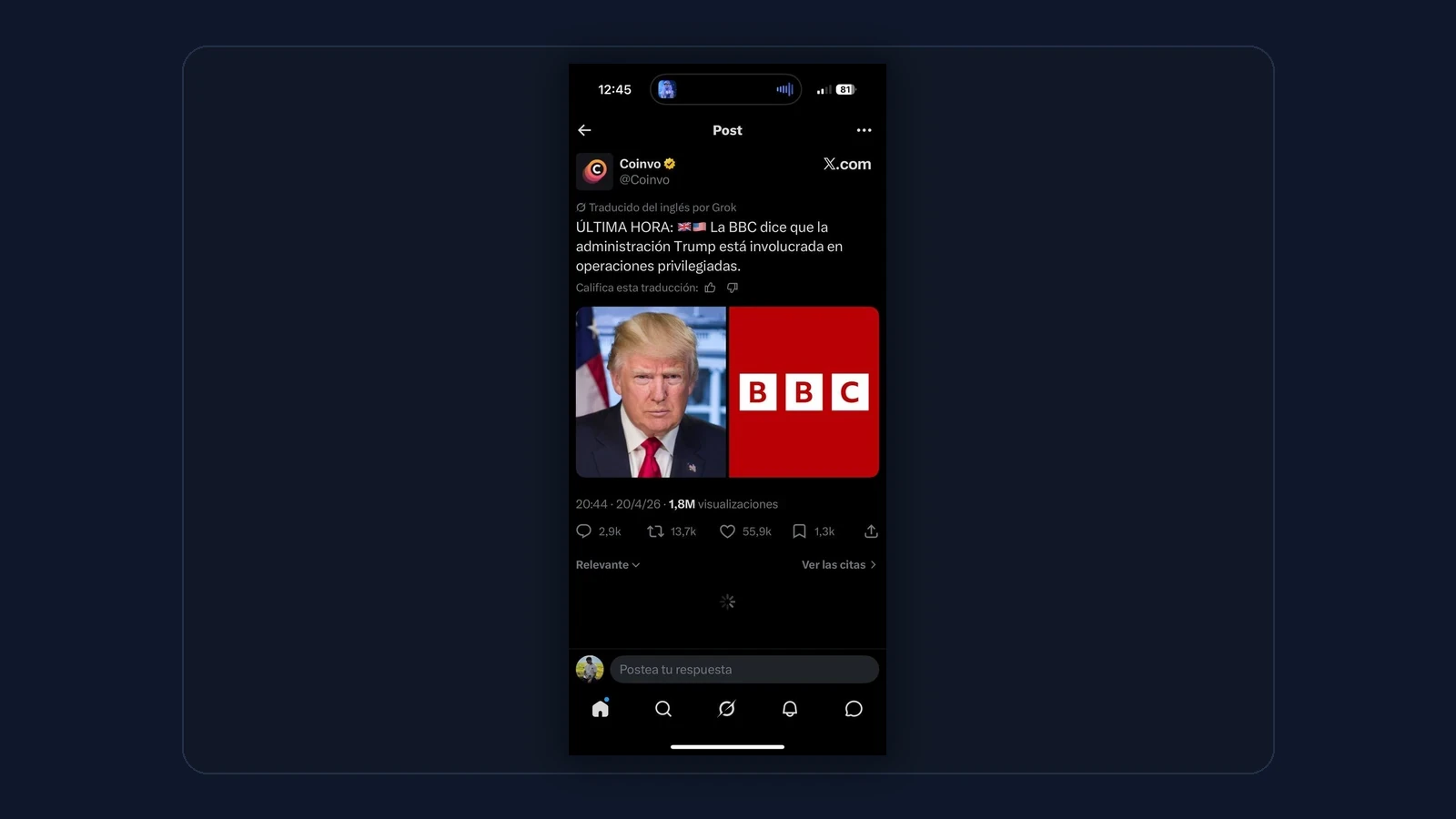
A viral post on X claiming that the BBC says the Trump administration is involved in insider trading has pushed a sensitive market integrity story into the mainstream. But the BBC's framing is more precise than the social media version. Its latest reporting says it found a pattern of suspicious trading spikes ahead of public announcements by Donald Trump, a pattern that is now being debated across traditional finance, oil futures, prediction markets and crypto-linked trading venues.
That distinction matters. A suspicious pattern is not the same thing as a legal finding. But it is more than noise if the same type of activity keeps showing up before market-moving headlines. For traders, the real issue is not only whether someone broke a law. It is whether people with faster access to political information are repeatedly moving into positions before the public gets the news.
Why this story matters
- The BBC says it found a pattern of trade spikes ahead of Trump announcements, not just one isolated trade.
- One related BBC report said traders placed hundreds of millions of dollars in oil contracts minutes before Trump said the US would postpone strikes against Iranian energy infrastructure.
- Another BBC story said an anonymous crypto gambler made about $436,000 after placing a $32,000 wager shortly before Trump announced Nicolás Maduro was in US custody.
- The BBC also reported that White House staff were told not to place bets on prediction markets, a sign that the optics and leak risk are being taken seriously.
What the BBC Report Actually Adds
The most important contribution from the BBC is not one dramatic accusation. It is the claim that there is a recurring pattern. According to the BBC search results now circulating, its investigation found spikes in trading activity ahead of public announcements by Trump. Separate BBC stories also point to highly specific cases where the timing looks unusually sharp.
One example involved oil. The BBC reported that traders bet hundreds of millions of dollars on oil contracts just minutes before Trump announced that the US would postpone strikes against Iranian energy infrastructure. Another involved prediction markets and crypto-linked betting behavior. The BBC reported that an anonymous crypto gambler made $436,000 on the Maduro capture story after placing a $32,000 wager just before Trump made the announcement public. When several cases point in the same direction, the market begins asking the same question: is this just very smart positioning, or are some actors trading on information the broader public does not yet have?
Why Traditional Markets Care So Much
In traditional markets, insider trading is built around a simple idea: someone uses material non-public information to trade before the rest of the market receives it. In practice, that can involve equities, options, commodities, Treasury products, ETFs or sector baskets. With geopolitical announcements, oil futures are especially sensitive because they reprice almost instantly on war risk, supply disruption and sanctions headlines.
That is why the oil example matters so much. If traders leaned into energy contracts just before a politically controlled announcement that materially changed the risk outlook, the profit opportunity would not have depended on brilliant analysis alone. It would have depended on timing. And in market integrity cases, timing is often where suspicion starts.
TradFi vs crypto market integrity problem
Why Crypto Traders Should Not Treat This as a TradFi Story Only
For crypto traders, the obvious temptation is to see this as a Washington plus Wall Street problem. That would be a mistake. Political information leaks increasingly move multiple asset classes at once. A geopolitical headline can hit oil, defense stocks, Treasury yields, the dollar, Bitcoin, perpetual futures and event contracts in the same window. If someone has an information edge, they do not need to choose one venue. They can spread risk across many.
Crypto also introduces a structural twist. Prediction markets and on-chain venues can make suspicious activity easier to spot at the wallet level, especially when researchers can inspect movements through a blockchain explorer. But identity is still the missing layer. A wallet can be visible while the person behind it remains hidden, nested behind exchanges, intermediaries or offshore entities. That means crypto can be both more transparent and more elusive at the same time.
Why prediction markets are now central to the debate
- They let traders express a view on a political event directly instead of using a complicated hedge basket.
- They operate at headline speed, which makes advance information unusually valuable.
- They often sit near crypto rails, stablecoins or on-chain analytics, even when the legal wrapper differs from a classic token market.
- They expose the same core integrity problem: if one side has the news first, the market is no longer pricing fair public information.
Suspicion Is Not Proof, But the Optics Are Getting Worse
This story is sensitive because the gap between suspicion and proof is real, but the reputational damage can arrive much faster than a regulator. A market does not wait for a courtroom standard before it decides that something smells wrong. Once traders see repeated pre-announcement positioning, they start to assume that politics itself has become a signal feed for connected money.
The BBC's related report that White House staff were told not to place bets on prediction markets is important for exactly that reason. Even without a formal finding, it suggests that insiders understand the risk of leaks, the damage from bad optics and the possibility that political information is now being monetized in venues far beyond stocks alone.
What Traders Should Watch Next
The next phase of this story will not be driven by social media screenshots. It will be driven by data. Traders and analysts will watch whether abnormal positioning continues to show up before policy headlines, whether the same wallets or entities can be tied to repeated event-driven trades and whether regulators or journalists can connect those positions to people with privileged access.
For crypto specifically, the key tell may be cross-market synchronization. If a wallet or cluster appears in event contracts, then rotates into majors, sector tokens or stablecoin routing around the same political catalyst, the story becomes much harder to dismiss as coincidence. That does not prove wrongdoing by itself. But it is exactly the kind of pattern that turns a rumor into a serious market structure problem.
Related reading
Disclaimer: This article summarizes public reporting and market implications. It does not assert criminal liability by any individual or institution, and it is not investment or legal advice.