Corporate Crypto Payments Risk for European Banks
— By Whatsertrade in Analysis

Corporate crypto payments could shake up major European banks like HSBC and Deutsche. Analysts watch closely as blockchain's role in finance expands.
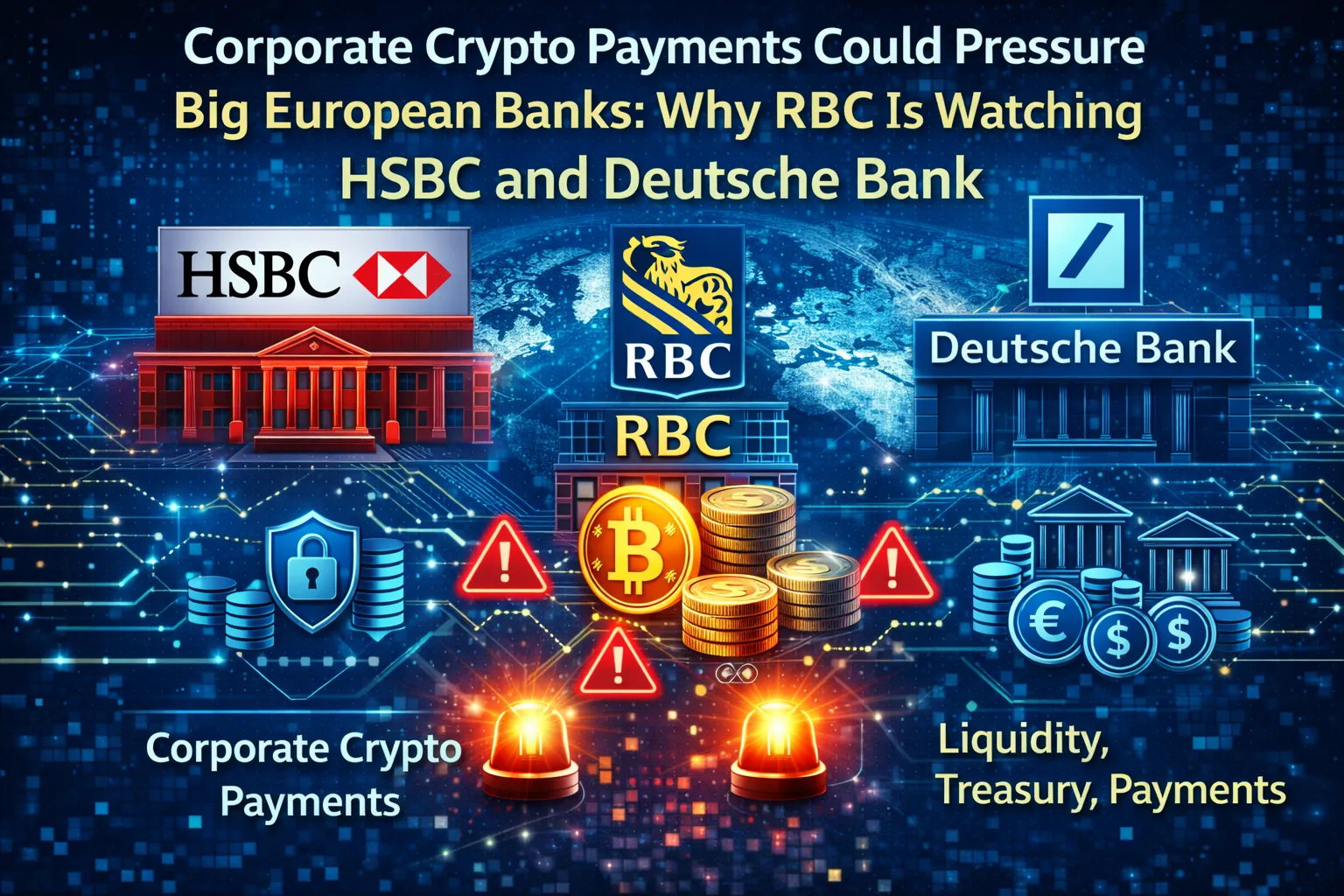
Corporate crypto payments are no longer a niche topic. They are becoming a strategic issue for some of Europe’s biggest banks, especially those with large corporate cash management and payments businesses. That is why analysts at RBC are paying close attention to HSBC and Deutsche Bank, which were identified as among the most exposed if companies increasingly use crypto-based tools to move, hold, and manage money.
The core issue is simple. Banks make money from helping companies handle payments, liquidity, cash pooling, treasury services, and cross-border transfers. If corporate clients begin shifting part of that activity toward stablecoins, tokenized money, or blockchain-based payment rails, some of that revenue could come under pressure. According to the RBC view reported by Reuters, banks with larger corporate payments divisions could face tighter margins and even client losses if they fail to adapt quickly enough.
HSBC and Deutsche Bank's Unique Position
HSBC and Deutsche Bank matter here because both have significant exposure to corporate payments and cash management. That makes them especially relevant in any scenario where companies start using crypto payment infrastructure more actively. The risk is not just that transactions move elsewhere. It's that the entire value chain of treasury and payments could gradually become more digital, more tokenized, and less dependent on legacy banking rails.
This does not mean either bank is in immediate danger. It means the market is starting to ask a bigger question: what happens if crypto payments begin to compete directly with one of the most stable and profitable parts of traditional banking? That is why this topic is getting attention from investors, strategists, and financial media.
The Transition to Crypto Payments
The biggest change is speed and control. Corporate clients are increasingly interested in faster cross-border settlement, always-on payment systems, and more programmable ways to manage money. Stablecoins and blockchain-based payment tools appeal to companies because they can reduce delays, improve visibility, and create more flexibility in international transfers.
For banks, that creates a two-sided reality. On one side, it threatens fee income linked to traditional payment flows. On the other side, it opens a path to new revenue streams for institutions that can offer digital asset services, custody, tokenized treasury tools, and crypto-enabled payments infrastructure. Reuters noted that RBC sees both risks and opportunities in this shift.
European Banks Under Digital Pressure
This story is especially important in Europe because the region is already dealing with digital payments competition, stablecoin policy debates, and pressure to modernize financial infrastructure. If corporate crypto payments become more common, the banks most exposed are likely to be those with the largest and most international payments franchises.
That is where HSBC and Deutsche Bank stand out. Their size and reach make them well-positioned to benefit if they adapt, but also more vulnerable if the shift accelerates faster than expected. In other words, the same scale that makes them powerful today could become a source of pressure if corporate clients begin moving payment activity onto newer rails.
Understanding the Stablecoin Factor
Stablecoins are central to this conversation because they are one of the clearest bridges between crypto infrastructure and real-world payments. If companies begin using stablecoins for treasury or international settlement, banks may face pressure not only on transaction fees but also on deposits and liquidity relationships.
That concern fits with a broader trend in policy and banking. European officials have recently pushed for stronger local digital money infrastructure, including euro stablecoins, while central bankers have also warned that stablecoins could draw value away from traditional deposits and reshape payment flows. This wider context makes RBC’s warning more important because it suggests the market is not talking about a distant theoretical risk. It is talking about a structural shift that may already be beginning.
Investor Perspectives on Banking and Crypto
For investors, the key question is not whether crypto payments replace banks tomorrow. The real question is whether the growth of blockchain-based corporate payments starts changing bank economics over time. If even a modest share of corporate payment activity moves toward crypto rails, that could influence fee income, funding costs, and competitive positioning.
This is why the story has strong SEO and market appeal right now. It sits at the intersection of crypto adoption, traditional finance, stablecoins, and banking strategy. It is not just a crypto story. It is a payments story, a revenue story, and a market structure story.
Balancing Risks and Opportunities
There is an important balance here. Banks are not just exposed to downside. They also have an opportunity to build products around the same trend. Institutions that move early into digital asset custody, tokenized payments, treasury rails, and crypto-linked services may be able to defend their existing franchise while opening new areas of growth.
This is not best understood as a simple disruption narrative. It is really a transition story. The banks that understand corporate crypto payments early may be able to shape the next generation of financial services. The ones that move too slowly could find pressure building around one of their most important businesses. Reuters’ summary of the RBC note makes that point by highlighting both the risk of margin pressure and the potential for new revenue opportunities.
Corporate crypto payments could become one of the most important themes for European banking over the next few years. HSBC and Deutsche Bank are in focus because they have large corporate payments businesses and therefore more exposure if companies start shifting treasury and settlement activity toward crypto-based systems. That is why RBC is watching them so closely.
The deeper point is bigger than any single bank. If digital money becomes a more important part of corporate finance, then payments, liquidity, and treasury management may begin to change at the same time. For the banking sector, that creates pressure. For faster-moving institutions, it may also create a rare chance to redefine where the next generation of fee income comes from.
How to Bridge Crypto Between Chains: Complete Cross-Chain Tutorial 2026 How to Use 1inch: Complete DEX Aggregator Swap Tutorial (2026) How to Use OKX Web3 Wallet: Multi-Chain DeFi Hub Guide (2026)