Onchain Geopolitics: Oil, Info & Predictions
— By Whatsertrade in News

Unpack 2026's onchain geopolitics: Oil, derivatives, and prediction markets collide with insider trading concerns amid evolving regulatory scenes.
Crypto traders used to talk about geopolitics like it was background noise. It moved Bitcoin, shook risk assets, and changed sentiment, but it still felt like something happening outside the onchain world. That is no longer true. In 2026, the line between macro events and crypto markets is getting thinner, and the latest wave of suspiciously well timed trades around Trump administration announcements shows why. Reuters reported on March 29 that several large bets were placed shortly before major policy moves involving Iran, Venezuela, tariffs, and oil, raising questions about whether nonpublic information may have leaked into options, commodities, and prediction markets.
This matters because it changes how traders should think about onchain markets. Prediction markets are not just novelty products anymore. They are becoming part of a larger system where geopolitics, derivatives, media attention, and crowd sentiment all feed into each other in real time. When an oil trade, a political raid, and a prediction contract can all react to the same event within minutes, the old idea that crypto lives in a separate universe starts to fall apart.
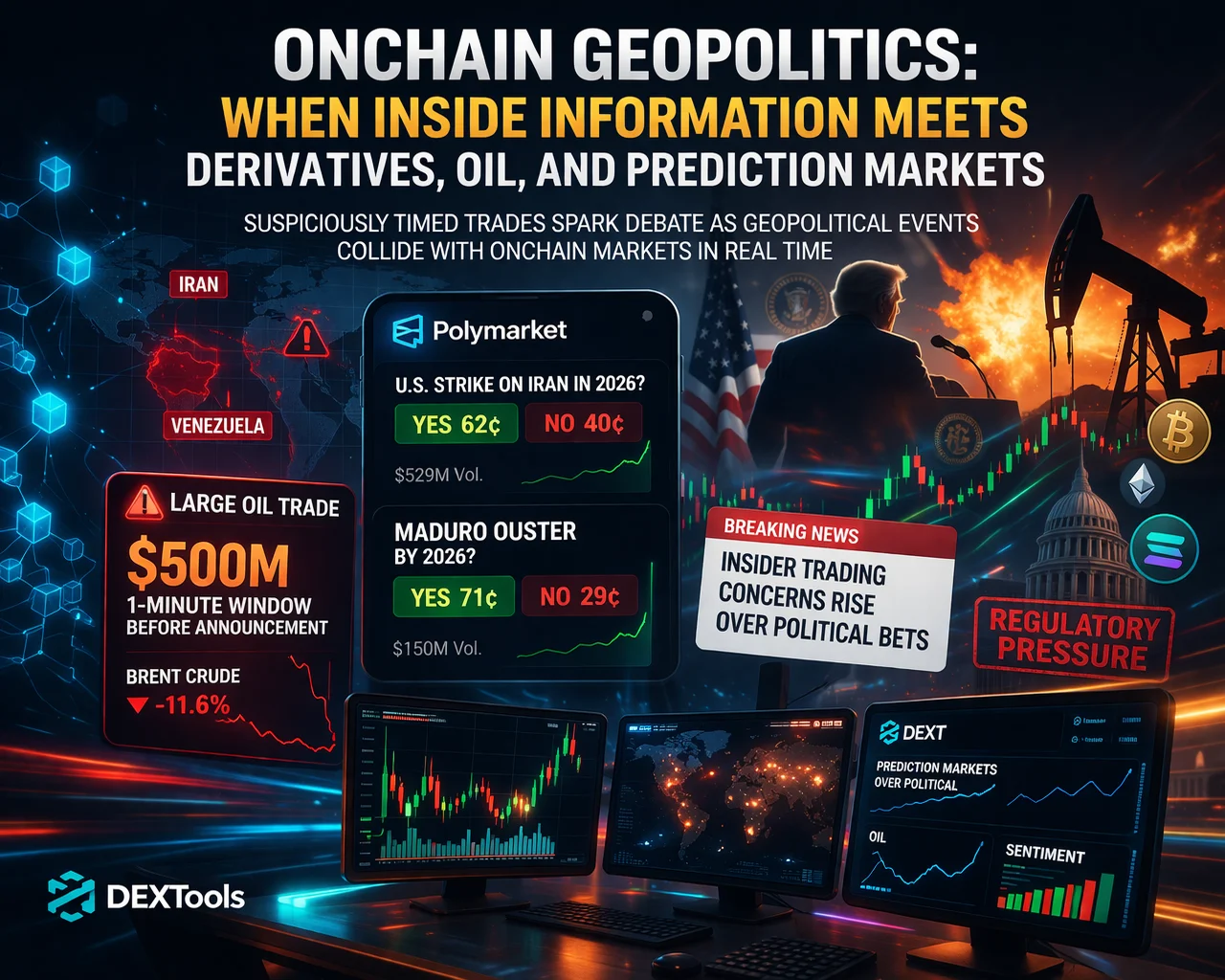
The most striking example came this week in energy markets. Reuters reported that unidentified traders placed a roughly $500 million oil bet in a one minute period before Trump announced a delay in an assault on Iranian energy assets. Once Trump's post went live, Brent crude fell to $99 from $112 and WTI dropped to $86 from $99. The speed and scale of the move made the trade stand out immediately, not just because of the profit opportunity, but because it showed how tightly geopolitics and market positioning are now linked.
That same Reuters review also highlighted the prediction market side of the story. Around the February 28 strikes that killed Iran's Supreme Leader Ayatollah Ali Khamenei, about $529 million was wagered on contracts tied to the timing of U.S. and Israeli strikes on Iran, while another $150 million was staked on Khamenei's removal as supreme leader. Reuters said analytics firm Bubblemaps identified six accounts that made a combined $1.2 million profit from Polymarket bets funded in the hours immediately before the raids.
A separate case tied to Venezuela pushed the same debate further. Reuters reported that an unknown trader made about $410,000 after betting on the ouster of Nicolás Maduro before a U.S. operation captured him on January 3. The position had been built when the odds still implied a low probability event, then surged in value once news of the raid emerged. For traders, this is where the story stops being abstract. A platform that looks like a sentiment tool can suddenly become a venue where privileged geopolitical information, if it exists, turns into direct profit.
This is why onchain geopolitics is such a strong topic now. It is not only about prediction markets becoming popular. It is about a deeper market structure shift. Event driven trading is becoming faster, more public, and more connected across asset classes. A geopolitical development can hit oil, equities, rates, and prediction platforms at once. That makes crypto native markets feel less like an alternative world and more like a high speed layer attached to the same macro machine as traditional finance. That is an inference from the recent cases, but it is strongly supported by the fact that Reuters found unusual trades across options, commodities futures, and predictions tied to the same category of political surprises.
The regulatory backdrop makes the story even more important. On March 27, California Governor Gavin Newsom issued an executive order barring state officials from using insider knowledge to bet on prediction markets like Polymarket and Kalshi. The order followed concerns that government officials could use nonpublic information to profit from these platforms, especially after the Maduro trade drew attention.
At the same time, the industry is trying to look more mature because the pressure is clearly rising. AP reported that Kalshi and Polymarket introduced new insider trading restrictions after senators proposed legislation that could severely limit the sector. Kalshi said it would ban political candidates from trading on their own campaigns and block people involved in sports from trading related contracts. AP also reported that Senators Adam Schiff and John Curtis introduced the "Prediction Markets are Gambling Act," which would ban sports related contracts and could damage a large part of the industry's growth model.
And yet the market opportunity remains huge. Also on March 27, Reuters reported that Intercontinental Exchange, the parent of the New York Stock Exchange, invested $600 million in Polymarket as part of a previously announced plan to invest up to $2 billion. Reuters noted that prediction markets have shifted from a niche corner of crypto and academic finance into a fast growing trading segment, with exchanges seeing them as a way to attract more retail traders and diversify revenue beyond traditional futures and options.
That contradiction is what makes this theme so powerful for a DEXTools audience. On one side, prediction markets are getting institutional validation and more attention than ever. On the other, they are moving directly into the same ethical minefields that traditional finance has dealt with for decades. If insiders can exploit military decisions, tariff announcements, or political raids, then the market is not just innovative. It is vulnerable. If regulators crack down too hard, the category may lose part of the openness and velocity that made it attractive in the first place.
For traders, the lesson is not to avoid the theme. The lesson is to read it correctly. Onchain geopolitics is becoming a real trading category because attention, information, and execution now move together. But that also means information asymmetry matters more. The edge is no longer only about being early on a token or spotting a narrative before crypto Twitter does. Increasingly, the edge may come from understanding how macro events flow into oil, rates, prediction markets, and sentiment at the same time. That is an analytical inference, but it follows from the cross market pattern Reuters documented.
There is also a second order effect that matters. The more traders start treating prediction markets as live macro dashboards, the more these platforms become part of the broader price discovery process. They stop being entertainment and start acting like public probability surfaces. That can be useful, because they show what the crowd believes before the headlines harden into consensus. But it can also be dangerous, because if those prices are influenced by privileged information, then market confidence can erode very quickly. Recent rule changes by Kalshi and Polymarket suggest the platforms understand that risk.
The biggest takeaway is simple. Crypto is no longer isolated from the ethical dilemmas of traditional markets. It is inheriting them in real time. Oil futures, event contracts, geopolitical bets, and onchain attention loops are colliding into one market reality. That means the next big crypto story may not begin with a new token or a protocol launch. It may begin with a geopolitical leak, a sudden macro announcement, or a probability market moving before everyone else understands why. The recent Reuters findings are exactly why this topic now deserves close attention from any serious onchain trader.
Crypto Market Holds $2.37T as Fear Index Hits 9 Bitcoin Surges Past $71,000 as Trump Delays Iran Strikes Dubai's Crypto Hub Faces Geopolitical Challenges Markets Bleed as Rate Hike Fears Surge Key Regulatory Signals Crypto Traders Must MonitorFrequently Asked Questions
What does "onchain" mean?
Onchain refers to data and transactions recorded on a blockchain's distributed ledger. This information is publicly verifiable and immutable.
How does onchain data relate to geopolitics?
Onchain data can provide transparency into financial flows, supply chains, and resource allocation, offering insights into economic power dynamics and potential geopolitical shifts.
Can onchain analysis predict geopolitical events?
While onchain analysis can highlight trends and anomalies, it cannot directly predict complex geopolitical events. It offers a new lens for understanding underlying economic and social factors.
What types of information are considered onchain?
Onchain information includes cryptocurrency transactions, smart contract interactions, NFT ownership, and data stored directly on a blockchain. It represents verifiable activity within a decentralized network.
Is all blockchain data "onchain"?
Not all data related to blockchain technology is onchain. Offchain solutions and sidechains exist to process transactions separately from the main blockchain, often for scalability or privacy reasons.