Solana's Evolution: Stablecoins and Markets
— By Whatsertrade in Analysis

Explore Solana's transformation from a memecoin hub to a serious player in stablecoins, payments, and capital markets.
For a lot of crypto traders, Solana still means one thing first: memecoins. That reputation didn't come from nowhere. Solana became one of the fastest places for retail speculation, narrative rotations, and high velocity trading. But that view is now too narrow. In 2026, Solana is trying to look like something much bigger: a network for stablecoins, real payments, and internet capital markets. This mature narrative is no longer about whether Solana can just host speculation; it's about whether it is becoming a serious liquidity layer for real financial activity.
That shift matters because serious liquidity does not come only from hype. It comes from assets people want to hold, rails people want to use, and markets people can build on. Solana's official February 2026 ecosystem report said total stablecoin supply held near $15 billion through the month, while the share outside USDC and USDT had grown nearly 10x since January 2025. The same report also noted Solana processed $650 billion in stablecoin transactions in February, more than doubling its previous record and the highest among blockchains for that month.
Solana stablecoins are becoming a real market story
The stablecoin angle is where the Solana narrative starts to become more interesting. A chain that supports major speculative volume is one thing; a chain becoming important for dollar liquidity is something else entirely. Stablecoins tend to be stickier than memecoin flows because they're tied to settlement, treasury movement, payments, and collateral. As stablecoin activity grows, the quality of liquidity often changes too.
The February report is key because it suggests Solana's stablecoin market is not growing in just one narrow lane. The supply stayed around $15 billion, but the composition broadened beyond the usual leaders. Solana highlighted USD1, USDG, and PYUSD as examples of growing non-USDC and non-USDT positions. This broadening matters because a wider stablecoin base can make an ecosystem look less dependent on one or two issuers and more appealing to builders, traders, and payment providers.
For traders, this isn't just a payments story. Stablecoins shape where liquidity sits before it shows in price action. They affect which pairs get deeper, which protocols become more crucial, and which chains become more valued as collateral hubs. If Solana continues to expand its stablecoin mix while maintaining large transfer volumes, it supports a stronger long-term case than the old idea that it only wins when retail demands fast risk.
Payments are turning Solana into infrastructure, not just a venue
One reason the Solana story is changing is that payments have moved closer to the center of its identity. Solana's own documentation reports the network processed over $1 trillion in stablecoin volume in 2025 and highlights use cases like remittances, treasury optimization, global payouts, merchant acceptance, and invoices. Its institutional payments page presents Solana as a low-cost, near-instant payment rail for stablecoins, with partners and ecosystem adoption across payments and enterprise finance.
The February ecosystem report adds live examples that make this thesis more concrete. It noted that SoFi enabled native Solana deposits on February 27, allowing users to generate a Solana deposit address inside the app and hold SOL alongside traditional financial products. It also highlighted Altitude's bill pay product, Zebec's payroll and card stack, and RedotPay's Solana branded virtual Visa card for spending SOL, USDC, and USDT via Apple Pay and Google Pay. These are not just crypto-native experiments; they show an ecosystem trying to push stablecoin and token-based value into familiar financial behavior.
Here is where Solana starts to look more serious. A chain matures when it's used not only to speculate but to move money, settle balances, and integrate digital dollars into consumer and business flows. Solana is clearly striving to become that kind of chain. The question is whether it will fully succeed, but the trend is hard to ignore.
Why capital markets matter more than the meme narrative
The strongest argument that Solana is evolving comes from capital markets. Solana's homepage now describes the network as the platform for "internet capital markets," and its tokenization materials position the chain as infrastructure for bringing financial assets onchain. This language is key because it shows how Solana wants to be perceived: not only as a fast chain for crypto apps but as a venue where financial products can be issued, traded, settled, and reused inside broader onchain markets.
The xStocks case study makes this strategy easier to understand. Solana says xStocks brought over 60 tokenized U.S. stocks and ETFs onchain starting June 30, 2025, with each token backed 1:1 by a real share held by a regulated custodian. The same study mentions xStocks surpassed $3 billion in onchain transaction volume by January 19, 2026, with over $517 million in DEX volume and over 57,000 unique holders. Solana also emphasizes the product's 24/7 access, instant onchain settlement, fractional ownership, and DeFi composability.
This is a different narrative from memecoins. It suggests Solana is becoming a place where market structure itself can be rebuilt. Tokenized equities, around-the-clock access, T+0 settlement, and collateral use inside DeFi point toward a more sophisticated ecosystem. Even if these products are in their infancy, they signal that Solana is attracting builders focused on financial plumbing rather than viral attention.
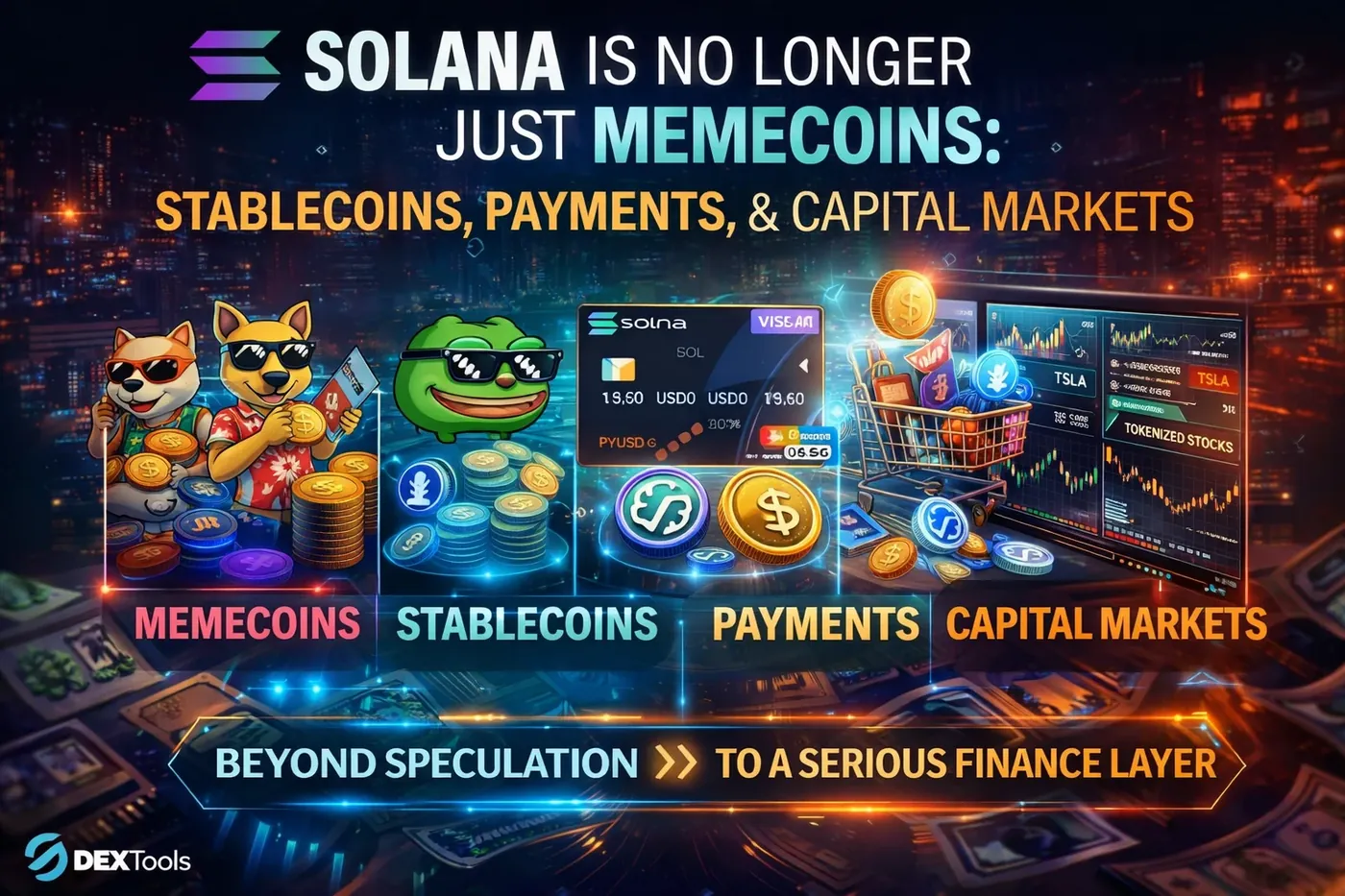
Solana payments and cards show where adoption may come from
One insightful way to understand this transition is through cards and consumer spending. A recent Solana Foundation article on stablecoin card adoption described Rain as settling payment volume with Visa in stablecoins and processing billions in volume, while working with financial players like Western Union. The article's broader thesis highlighted that users don't need to grasp the underlying blockchain for stablecoin infrastructure to be significant; they just need a payment experience that feels straightforward.
This might be the most important clue in the whole Solana story. Networks stop feeling niche when the blockchain disappears into the experience. If Solana can support payment rails, card settlement, remittances, and stablecoin treasury flows behind the scenes, then its growth doesn't solely depend on the next retail mania occurring on chain. It starts to hinge on whether businesses and financial apps find the rails useful enough to build upon.
Why traders should care about this shift
This matters to traders because better infrastructure tends to attract more durable liquidity. Memecoin liquidity can be explosive, but it is also fragile. Payments liquidity and capital markets liquidity behave differently and are tied to practical use, real balances, and recurring activity. This can create a stronger base layer for DeFi, lending, market making, and settlement across the ecosystem.
There is also a secondary effect. Once a chain gains traction in stablecoins and tokenized assets, traders begin to pay attention not just to the assets but to the platforms around them. Wallets, aggregators, AMMs, lending protocols, and payment apps can all benefit if more serious capital flows through the same system. Solana's own scaling and token infrastructure materials emphasize this composability, noting the SPL token standard is foundational to stablecoin payments, DeFi swaps, lending, and many applications.
Solana still has the meme energy, but the story is getting bigger
This doesn't mean Solana has ceased being a memecoin chain. It means that label alone isn't enough. The network is striving to support multiple layers of financial activity: retail trading, stablecoin payments, tokenized assets, cards, treasury systems, and institutional style products. This broader array is precisely what can transform a fast chain into a more durable market ecosystem.
The strongest version of the bullish case is straightforward. Solana may be one of the few crypto ecosystems that can merge retail energy with serious financial throughput. If stablecoins stay large, payments keep expanding, and capital markets use cases continue to appear, Solana's reputation could shift from "where the memes trade" to "where internet finance actually moves." While not guaranteed, the official data and ecosystem positioning suggest this transition is already happening.
The cliché that Solana is all about memecoins is becoming harder to defend. In 2026, the intriguing story is Solana building a robust stablecoin layer, increasing payment infrastructure, and delving deeper into capital markets. The February ecosystem report substantiates this story, and the related product launches imply it's more of a structural change than a seasonal trend.
For DEX traders, the takeaway is straightforward: monitor where liquidity quality is improving, not just where the loudest speculation is. Solana may still thrive on attention, but its next phase could be characterized by something more vital: financial utility that retains liquidity onchain longer.
Puedo convertirlo también en una versión más agresiva y más trader, con tono DEXTools, o en una versión más corta para newsletter y X thread.
Solana Aims for Enterprise Role in Stablecoin Era Evolving Crypto: From Meme Coins to Capital Solana Foundation Taps Mastercard and Western Union for Institutional Developer Platform Solana Blockchain: How it works and real-world impact Why Is Solana Going Up Today? 2026 Catalysts & Price LevelsFrequently Asked Questions
What stablecoins are currently prominent on Solana?
Several stablecoins, including USDC and USDT, are widely used on the Solana blockchain. Other stablecoins may also gain traction over time.
How might Solana's stablecoin landscape change by 2026?
The Solana stablecoin landscape could evolve with new entrants, increased adoption of existing ones, and potential regulatory developments impacting their usage.
Will new stablecoin projects emerge on Solana by 2026?
It is possible that new stablecoin projects, both centralized and decentralized, may launch on Solana by 2026, driven by innovation and market demand.
What role do stablecoins play in Solana's DeFi ecosystem?
Stablecoins are fundamental to Solana's DeFi ecosystem, facilitating trading, lending, borrowing, and other financial activities by providing price stability.
How could regulatory changes affect stablecoins on Solana by 2026?
Regulatory changes could significantly impact stablecoins on Solana by 2026, potentially influencing their issuance, usage, and compliance requirements for projects and users.