Why is Ethereum Gas So High Right Now?
Examine the factors that influence Ethereum gas fees and learn how to manage them efficiently in today’s DeFi ecosystem. Keep up to date with transaction costs and practical strategies.
Why is Ethereum Gas So High Right Now? A 2026 Guide to Navigating Fees
As of April 2, 2026, the Ethereum ecosystem has matured into a sophisticated multi-layered network. Despite the massive success of the Fusaka and Pectra upgrades over the last year, many users still find themselves asking: "Why is it so expensive to use the Mainnet today?" Even with Layer 2 (L2) solutions handling the bulk of retail traffic, the Ethereum base layer remains the "Supreme Court" of global finance, and space on it comes at a premium.
What is Gas and How Does it Work in 2026?
In the Ethereum network, gas is the unit used to measure the computational effort required to execute specific operations. Every action, from a simple transfer of ETH to a complex swap on a decentralized exchange, requires a different amount of gas. Think of it as the fuel for a vehicle: a short trip to a local shop (a transfer) uses less fuel than a cross-country haul (a complex smart contract execution).
Since the EIP-1559 upgrade years ago, gas fees are split into two primary components:
Base Fee: This is the minimum amount of Gwei (the smallest unit of ETH) required for a transaction to be included in a block. This fee is burned by the protocol, effectively reducing the total supply of ETH.
Priority Fee (Tip): This is an optional payment made directly to validators to incentivize them to prioritize your transaction during times of high congestion.
The total cost is calculated using the following formula:
For example, a standard ETH transfer always costs exactly 21,000 gas units. If the current network congestion has pushed the gas price to 50 Gwei, your cost would be:
Why Gas Prices are Spiking in April 2026
- If you are seeing high fees today, April 2, it is likely due to the recent "Spring DeFi Surge." Following the Fusaka upgrade in December 2025, which introduced PeerDAS (Data Availability Sampling), the network's capacity to handle data "blobs" for Layer 2s increased significantly. However, this has paradoxically led to more high-value activity on the Mainnet.
- Currently, we are seeing a massive influx of Real World Asset (RWA) tokenization. Major institutional players are settling multi-billion dollar bond trades directly on the Ethereum L1. Because these institutions prioritize the ultimate security of the base layer over the cost-efficiency of an L2, they are willing to outbid retail users for block space. This "Institutional Crowding" is the primary driver of high L1 gas prices in early 2026.
Historical Oscillation: From 2024 to 2026
To understand today's prices, we must look at the wild swings of the last two years:
Early 2024 (The Dencun Era): Gas prices on L1 were often high, but the introduction of EIP-4844 (blobs) dropped L2 fees by over 90%. Retail users migrated to Base, Arbitrum, and Optimism, leading to a "hollowed out" but expensive L1.
2025 (The Pectra Upgrade): This upgrade increased the block gas limit to 60 million. For a few months, gas was incredibly cheap (often below 10 Gwei) because the network could fit more transactions per block.
Early 2026 (The Fusaka Impact): While Fusaka made L2s virtually free (often costing less than $0.01 per trade), it also enabled more complex L1 interactions. As the global economy integrated more deeply with Ethereum, the demand for L1 "Premium Space" returned to 2021-era levels during peak hours.
Strategic Trading: Turning Gas Variation into an Advantage
High gas does not have to be a deterrent; for a savvy trader, it can be a signal. Here is how you can use gas price movements to your advantage:
1. Use Gas as a Volatility Indicator
Spikes in gas prices often precede large price movements in ETH itself. When gas goes from 20 Gwei to 100 Gwei in minutes, it usually means a "whale" is moving funds or a major liquidity pool is being rebalanced. Traders can use these spikes to predict incoming market volatility.
2. Leverage Account Abstraction (EIP-7702)
Thanks to the Pectra upgrade, your standard wallet now supports "Smart Account" features. You can now schedule transactions to execute only when gas falls below a certain threshold.
Example: You want to claim rewards from a staking pool but don't need them immediately. You set a "Conditional Transaction" to execute only when the base fee is under 15 Gwei. This usually happens on Sunday mornings at 3:00 AM UTC.
3. Use Private RPCs and Flashbots
In a high-gas environment, "Priority Fees" can get out of hand due to MEV (Maximal Extractable Value) bots fighting for space. By using a private RPC (Remote Procedure Call) like Flashbots, your transaction stays off the public "mempool." This prevents bots from front-running you, which can save you up to 20% in hidden slippage and gas costs.
How to Save on Gas: A Step-by-Step Tutorial
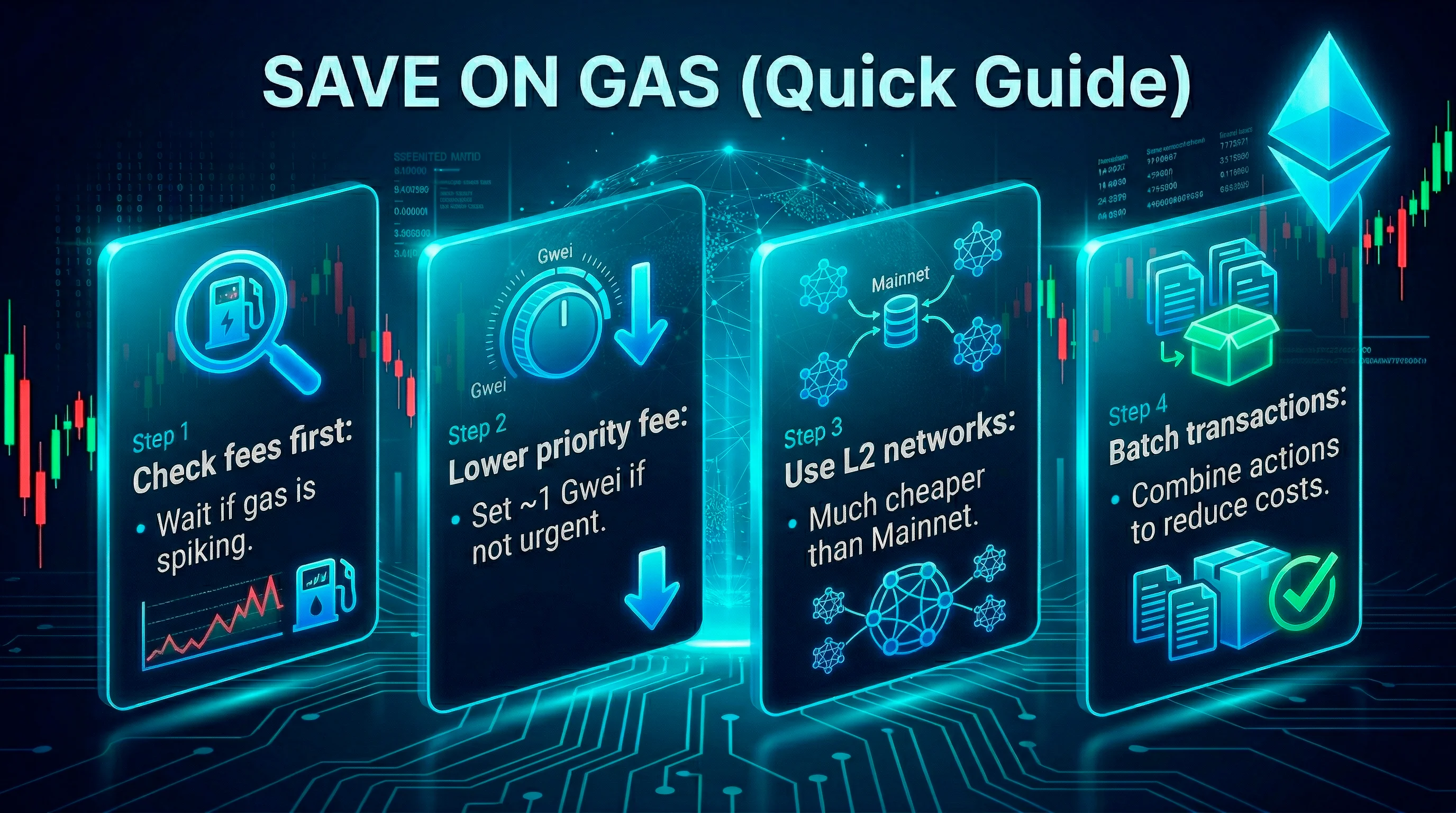
If you must trade on the Mainnet today, follow these steps to keep your costs as low as possible:
Check the Gas Tracker: Before opening your wallet, check a real-time monitor. If the "Base Fee" is rising rapidly, wait 15 minutes. Gas often moves in "bursts."
Manually Set Your Priority Fee: Most wallets in 2026 over-estimate the "tip" needed. If you are not in a rush, set your Priority Fee to 1 Gwei. Your transaction might take 5 minutes instead of 15 seconds, but you could save $10 to $20.
Bridge to L2: If you are trading a popular token, check if it has a liquidity pool on Base or Arbitrum. In 2026, most major tokens are multi-chain. A swap that costs $50 on L1 will cost less than $0.05 on an L2.
Batch Your Transactions: Modern wallets now allow you to bundle multiple actions (e.g., Approve + Swap) into a single transaction. This uses the new "Paymaster" features from the 2025 upgrades, significantly reducing the total gas used.
Summary of Key Points
Gas is computational fuel: It measures the effort required for transactions and is paid in Gwei.
EIP-1559 Dynamics: You pay a Base Fee (burned) and a Priority Fee (given to validators).
Why it's high today: Institutional RWA tokenization and DeFi volume are crowding the L1 "Premium Space."
2024 to 2026 Trend: We moved from L1-only traffic to an L2-dominant world, but L1 remains the most expensive and secure tier.
Optimization: Use scheduled transactions, batching, and L2 networks to avoid the high costs of the base layer.
Signal Trading: High gas spikes often indicate impending market volatility or whale activity.
To get the most accurate, real-time data on gas prices and liquidity across all Ethereum layers, we invite you to use the Ethereum dashboard on DEXTools here. DEXTools allows you to monitor network congestion and trade with advanced security features, helping you to trade safely in even the most volatile gas environments.
Disclaimer: This article is for informational purposes only and does not constitute investment advice, financial advice, trading advice, or any other kind of advice. DEXTools does not recommend buying, selling, or holding any cryptocurrency or token. Users should conduct their own research and consult with a qualified financial advisor before making any investment decisions. Cryptocurrency investments are volatile and high-risk. DEXTools is not responsible for any losses incurred.