Why Is Solana Going Down Today? Support Levels & Analysis
— By AliceOnChain in Crypto

Solana is under pressure today as macro uncertainty, cooling on-chain activity, and key technical rejections weigh on price. Here is what traders need to know about SOL’s latest move and the critical support levels to watch.
Why Is Solana Going Down Today? Key Drivers, On-Chain Signals and Critical Support Levels
The Solana ecosystem is facing renewed volatility today, March 19, 2026. After multiple attempts to break above key psychological resistance, SOL has been rejected, leaving traders asking the obvious question: why is Solana going down today?
This move is not happening in isolation. A combination of macro uncertainty, cooling speculative activity within the Solana ecosystem, and weakening short-term technical structure is driving the current pullback. For traders using DEXTools, this is a pivotal moment. Understanding whether this is a healthy correction or the start of a deeper trend shift is key to capital preservation in the current market climate.
Macroeconomic Pressure Returns to the Crypto Market
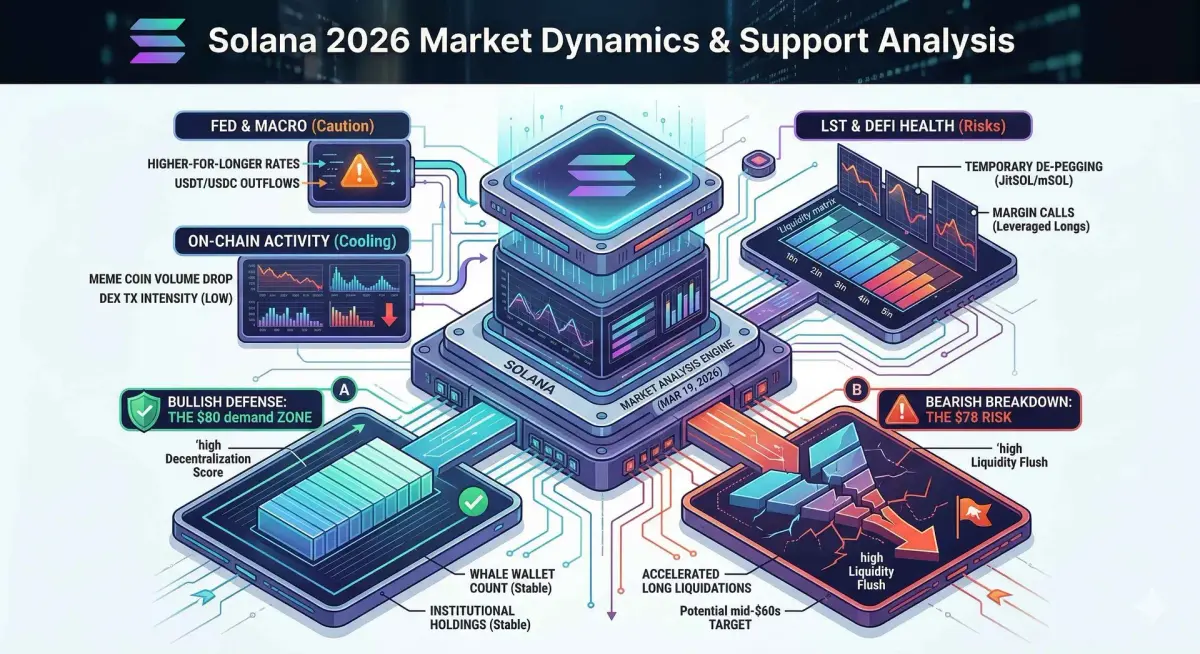
One of the main drivers behind today’s weakness is a shift in global macro sentiment.
Recent communication from the Federal Reserve has reinforced a more cautious stance on interest rate cuts for the remainder of 2026. Markets have interpreted recent signals as relatively hawkish, suggesting inflation remains a concern that could delay the expected easing cycle.
As a result, U.S. Treasury yields have moved higher and the U.S. dollar index (DXY) has strengthened. This environment typically reduces liquidity across risk assets. Crypto, and especially high-beta assets like Solana, tend to react quickly to these shifts.
When global liquidity tightens, speculative capital is often the first to pull back. That dynamic is visible in today’s price action, with SOL reacting more aggressively than many large-cap altcoins.
On-Chain Activity Shows Signs of Cooling
Beyond macro factors, there are early signals that Solana’s internal momentum is slowing compared to the highs seen earlier this year.
Meme Coin Activity Is Losing Steam
A significant portion of Solana’s recent growth has been driven by high-velocity meme coin trading on platforms like Pump.fun and Meteora.
Recent sessions suggest a slowdown:
-
Lower trading intensity across newly launched tokens
-
Reduced viral breakout activity
-
Less aggressive retail participation
-
Shorter holding periods and reduced conviction in speculative pairs
This does not necessarily signal the end of the trend, but it does indicate a cooling phase after an overheated period.
Stablecoin Flows Are Turning Cautious
Another important signal is the shift in stablecoin behavior across the chain.
Recent data points to net outflows of stablecoins such as USDT and USDC from the Solana ecosystem. This suggests some participants are:
-
Moving capital to centralized exchanges
-
Rotating into other ecosystems
-
Or reducing exposure
Lower on-chain liquidity reduces immediate buying power and can amplify downside moves during periods of selling pressure.
Liquid Staking Dynamics and Volatility Risk
A more technical factor to monitor is the behavior of Liquid Staking Tokens (LSTs) such as JitoSOL and mSOL.
During periods of volatility:
-
LSTs can experience temporary de-pegging relative to SOL
-
Leveraged positions using LSTs as collateral may face liquidation
-
These events can introduce additional sell pressure into the market
While not always visible at first glance, these mechanisms can accelerate downside moves if market conditions deteriorate.
Network Developments and Market Positioning
Ongoing network upgrades and validator-level improvements can also contribute to short-term caution among large holders.
While these developments are typically positive for long-term scalability and performance, they can lead to temporary de-risking as participants wait for stable implementation.
This helps explain the lack of aggressive “buy the dip” behavior at higher levels in the current environment.
Solana Technical Analysis: Key Levels to Watch
From a technical perspective, SOL is now testing critical levels that could define the short-term trend.
The $80 Zone: A Critical Support Level
The $80 level stands out as a key structural support that has held multiple times in recent months.
A confirmed breakdown below this level could shift market structure and open the door to lower liquidity zones.
Bull vs. Bear Scenarios
Bearish scenario:
-
Loss of $80 support
-
Acceleration of long liquidations
-
Potential move toward the mid-$60s
Bullish scenario:
-
Reclaim of short-term moving averages in the mid-$80s
-
Break above the $95 to $100 resistance zone
-
Restoration of bullish momentum
At this stage, price remains in a decision zone.
Institutional Interest vs. Retail Cooling
While short-term price action is weak, broader market participation remains intact.
Institutional-style exposure to SOL through structured products appears relatively stable and less reactive to short-term volatility. This suggests that long-term conviction may still be present, even as retail flows dominate the current pullback.
The market appears to be transitioning from purely speculative momentum toward a more mature structure, although this process often comes with increased volatility.
Conclusion: A Healthy Pullback or Trend Reversal?
So, why is Solana going down today?
The answer lies in a combination of macro pressure, tighter liquidity conditions, and a cooling of speculative activity within the ecosystem. The rejection at key resistance levels has triggered a short-term reassessment of the trend.
At this stage, the move resembles a market reset rather than a confirmed long-term breakdown. However, the reaction around the $80 level will be critical in determining the next direction.
For traders on DEXTools, this is a moment to stay data-driven:
-
Monitor liquidity flows
-
Track on-chain activity
-
Watch key support levels closely
Until the market shows clear signs of strength, caution remains the dominant strategy.
Solana Ecosystem Roundup--
Disclaimer: This article is for informational purposes only and does not constitute investment advice, financial advice, trading advice, or any other kind of advice. DEXTools does not recommend buying, selling, or holding any cryptocurrency or token. Users should conduct their own research and consult with a qualified financial advisor before making any investment decisions. Cryptocurrency investments are volatile and high-risk. DEXTools is not responsible for any losses incurred.