Danksharding Explained: Ethereum's Long-Term Scaling Plan

Centralized hardware requirements threaten blockchain decentralization. We break down how Ethereum's Full Danksharding utilizes polynomial data sampling to scale rollups.
The Modular Pivot: Transforming Ethereum into a Universal Data Engine
- Early blockchain networks operated under a monolithic architecture, forcing every individual node on the network to execute transactions, compute state changes, and permanently store every byte of historical ledger data. This structural bottleneck created a compounding scalability crisis: as global transactional demand surged, mainnet processing fees spiked, pricing out average participants and restricting network throughput.
- To resolve this limitation, Ethereum executed a permanent pivot toward a modular architecture. Rather than processing all user transactions directly on the base chain, the network transitioned into a secure settlement and Data Availability (DA) layer, outsourcing consumer transaction execution to Layer 2 (L2) Rollups like Arbitrum, Optimism, and Base.
- The ultimate, multi-phase scaling endgame for this modular blueprint is Danksharding. Named after core researcher Dankrad Feist, Danksharding optimizes how the network ingests, validates, and discards massive bundles of layer-2 data, providing a foundation to support over 100,000 transactions per second (TPS) across the broader Web3 ecosystem.
1. The Evolutionary Timeline: Proto-Danksharding vs. Full Danksharding
The implementation of data availability on Ethereum architecture is divided into a strategic, multi-step roadmap designed to safely scale network throughput without threatening the hardware decentralization of home-staking nodes.
The Transitional Foundation: EIP-4844
- Launched as a historical structural upgrade in 2024, Proto-Danksharding (EIP-4844) introduced the concept of blob-carrying transactions. Prior to this deployment, rollups had to compress and store their transaction logs inside Ethereum's permanent execution space (
calldata), which was highly expensive. EIP-4844 created isolated, temporary data sidecars ("blobs") that reduced layer-2 gas fees by over 90%. However, Proto-Danksharding was a temporary compromise: it still required every full node on the network to download and verify 100% of the raw blob data.
The Final Destination: Full Danksharding
- Full Danksharding scales this data framework by massively increasing the target data capacity per block (aiming for a 16MB target ceiling). Because forcing standard home nodes to download 16MB of data every 12 seconds would instantly paralyze average consumer internet connections, Full Danksharding completely eliminates the all-node download rule.
- Through specialized cryptographic sampling and structured separation of node responsibilities, the network can securely verify massive block data arrays while keeping the bandwidth footprint for individual validators exceptionally low.
2. The Mechanics of Blob Space Expansion
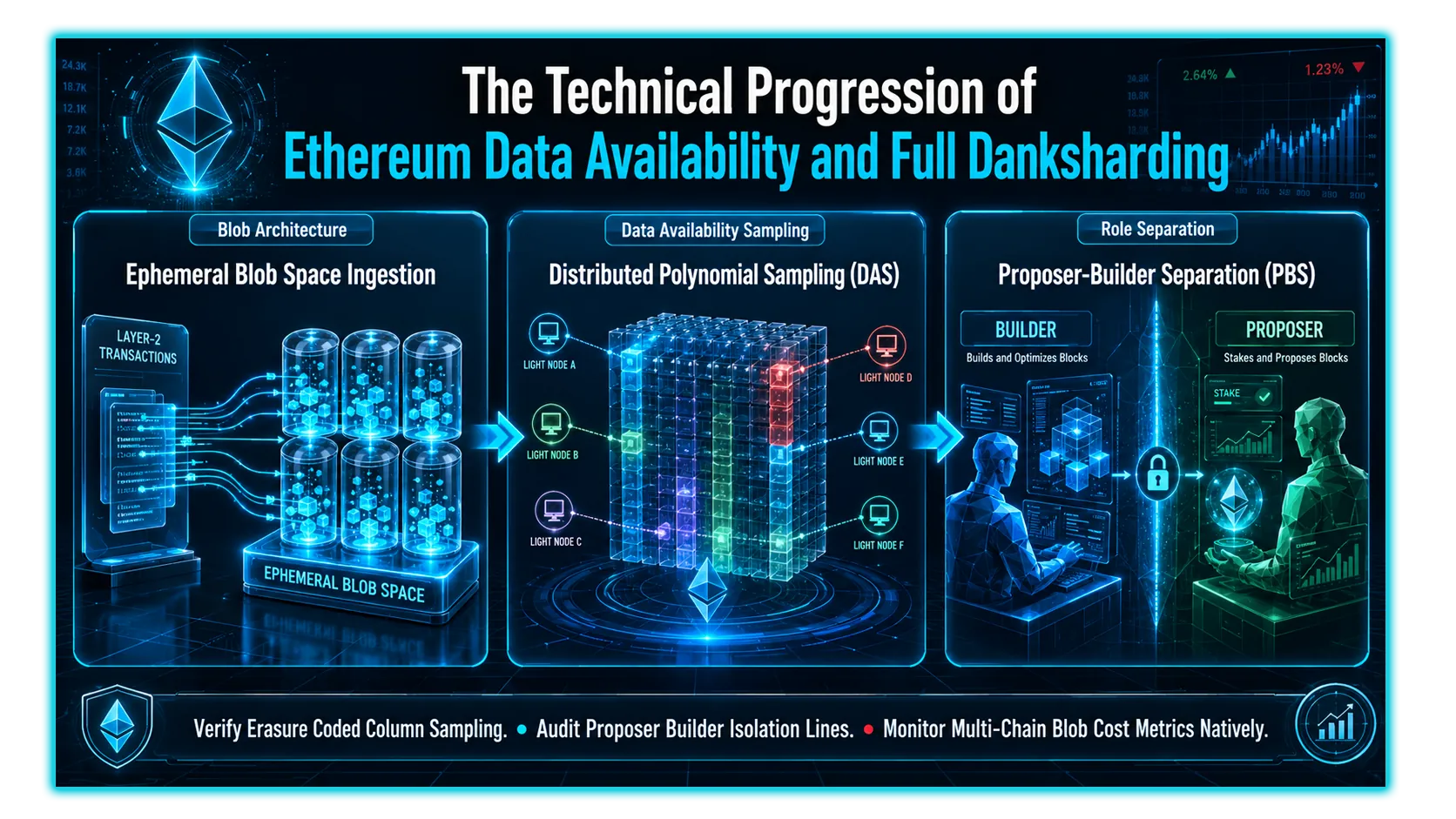
- A "blob" (Binary Large Object) is an ephemeral data storage capsule designed explicitly for rollup batches. Unlike standard Ethereum smart contract transactions, the execution engine cannot read or execute the data nested within a blob; it can only view a cryptographic commitment pointing to it.
- Rollups purchase this dedicated Blob Space through an independent fee market that runs completely separate from traditional Layer 1 mainnet gas auctions. To prevent the blockchain ledger from swelling to unmanageable proportions, blobs are explicitly temporary. They are hardcoded to automatically expire and drop off the network's active memory layers after roughly 18 days. This window provides ample time for layer-2 challenges and fraud proofs to settle, ensuring archive nodes or decentralized storage protocols (like the Portal Network) handle historical retrievability while keeping the validator's disk storage light.
3. The Scaling Secret: Data Availability Sampling (DAS)
The core breakthrough enabling Full Danksharding to scale block capacities safely is Data Availability Sampling (DAS). DAS allows a node (including lightweight non-staking clients) to cryptographically verify that a block's entire blob payload has been fully published to the network without downloading the data itself.
The Mathematics of Erasure Coding
- Before distributing a block, the network takes the raw blob data array and applies a mathematical technique known as Reed-Solomon erasure coding. This process extends the original data matrix by fitting a polynomial equation over the data points, evaluating it at additional coordinates to generate redundant "parity data."
- The mathematical elegance of this matrix extension lies in its strict recovery thresholds: if any random 50% of the expanded polynomial evaluations are successfully retrieved by the network, anyone can instantly reconstruct 100% of the original, uncoded blob data.
Column Sampling via PeerDAS
- To deploy this sampling safely at scale, the protocol utilizes PeerDAS (EIP-7594). Under this architecture, the extended blob data matrix is structured into uniform mathematical columns. Individual validator nodes and light clients routinely perform rapid, randomized peer queries, downloading only tiny, multi-kilobyte column shards of the total data matrix.
- Because of the underlying erasure coding math, an adversarial block producer attempting to maliciously withhold even a tiny 1% sliver of raw data is mathematically forced to withhold over 50% of the extended matrix evaluations. Consequently, as light clients execute a handful of independent, randomized sampling checks, the statistical probability of detecting data withholding fraud climbs to over 99.999% within milliseconds, allowing the network to verify massive data availability blocks with nominal bandwidth overhead.
4. Separation of Roles: Proposer-Builder Separation (PBS)
While Data Availability Sampling keeps block verification accessible to consumer hardware, the upfront computation required to collect thousands of layer-2 transactions, compute massive data matrices, and generate complex polynomial KZG commitments remains computationally heavy. Full Danksharding resolves this burden by mandating Proposer-Builder Separation (PBS).
PBS formally divides the traditional validation process into two isolated, specialized infrastructure paths:
The Block Builders: Professional, high-performance computing desks that compete in an open market to aggregate transactions, construct optimized blob matrices, compute cryptographic proofs, and bid for the right to assemble the next block.
The Block Proposers: Decentralized home-staking validators (the 32 ETH nodes). Proposers do not build blocks or process heavy data overhead. Instead, they use simple node software to select the highest-paying block header submitted by the builder marketplace, broadcast it to the consensus layer, and collect the bundled priority fees with minimal hardware strain.
Data Availability Infrastructure Matrix
| Architecture Era | Max Block Data Cap | Node Ingestion Rule | Scalability Limit |
| Monolithic Era | ~0.08 MB (Calldata) | Complete Node Download | Low (~15–45 TPS) |
| Proto-Danksharding | ~0.75 MB (6 Blobs) | Complete Node Download | Intermediate (~100x Fee Drop) |
| Full Danksharding | ~16.0 MB (Max Cap) | Randomized Column Sampling | Elite (>100,000 Network TPS) |
Monitoring Data-Layer Ecosystems via DEXTools Telemetry
- As Ethereum matures into a highly efficient data availability engine, tracking the capitalization shifts, token velocities, and secondary market liquidity configurations of accompanying Layer-2 rollup protocols, data availability layers, and modular utility bridges becomes an essential workflow for market participants. Sourcing analytics through advanced decentralized charting architectures like DEXTools gives market participants an essential universal platform to monitor live token behaviors, evaluate pool depths, and inspect contract parameters across all public execution networks.
- By leveraging core features like the Pair Explorer, Live New Pairs dashboard, and the integrated Trade Story or Top Traders diagnostic tools, technical traders can seamlessly audit localized volume trends, track large whale wallet capital reallocations via the Big Swap Explorer, and check automated contract safety scores before initiating any on-chain interactions, ensuring your hardened hardware setup interacts safely with verified market venues.
You can access DEXTools here and start trading today!
Disclaimer: This article is for informational purposes only and does not constitute investment advice, financial advice, trading advice, or any other kind of advice. DEXTools does not recommend buying, selling, or holding any cryptocurrency or token. Users should conduct their own research and consult with a qualified financial advisor before making any investment decisions. Cryptocurrency investments are volatile and high-risk. DEXTools is not responsible for any losses incurred.