How to Earn from DePIN: Hardware vs. Tokens vs. Liquidity
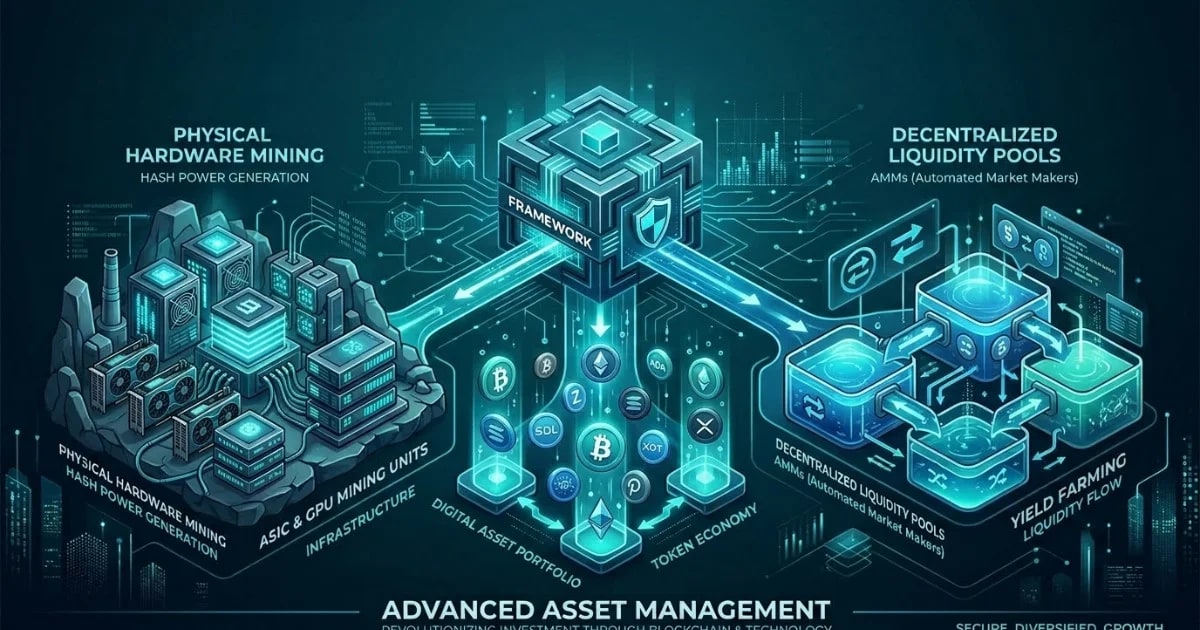
Generating returns from decentralized infrastructure spans multiple risk profiles. We break down the financials of bare-metal hardware mining setups, spot token accumulation, and automated market maker fee strategies.
The Decentralized Cash Flow Layer: Navigating the Monetization of Physical Networks
- The Decentralized Physical Infrastructure Networks (DePIN) sector has undergone a critical macroeconomic shift. The era of surviving purely on highly inflationary token rewards to bootstrap empty networks has come to an end. Today's successful protocols focus heavily on real-world utilization, providing core processing assets to external enterprise clients, AI research laboratories, logistics fleets, and telecom subscribers who pay using real economic credit lines.
- For capital allocators, this maturity opens up diverse cash-flow opportunities. Generating sustainable yields from DePIN no longer requires a single, rigid deployment path. Investors can participate through three primary vectors: provisioning physical bare-metal hardware, executing spot token strategies tied to consumption mechanics, or providing two-sided liquidity within decentralized finance (DeFi) automated market makers. This guide breaks down the operational parameters, return-on-investment (ROI) timelines, and underlying risk profiles of each strategy.
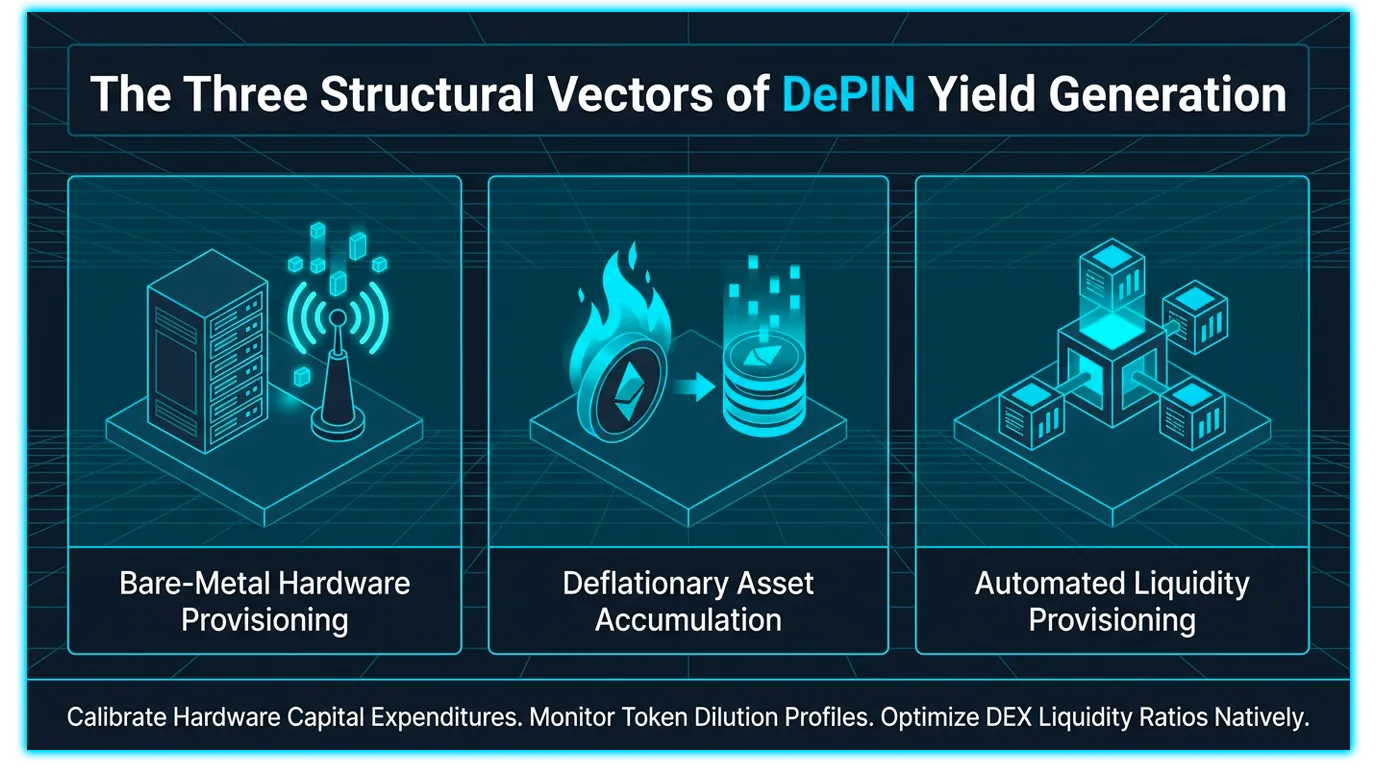
1. The Physical Route: Hardware Provisioning and Real ROI
Deploying physical hardware remains the foundational anchor of the DePIN ecosystem. This strategy transforms an investor from a speculative trader into an independent infrastructure service operator.
Specialized Miners vs. Commodity Hardware
Hardware provisioning divides into two main tech profiles:
Specialized, Plug-and-Play Devices: This track covers niche tracking sensors, spatial location modules, and telecommunication antennas (such as Geodnet, Hivemapper Bee, and Helium hotspots). These units require minimal ongoing configuration beyond matching explicit placement criteria, making them highly accessible for retail setups.
Commodity Compute Arrays: This model leverages high-end processing hardware (primarily top-tier enterprise or consumer graphics cards (like the Nvidia RTX 4090 or H100 series) to supply distributed compute marketplaces like io.net or Akash Network. These rigs demand intermediate command-line interface (CLI) technical skills to connect containerized environments securely to centralized scheduling networks.
Calculating True Hardware ROI
- Sourcing infrastructure yields via physical setups requires strict capital expenditure (CapEx) and operational expenditure (OpEx) financial budgeting. Operators must balance their upfront equipment costs against shifting localized electricity overheads, cooling parameters, and network difficulty adjustments.
- As more global operators connect duplicate hardware devices to the same regional coordinates, individual token allocations naturally dilute. Consequently, sustainable hardware operations factor in equipment depreciation cycles, optimizing for networks that tie payouts directly to active data traffic and verified usage rather than mere passive coverage uptime.
2. The Pure Financial Route: Token Strategies and Market Exposure
For investors who want to sidestep the logistical friction of hardware setups (such as electrical limits, physical component degradation, and international shipping lead times) secondary market accumulation offers an alternative path.
Exploiting the Burn-and-Mint Equilibrium (BME)
Advanced token accumulators analyze a protocol's underlying economic design, specifically targeting platforms utilizing the Burn-and-Mint Equilibrium (BME) framework. By tracking on-chain metrics, investors look for structural inflection points where an enterprise client’s real-world data consumption rate triggers a token burn velocity that outpaces the blockchain's programmatic reward minting schedule. When real demand drives net-deflationary supply contraction, spot token accumulators capture macroeconomic value without ever turning on a physical hardware device.
Liquid Validation and Machine Staking
Beyond basic spot allocation, modern DePIN layer-1 networks (like peaq or Solana) support native staking frameworks. Token holders can delegate their idle capital assets to high-reputation network validators who handle the secure data routing for the underlying machine nodes. This liquid validation model generates passive staking yields, while newer asset structures like Machine NFTs let users purchase fractional shared equity in operational real-world robots or vehicle fleets, capturing an automated slice of their real-world transaction revenues.
3. The Yield Multiplier: Providing Liquidity to DePIN Pools
Because DePIN assets are continually distributed to hardware providers who often liquidate a portion of their daily payouts to cover real-world utility bills, these tokens experience constant trading volumes and highly active circulation paths across decentralized exchanges (DEXs).
This constant transactional churn creates a highly profitable environment for Liquidity Providers (LPs):
Concentrated Liquidity Optimization: By deploying asset pairs into concentrated liquidity automated market makers (like Uniswap V3, Meteora, or Raydium), market participants can lock their capital within customized trading bands surrounding the token's active market value, capturing elevated trading fee shares.
Managing Impermanent Loss (IL): Providing liquidity introduces risks. Because DePIN tokens can experience volatile price adjustments based on network upgrade milestones or broader market cycles, asymmetric shifts between the paired assets can trigger impermanent loss. Successful LPs manage this risk by pairing correlated infrastructure assets together or targeting mature, high-volume tokens where accumulated transaction fee yields consistently outpace asset divergence drag.
DePIN Monetization Vector Matrix
| Vector | CapEx | Core Asset | Main Risk |
| Hardware | High | Rigs / Sensors | Depreciation |
| Tokens | None | Spot Staking | Market Crashes |
| Liquidity | Low | AMM Pools | Impermanent Loss |
Analyzing Infrastructure Asset Markets via DEXTools Telemetry
- Accessing advanced decentralized charting architectures like DEXTools gives market participants an essential universal platform to monitor live token behaviors, evaluate pool depths, and inspect contract parameters across all public execution networks.
- By leveraging core features like the Pair Explorer, Live New Pairs dashboard, and the integrated Trade Story or Top Traders diagnostic tools, technical traders can seamlessly audit localized volume trends, track large whale wallet capital reallocations via the Big Swap Explorer, and check automated contract safety scores before initiating any on-chain interactions, ensuring your hardened hardware setup interacts safely with verified market venues.
Disclaimer: This article is for informational purposes only and does not constitute investment advice, financial advice, trading advice, or any other kind of advice. DEXTools does not recommend buying, selling, or holding any cryptocurrency or token. Users should conduct their own research and consult with a qualified financial advisor before making any investment decisions. Cryptocurrency investments are volatile and high-risk. DEXTools is not responsible for any losses incurred.
DePIN's Capital Stack: Beyond the Obvious
While the surface of DePIN investing often focuses on hardware acquisition or token speculation, a deeper look reveals a more nuanced capital stack, mirroring traditional finance but with Web3 characteristics. Understanding where your capital sits in this hierarchy is crucial for assessing risk and potential reward, particularly as the sector matures and institutional interest grows.
The "capital stack" refers to the various types of financing a project or company uses, ordered by their claim on assets and income. In DePIN, this translates to different ways capital is deployed and how those deployments are prioritized in terms of returns and loss absorption. It's not just about owning a piece of the network, but understanding what kind of piece you own.
Prioritizing Your DePIN Investment
- Bare-Metal Hardware Providers: These are often at the "equity" layer, providing core infrastructure. They bear significant upfront capital expenditure and operational risk, but have direct access to network revenue streams and potential future token grants. Their claims are often junior to certain debt-like structures.
- Token Stakers and LP Providers: These participants can be seen as providing "mezzanine" capital. Staking locks up tokens, securing the network and earning rewards, akin to preferred equity. LP providers supply liquidity, earning fees but also facing impermanent loss, a unique Web3 risk not present in traditional debt.
- DePIN-Specific Lending Protocols: As the ecosystem evolves, we're seeing protocols emerge that offer financing solutions for hardware purchases or operational costs, often collateralized by future revenue or tokens. These represent a "debt" layer, offering lower returns but potentially higher seniority in specific scenarios.
- Early-Stage Investors and VCs: Often providing the initial "seed" or "venture equity," these entities take the highest risk for the highest potential reward, funding the development before a network is fully operational. Their claims are typically the most junior.
- Data Consumers and Network Users: While not direct investors in the traditional sense, their payments for services represent the ultimate revenue stream for the entire stack. Without demand, the value of all other layers diminishes.
Related Guides
- Ledger vs Trezor 2026: Hardware Wallet Tested Showdown
- Ledger vs Trezor: Hardware Wallet Comparison 2026
- Keystone Wallet Review: Air-Gapped Hardware Wallet Explained
- Trezor Tutorial 2026: Setup & Use Your Hardware Wallet
- How to Set Up Trezor Hardware Wallet: Safe 3 and Safe 5 Tutorial (2026)
Frequently Asked Questions
What is DePIN?
DePIN stands for decentralized physical infrastructure networks, where participants contribute real-world hardware or resources and earn token rewards. Examples include networks for wireless coverage, storage, or sensing.
How can you earn from DePIN?
Common approaches include running hardware to provide a service and earn tokens, buying and holding the network's token for exposure, or providing liquidity in markets for that token. Each path carries different effort and risk profiles.
What is the difference between earning with hardware versus tokens?
Earning with hardware involves upfront equipment costs, setup, and ongoing operation in exchange for rewards, while holding tokens is a more passive form of exposure to the network. Hardware can offer direct participation but adds operational responsibility.
What are the risks of earning from DePIN?
Risks include token price volatility, uncertain reward rates, hardware costs that may not be recovered, and smart-contract or liquidity risks in token markets. Returns are not guaranteed and depend heavily on network adoption.