Crypto Whitepaper: How to Read One Like a Pro
— By AliceOnChain in Tutorials

A comprehensive framework for evaluating cryptocurrency whitepapers. Combine technical documentation analysis with real-time on-chain metrics to verify a project's viability and manage market risks.
Crypto Whitepaper: How to Read One Like a Pro
The cryptocurrency sector moves at a pace that often leaves fundamental analysis overlooked. Many market participants rely entirely on social media momentum, price action, and market sentiment to dictate their trading decisions. However, relying solely on speculative hype introduces significant risk. To evaluate a decentralized project sustainably, one must master a foundational skill: the ability to read whitepaper crypto documentation effectively.
A whitepaper serves as the foundational blueprint of a blockchain project. It outlines the technical architecture, economic design, and specific problem the protocol intends to solve. Yet, a whitepaper is also a marketing document. Teams naturally present their projects in the best possible light. To read a whitepaper like a professional, you must learn to balance technical documentation with real-time on-chain data, cross-referencing promises made on paper with the reality of smart contract execution.
1. The Initial Screening: Scope and Problem Identification
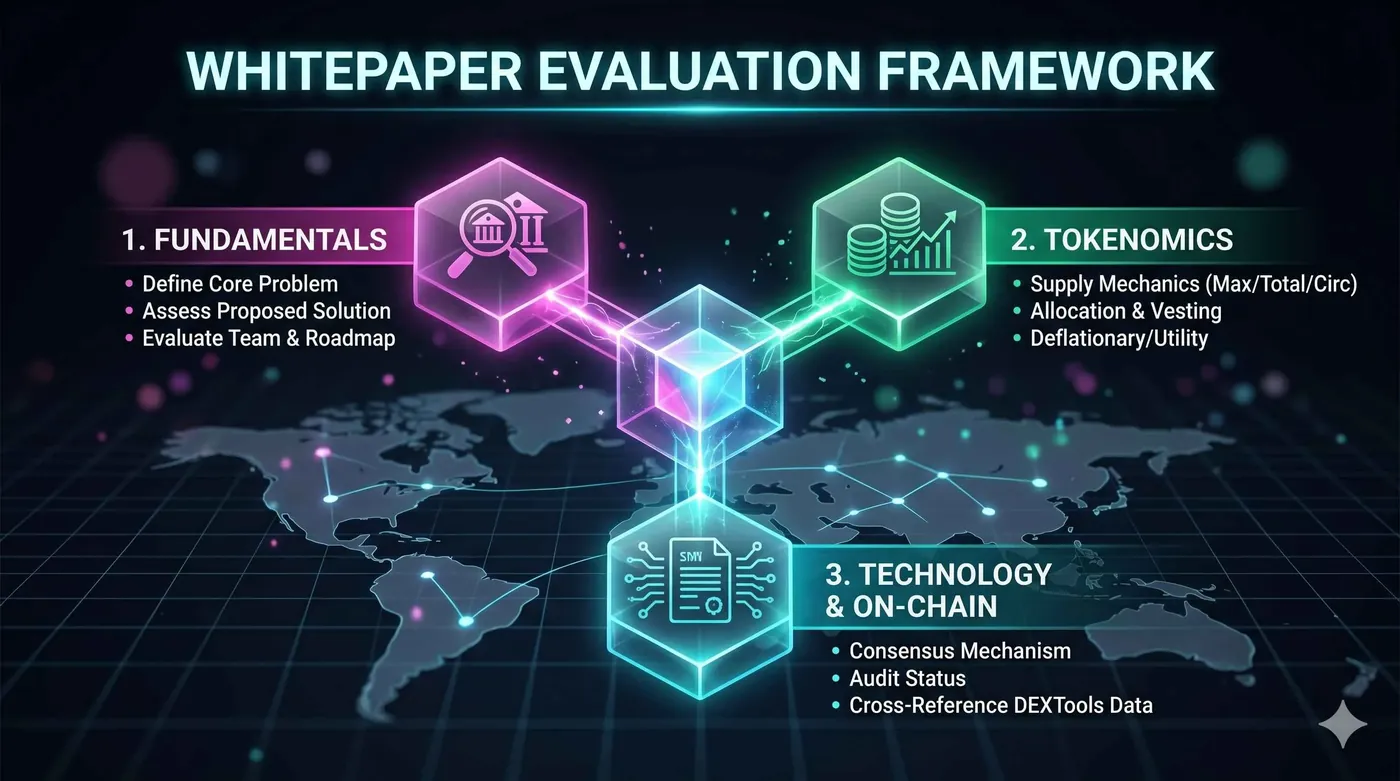
Before diving into complex tokenomics formulas or cryptographic proofs, an analyst must establish the project's core thesis. A well-constructed whitepaper should clearly define a specific problem within the Web3 or broader technological ecosystem and present a viable, decentralized solution.
Assessing the Problem Statement
The introductory sections of a whitepaper should outline a market inefficiency. For instance, a new decentralized exchange (DEX) might address capital inefficiency or high slippage in existing automated market makers (AMMs). If the problem statement is vague, filled with excessive buzzwords, or fails to explain why a decentralized ledger is necessary, the project may lack a legitimate use case.
Evaluating the Proposed Solution
The solution must logically align with the identified problem. Consider whether the proposed architecture actually requires a native token, or if the system could function more efficiently using existing infrastructure like Ethereum or established stablecoins. If the native utility token seems forced into the ecosystem primarily to raise capital, the long-term viability of the asset may be compromised.
2. Technical Architecture and Smart Contract Security
Understanding the technical layer is essential for assessing execution risk. While you do not need to be a senior Solidity developer to analyze a project, you should be able to evaluate the structural logic of the protocol.
Consensus and Network Infrastructure
A whitepaper should specify the underlying consensus mechanism or the specific layer-1 or layer-2 network where the protocol operates. The choice of infrastructure heavily influences transaction throughput, finality times, and security parameters. If a project claims to achieve unprecedented scalability, look closely for the trade-offs being made regarding decentralization or network security.
Code Audits and Security Frameworks
Reputable projects typically include links to their open-source code repositories and formal security audits conducted by third-party firms. A professional analyst cross-references these claims. You can use platforms like DEXTools to inspect a trading pair’s security audit data directly alongside live charts. This allows you to verify if the contract contains high-risk elements such as minting functions, modifiable taxes, or proxy structures that could lead to unexpected adjustments by the deployer.
3. How to Read Whitepaper Crypto Tokenomics: Supply, Allocation, and Vesting
Tokenomics represents the economic backbone of any decentralized protocol. Even the most innovative technical solution can fail if the underlying economic model misaligns incentives or creates unsustainable inflationary pressure. When you read whitepaper crypto breakdowns, the distribution section requires the highest level of scrutiny.
Total Supply vs. Circulating Supply
Analyze the structural distribution of the token supply. A wide disparity between the circulating supply and the maximum or total supply indicates that a large volume of tokens has yet to enter the market. This scenario often signals future dilutive pressure, which can negatively impact price action over time as new supply unlocks.
Distribution Schedules and Vesting Cliffs
Examine the allocation breakdown among the core team, advisors, private investors, and public participants. Pay close attention to the vesting schedules and cliffs:
Vesting Cliffs: A period during which tokens remain entirely locked before any release occurs.
Linear Unlocks: Tokens are released gradually over months or years, smoothing out potential sell pressure.
If early investors or team members hold a significant percentage of the supply with short vesting periods, the risk of structural sell pressure increases significantly.
Validating Token Distribution On-Chain
Documentation does not always mirror reality. Once you understand the theoretical distribution from the whitepaper, verify the actual distribution using the Holder Analysis tool on DEXTools. This allows you to view the top wallet addresses holding the asset. If the whitepaper claims that 50% of the supply is locked for ecosystem rewards, but on-chain data shows those tokens sitting in an unverified, externally owned account (EOA) rather than a multi-signature vesting contract, it raises immediate red flags regarding transparency.
4. Cross-Referencing Documentation with On-Chain Metrics
A professional analyst does not evaluate a whitepaper in a vacuum. The claims made within a PDF must be continuously validated against real-time market behavior. This is where on-chain infrastructure becomes indispensable.
Liquidity and Market Depth
A whitepaper may outline plans for deep, institutional-grade liquidity, but active data provides the truth. By utilizing the Pair Explorer on DEXTools, you can evaluate the actual liquidity depth of a specific token pair relative to its daily volume. Healthy protocols generally feature deep, locked liquidity pools that mitigate extreme volatility management issues and prevent substantial slippage during large trades.
Tracking Whale Activity and Concentrated Supply
Large wallet movements, often referred to as whale activity, can dictate localized trends and override standard support/resistance levels. Tools like Bubblemaps offer a visual representation of how wallets are interconnected. If a whitepaper boasts a highly decentralized governance structure, but Bubblemaps reveals a web of interconnected wallets quietly controlling a dominant share of the circulating supply, the protocol's claims of decentralization may be structurally inaccurate.
5. Identifying Red Flags and Technical Discrepancies
Developing a systematic approach to reading whitepapers helps you quickly filter out low-quality projects or potential malicious actors.
Lack of Technical Specification
If a whitepaper reads more like a conceptual essay or a pitch deck rather than a technical specification document, caution is warranted. High-quality papers generally include mathematical formulations, structural diagrams of the protocol's state machine, and explicit details regarding data flow.
Plagiarism and Copy-Paste Code
The open-source nature of Web3 allows teams to fork existing protocols legally. However, a professional project will explicitly credit the original codebase and detail the innovations or modifications they have introduced. Plagiarized text or unedited smart contract documentation from older protocols often indicates a lack of development capability.
6. Developing a Trading and Risk Management Framework
Once you have validated a whitepaper's fundamentals and cross-referenced them with on-chain realities, you can synthesize this information into an actionable market strategy.
Evaluating Price Action and Volatility
Combine your fundamental conclusions with quantitative technical analysis. Monitor the asset's charts to determine if the market has already priced in upcoming whitepaper milestones, such as mainnet launches or token burns. Look for structural patterns like key support/resistance zones, and monitor for signs of momentum exhaustion using indicators like an RSI divergence on higher timeframes (such as 4-hour or daily charts).
Active Monitoring and Risk Mitigation
Markets evolve rapidly, and a project's on-chain profile can change within minutes. To manage risk effectively without staring at screens all day, implement automated monitoring tools. Utilizing features like Price Alerts allows you to stay informed of sudden, anomalous price action that may indicate structural shifts in market sentiment or unannounced dev wallet movements. Additionally, checking the Top Traders section on DEXTools can reveal whether profitable, high-volume addresses are accumulating or distribution-loading the asset relative to the milestones outlined in the whitepaper roadmap.
Conclusion
Mastering how to read whitepaper crypto essentials shifts your approach from speculative guessing to data-driven, probabilistic analysis. By systematically breaking down a project's problem statement, technical architecture, and tokenomics model, you establish a clear baseline of its fundamental value.
However, a whitepaper only represents a team's intentions. To protect your capital and navigate the DeFi landscape like a professional, always validate those intentions using robust on-chain tools. Use live analytics, track holder distributions, monitor liquidity depth, and ensure that the protocol's real-time smart contract data matches its written promises. In decentralized finance, verification is the ultimate form of risk management.
Disclaimer: This article is for informational purposes only and does not constitute investment advice, financial advice, trading advice, or any other kind of advice. DEXTools does not recommend buying, selling, or holding any cryptocurrency or token. Users should conduct their own research and consult with a qualified financial advisor before making any investment decisions. Cryptocurrency investments are volatile and high-risk. DEXTools is not responsible for any losses incurred.