Public Key vs. Private Key Explained

Centralized banks manage your password security behind closed doors. We break down the elliptic curve trapdoors and digital signature frameworks that grant you absolute financial sovereignty.
The Asymmetric Architecture: The Foundation of Digital Ownership
- In legacy centralized banking networks, proving your identity and authorizing financial transactions relies on trusted intermediaries. A bank validates your signature, manages your account ledger behind closed doors, and issues passwords that can be reset if misplaced. This configuration requires you to delegate total control of your assets to a central counterparty.
- Decentralized networks eliminate the need for these trusted gatekeepers through Asymmetric Cryptography. Instead of a single password that opens your account, asymmetric systems generate a mathematically linked pair: a Private Key and a Public Key. Together, these keys allow you to prove ownership of digital assets, authorize transactions, and interact with global blockchains securely without ever revealing your secret credentials to the open internet.
- To understand how these keys interact, think of a traditional mailbox. The Public Key is your public mailing address; anyone can look it up, share it, and drop letters through the open mail slot. The Private Key, by contrast, is the physical key that unlocks the back of the mailbox. Only the person who holds that physical key can open the box and retrieve or spend the assets nested inside.
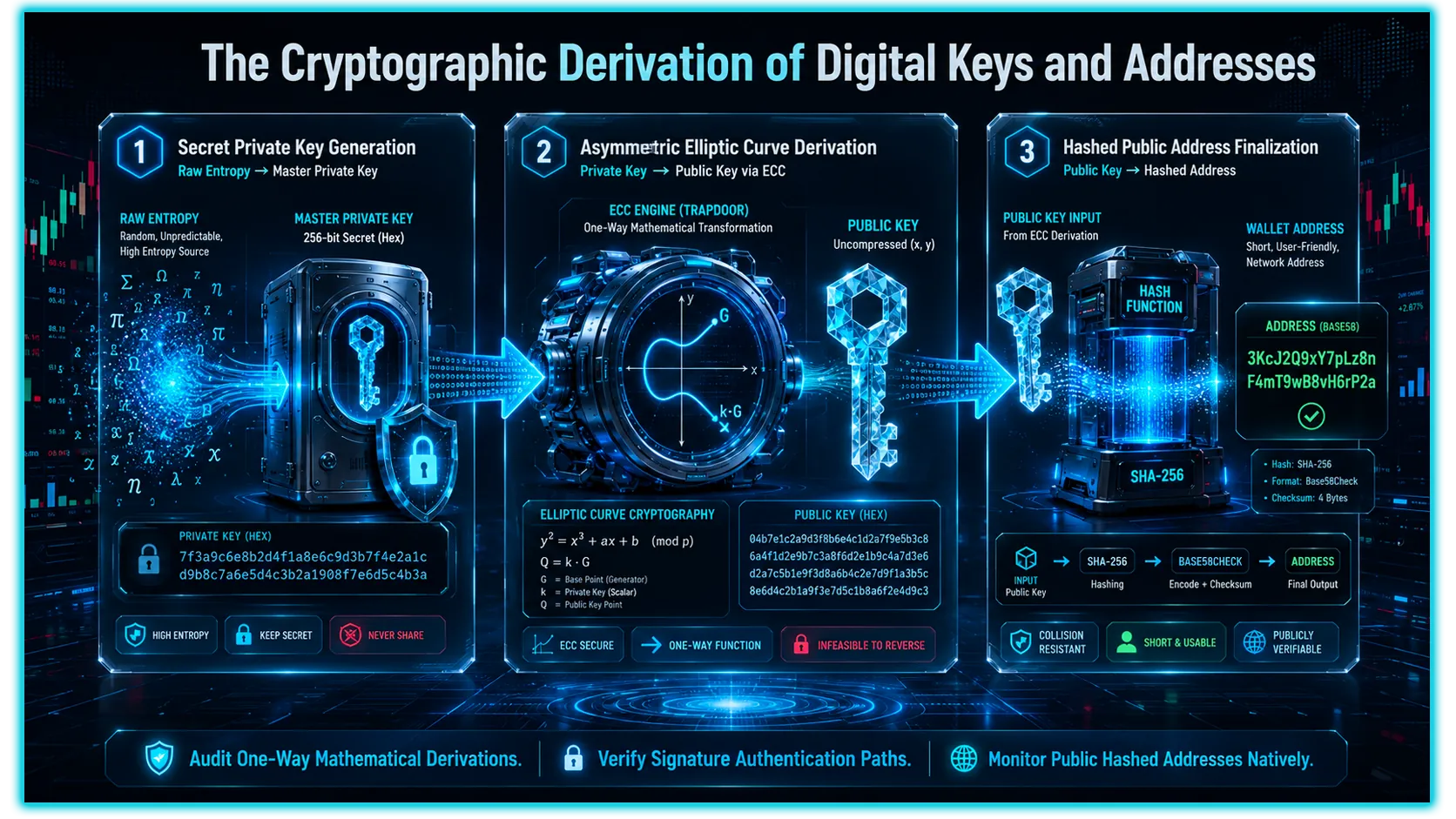
1. The Derivation Pipeline: A One-Way Mathematical Street
The relationship defining a digital wallet is a strict, unidirectional mathematical pipeline. You can easily calculate forward down the chain, but reversing the process is computationally impossible.
Step 1: Raw Entropy to Private Key
The journey begins with true randomness, known as entropy. Your wallet software generates a massive random number, typically represented as a 12- or 24-word seed phrase (BIP39 standard). This seed phrase translates directly into your master Private Key: a long string of alphanumeric characters that serves as the ultimate secret passkey for your capital.
Step 2: Private Key to Public Key
- Next, the protocol passes the private keys through an advanced mathematical function known as Elliptic Curve Cryptography (specifically the secp256k1 curve standard for networks like Bitcoin and Ethereum). This process executes a series of geometric point multiplications to calculate Public Keys.
- This calculation functions as a cryptographic "trapdoor." While it is easy for a computer to multiply the private key forward to find the public key, reversing the math to deduce a private key from a public key would take a modern supercomputer billions of years to compute, making the architecture highly resilient against brute-force attacks.
2. Cryptographic Signing: Proving Ownership Safely
The primary operational purpose of your private key is to sign transactions. When you send tokens to another user, you do not broadcast your private key to the network to prove you own the funds. Instead, you generate a digital signature.
The transaction signing loop functions through two distinct phases:
The Signing Phase: Your wallet client takes the transaction details (such as destination address and amount) and combines them with your secret private key to generate a unique mathematical Digital Signature.
The Verification Phase: This digital signature is broadcast to the public mempool alongside the transaction data and your public key. Validator nodes run a rapid verification check. The math proves that the signature could only have been created by the specific private key linked to that public key, authorizing the transfer without ever exposing your secret key.
3. Generating Public Addresses: The Hashed Fingerprint
- While your public key is safe to share, it is structurally too long and unwieldy to be used as a convenient account number. To create a cleaner, user-friendly interface, protocols compress the public key down into a Public Address.
- To generate a wallet address, public keys are run through intense, multi-stage cryptographic hashing algorithms (such as SHA-256, RIPEMD-160, or Keccak-256). This process shortens the data string and adds built-in error-checking characters. The resulting output is the public wallet address you paste into applications to receive funds, acting as a clean, compressed fingerprint of your master public key.
Cryptographic Key Matrix
| Primitive Type | Core Function | Network Visibility |
| Private Key | Signs transactions | Strictly Private |
| Public Key | Verifies signatures | Node Accessible |
| Public Address | Receives assets | Publicly Shared |
Key Security & Risk Vectors
| Exposure Type | Systemic Danger | Mitigation Track |
| Private Key Leak | Complete loss of funds | Hardware cold storage |
| Address Spoofing | Sending to wrong target | Multi-check copy paste |
| Public Key View | Exposes history balances | Maintain address privacy |
Real-Time Telemetry Tracking via DEXTools
- As public addresses route transactions across alternative networks, manage automated smart contract permissions, and distribute newly launched tokens into global circulation, keeping constant track of localized liquidity pool parameters, volume spikes, and wallet histories is a vital requirement for risk management.
- By leveraging core features like the Pair Explorer, Live New Pairs dashboard, and the integrated Trade Story or Top Traders diagnostic tools, technical traders can seamlessly audit localized volume trends, track large whale wallet capital reallocations via the Big Swap Explorer, and check automated contract safety scores before initiating any on-chain interactions. This ensures your hardened hardware setup interacts safely with verified market venues as you audit live public address transfers natively.
You can access DEXTools here and start trading today!
Disclaimer: This article is for informational purposes only and does not constitute investment advice, financial advice, trading advice, or any other kind of advice. DEXTools does not recommend buying, selling, or holding any cryptocurrency or token. Users should conduct their own research and consult with a qualified financial advisor before making any investment decisions. Cryptocurrency investments are volatile and high-risk. DEXTools is not responsible for any losses incurred.