What is Axelar (AXL)? GMP and Interchain Tokens Explained
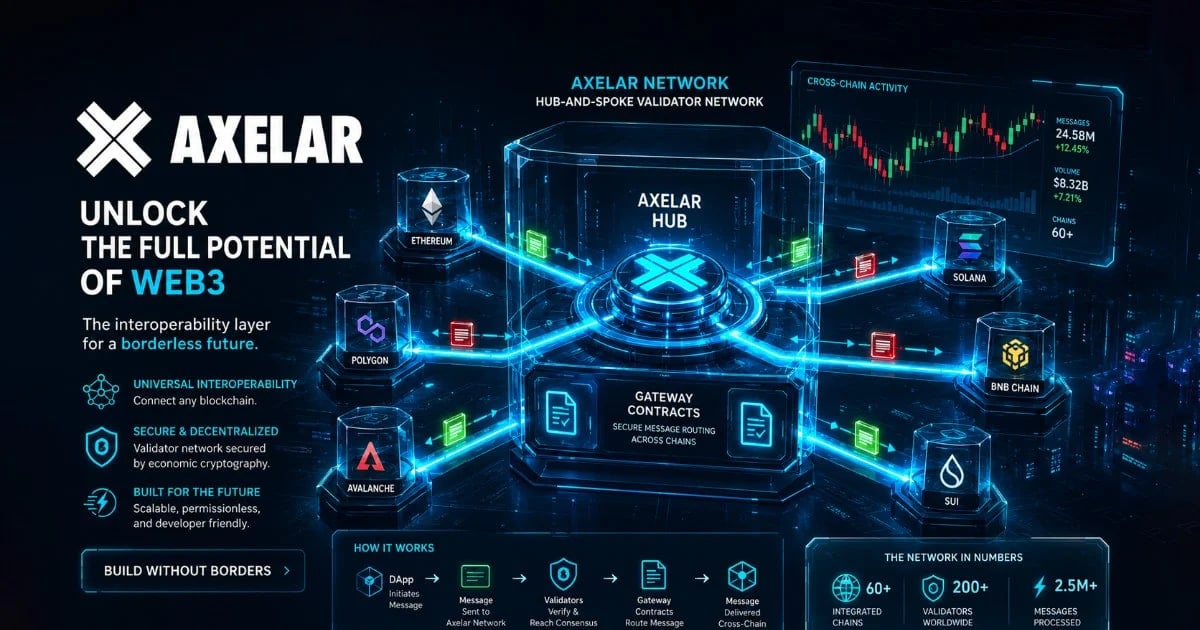
Traditional cross-chain bridges isolate users within fragile multi-sigs and fragmented assets. We break down the Tendermint consensus engine and token managers powering Axelar's interchain network.
The Interchain Communication Blueprint: A Proof-of-Stake Routing Engine
- Early public blockchain networks operated as completely isolated digital islands. Shifting capital across these boundaries historically required centralized exchanges or rigid, two-party asset bridges that introduced heavy security assumptions and fragmented liquidity. When decentralized finance (DeFi) pivoted toward modularity and alternative Layer 1 execution layers, the lack of a universal communication standard became Web3's biggest growth constraint.
- Axelar completely re-engineers this connectivity deficit. Operating as a decentralized, overlay network, Axelar functions as a programmable cross-chain routing layer. Rather than relying on simple message-relaying code or isolated multi-signatures, Axelar deploys a fully sovereign Proof-of-Stake (PoS) hub-and-spoke consensus engine built using Cosmos Tendermint. Now shepherded by primary ecosystem stewards Common Prefix following infrastructure handoffs from Interop Labs, Axelar secures billions in cross-chain volume across over 60 integrated networks: including primary mainnet channels for Ethereum, Cosmos, XRP Ledger, Hedera, and its highly active deployment on Solana.
1. General Message Passing (GMP): Beyond Asset Bridging
Traditional cross-chain bridges are mono-functional: they process simple user lock-and-mint loops to shift static token balances from Chain A to Chain B. Axelar expands this capability by introducing General Message Passing (GMP).
MP allows developers to pass arbitrary data payloads, state parameters, and direct smart contract execution commands across different blockchain environments natively.
Unified Application Loops: Instead of building isolated instances of an application across multiple chains, a developer can construct a centralized core logic contract on one chain that seamlessly orchestrates actions across alternative ledgers.
One-Click Function Calls: A user can interact with a front-end on a fast Layer 2 rollup, trigger an intricate multi-protocol swap that pulls liquidity from Ethereum Mainnet, and land the finalized yield-bearing asset back into their native wallet within a single transaction loop.
2. Gateway Contracts: The On-Chain Ports of Entry
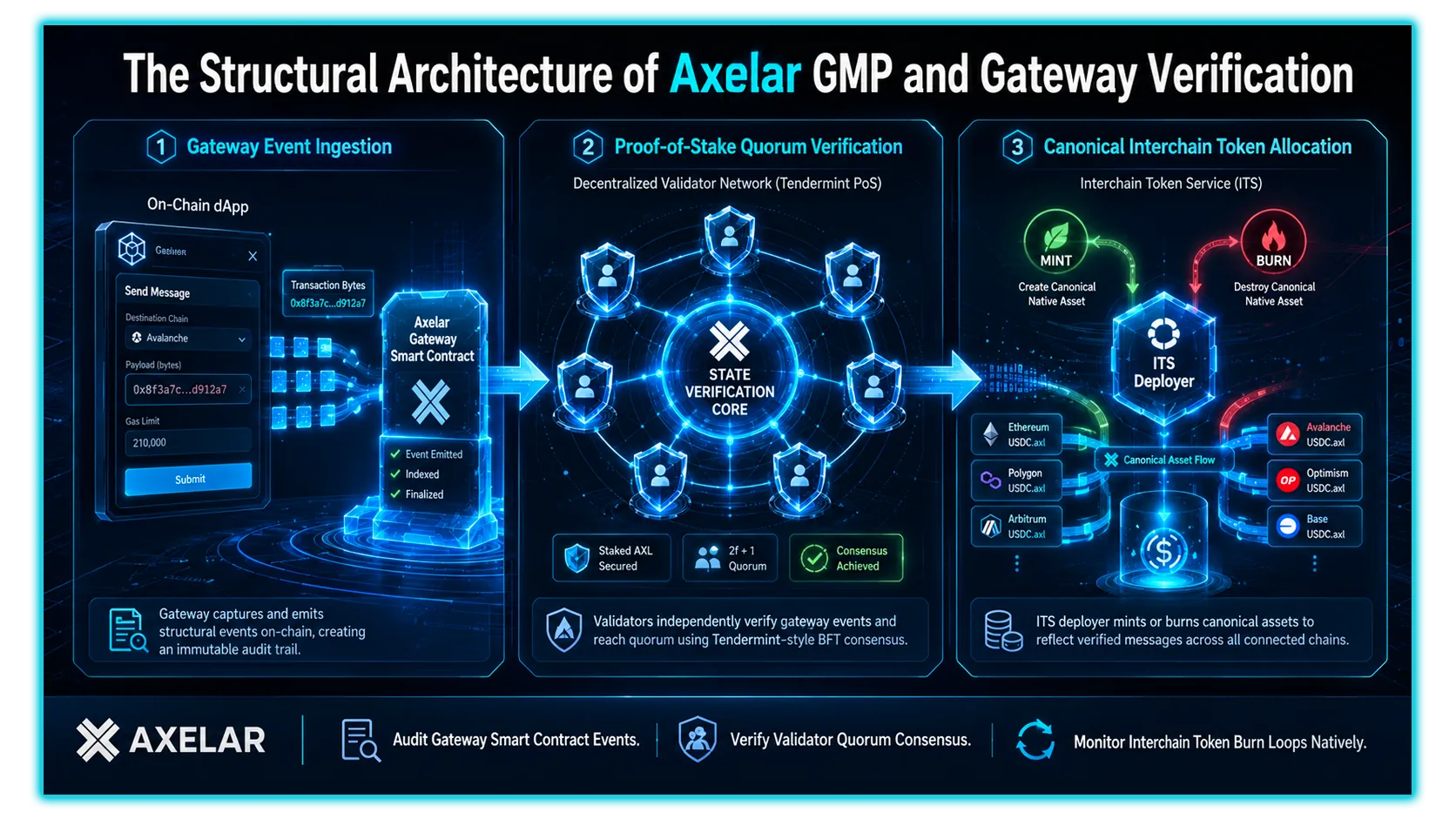
The communication pathway between external public ledgers and Axelar's validation hub relies entirely on Gateway Contracts.
Gateways are immutable smart contracts deployed natively across every connected blockchain network. They serve as the entry and exit checkpoints for all interchain activity:
The Ingestion Check: When a cross-chain application wants to trigger a GMP call, it invokes the local Axelar Gateway using specific protocol parameters (
callContractorcallContractWithToken). The Gateway records the payload bytes and emits a standardized on-chain event.The Execution Check: On the destination side, the localized Gateway acts as a cryptographic gatekeeper. It holds the authoritative list of active validator public keys and will only release funds or forward execution data to the target application contract once it receives a multi-signature proof signed by a consensus quorum of Axelar's validators.
3. The Interchain Token Service (ITS): Ending Liquidity Fragmentation
To resolve the systemic de-pegging, smart contract vulnerabilities, and UX confusion introduced by traditional third-party wrapped tokens, Axelar engineered the Interchain Token Service (ITS).
ITS is a developer toolkit and open-source smart contract suite designed to turn any standard ERC-20 token into a native, cross-chain Interchain Token with a single click.
The service upgrades traditional token distribution through key features:
Address Uniformity: Utilizing specialized
CREATE3deployment factories, ITS ensures that an Interchain Token retains the exact same contract address across all configured public EVM networks, preserving developer toolkits and exchange integration paths.Custom Supply Management: Token issuers can configure how liquidity shifts across chains based on their underlying risk tolerances. The service supports automated Burn-and-Mint mechanics (completely destroying supply on the source chain to regenerate it natively on the destination chain) or Lock-and-Mint Token Managers to securely coordinate assets within established legacy contracts.
4. Validator Infrastructure and Consensus Mechanics
The ultimate backstop defending Axelar's security is its dynamic, permissionless Proof-of-Stake Validator Set.
Unlike lightweight messaging bridges that rely on a small group of trusted off-chain signers, Axelar validators run a highly resilient Cosmos-based consensus ledger.
External Client Validation: To maintain security across integrated chains, Axelar validators are required to co-host and run full-node execution clients for the specific external networks they are assigned to monitor (such as Ethereum or Solana).
Quorum Event Voting: When a Gateway contract on an external chain emits a cross-chain event, Axelar validators poll their local external nodes to confirm that the transaction successfully finalized on that native ledger. The validators then broadcast a Tendermint consensus vote on the Axelar network. Once a supermajority quorum is achieved, the network cryptographically signs a master execution command to unlock the target destination Gateway.
The 2026 Economic Hardening Roadmap
To scale this security model for massive enterprise capital, Axelar's 2026 architectural upgrades introduce Co-Staking. This framework allows validators to secure the network by staking high-reputation, blue-chip assets alongside native AXL tokens. This radically expands the platform's economic security threshold, insulating it against capital manipulation attacks during high-volume institutional settlement rounds.
Interoperability Architecture Comparison Matrix
| Metric | Relayer Bridges (e.g., LayerZero V1) | Axelar Interchain Platform |
| Consensus Layer | None (Independent Signer Arrays) | Full Tendermint Proof-of-Stake |
| Data Capability | Basic Asset Routing / Messages | Generalized Message Passing (GMP) |
| Token Deployment | Fragmented Wrapped Synthetics | Interchain Tokens (ITS/Same Address) |
| Gas Fee Experience | Variable Manual Estimates | Upfront Gas Service (Overhaul Live) |
Routing via DEXTools Telemetry
- As applications transition to native interchain designs and deploy assets across a growing array of networks, tracking cross-chain liquidity distribution, transaction trends, and contract security rankings is essential for risk management. Sourcing analytics through advanced decentralized charting architectures like DEXTools gives market participants an essential universal platform to monitor live token behaviors, evaluate pool depths, and inspect contract parameters across all all public execution networks.
- By leveraging core features like the Pair Explorer, Live New Pairs dashboard, and the integrated Trade Story or Top Traders diagnostic tools, technical traders can seamlessly audit localized volume trends, track large whale wallet capital reallocations via the Big Swap Explorer, and check automated contract safety scores before initiating any on-chain interactions, ensuring your hardened hardware setup interacts safely with verified market venues.
You can access DEXTools here and start trading today!
Disclaimer: This article is for informational purposes only and does not constitute investment advice, financial advice, trading advice, or any other kind of advice. DEXTools does not recommend buying, selling, or holding any cryptocurrency or token. Users should conduct their own research and consult with a qualified financial advisor before making any investment decisions. Cryptocurrency investments are volatile and high-risk. DEXTools is not responsible for any losses incurred.