What is DIMO? Connected Vehicle Network Explained

Car companies trap valuable telemetry inside proprietary corporate siloes. We break down how DIMO uses blockchain data marketplaces and plug-and-play OBD2 adapters to hand asset data rights back to drivers.
What is DIMO
DIMO (Digital Infrastructure for Moving Objects) shatters this closed model. Operating as a decentralized physical infrastructure network (DePIN) built on the Polygon blockchain, DIMO transforms everyday cars into user-owned smart devices. By giving drivers the power to securely collect, self-custody, and monetize their own telemetry, DIMO builds an open-source machine economy for the future of mobility.
The Telemetry Goldmine: Reclaiming Automotive Data Sovereignty
The global automotive industry is sitting on an invisible fortune: vehicle telemetry. Every time you drive, your car generates massive amounts of data, including engine diagnostics, battery performance, fuel metrics, and mileage history. Historically, this valuable information has been locked inside proprietary corporate siloes owned by multi-billion-dollar car manufacturers. Car owners have had zero access to their own data, often paying mechanics high fees simply to read an error code that their vehicle already knew.
1. Core Infrastructure: How DIMO Connects Vehicles
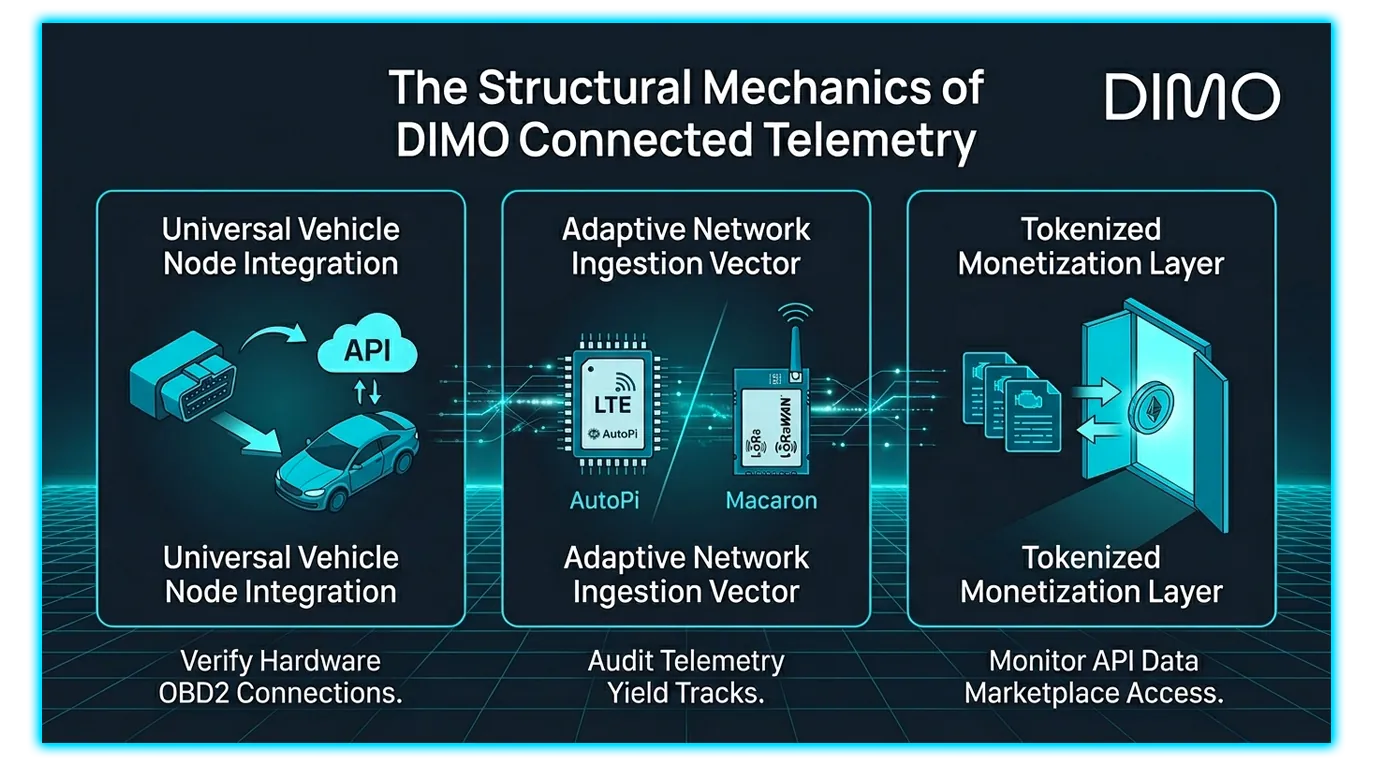
At its architectural layer, DIMO establishes an open cryptographic identity for vehicles, drivers, and decentralized applications (dApps). When a vehicle joins the network, the user mints their car as a unique Non-Fungible Token (NFT), creating a secure digital twin on the ledger.
Vehicles connect to the DIMO protocol using two distinct onboarding paths:
Software API Integration: Owners of modern, natively connected vehicles (such as Tesla, Ford, or BMW) can instantly sync their cars wirelessly using pre-existing manufacturing applications like the Tesla App or FordPass, bypasssing the need for physical accessories.
Hardware OBD2 Devices: Owners of legacy vehicles built after 2008 plug a dedicated hardware module directly into their car's onboard diagnostics (OBD2) port, typically located right underneath the steering wheel box.
2. The Hardware Choices: AutoPi vs. Macaron
For drivers who require physical hardware adapters to connect their cars, DIMO offers two official plug-and-play options built for different budgets and operational needs.
The DIMO Macaron
The Macaron is the network's ultra-compact, budget-friendly entry point. To keep operating costs virtually non-existent, the Macaron eliminates traditional cellular data plan fees by routing its telemetry over the Helium IoT Network. The device pings nearby Helium LoRaWAN hotspots passively every 30 seconds to upload coordinates and basic vehicle diagnostics. While it requires occasional Bluetooth syncing with the DIMO mobile app and earns a lower baseline reward multiplier, it includes a three-year data package out of the box, making it a highly cost-efficient hardware investment.
The DIMO AutoPi
The AutoPi represents the network's premium, full-performance infrastructure tier. Built around a powerful Raspberry Pi computer architecture, the AutoPi features an integrated cellular SIM card (4G/LTE) to stream vehicle parameters autonomously to the blockchain without requiring a smartphone link or nearby IoT hotspots. This constant cellular connection makes the AutoPi ideal for fleet tracking or rural environments with poor Helium coverage. To match its higher retail price tag, the AutoPi receives an amplified baseline token emission weight.
Hardware Device Matrix
| Device | Connection | Data Mode | Focus |
| Macaron | Helium LoRaWAN | App Syncing | Low Budget |
| AutoPi | Cellular 4G LTE | Autonomous | Max Yields |
3. The Connected Data Marketplace
To understand what is DIMO, you have to comprehend that the true macroeconomic value of the DIMO network lies in its decentralized Data Marketplace. Telemetry collected by connected cars is separated into two clean categories: public metadata (such as vehicle make, model, and year) and private metadata (such as exact location tracking, vehicle identification numbers, and granular health logs). Private data remains completely encrypted, and users can choose when, how, and with whom to share it.
By giving developers open API access to verified, user-consented vehicle data, DIMO fosters a competitive ecosystem of connected-car applications:
Real-Time Health Monitoring: Drivers can audit engine fault codes, track tire pressures, and check real-time battery degradation scores to sidestep expensive mechanic diagnostic diagnostics.
Peer-to-Peer Car Valuations: Integrated applications evaluate your vehicle's true mileage and diagnostic state on-chain, sourcing instant, unalterable market trade-in offers.
Smart Marketplace Integration: Insurers can offer usage-based, discounted premiums driven by verifiable safe driving metrics, while fleet management companies track entire vehicle networks through unified developer interfaces.
Corporate data consumers, automotive researchers, and developers must acquire and spend the native utility asset, the DIMO token, to buy protocol data access or invoke specific car API keys, steadily driving real-world utility back into the cryptoeconomic ecosystem.
Monitoring DePIN Markets via DEXTools Analytics
- Reviewing real-time market reallocations, assessing token distribution metrics, and auditing asset pool compositions requires deep data clarity. Accessing comprehensive decentralized analytics through specialized environments like DEXTools gives the Web3 community a universal cockpit to monitor real-time token behaviors, assess exchange liquidity pool configurations, and audit live smart contracts across various ledgers.
- By checking data streams inside the Pair Explorer, monitoring immediate deployments via the Live New Pairs dashboard, or analyzing investor behaviors through Top Traders or Trade Story records, technical analysts can evaluate local volume trends, watch institutional movements via the Big Swap Explorer, and audit contract trust metrics before transacting, helping your hardware validator assets engage safely with verified trading environments.
You can access DEXTools here and start trading today.
Disclaimer: This article is for informational purposes only and does not constitute investment advice, financial advice, trading advice, or any other kind of advice. DEXTools does not recommend buying, selling, or holding any cryptocurrency or token. Users should conduct their own research and consult with a qualified financial advisor before making any investment decisions. Cryptocurrency investments are volatile and high-risk. DEXTools is not responsible for any losses incurred.
Related Guides
- What Is Theta Network (THETA + TFUEL)? Decentralized Video Streaming Guide 2026
- What is the Lightning Network? Bitcoin L2 Scalability Guide
- Sui Network Architecture: Object-Centric Design, Parallel Execution and DeFi Apps (2026)
- What Is Spectral Network (SPEC)? The Onchain AI Agent Marketplace Explained in 2026
- What Is Sonic Network: S Token & Fantom Rebrand Guide 2026
Frequently Asked Questions
What is DIMO and how does it work?
DIMO is a network that lets vehicle owners collect and control telemetry from their cars, often using a plug-in device or connected app. The goal is to give drivers ownership of their vehicle data rather than leaving it locked inside manufacturer systems.
What kind of data does a connected vehicle network collect?
Connected vehicle networks can gather telemetry such as location, mileage, engine diagnostics, and battery or fuel status. The specific data depends on the device used and the permissions the owner grants.
Why put vehicle data on a blockchain?
Using a blockchain can let owners control access permissions and create a verifiable record of who can use their data. This supports the idea of a data marketplace where drivers can choose to share data on their own terms.
What is an OBD2 adapter used for in a vehicle data network?
An OBD2 adapter plugs into the standard diagnostic port found on most modern cars to read vehicle data. In a connected vehicle network it acts as the hardware bridge that streams telemetry from the car to the network.