What is a Nonce in Crypto? Wallet, Block and Mining Nonces
— By AliceOnChain in Tutorials

A fundamental but frequently misunderstood concept in decentralized networks, the "nonce" plays a vital role in both transaction ordering and network security. This guide breaks down the operational differences between wallet nonces, block nonces, and mining nonces, offering retail traders the technical clarity needed to troubleshoot stuck transactions and navigate on-chain markets effectively.
What is a Nonce in Crypto? Wallet, Block and Mining Nonces
In the fast-paced environment of decentralized finance (DeFi), tracking volume, analyzing liquidity pools, or mapping holder distribution often dominate a trader's attention. However, beneath the surface of clean charts and real-time market sentiment indicators lies a foundational cryptographic mechanism that keeps the entire infrastructure secure and orderly. For newcomers and intermediate traders exploring decentralized architecture, understanding what is a nonce crypto protocols depend on represents the first step toward mastering transaction mechanics and avoiding costly execution errors.
If you have ever had an Ethereum transaction get stuck in a queue during a high-volatility market event, or if you have ever wondered how Bitcoin miners actually validate data, you have interacted with a crypto nonce. Understanding how this single variable operates across different layers of blockchain architecture is a practical necessity for any participant looking to execute advanced on-chain strategies without technical friction.
Defining the Cryptographic Nonce
The term "nonce" is a portmanteau of "number used once." In cryptography, it refers to a random or pseudo-random number generated for a specific use, typically related to authentication, encryption, or transaction processing. The core purpose of a crypto nonce is to ensure that a specific piece of data cannot be reused, replicated, or replayed maliciously.
Within decentralized networks, analyzing what is a nonce crypto developers implement helps explain how systems prevent a variety of attack vectors. Most notably, it solves the double-spending problem, where an actor attempts to spend the same digital asset twice. While the basic definition remains consistent, the practical application of this value changes significantly depending on whether it is being used within a user's Web3 wallet, a cryptographic block header, or a proof-of-work mining algorithm.
Wallet Nonces: Preventing Double-Spending and Replay Attacks
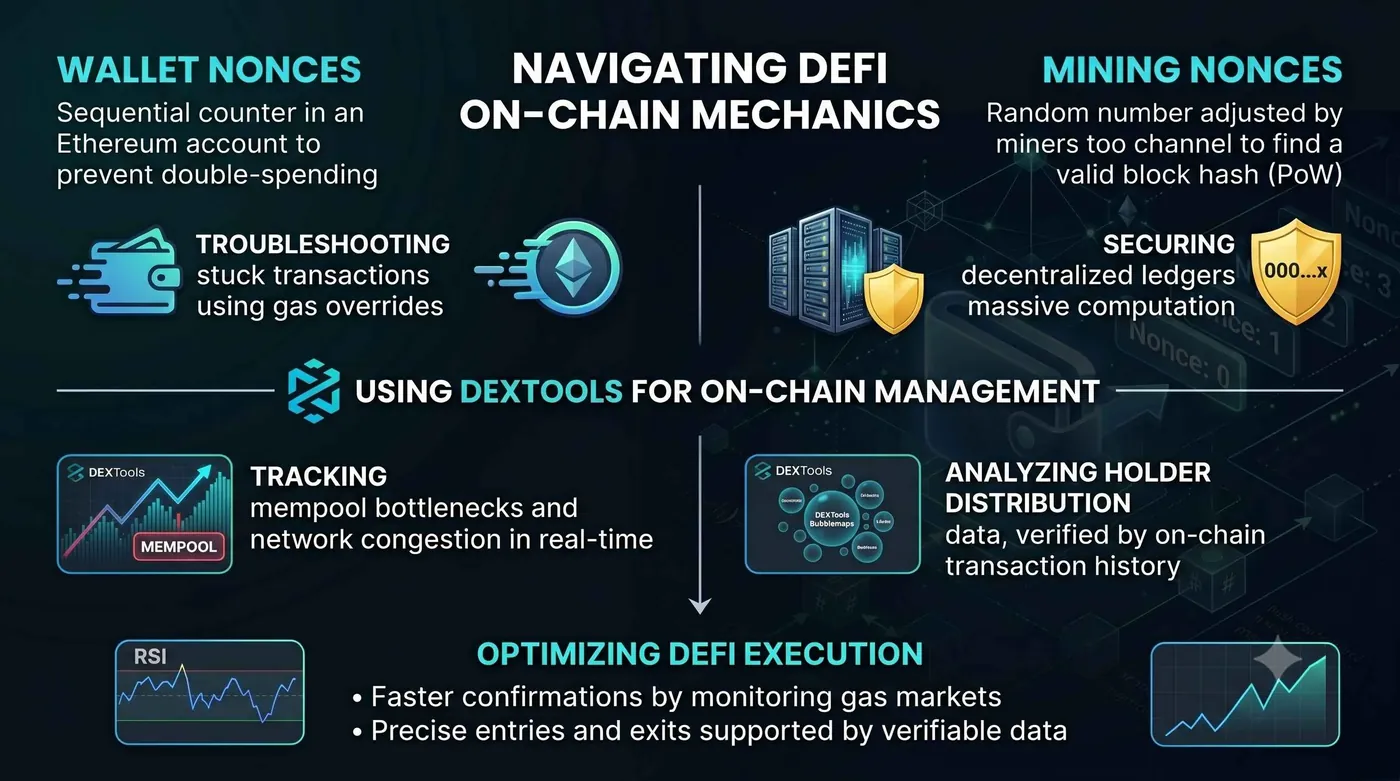
In account-based blockchain networks like Ethereum and the Binance Smart Chain, an ethereum wallet nonce is a sequential scalar value associated with every unique address. It represents the exact number of transactions sent from that specific wallet, starting at zero for the very first transaction.
How Account-Based Nonces Work on-Chain
Every time you sign a transaction-whether you are swapping tokens, adding liquidity to a decentralized exchange, or setting up Price Alerts-the transaction payload includes your current wallet value. Once that transaction is successfully validated and added to a block, your wallet's on-chain counter increments by exactly one.
When studying how nonce works on-chain, this sequential ordering dictates how the network processes your actions:
Strict Monotonic Order: The network will only execute transaction number 5 if transaction number 4 has already been processed.
Uniqueness: If an attacker intercepts your signed transaction data and tries to broadcast it to the network again (a replay attack), the blockchain nodes will reject it immediately because a transaction with that exact counter value has already been executed.
Troubleshooting Stuck Transactions via Nonce Overrides
During periods of extreme market volatility, network congestion often spikes alongside sharp price action. If a trader submits a transaction with a gas price that is too low relative to the current network demand, that transaction can become stuck in the mempool (the holding area for unconfirmed transactions).
Because of the strict sequential nature of how a crypto nonce operates, any subsequent transactions sent from that same wallet will be blocked behind the pending one. For example, if nonce 12 is stuck, nonce 13 and 14 cannot execute, potentially causing a trader to miss critical entries or exits when analyzing support/resistance levels.
To resolve this, traders can execute a manual override. By generating a new transaction with the exact same value as the stuck transaction (in this case, 12) but assigning a significantly higher gas fee, the network nodes will prioritize the new transaction over the old one. Once the high-gas transaction executes, the original, underpriced transaction is effectively canceled and overwritten, clearing the bottleneck for subsequent on-chain activities.
Block Nonces and the Mechanics of Proof-of-Work Mining
While wallet counters manage individual account sequences, a block nonce operates at the network-wide consensus layer. In Proof-of-Work (PoW) blockchains, such as Bitcoin, the mining nonce is an essential variable used by miners to secure the network ledger.
The Mining Race Explained
A blockchain is quite literally a chain of blocks, where each block contains a batch of validated transactions, a reference to the previous block's cryptographic hash, and a blank field reserved for the specific mining nonce.
The job of a Proof-of-Work miner is to take all the data in the current block header and run it through a cryptographic hashing function (like SHA-256) to produce an output that meets a very specific condition. This condition is dictated by the network's current mining difficulty, which usually requires the resulting hash to begin with a predetermined number of leading zeros.
When evaluating what is a nonce crypto miners must actively calculate, the transaction data and the previous block's hash remain static variables. The miner cannot alter them to change the output. The only variable the miner can change is the block nonce. Miners alter this value slightly, hash the modified block header, and check if the output matches the network's difficulty target.
The Probability of the Perfect Hash
Miners must engage in a high-speed trial-and-error process, changing the mining nonce trillions of times per second across global hardware networks. If the output does not meet the criteria, the miner increments the number and tries again.
The first miner globally to find a valid block nonce that generates a valid hash wins the right to append the block to the blockchain and claims the associated block reward. This mechanism demonstrates that finding a valid solution requires immense computational work, while verifying that the number is correct takes other network nodes only a fraction of a second.
Nonces and Their Impact on the Broader DeFi Ecosystem
Though the concept may seem confined to the backend of ledger engineering, understanding how nonce works on-chain directly impacts the user experience across modern DeFi protocols and analytics tools.
When observing real-time token metrics using advanced analytical suites like DEXTools-whether inspecting the Pair Explorer for unusual whale activity or utilizing Holder Analysis to evaluate distribution metrics-understanding transaction finality is critical. Sudden shifts in volume or an unexpected RSI divergence on a chart can trigger a wave of user transactions, each requiring a fresh crypto nonce to be processed.
If a significant percentage of retail traders fail to configure their ethereum wallet nonce or gas metrics properly during these high-volume events, transaction failures can cascade. This can distort short-term volatility management indicators, as reported volume may lag behind actual market intent due to pending or canceled mempool states.
Furthermore, analyzing holder structures via modern visualizers, such as Bubblemaps, relies on tracing the precise historical flow of transactions from smart contracts and deployer wallets. Every single one of those historical token allocations was ordered and secured by the sequential deployment of a wallet crypto nonce, illustrating how deeply interwoven these basic cryptographic numbers are with the transparency of modern on-chain data.
Conclusion and Risk Management
Navigating the decentralized space successfully requires a balanced understanding of both market mechanics and protocol-level infrastructure. When traders ask what is a nonce crypto networks utilize, they uncover that it is not merely a technical footnote; it is the traffic controller of account histories and the cryptographic anchor of proof-of-work consensus.
For the active retail trader, mastering how an ethereum wallet nonce operates provides a concrete advantage when troubleshooting execution issues during periods of high network volatility. Properly managing your transaction queue ensures that your capital remains agile, allowing you to react to support and resistance levels precisely when market conditions demand it. As with all on-chain operations, developing technical proficiency regarding a crypto nonce is a core component of overall risk management, helping protect your assets from unnecessary execution delays and capital inefficiencies.
How to Fix a Stuck Pending Crypto TransactionWhat Is a Block Reward: Complete Bitcoin Mining Reward Guide
What Are Gas Fees? How They Work on Ethereum and L2s
Bitcoin Hashrate Falls for First Time in 6 Years as Miners Pivot to AI
Disclaimer: This article is for informational purposes only and does not constitute investment advice, financial advice, trading advice, or any other kind of advice. DEXTools does not recommend buying, selling, or holding any cryptocurrency or token. Users should conduct their own research and consult with a qualified financial advisor before making any investment decisions. Cryptocurrency investments are volatile and high-risk. DEXTools is not responsible for any losses incurred.
Frequently Asked Questions
What is a nonce in crypto?
A nonce, or 'number only used once,' is a random or pseudo-random number generated for cryptographic communication. It's used to prevent replay attacks and ensure the uniqueness of a transaction or block.
How is a nonce used in blockchain mining?
In blockchain mining, a nonce is a critical component that miners adjust to find a valid hash for a new block. Miners repeatedly change the nonce and re-hash the block data until they produce a hash that meets the network's difficulty target.
What is the role of a nonce in proof of work?
The nonce is central to proof of work (PoW) consensus mechanisms. Miners expend computational effort to find a nonce that, when combined with other block data, results in a hash below a certain threshold, thereby proving their work.
Can a nonce be reused in crypto?
No, a nonce is designed to be used only once to maintain security and prevent certain types of attacks, such as replay attacks. Reusing a nonce could compromise the integrity of transactions or communications.
What is the difference between a nonce for a wallet and a mining nonce?
A wallet nonce typically refers to a transaction counter that prevents double-spending and ensures transaction order. A mining nonce is a variable adjusted by miners to find a valid block hash in proof-of-work systems.