Aave Just Launched Fixed-Rate Stable Vaults to Chase Morpho. We Read Them On-Chain: They Hold About $1,400
— By Tony Rabbit in News

Aave made its fixed-rate Stable Vaults publicly available, a stablecoin-yield engine for fintechs aimed at Morpho. We read the vaults straight from the contracts: one day in they hold about $1,400 in total across USDC, USDT and GHO, on a protocol holding over $12 billion. Live, but barely used yet. Here is the on-chain reality.
Aave, the largest lending protocol in DeFi, just made a direct move on one of the fastest-growing corners of the market. It productized its Stable Vaults, a fixed-rate stablecoin-yield layer built for fintechs to plug into, and the announcement landed as a challenge to Morpho, the protocol that quietly powers on-chain yield behind mainstream apps like Coinbase and Robinhood. Eight outlets ran the press release. We did something none of them did: we read the vaults straight from the contracts. One day in, all three of them together hold about $1,400.
What Aave actually shipped
The idea is genuinely significant. Aave lending today pays a floating rate that moves with utilization, which is fine for crypto natives but awkward for a fintech that wants to promise its users a clean, predictable number. Stable Vaults are Aave's answer: a fixed-rate wrapper around stablecoin yield that a consumer app can build a savings product on top of. It is aimed squarely at the niche Morpho already dominates, and it comes from a protocol with more than $12.5 billion locked, according to DefiLlama. On paper, that is a heavyweight entering the ring. The contracts have existed quietly for a while, already wired into Aave's mobile savings app, so this is a productization and public launch rather than a from-scratch debut.
What we found reading the vaults
Aave's Stable Vaults are accounting vaults, one per stablecoin, and their balances are public. We called totalAssets on each. The USDT vault holds about 545 USDT, the USDC vault about 498 USDC, and the GHO vault about 364 GHO. Added up, the entire new product holds roughly $1,400. That is not a criticism so much as a timestamp: this is what a real launch looks like on day one, before any fintech has plugged in at scale. It is the opposite of the inflated, pre-seeded numbers that sometimes accompany a launch, and it means anyone can now watch the adoption curve from zero, on-chain, in real time.
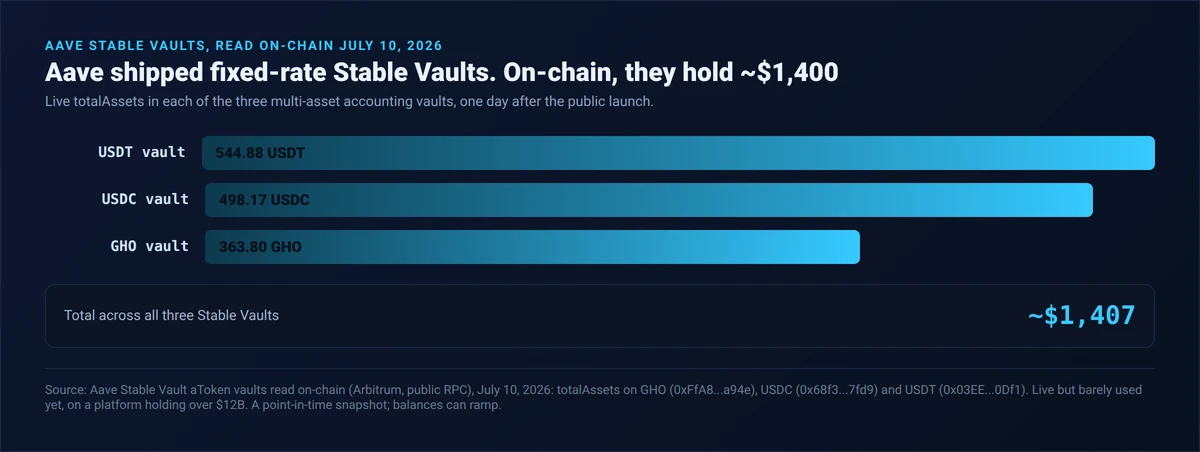
The gap between the platform and the product is the story. Aave the protocol is a $12.5 billion giant; Aave's newest product is a $1,400 seedling. Both facts are true at once, and only the chain shows you the second one.
The race it is entering
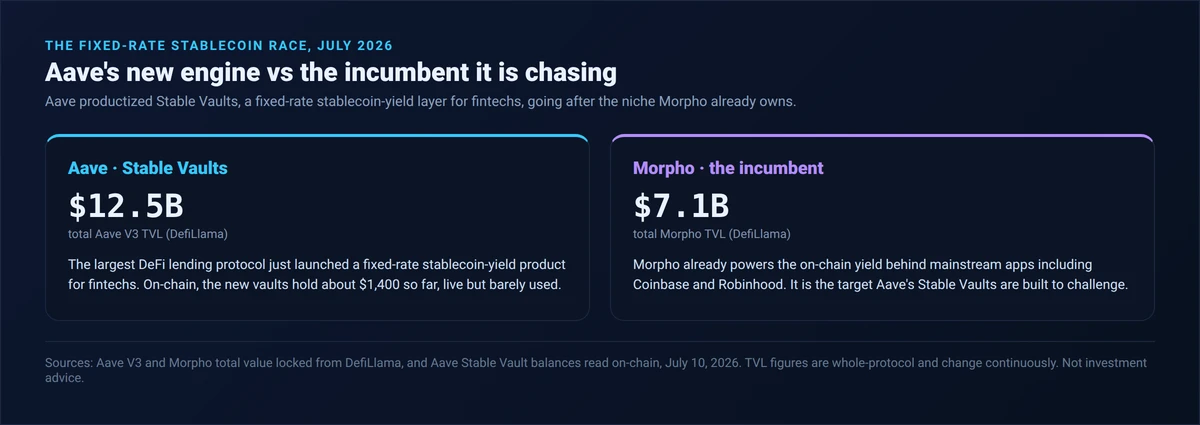
Stable Vaults are not launching into empty space. Morpho, with about $7.1 billion locked, has spent the last stretch becoming the invisible yield engine behind consumer crypto, powering the interest that apps like Coinbase and Robinhood pass on to users. That is the exact position Aave wants. The question the press release cannot answer, but the chain can, is whether Aave's brand and $12.5 billion of liquidity will pull fintech integrations away from the incumbent, or whether Morpho's head start holds.
The fine print worth watching
One detail matters for anyone who ends up holding this yield through a consumer app. A fixed rate is a promise made by whoever runs the vault, and the difference between the fixed rate paid out and the floating rate the underlying lending actually earns is a spread that the operator keeps or covers. That is a normal, legitimate business model, but it means the sustainability of a fixed rate depends on the buffer behind it, not on magic. As these vaults fill, the honest thing to track is not just the headline APY but the balances and the utilization underneath it, all of which are on-chain. For the bigger picture of how on-chain yield is built, our guide to DeFi yield is a useful primer.
- a fixed, predictable stablecoin yield that fintechs can build savings products on
- from the largest DeFi lending protocol, with over $12B already on it
- a direct move on Morpho, which quietly powers Coinbase and Robinhood on-chain yield
- the three Stable Vaults together hold about $1,400 so far
- live and readable, but adoption has not started, this is a launch not a landslide
- and a fixed rate means the operator keeps the spread, so watch where the yield really comes from
Aave entering the fixed-rate stablecoin race is real news, and a $12.5 billion protocol going after Morpho is worth taking seriously. But a launch is a starting line, not a result. The press release says Aave is coming for the fintech-yield market; the chain says the product holds $1,400 so far. Both are worth knowing, and only one of them you have to read the contracts to see. We will keep watching the balances.
Methodology and disclaimer: Aave Stable Vault balances were read on-chain on July 10, 2026 by calling totalAssets on the three aToken accounting vaults (GHO 0xFfA8a407F067f44FB06DE7FAE075c8857346a94e, USDC 0x68f30a3f6b95c0E7c526D7C480590D86952C7fd9, USDT 0x03EE88c9769F2C61a93F1cbafFE89549A9405Df1), returning about 363.8 GHO, 498.2 USDC and 544.9 USDT, roughly $1,400 combined; these are a point-in-time snapshot and can rise as the product is adopted. Aave V3 total value locked (about $12.5B) and Morpho total value locked (about $7.1B) are from DefiLlama and are whole-protocol figures that change continuously. The Stable Vaults productization/public launch is as reported by Aave and outlets including CoinDesk and The Block; the description of Morpho powering Coinbase and Robinhood yield is as reported. This article is on-chain analysis for information only and is not financial or investment advice, and nothing here is a yield or APY promise. Do your own research.