Base Built the B20 Standard for Stablecoins and RWAs. Day One, We Counted On-Chain: It Minted Memecoins
— By Tony Rabbit in News
Base turned on its B20 native-token standard on July 8, pitched for stablecoins, real-world assets and tokenized equities. We enumerated the first cohort straight from the registry on-chain: 2,000 tokens minted in a single seven-hour window, 98% of them 18-decimal memecoins, and not one genuine stablecoin or RWA among the ones we read.
On July 8, 2026, at 18:00 UTC, Base switched on its B20 Native Token Standard, a new way to mint fungible tokens directly on the network with compliance baked in. Coinbase's Layer-2 pitched it as the rails for stablecoins, real-world assets and tokenized equities: issuers get freeze functions, transfer controls and role-based permissions without writing and auditing a custom ERC-20. It is a serious piece of infrastructure. So we did what we do, and counted what actually got minted through it. We pulled the B20 registry's creation logs straight off the chain, and the first cohort is not stablecoins or real-world assets. It is memecoins, by the thousand.
What B20 is supposed to be
The standard itself is genuinely useful. B20 was shipped as part of Base's Beryl upgrade in late June and turned on for token creation on July 8. It stays ERC-20 compatible while adding native compliance controls, and it comes in two flavors: a stablecoin variant fixed at six decimals with a required fiat denomination, and an asset variant with configurable decimals from six to eighteen for everything else. The goal is to let regulated issuers put a compliant dollar token, a tokenized treasury or a tokenized stock on-chain without reinventing the wheel each time. That is a real problem worth solving, and if you want the background on why tokenized assets matter, our guide to real-world assets lays it out.
What we counted on-chain, day one
Here is the reality of the first hours. B20 tokens are created through an on-chain registry, and every creation emits a log, so the cohort is fully enumerable. We read the registry's creation logs via Blockscout and pulled each token's details straight from Base's public RPC. In a single seven-hour window on July 9, from 06:31 to 13:26 UTC, we counted 2,000 B20 tokens created, a rate of roughly 285 an hour. We then read a 250-token sample in detail. Of those, 98.4% were the 18-decimal asset variant, and 64% carried a supply of exactly one billion, the round number that screams memecoin. Names in the cohort included ghostcat, a token whose ticker was just the number 1000000000, and plenty with emoji tickers.
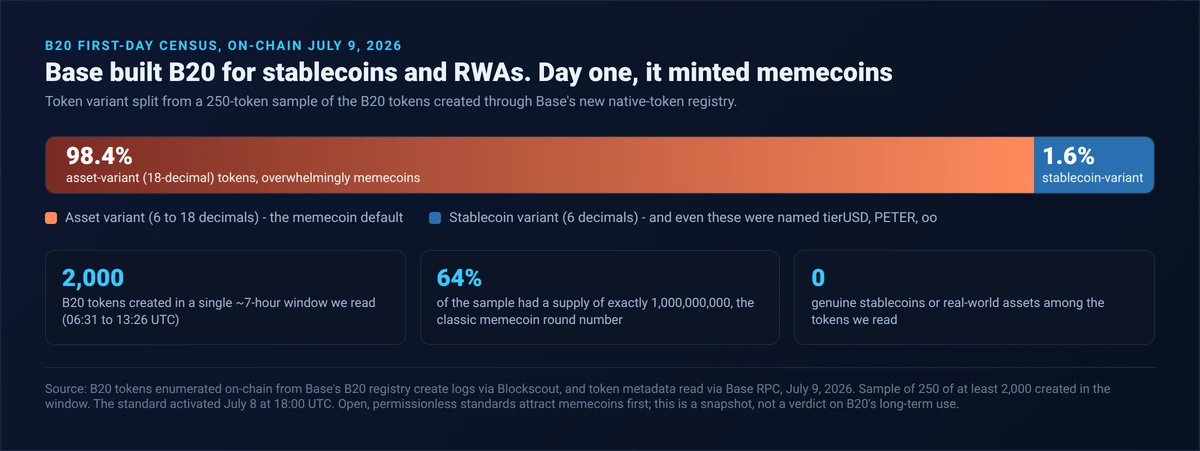
And the stablecoin variant, the six-decimal slot meant for compliant dollar tokens? It made up just 1.6% of the sample, and even those were not real stablecoins. The ones we read were named tierUSD, PETER and oo, with supplies like 10,000 and 100,000. In other words, people used the standard's stablecoin format to mint more memecoins. Among every token we read, there was not a single genuine stablecoin or real-world asset.
The liquidity reality
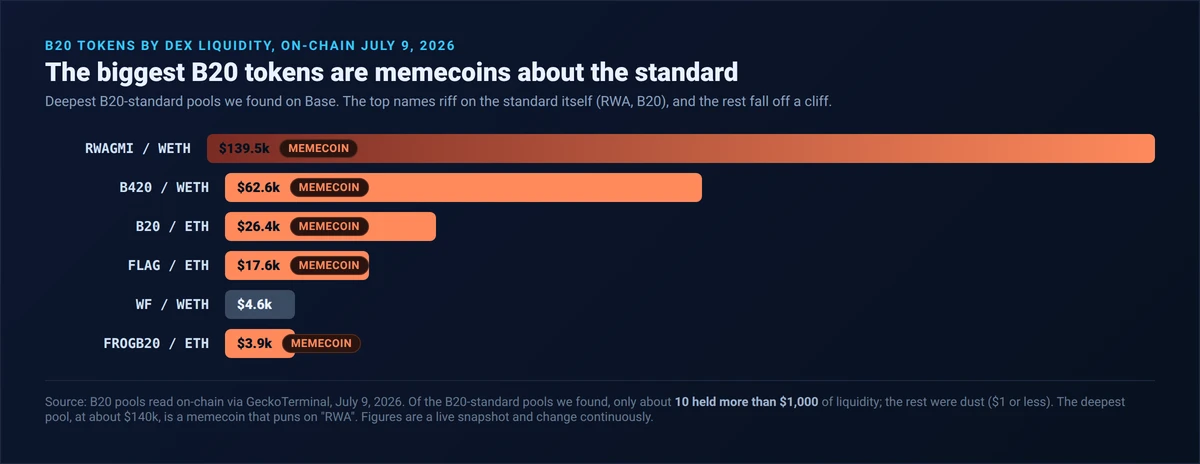
Almost none of these tokens go anywhere. Most never get a market at all, and of the B20 tokens that did get a DEX pool, only about ten held more than $1,000 of liquidity. The rest were dust, a dollar or less. And the biggest ones are the punchline: the deepest B20 pools we found are memecoins about the standard, with tickers like RWAGMI (a play on real-world assets), B420, B20 and FROGB20. The single deepest pool, around $140,000, is that RWAGMI memecoin. The first thing the market did with Base's new RWA-and-stablecoin standard was mint memecoins that make fun of it.
This is also a token-safety note worth flagging. Because these are native standard tokens, a memecoin minted through B20 can carry the same "official" cues, and even the same freeze and role permissions, as a serious issuer's token. That is exactly why you check before you buy. Paste any contract into the DEXTools Token Safety Checker and look at liquidity, holders and permissions first, and use our New Token Tracker to see what is actually launching rather than what is being marketed.
Why this happens, and why it is not the whole story
None of this makes B20 a failure. Open, permissionless standards attract memecoins first, every single time, because anyone can deploy the moment the door opens and speculation is the fastest thing to ship. We saw the exact same pattern this week when we read Robinhood Chain: a network built for tokenized stocks whose open liquidity is memecoins. The serious use of B20, compliant stablecoins and tokenized assets from audited issuers, does not happen in the first seven hours. It happens over weeks and months, through deliberate deployments by regulated players. That is the honest metric to watch: not the day-one memecoin flood, but whether real stablecoin and RWA issuers actually adopt the standard. Today, the marketing and the mints point in different directions. Only the chain shows you which is which.
- a native token standard so issuers skip building and auditing custom ERC-20s
- built-in compliance: transfer controls, freeze functions and role-based permissions
- purpose-built variants for stablecoins, real-world assets and tokenized equities
- about 2,000 tokens minted in a single seven-hour window we read
- 98.4% were 18-decimal asset tokens, most with a 1 billion memecoin supply
- the deepest B20 pools are memecoins that pun on the standard itself
The takeaway is not that Base did something wrong, or that memecoins are the point of B20. It is that a standard built for compliant, real-world finance spent its first day as a memecoin launcher, and that gap between the pitch and the print is only visible if you read the chain. We did.
Methodology and disclaimer: we enumerated B20 tokens from the create logs of Base's B20 registry (0xB20f000000000000000000000000000000000000) via Blockscout, and read each token's decimals, symbol, name and supply from Base's public RPC, on July 9, 2026. The 2,000 count covers a single window from 06:31 to 13:26 UTC that day; the total since the July 8, 18:00 UTC activation is higher. The variant split (98.4% asset, 1.6% stablecoin) and the 64% one-billion-supply figure are from a 250-token sample of that window; liquidity figures are from GeckoTerminal and are a live snapshot. "Memecoin" is a characterization based on token decimals, round supplies, names and the absence of any backing or issuer disclosure, not a claim about any specific project's intent. Nothing here is affiliated with, or an allegation against, Base, Coinbase or any token issuer. This article is for information only and is not financial advice. Newly minted tokens are extremely high risk and can lose all value; verify every contract and do your own research.