Bitcoin Surpasses $80K: Breakout or Ceiling?
Bitcoin has surpassed $80,000, but is it a real floor? We analyze the geopolitical impact of "Project Freedom," BTCFi yield, and the urgent quantum breakthrough risks.
Bitcoin Breaches $80,000: A Technical Milestone?
- As of May 5, 2026, the digital asset market has reached a historical psychological threshold. After a day characterized by extreme volatility, Bitcoin (BTC) has surged past the $80,000 mark, hitting an intraday peak of approximately $80,596.
- While this milestone is being celebrated by some as the confirmation of an "institutional floor," a more honest and analytical perspective suggests we are at a critical crossroads where geopolitical risk, massive leverage, and emergent technologies are colliding in unpredictable ways.
- The current price action, with Bitcoin consolidating between $79,800 and $81,200, reflects a market that is fundamentally different from the retail-driven bubbles of the past. However, the narrative of a guaranteed "floor" remains hypothetical. Today’s rally is a complex interplay between institutional ETF inflows and a sudden spike in the "risk premium" due to escalating tensions in the Strait of Hormuz.
The Geopolitical Catalyst: "Project Freedom" and Market Uncertainty
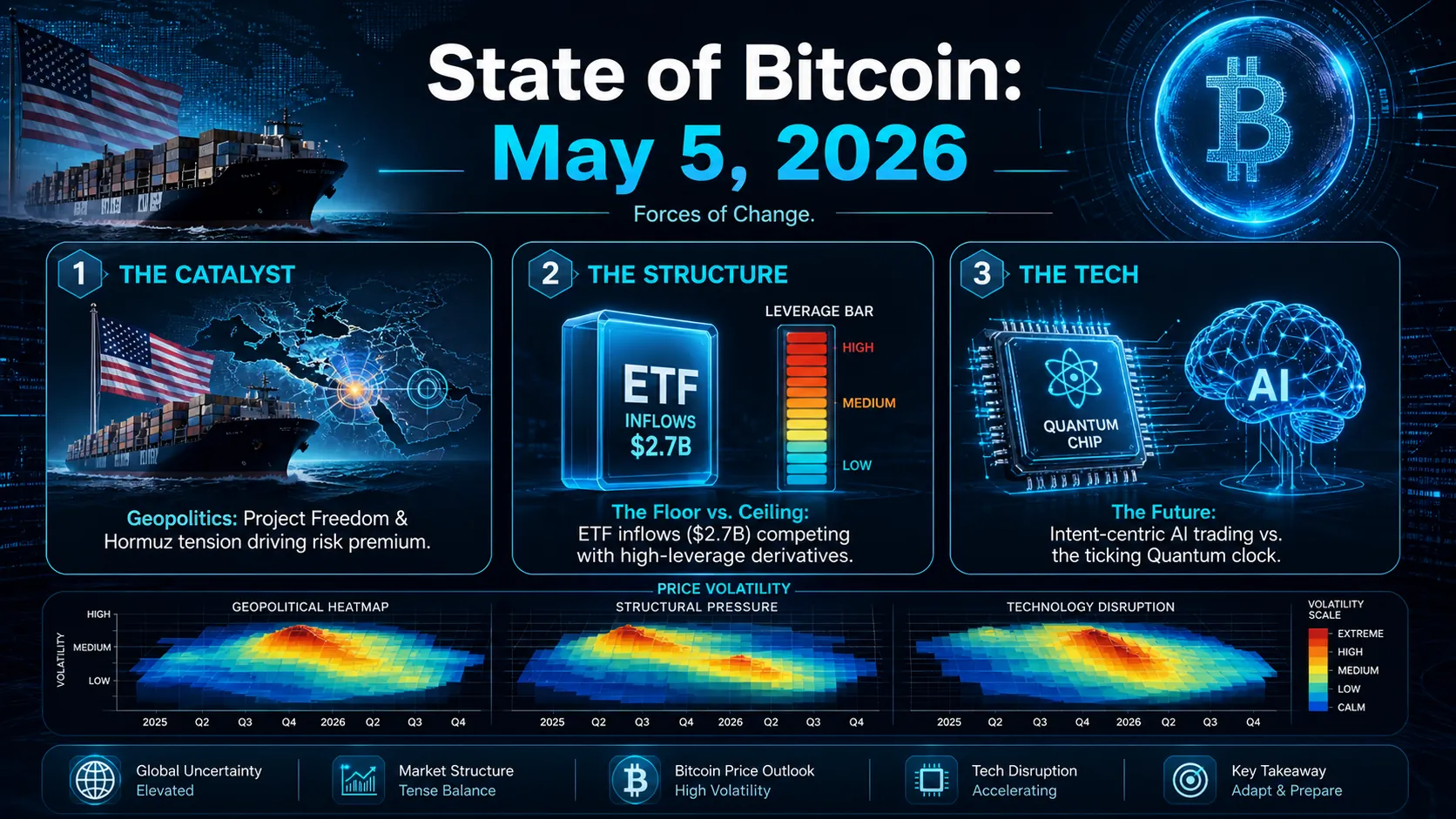
- The most immediate driver of today’s price surge is the announcement from the U.S. Administration regarding the commencement of "Project Freedom." This international mission, designed to secure and evacuate commercial vessels stranded in the Strait of Hormuz, has injected a significant dose of uncertainty into global financial markets.
- As maritime traffic restrictions threaten global fuel and supply chains, investors have once again turned to Bitcoin as a potential "safe haven" or "digital gold." This geopolitical tension has pushed Bitcoin’s market capitalization toward $1.6 trillion, with global operating volume reaching $34 billion in the last 24 hours. Yet, we must ask: Is this a sustainable move toward a new support level, or is Bitcoin merely acting as a volatility sponge for short-term geopolitical fear?
Honest Analysis: Is the "Institutional Floor" a Myth?
- While market participants often speak of an "institutional floor" created by spot ETFs, the reality of May 2026 is more nuanced. It is true that we have seen nine consecutive days of net inflows into U.S. ETF products, totaling nearly $2.7 billion over the last three weeks. However, these inflows are highly sensitive to macroeconomic shifts.
- The "breakout" above $80,000 was significantly amplified by a buildup of leveraged long positions in the derivatives markets. Funding rates on major exchanges have spiked, indicating that much of this rally is fueled by debt rather than pure spot accumulation. If Bitcoin fails to maintain its footing above $82,000, we could face a "liquidity cascade" where these leveraged positions are forcibly closed, potentially dragging the price back down toward the $74,000 - $76,000 support zone. In this sense, $80,000 might currently be more of a "leverage-driven ceiling" than a permanent floor.
BTCFi: The Resurgence of Programmable Bitcoin
- One factual trend that provides a counterbalance to the speculative volatility is the maturity of BTCFi. In 2026, Bitcoin is no longer just a passive asset sitting in cold storage. Thanks to the evolution of Layer 2 solutions like Stacks and the deployment of the Babylon protocol, Bitcoin has become a productive programmable asset.
Native Staking: For the first time, institutional holders are earning yield directly on their BTC through trustless staking mechanisms. This "Active Yield" era is reducing the circulating supply on exchanges, as more Bitcoin is locked into security protocols to earn 4-6% APY.
Programmability: The integration of BitVM allows for complex smart contracts to be anchored to the Bitcoin network. This has allowed Bitcoin to slowly erode Ethereum’s dominance in certain DeFi sectors, particularly those requiring the highest level of security for collateralized lending.
The "Agentic Era": AI Agents as Market Whales
- A major shift in 2026 is the role of Autonomous AI Agents. These agents, equipped with their own wallets and "Intent-Centric" logic, now account for a substantial portion of on-chain activity. They do not trade based on "hope"; they trade based on mathematical optimization.
- In the current $80k environment, AI agents are managing "Intents" for large treasury funds. For example, if a fund’s intent is to "Maintain 80k price exposure while hedging against Hormuz-related oil spikes," the AI agent executes complex cross-chain strategies across Bitcoin and RWA (Real-World Asset) platforms in milliseconds. This algorithmic presence provides a certain level of "automated support," but it also means that market corrections can happen with terrifying, machine-driven speed.
The Quantum Threat: A 2026 Engineering Reality
- Perhaps the most significant "black swan" risk being discussed today involves the recent breakthroughs in Quantum Computing. In March and April 2026, landmark papers from Google Quantum AI and Caltech demonstrated that the resources required to break 256-bit elliptic curve cryptography (ECC) are much lower than previously estimated.
- Experts suggest that a system with roughly 26,000 to 500,000 qubits could potentially crack a Bitcoin private key in as little as nine minutes. While this technology is not yet widespread, the "Harvest Now, Decrypt Later" (HNDL) strategy poses a long-term risk to the 20-30% of Bitcoin supply held in legacy addresses. This has sparked an urgent push toward Post-Quantum Cryptography (PQC). Forward-thinking protocols are already experimenting with lattice-based signatures to ensure that Bitcoin remains unhackable in the 2030s.
Comparative Schematic: Prototypical Asset Models
To navigate this complex landscape, we compare three prototypical asset models currently coexisting in the 2026 market.
| Feature | Prototype A (Legacy BTC) | Prototype B (AI-Optimized BTC) | Prototype C (PQ-Secured BTC) |
| Philosophy | Passive Store of Value | Active Capital Management | Long-term Sovereign Security |
| Logic | HODL / Cold Storage | Intent-Centric AI Trading | Post-Quantum Cryptography |
| Primary Risk | Quantum Obsolescence | Algorithmic Flash Crashes | Tech Complexity / Migration |
| Current Role | Historical Value Anchor | Market Liquidity & Yield | Institutional Safe Harbor |
Prototype A: represents the original vision of Bitcoin. While it remains the most trusted "brand," it faces the most significant long-term technical debt regarding quantum threats.
Prototype B: is where the current volume lies. It is Bitcoin managed by AI Agents, optimized for the high-velocity "Freedom Project" markets.
Prototype C: is the emerging frontier. These are Bitcoin L2 assets or "wrapped" variants built on NIST-standardized PQC frameworks, designed for the ultra-conservative capital that looks 10-20 years into the future.
Verification and Market Forensics via DEXTools
In a market defined by extreme geopolitical tension and high-frequency AI trading, the risk of technical exploits and "imposter" L2 protocols is at an all-time high. DEXTools remains the essential standard for real-time audit and verification. It is the optimal tool for analyzing the market, finding early crypto gems, and avoiding scams in the rapidly expanding BTCFi sector.
Before committing capital to any new Bitcoin L2 or "Yield-Bearing BTC" protocol, professional traders verify:
The DEXTscore: High scores (90+) are a prerequisite for any institutional participation.
Contract Sovereignty: Ensuring that the protocol has revoked "Mint" and "Freeze" authorities.
Audit Transparency: Verifying that the project has been audited for 2026-standard security.
To monitor the DeFi market in an agile and secure way in real-time and trade Bitcoin-based assets with the help of the best crypto tools, you can access DEXTools here.
Disclaimer: This article is for informational purposes only and does not constitute investment advice, financial advice, trading advice, or any other kind of advice. DEXTools does not recommend buying, selling, or holding any cryptocurrency or token. Users should conduct their own research and consult with a qualified financial advisor before making any investment decisions. Cryptocurrency investments are volatile and high-risk. DEXTools is not responsible for any losses incurred.