MEV Risks for Crypto Traders: How to Reduce Losses
— By Whatsertrade in Tutorials

Mitigate MEV risks in crypto trading by understanding sandwich attacks, backrunning, and priority games. Use private transactions, low slippage, and smalle
Maximum Extractable Value (MEV) presents a significant, often hidden, risk for crypto traders, manifesting as increased slippage, missed opportunities, and suboptimal trade execution. To reduce losses from MEV, traders must adopt proactive strategies such as utilizing private transaction relays, setting conservative slippage tolerances, breaking large orders into smaller parts, and avoiding highly volatile or illiquid trading environments where MEV bots thrive.
What is Maximum Extractable Value (MEV)?
Maximum Extractable Value (MEV) refers to the total value that can be extracted by block producers (validators/miners) and other network participants (searchers/bots) by arbitrarily including, excluding, or reordering transactions within a block. For crypto traders, this means that their pending transactions in the public mempool are visible and can be exploited by sophisticated bots. These bots can execute trades before, during, or after a trader's transaction, profiting from the resulting price movements or by front-running the trader's intended action.
The Mempool: An Open Battlefield
The blockchain's mempool acts as a public waiting room for all unconfirmed transactions. When you initiate a swap or any on-chain transaction, it first lands in this mempool. This transparency is a double-edged sword: while it ensures decentralization, it also exposes your intentions to a network of highly optimized bots. These 'searchers' constantly scan the mempool for profitable opportunities, especially large trades, arbitrage chances, or liquidations, making it an active battlefield where transaction ordering dictates profit and loss.
How a Crypto Swap Unfolds (and Where MEV Intervenes)
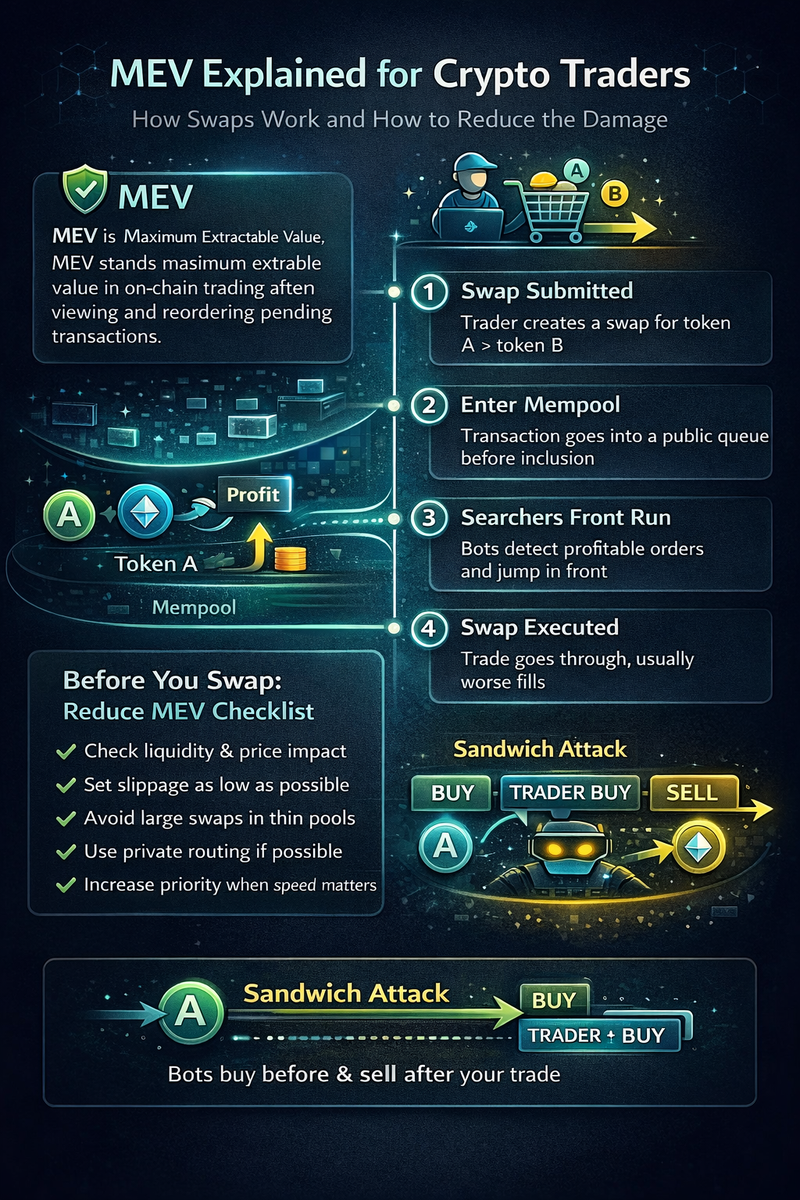
Understanding the lifecycle of a crypto swap reveals the precise points where MEV can be extracted:
- Transaction Creation. Your wallet generates a transaction, specifying details like token pair, amount, desired slippage tolerance, and a transaction deadline. This is your intent.
- Broadcasting to the Network. The transaction is then broadcasted to the blockchain network, entering the public mempool. At this stage, it becomes visible to all nodes and, crucially, to MEV bots.
- Detection by Searchers. Sophisticated bots, often referred to as 'searchers,' continuously monitor the mempool. They identify pending transactions that present profitable opportunities, such as large swaps that are likely to significantly impact token prices or transactions with high slippage tolerance.
- Block Assembly by Validators. Validators (or miners, in PoW chains) are responsible for assembling transactions from the mempool into new blocks. They have the power to order these transactions within a block. Searchers often bid higher gas fees to incentivize validators to prioritize their MEV-extracting transactions.
- Swap Execution. Your trade executes at the price determined by the liquidity pool. However, due to MEV activity (e.g., front-running or sandwich attacks), the price may have moved unfavorably, leading to worse execution than anticipated.
Primary MEV Attack Vectors for Traders
Traders primarily encounter MEV through specific attack types:
- Sandwich Attacks. This is perhaps the most common and damaging MEV attack. A bot detects your pending buy order. It then executes a small buy order immediately before yours (front-running) to drive up the price. Your larger buy order then executes at this inflated price. Immediately after your transaction, the bot sells its tokens (back-running), profiting from the price increase it engineered. You are 'sandwiched' between two bot trades, suffering from worse execution.
- Backrunning. In this scenario, a bot observes your transaction, which is likely to cause a significant price movement (e.g., a large buy or sell). The bot then executes a profitable trade immediately after yours, capitalizing on the price change your transaction created. While not directly front-running you, it still extracts value that could have been yours.
- Front-running. A bot sees your pending transaction and executes a similar transaction with a higher gas fee, ensuring its transaction is processed before yours. This is often used for arbitrage opportunities or to buy up tokens before your larger order pushes the price up.
- Transaction Priority Games. This isn't an attack per se, but a mechanism that enables MEV. Traders or bots pay higher gas fees (bribes to validators) to ensure their transactions are included or ordered favorably within a block. This can push your transaction further down the queue, making it more vulnerable to other MEV attacks or simply delaying its execution until market conditions are less favorable.
Why New Tokens and Low Liquidity Pairs are MEV Hotbeds
MEV risks are significantly amplified in specific market conditions, primarily involving new tokens and low liquidity pairs:
- High Volatility: New tokens, especially during launch or hype cycles, experience extreme price swings. These volatile conditions create larger price discrepancies for bots to exploit.
- Low Liquidity: Thinly traded pairs mean that even relatively small orders can cause significant price impact. This makes them prime targets for sandwich attacks, as bots can easily manipulate prices with minimal capital.
- Predictable Environments: New token launches often follow predictable patterns (e.g., specific DEX listings, initial liquidity additions). Bots are programmed to detect these events and deploy MEV strategies instantly.
- Large Orders with High Slippage: Traders often set high slippage tolerance for new, volatile tokens to ensure their trades go through. This generosity is a direct invitation for MEV bots to extract maximum value within that tolerance.
Comprehensive Strategies to Reduce MEV Risks
While eliminating MEV entirely is challenging due to the fundamental design of public blockchains, traders can significantly mitigate its impact by adopting a multi-faceted approach:
- Utilize Private Transaction Relays (MEV-Resistant RPCs). This is arguably the most effective strategy. Instead of broadcasting your transaction directly to the public mempool, private transaction relays (like Flashbots Protect, Eden Network, or similar services on other chains) send your transaction directly to a validator. This bypasses the public mempool, making your transaction invisible to searcher bots and preventing front-running and sandwich attacks.
- Set Conservative Slippage Settings. Always set your slippage tolerance as low as realistically possible. While higher slippage ensures your trade executes, it also gives MEV bots a larger window to profit from. For stable assets, 0.1-0.3% is often achievable. For volatile assets, aim for 0.5-1% and only increase if necessary.
- Break Large Orders Into Smaller Parts. Large swaps, especially in low-liquidity pools, create significant price impact and are highly attractive to MEV bots. Splitting a large order into several smaller, sequential trades reduces the individual price impact of each trade, making them less appealing targets.
- Avoid Trading During High-MEV Events. Times of extreme market activity, such as token launches, major news announcements, or large liquidations, are prime moments for MEV exploits. If possible, defer non-urgent trades during these periods or use private transaction options.
- Monitor Price Impact and Liquidity. Before executing a trade, always assess the estimated price impact. High price impact indicates low liquidity and higher MEV risk. Tools like DEXTools provide real-time liquidity and price impact metrics, helping you make informed decisions.
- Adjust Transaction Priority (Gas Fees) Strategically. While paying higher gas can make you a target, sometimes a slightly higher gas fee (but not excessively high) can ensure your transaction is included in the next block without being significantly delayed and exposed to MEV for too long. However, avoid 'maxing out' gas, as this can be interpreted as an invitation for sandwich attacks.
- Use Limit Orders Where Available. On platforms that support them, limit orders can protect against MEV by ensuring your trade only executes at or better than a specified price. While they might not fill immediately, they prevent unfavorable execution.
- Leverage Decentralized Exchanges (DEXs) with MEV Protection. Some DEXs or aggregators are integrating MEV protection features directly into their protocols, such as batching transactions or using specialized order flow auctions. Research and prioritize using these platforms.
The Role of DEXTools in Identifying MEV Risk
DEXTools empowers traders with critical data to identify and navigate MEV risks. By providing real-time market data, liquidity pool information, and price impact estimations, DEXTools helps users make more informed decisions:
- Liquidity Pool Monitoring: Easily view the depth and size of liquidity pools. Low liquidity is a direct indicator of higher MEV risk.
- Price Impact Estimation: Before executing a trade, DEXTools often displays the estimated price impact. A high percentage indicates that your trade will significantly move the market, making it an attractive target for MEV bots.
- Volume and Volatility Tracking: High trading volume combined with extreme volatility, especially for newer tokens, signals a high-MEV environment. DEXTools' charts and metrics help identify these conditions.
- Transaction History Analysis: While DEXTools doesn't directly show MEV attacks, observing rapid, unexplained price movements around your executed trades can sometimes indicate MEV activity.
MEV Mitigation Checklist for Traders
The Evolution of MEV and Future Trends
MEV is not static; it's an arms race between searchers, validators, and protocol developers. Future trends include:
- Proposer-Builder Separation (PBS): Ethereum's PBS aims to decentralize block building, making it harder for a single entity to control transaction ordering and extract MEV.
- Encrypted Mempools: Research into encrypted mempools or commit-reveal schemes could hide transaction details until they are confirmed, significantly reducing front-running opportunities.
- Specialized MEV-Resistant DEXs: More DEXs are likely to integrate native MEV protection mechanisms, offering traders safer execution environments.
- Cross-Chain MEV: As interoperability grows, MEV opportunities across different blockchains are emerging, adding a new layer of complexity.
Conclusion: Empowering Traders Against MEV
MEV is an inherent characteristic of transparent, public blockchains, and it significantly impacts crypto trading outcomes. By understanding how MEV operates, recognizing its common attack vectors, and implementing robust mitigation strategies, traders can significantly reduce their exposure to these hidden costs. Leveraging tools like DEXTools for real-time market insights and prioritizing MEV-resistant trading practices are essential steps towards more profitable and secure DeFi trading in 2026 and beyond.
Frequently Asked Questions
What is MEV in crypto trading?
MEV (Maximum Extractable Value) is the profit extracted by block producers and searchers by reordering, including, or excluding transactions in a blockchain block, often at the expense of regular traders.
How do sandwich attacks work?
A sandwich attack involves a bot executing a buy order before your transaction to drive up the price, letting your trade execute at the inflated price, and then selling immediately after your transaction to profit from the price difference.
What is the mempool and why is it relevant to MEV?
The mempool is a public queue of unconfirmed transactions. It's relevant because MEV bots monitor this pool to identify and exploit profitable opportunities before transactions are included in a block.
How can I reduce MEV risks when trading new tokens?
To reduce MEV risks with new tokens, use private transaction relays, set very low slippage, break large orders into smaller parts, and avoid trading during peak launch hype when bots are most active.
Are private transactions truly MEV-proof?
Private transactions significantly reduce MEV risks by bypassing the public mempool and sending your transaction directly to a validator, making it invisible to most searcher bots. However, no method is 100% foolproof against all forms of MEV.
Why is high slippage tolerance risky for MEV?
High slippage tolerance gives MEV bots a larger price range within which they can manipulate the market and execute their trades, maximizing their profit at your expense.
Does MEV only affect Ethereum?
No, MEV affects any public blockchain with a transparent mempool and programmable smart contracts, including EVM-compatible chains and others like Solana, Avalanche, and Binance Smart Chain.
What are some tools or services for MEV protection?
Tools like Flashbots Protect (for Ethereum), Eden Network, and various MEV-resistant RPC endpoints or DEX aggregators with built-in protection are designed to help mitigate MEV risks.
How does DEXTools help with MEV risks?
DEXTools provides real-time data on liquidity, price impact, volume, and volatility, which are crucial indicators for identifying high-MEV risk environments and making informed trading decisions.