Crypto Geopolitics: Libertarian Dream to Drone Power
— By Whatsertrade in Analysis

Digital currency has evolved from a libertarian dream to a key player in global geopolitics, impacting sanctions, conflict, and power dynamics.
For years, cryptocurrency was marketed as a tool of financial freedom. It was supposed to reduce dependence on banks, weaken centralized control, and give individuals more power over their money. That vision helped define the early identity of Bitcoin and the wider crypto movement. But in 2026, the story looks far more complicated. Cryptocurrency is no longer just a symbol of decentralization. It is also becoming part of the machinery of geopolitics, sanctions pressure, and modern conflict.
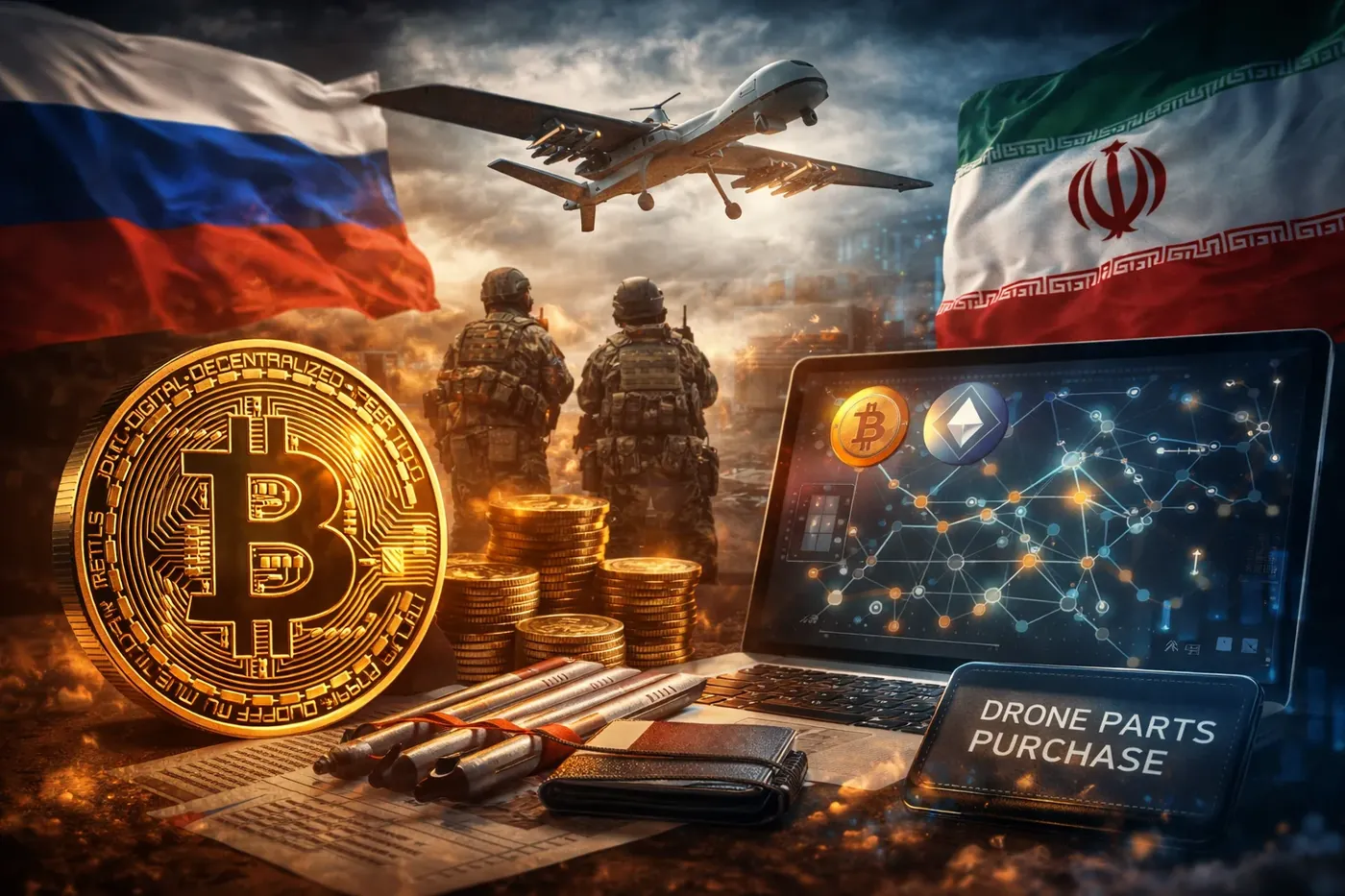
That shift is now impossible to ignore. New reporting and blockchain analysis show that networks linked to Russia and Iran are increasingly using cryptocurrency to help finance the purchase of low-cost drones and related components. Since the full-scale invasion of Ukraine in 2022, pro-Russia groups have raised more than $8.3 million in crypto donations, with drones among the specifically listed items acquired through those funds. Simultaneously, investigators traced an Iranian wallet linked to actors tied to the Islamic Revolutionary Guard Corps to purchases of drone parts from a supplier based in Hong Kong.
This does not mean crypto has replaced traditional finance in war procurement. It has not. Most military and dual-use purchases still move through conventional channels. However, the growing use of blockchain-based money shows how digital assets are becoming a practical layer in conflict-era finance. Cryptocurrency is not the whole system. It is the flexible edge of the system, useful where sanctions, secrecy, speed, and cross-border transactions matter most.
A Strategic Tool in the Modern Era
The original crypto narrative was built on distrust of institutions. After the global financial crisis, Bitcoin gained attention as a monetary alternative beyond the reach of states and central banks. That promise attracted libertarians, technologists, investors, and people living under restrictive financial systems. The idea was simple: open networks would empower ordinary users.
But open networks do not choose their users. The same qualities that made crypto attractive to dissidents and entrepreneurs also made it attractive to sanctioned actors, illicit networks, and procurement intermediaries. Borderless settlement, fast transfers, and pseudonymous wallets can serve innovation, but they can also support evasion. In that sense, digital currencies have matured into something less ideological and more realistic. It is infrastructure. And infrastructure can be used by almost anyone.
Drones and Digital Asset Dynamics
Economic Shifts in Warfare
The rise of cheap drones has changed the economics of warfare. Modern conflicts no longer depend only on expensive advanced weapons. Commercially available drones and accessible components now play a major role in surveillance, targeting, and attack operations. Because these items are relatively cheap and widely available, they are easier to source through diffuse supply chains and harder to police completely.
That is where cryptocurrency becomes useful. A blockchain payment does not magically hide a purchase, but it can make it easier to move funds across borders, assemble payments through intermediaries, and operate around the friction of traditional banking controls. Chain analysis in the new report linked crypto transfers in the $2,200 to $3,500 range to known price points for drone-related products sold on e-commerce platforms. Those amounts matter because they suggest investigators are not just seeing vague fundraising. They are seeing transactions that match real procurement behavior.
Russia and Iran's Crypto Utilization
Russia and Iran are not identical cases, but both show how crypto fits into broader sanctions-constrained ecosystems. In the Russia-linked case, pro-Russia volunteer and paramilitary groups have used crypto donations to fund war-related purchases since 2022. In the Iran-linked case, the report points to wallets with direct and indirect flows from Nobitex, IRGC-linked wallets, and a sanctioned Iranian facilitator into transactions associated with drone parts procurement.
This matters because it shows crypto is not only being used by isolated extremists or rogue individuals. It is appearing within more structured procurement environments where state-aligned actors, informal networks, exchanges, and third-country suppliers can all intersect. That is a major change from the older image of crypto crime being mainly about ransomware, darknet markets, or retail scams. Today, digital currencies are increasingly entangled with national strategy, military supply chains, and sanctions workarounds.
Transparent Yet Obscure
There is an irony at the center of this story. Cryptocurrency is often described as a hidden financial system, yet public blockchains can also make certain forms of illicit activity more visible. The same technology that helps sanctioned actors move value can also help investigators trace flows, map counterparties, and identify procurement patterns that would otherwise stay obscure. Reuters noted that while the crypto volume involved remains small relative to total military spending, blockchain analysis can still clarify intent and reveal networks that are difficult to track through traditional channels alone.
That does not make crypto safe or harmless. It does mean the technology is not simply a black box. In practice, it is both a risk and an investigative opportunity. This dual reality is what makes crypto geopolitics such a difficult subject for regulators and security agencies. Ban too little, and sensitive procurement channels keep adapting. Ban too broadly, and legitimate users, exchanges, and developers face growing friction.
Implications for the Crypto Industry
For the crypto industry, this is not just a political issue. It is a credibility issue. Every time digital currencies appear in stories about drones, sanctions evasion, or military procurement, the market faces renewed pressure from regulators, banks, and policymakers. The industry may still argue that crypto is a neutral tool, and at a technical level that is true. But neutrality does not shield the sector from consequences when the technology becomes associated with conflict finance.
This is especially important as the industry tries to win broader institutional acceptance. Spot products, regulated trading venues, tokenized finance, and stablecoin payment rails all depend on trust. That trust weakens when geopolitical risk becomes part of the everyday digital currency narrative. Investors are no longer only asking whether crypto can scale. They are also asking whether the industry can manage compliance, sanctions exposure, and national security scrutiny.
Beyond the Libertarian Ideal
The deeper truth is that cryptocurrency has entered its post-innocence era. It is no longer credible to describe digital assets only as a grassroots rebellion against financial control. Crypto now operates in a world of states, wars, export controls, intelligence agencies, and contested supply chains. It can still expand access and support innovation, but it can also serve harder purposes. The same wallet architecture that supports peer-to-peer payments can support dual-use procurement. The same cross-border rails that help users bypass broken banking systems can help sanctioned actors move funds where they are not supposed to go.
That is why the story of cryptocurrency and geopolitics matters so much in 2026. The question is no longer whether digital currencies are part of global power competition. They already are. The real question is how governments, markets, and the crypto industry respond now that the libertarian dream has collided with the realities of modern warfare.
Frequently Asked Questions
Q: How is cryptocurrency used in geopolitics?
A: Cryptocurrency offers a decentralized method for transactions, potentially bypassing traditional financial systems and sanctions. This can impact state power dynamics and international relations.
Q: Can crypto finance drone operations?
A: Yes, cryptocurrency can be used to finance drone operations, particularly by non-state actors or groups seeking to obscure financial trails. Its pseudonymous nature can make tracing funds challenging.
Q: What are the implications of crypto drone financing for international law?
A: The use of crypto for drone financing raises complex questions regarding accountability, jurisdiction, and the enforcement of international humanitarian law. Existing frameworks may struggle to adapt.
Q: How do governments monitor crypto transactions for illicit activity?
A: Governments employ various techniques, including blockchain analysis, data forensics, and intelligence gathering, to monitor crypto transactions. However, the decentralized nature of crypto presents inherent challenges.
Q: What is the libertarian perspective on crypto geopolitics?
A: Libertarians often view cryptocurrency as a tool for individual freedom and a way to limit government control over finance. They may advocate for its use to circumvent state power and promote self-sovereignty.