Beyond the Chart: Decode Holder Distribution Risks
— By Whatsertrade in News

Token holder concentration risk is the vulnerability of a crypto asset due to a small number of wallets controlling a large portion of its supply.
Token holder concentration risk refers to the inherent vulnerability of a cryptocurrency or digital asset when a disproportionately large percentage of its total supply is held by a small number of individual wallets or entities. This concentration creates a single point of failure and significantly increases the asset's susceptibility to price manipulation, sudden sell-offs, and general market instability, making it a critical factor for any investor to assess beyond mere price action.
Beyond the Chart: Decoding Holder Distribution Risks
In the fast-paced world of cryptocurrency, price action often captures the lion's share of attention. A token starts trending, volume rises, and the chart appears inviting. For many traders, that's reason enough to invest. Yet, price action alone only highlights surface activity, not the underlying structural integrity supporting it. This is where holder distribution becomes crucial. To truly gauge a token's risk profile, smart investors look past superficial charts to understand who holds the supply, how ownership is spread, and if major wallets are interconnected. These indicators can signal inherent instability and potential vulnerabilities long before any chart decline becomes evident. Even with robust price action, a token is inherently risky if its supply is heavily concentrated in a few wallets. Conversely, quiet price behavior can sometimes mask a much healthier, more distributed ownership structure. Holder distribution is an invaluable on-chain tool for precision risk assessment in the modern crypto landscape.
Why Holder Distribution Holds More Weight Than Price
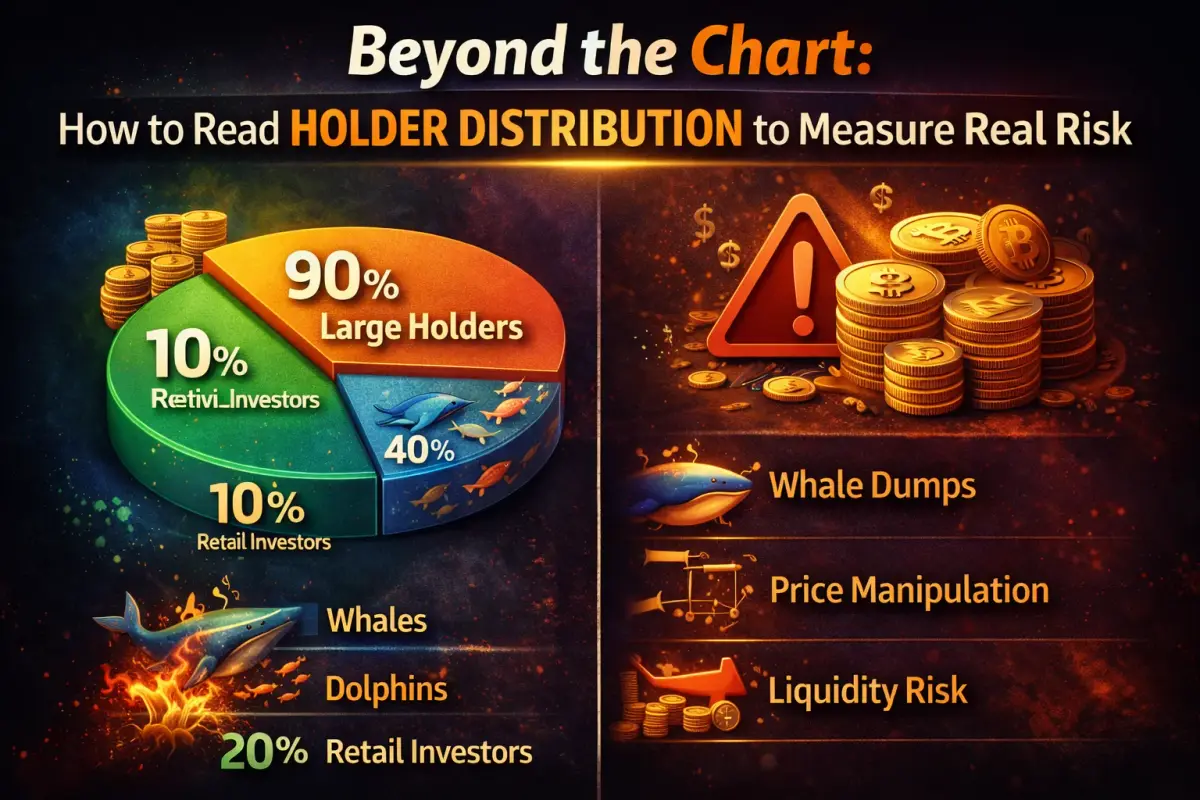
Traders often focus on price because it's immediately visible, emotionally engaging, and seemingly actionable. However, price movements alone do not reveal the underlying power dynamics or potential for manipulation within a token's ecosystem. Holder distribution is critical for assessing a token's stability, especially under pressure. Broad ownership generally indicates a firmer, more resilient market base, as no single entity or small group can easily dictate price. In contrast, concentrated ownership allows a few large wallets (often termed 'whales') to significantly sway price and sentiment, posing substantial exit risks for smaller investors. This dynamic is particularly critical for newer tokens, where initial enthusiasm and hype may inadvertently cloak foundational fragility. A project might appear vibrant and promising, yet if its top holders own an excessive percentage of the supply, vulnerability remains despite a strong-looking chart. Ultimately, chart signals momentum and past performance, but holder distribution signals control and future potential for stability or volatility.
The Top 10 Holders: Unveiling Market Structure
The first and often most telling step in assessing concentration risk is to examine the supply share of the top 10 holders. This metric directly highlights the degree of token centralization. If the top few wallets collectively hold a large percentage of the total supply (e.g., over 50-70%), the market's fragility increases exponentially. Even if these major holders are not actively selling at the moment, their potential exits or even minor rebalancing acts can cast a long shadow of uncertainty over other traders and significantly impact price. A healthier, more mature market typically shows a more balanced and progressively distributed ownership over time. While the top few wallets may still hold significant amounts, especially in early-stage projects, none should dominate to an extent that threatens market integrity. Lower concentration among the top wallets generally suggests a stronger, more decentralized, and thus more resilient market structure.
New vs. Old Wallets: Gauging Demand Type and Growth
Another key signal in holder distribution analysis is the balance between new and old wallets. This metric reveals whether fresh participants are actively joining the ecosystem or if the token's activity is predominantly driven by early holders and insiders. A healthy, growing token attracts a consistent influx of new wallets, suggesting successful project reach expansion, increasing interest, and broader adoption. New entrants naturally help to distribute ownership, lessening reliance on early buyers and reducing concentration risk over time. Older wallets also play a crucial role. If long-term holders remain active and engaged without dominating the market or preventing new growth, it's generally a positive sign. It indicates sustained trust, continuity, and belief in the project's long-term vision. However, problems arise when old wallets hold an excessively large portion of the supply and new wallet growth is stagnant or minimal. This often signals insufficient market expansion, maintaining or even exacerbating concentration risk. A truly strong token ecosystem balances both dynamics: older wallets remain engaged and supportive while a steady stream of new participants arrives, leading to a more organically distributed ownership structure as the market matures.
Buy Dispersion: Differentiating True Demand
Buying pressure is not uniform, and its composition significantly impacts a token's underlying health. A token's price may rise due to widespread, organic accumulation across many participants, or it could be driven by concentrated purchases from a few large wallets. Although the resulting chart patterns might appear similar, the inherent risks differ drastically. Thus, buy dispersion is a vital metric, showing whether demand is genuinely widespread or focused on a limited number of actors. Healthy buy dispersion suggests accumulation by a diverse range of participants, including small, medium, and larger buyers, all contributing to organic price discovery and stability. Conversely, if a price pump is primarily driven by a handful of large buy orders, it points to artificial demand that can quickly reverse, leaving smaller investors vulnerable. Monitoring buy dispersion helps differentiate sustainable growth from speculative, whale-driven pumps.
Sell Dispersion: Identifying Exit Risks
Just as important as buy dispersion is sell dispersion. This metric provides insight into the nature of selling pressure. If selling is concentrated among a few large wallets, it signals potential dump risks. A single whale offloading a significant portion of their holdings can trigger a cascading price decline, especially in tokens with low liquidity. Conversely, if selling is dispersed among many smaller holders, it often represents natural profit-taking or minor rebalancing, which is less likely to cause a catastrophic price collapse. Analyzing sell dispersion helps identify tokens where a few major holders could exert undue influence on price through large-scale liquidations, providing an early warning system for potential market downturns.
Wallet Interconnectivity and Cluster Analysis
Beyond individual wallet holdings, understanding wallet interconnectivity is crucial. Sophisticated on-chain analysis tools can identify clusters of wallets that might be controlled by the same entity or group, even if they appear as separate addresses. This 'cluster analysis' can reveal hidden concentration risk. For example, a project might appear to have a decent distribution if you only look at individual top wallets, but if those top 10 wallets are actually controlled by just two or three entities, the true concentration is much higher. Identifying such interconnectedness helps uncover attempts to mask true ownership and provides a more accurate picture of centralization. This is a more advanced technique but increasingly vital for detecting sophisticated manipulation tactics.
Liquidity Pool Holdings and Exchange Wallets
When analyzing holder distribution, it's essential to account for liquidity pool (LP) holdings and centralized exchange (CEX) wallets. These are often among the largest holders but represent a different type of ownership. LP tokens are locked to provide liquidity for trading pairs, and while they technically represent a large holding, they are distributed across many liquidity providers. Similarly, CEX wallets hold tokens on behalf of thousands or millions of users. These are not 'single entity' concentrations in the traditional sense. However, it's still important to understand their proportion. An extremely high percentage of tokens held in a single CEX wallet might indicate a lack of decentralization or potential for a single point of failure if that exchange were compromised. The key is to distinguish between operational holdings (LPs, CEX, project treasuries) and speculative, individual whale holdings.
Practical Steps to Assess Token Holder Concentration Risk
Assessing token holder concentration risk requires a systematic approach using on-chain data. Here's a step-by-step guide:
- Identify the Token Contract Address. This is the fundamental starting point for all on-chain analysis. Ensure you have the correct, verified contract address.
- Access Holder Distribution Data. Utilize platforms like DEXTools or other blockchain explorers (e.g., Etherscan, BSCScan, PolygonScan) to view the token's holder list.
- Analyze Top 10/20 Holders' Percentage. Calculate the cumulative percentage of the total supply held by the top 10, 20, or even 50 wallets. A high percentage (e.g., >50%) indicates significant concentration.
- Categorize Large Wallets. Attempt to identify the nature of these large wallets. Are they known project treasuries, liquidity pools, exchange wallets, or seemingly individual speculative wallets? This often requires cross-referencing with project documentation or community knowledge.
- Monitor Wallet Activity. Track the transaction history of the largest non-protocol wallets. Look for patterns of significant buys or sells, especially sudden large movements that could signal an impending dump or accumulation.
- Assess New vs. Old Wallet Growth. Examine the trend of new wallet addresses interacting with the token over time. A healthy project should show a consistent increase in new participants.
- Evaluate Buy and Sell Dispersion. Look at recent large transactions. Are buys and sells spread across many addresses or dominated by a few? High dispersion is healthier.
- Check for Interconnected Wallets (Advanced). Use cluster analysis tools if available to identify if multiple top wallets are linked to the same entity.
- Consider Market Cap and Liquidity. Concentration risk is amplified in low market cap, low liquidity tokens. A whale's impact is far greater in a smaller pool.
- Regularly Re-evaluate. Holder distribution is dynamic. What's healthy today might change tomorrow. Make this a continuous part of your due diligence.
Warning Signs of High Concentration Risk
Several indicators should immediately raise red flags when analyzing token holder concentration:
- Top 10 Holders Own >70% of Supply: This is an extremely high concentration, making the token highly susceptible to manipulation.
- Single Wallet Owns >20-30% of Supply: A single dominant whale can dictate market movements.
- Lack of Transparency on Large Wallets: If the project team is evasive about the nature of large holdings (e.g., not clarifying if they are LPs, treasuries, or private investors).
- Sudden, Large Influx of Tokens to an Exchange Wallet from a Top Holder: Often a precursor to a large sell-off.
- Stagnant or Declining New Wallet Growth: Indicates a lack of organic adoption and reliance on existing holders.
- Consistent Large Buys/Sells by the Same Few Wallets: Suggests artificial price movements rather than organic market dynamics.
How DEXTools Helps in Decoding Holder Distribution
DEXTools is an invaluable platform for traders seeking to go beyond simple price charts and delve into the critical on-chain data that reveals a token's true health. Within DEXTools, users can quickly access detailed holder information for most tokens. This includes a clear breakdown of the top holders, their respective percentage of the total supply, and often links directly to their wallet addresses on the relevant blockchain explorer. This functionality allows traders to:
- Visualize Concentration: Instantly see the distribution of supply among the largest holders.
- Track Wallet Activity: Click through to individual wallets to monitor their transaction history, identifying large buys, sells, or transfers.
- Identify New vs. Old Holders: While not a direct metric, observing the number of unique holders over time can provide insights into adoption trends.
- Assess Liquidity Pool Health: DEXTools provides comprehensive LP data, allowing users to see if large portions of liquidity are being withdrawn, which can be linked to top holder activity.
By integrating these on-chain insights, DEXTools empowers traders to make more informed decisions, mitigating the risks associated with highly concentrated token supplies and fostering a deeper understanding of market dynamics.
Conclusion: The Imperative of On-Chain Due Diligence
In the evolving crypto landscape of 2026 and beyond, relying solely on price charts for investment decisions is increasingly naive and perilous. Token holder concentration risk is a fundamental vulnerability that can undermine even the most promising projects. By diligently examining holder distribution, differentiating between various wallet types, and understanding the dispersion of buying and selling pressure, investors can gain a far more accurate and nuanced understanding of a token's true risk profile. This on-chain due diligence is not just a best practice; it's an imperative for navigating the complexities of decentralized markets and protecting capital from the inherent instability of concentrated ownership. Prioritizing projects with healthy, decentralized distributions is a cornerstone of sustainable and responsible crypto investing.
Frequently Asked Questions
What is token holder concentration risk?
Token holder concentration risk is the vulnerability of a cryptocurrency when a small number of wallets control a large percentage of its total supply, making it susceptible to manipulation and sudden price drops.
Why is holder distribution more important than price charts?
Price charts show past momentum, but holder distribution reveals underlying power dynamics, control, and potential for manipulation. Concentrated ownership can lead to instability even with strong price action.
What percentage of supply held by top wallets indicates high risk?
Generally, if the top 10 wallets collectively hold over 50-70% of the total supply, it indicates a high level of concentration risk. A single wallet holding over 20-30% is also a major red flag.
How do I differentiate between legitimate large holders and risky ones?
Legitimate large holders often include liquidity pools, project treasuries, staking contracts, or centralized exchange wallets. Risky ones are typically individual speculative wallets that can dump large amounts of tokens.
What is buy and sell dispersion?
Buy dispersion assesses if buying pressure is widespread among many participants or concentrated in a few. Sell dispersion indicates if selling pressure is spread out or dominated by a few large wallets, signaling potential dump risks.
What are 'new vs. old wallets' and why do they matter?
'New vs. old wallets' refers to the balance of fresh participants joining the token's ecosystem versus activity driven by early holders. A healthy token attracts new wallets, distributing ownership and indicating growth.
Can DEXTools help analyze holder concentration?
Yes, DEXTools provides direct access to detailed holder information, including the top holders' percentages and links to their wallet activities, enabling users to assess concentration risk effectively.
What are the main consequences of high token concentration?
Main consequences include increased risk of price manipulation, sudden large sell-offs (dumps), reduced market stability, and a higher potential for rug pulls, making the token highly volatile and unpredictable.
Is it always bad for a few wallets to hold a lot of tokens?
Not always. Project treasuries, liquidity pools, or exchange wallets holding a large supply are often necessary for operations. The risk arises when a few individual, speculative entities hold a disproportionate amount, giving them undue control.