Tokenized ETFs Make Wallets New Financial Interfaces
— By Whatsertrade in Analysis
Tokenized ETFs on blockchain leverage crypto wallets for continuous access, merging traditional finance with digital innovation.
The stock market closes. Crypto wallets do not.
That is why Franklin Templeton’s new move with Ondo matters so much. Franklin Templeton is partnering with Ondo Finance to offer tokenized versions of its ETFs that can trade around the clock through crypto wallets, bypassing the brokerage accounts and fixed market hours that have defined fund investing for decades. The offering covers five ETFs across US equities, fixed income, and gold.
This is bigger than a product launch. It is a signal that tokenized real world assets are moving out of the insider niche and into a format that feels native to crypto users. Instead of asking investors to come back into traditional brokerage rails, this model brings familiar Wall Street products directly into on-chain distribution.
Why Tokenized ETFs Matter Right Now
For years, real world assets were treated like a promising but still limited corner of crypto. The concept made sense, but most tokenized products still felt far from mainstream adoption. This announcement changes the tone because it combines a major asset manager with a crypto-native tokenization platform and a user experience built around wallets, not brokerage accounts.
That is exactly why this is such a strong narrative for the current market. Crypto is no longer only trying to create new assets from scratch. It is increasingly trying to repackage traditional assets in a way that fits the speed, accessibility, and always-on nature of blockchain rails. Franklin Templeton and Ondo are effectively betting that the future of fund distribution will look more like wallet infrastructure and less like the legacy brokerage model.
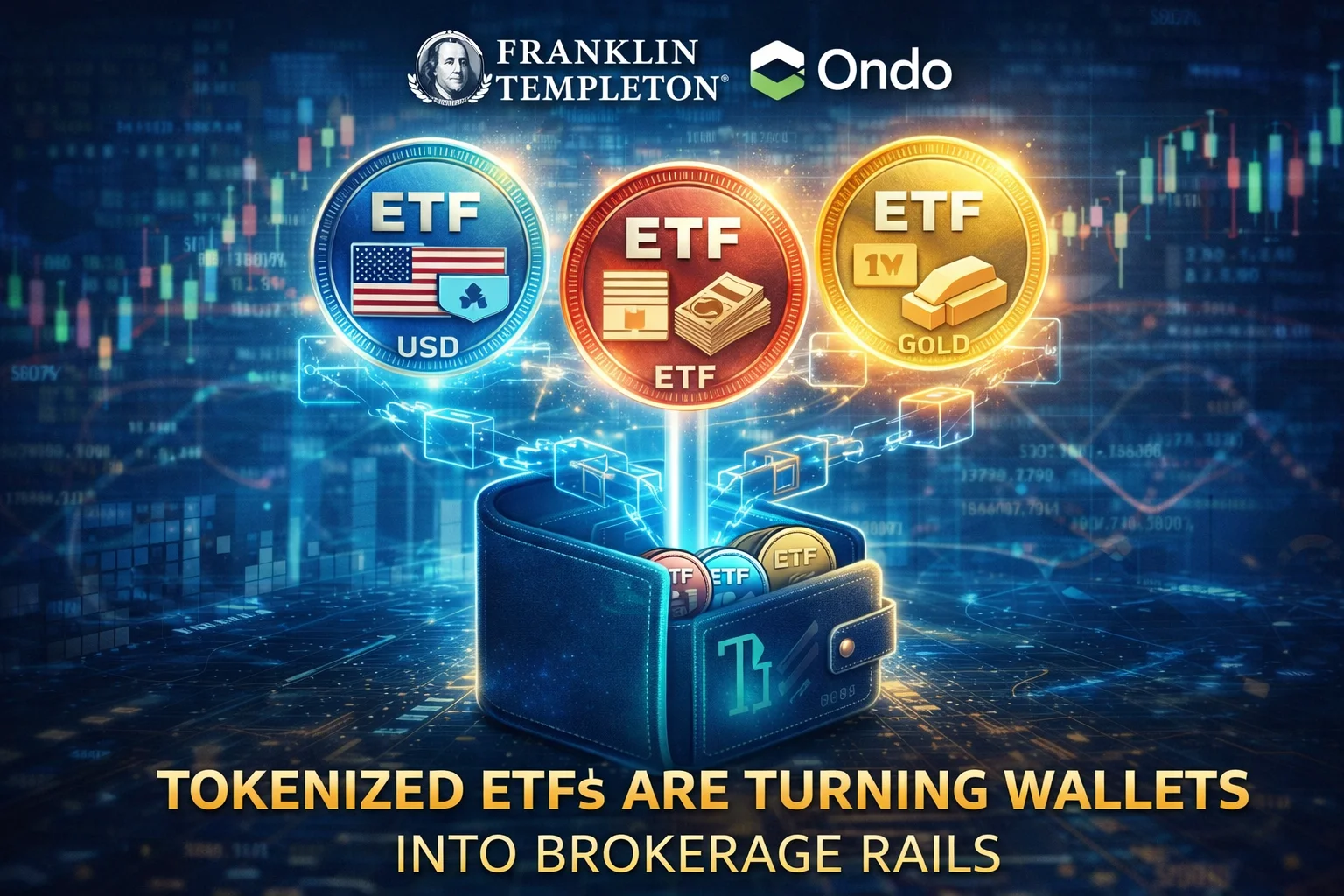
Wallets Are Becoming Financial Interfaces
The most important idea in this story is not just tokenization. It is distribution.
When ETFs become accessible through crypto wallets, the wallet starts to look less like a place to hold tokens and more like a new financial interface. That is a major shift. A wallet is no longer just for stablecoins, memecoins, or DeFi positions. It becomes a gateway to traditional financial products that can be held, transferred, and potentially integrated into on-chain strategies.
That is where the “brokerage rails” angle becomes powerful. Traditional brokerages have controlled access to public market products through accounts, market hours, and familiar institutional infrastructure. Tokenized ETFs challenge that model by letting blockchain wallets become the access point. The wrapper changes, the rails change, and eventually the user behavior may change too.
The 24/7 Trading Narrative Is a Big Deal
One of the clearest advantages in this structure is 24/7 access. Franklin Templeton’s tokenized ETF model with Ondo is being pitched around continuous wallet-based access rather than the usual rhythm of public market hours. That instantly makes the product feel more aligned with how crypto users already think.
This matters because crypto users are accustomed to markets that never close. Once investors experience capital moving all day, every day, traditional time limits start to feel outdated. Tokenized ETFs bring that expectation into a category that was previously locked behind old infrastructure. Even if the underlying exposure is traditional, the user experience becomes much more crypto-native.
That is a huge narrative shift. It says the future of investing may not be about forcing blockchain users to adapt to legacy systems. It may be about forcing legacy products to adapt to blockchain behavior.
Franklin Templeton Gives the Theme Institutional Weight
The size and reputation of Franklin Templeton make this more than just another tokenization headline. Bloomberg reported that the rollout is initially aimed at Europe, Asia-Pacific, the Middle East, and Latin America, while US availability depends on further regulatory clarity around how third parties can distribute registered funds on-chain.
That detail matters because it shows this is not a random experiment. It is a structured attempt to open new global distribution channels for traditional investment products while working within the boundaries of current regulation. The message is clear: tokenized ETFs are not just a crypto side project. They are becoming part of how large financial firms think about future market access.
Why Ondo Fits This Narrative
Ondo has spent months building its identity around tokenized finance, so this partnership strengthens a story the market already understands. According to Ondo’s announcement, this launch places five Franklin Templeton ETFs on-chain for the first time, reinforcing Ondo’s push to expand beyond tokenized Treasuries into a broader tokenized securities ecosystem.
That is why the partnership feels natural. Franklin Templeton brings institutional product credibility. Ondo brings the on-chain wrapper, wallet-native distribution, and crypto market framing. Together, they make the RWA theme easier for both traditional and crypto audiences to understand.
Tokenized ETFs Could Reshape Investor Behavior
The long-term significance of this trend is not just technological. It is behavioral.
If wallets become the place where users access ETFs, bonds, gold exposure, and other traditional products, then the lines between brokerage, bank account, and crypto wallet begin to blur. Investors may start to expect the same things from every asset class: instant access, 24/7 availability, self-custody options, and interoperability with digital finance tools.
That is when tokenization stops being a niche product category and starts becoming market infrastructure.
This is also why tokenized ETFs matter beyond RWAs as a buzzword. They push the conversation from “can traditional assets come on-chain?” to “what happens when on-chain access becomes a better distribution model than the old one?”
Final Take
Franklin Templeton and Ondo are not just launching tokenized ETFs. They are helping redefine how investment products may be accessed in the future.
The real headline is not only that five ETFs are coming on-chain. It is that crypto wallets are increasingly being positioned as the new rails for mainstream financial access. That changes the role of the wallet, expands the reach of tokenized real world assets, and gives the RWA sector a much stronger narrative than it had before.
Tokenized ETFs are turning wallets into brokerage rails. If that idea keeps gaining traction, this may end up being one of the most important shifts in the next phase of on-chain finance.
FAQ
What are tokenized ETFs?
Tokenized ETFs are blockchain-based representations of ETF exposure, designed to give investors access through digital wallet infrastructure rather than only through traditional brokerage accounts.
Why is the Franklin Templeton and Ondo launch important?
Because it brings five Franklin Templeton ETFs on-chain and makes them available through crypto wallets with a 24/7 trading model.
What assets do the tokenized ETFs cover?
The products span US equities, fixed income, and gold.
Where will the products launch first?
The initial rollout is aimed at Europe, Asia-Pacific, the Middle East, and Latin America. US availability depends on further regulatory clarity.
Why is this relevant to crypto?
Because it shows how wallets are evolving from simple token storage tools into full access points for traditional financial products, which strengthens the long-term case for on-chain real world assets.