RWA vs. AI Tokens: Which is the Real Narrative of 2026?

Examine the shifting narratives surrounding RWA and AI tokens within the crypto market, as both sectors continue to mature quickly and increasingly converge in novel and unexpected ways.
RWA vs. AI Tokens
- As we cross the threshold of late March 2026, the cryptocurrency market has matured into a sophisticated landscape where the speculative fever of previous years has been replaced by two dominant, competing industrial narratives. On one side, we have Real World Assets (RWA), the institutional bridge connecting traditional finance to the blockchain. On the other, we have Artificial Intelligence (AI) tokens, the fuel for a new era of autonomous, agentic commerce.
- While Bitcoin remains the undisputed store of value, the real battle for the soul of the 2026 market is being fought between these two sectors. Each offers a different vision of the future: one focused on the stability of tokenized physical value, and the other on the exponential growth of decentralized intelligence.
The Rise of the RWA Gold Standard
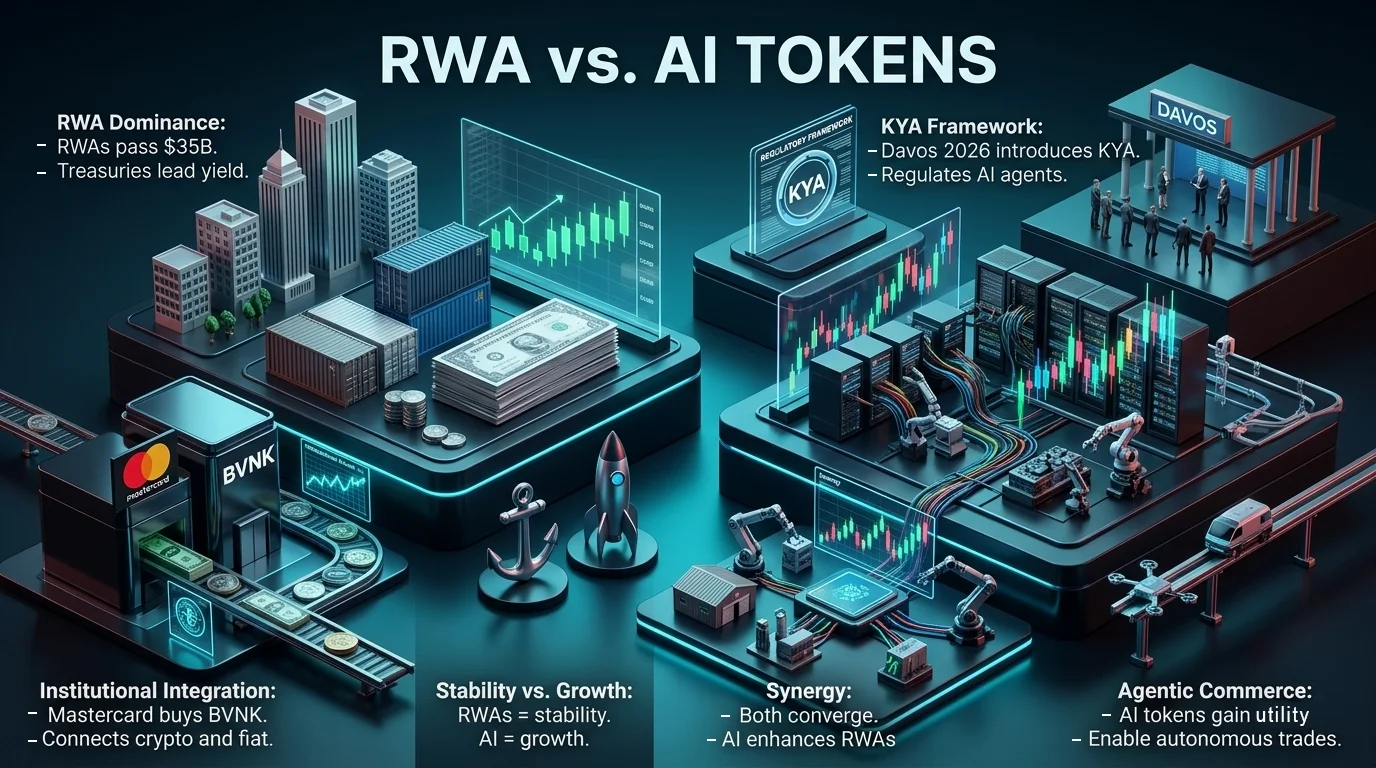
- Real World Assets have officially moved from the experimental phase of 2024 to the production phase of 2026. As of this month, the total value of tokenized assets on-chain has surpassed 35 billion dollars, a staggering increase driven largely by institutional demand for yield and transparency. The largest segment of this market is no longer just pilot projects, but tokenized U.S. Treasuries, which currently account for nearly 10 billion dollars in on-chain value.
- The primary appeal of RWA in 2026 is the democratization of high quality yield. In a world of fluctuating interest rates, the ability to hold a tokenized bond that provides real time yield settlement has become the "New Gold Standard" for both retail and institutional portfolios. We are seeing major financial entities like BlackRock and Franklin Templeton lead the charge. For example, the BlackRock BUIDL fund has alone reached over 1.7 billion dollars in assets, proving that Wall Street is no longer just watching from the sidelines. They are actively building the liquidity rails for the next decade.
AI Tokens: From Hype to Autonomous Utility
- While RWA provides the defensive, yield-bearing foundation of the 2026 market, AI tokens represent the offensive, high growth frontier. The narrative surrounding AI has shifted dramatically over the last two years. In 2024, AI tokens were often criticized for being "vaporware" or projects that simply added "AI" to their name to capture hype. Today, in 2026, these tokens serve a critical infrastructure role in the decentralized compute economy.
- The explosion of large language models and autonomous agents has created an insatiable demand for GPU power. Projects like Theta Network and its EdgeCloud initiative have become essential by providing a decentralized marketplace for compute resources. This allows academic institutions and enterprises to tap into global GPU networks without being locked into the pricing of centralized cloud giants. AI tokens are no longer just speculative assets; they are the "gas" required to run the decentralized brain of the internet.
The Davos 2026 Shift: KYA vs. KYC
- One of the most significant developments this year came out of the World Economic Forum in Davos. For the first time, global leaders moved beyond the traditional "Know Your Customer" (KYC) frameworks to discuss a new concept: "Know Your Agent" (KYA). As autonomous AI agents begin to hold their own crypto wallets and execute financial transactions without human intervention, the need for a regulatory framework to govern these "non-human" entities has become urgent.
- This shift highlights the core difference between the two narratives. RWA is built on the perfection of KYC, ensuring that every tokenized asset is tied to a verified legal identity and a physical asset like a treasury bond or a piece of real estate. AI tokens, however, are pushing the boundaries of KYA. They are enabling a world where a software agent can rent compute power, sell data, and manage a portfolio autonomously. This "Agentic Commerce" is where the most radical innovation is happening in 2026.
Stability vs. Autonomy: The Strategic Choice
- For the modern investor, the choice between RWA and AI tokens is essentially a choice between stability and autonomy. RWA protocols like Ondo Finance or Centrifuge offer a bridge to the real economy, providing assets that are backed by physical collateral and regulated by traditional frameworks. These are the "safe havens" of the digital world, attracting capital from pension funds and corporate treasuries that require 24/7 liquidity and low volatility.
- In contrast, the AI sector is characterized by high volatility but massive scalability. The economy of autonomous agents is projected to be worth hundreds of billions in the coming decade. Examples of this are already visible in decentralized finance (DeFi), where AI agents now perform over 30 percent of all cross-chain arbitrage and liquidity provisioning. These agents do not sleep, and they do not require human salaries. They only require the tokens that power their networks.
The Institutional Bridge: The Mastercard-BVNK Signal
- Perhaps the strongest signal of the market's direction came on March 17, 2026, when Mastercard announced its 1.8 billion dollar acquisition of BVNK. This deal was not just a headline; it was a formal integration of stablecoin infrastructure into one of the world's largest payment networks. By acquiring BVNK, Mastercard has positioned itself as the central "interoperability bridge" between traditional fiat systems and the new tokenized economy.
- This acquisition validates both the RWA and AI narratives. For RWA, it means that tokenized assets can now be liquidated into fiat for everyday purchases more easily than ever before. For AI tokens, it provides the rails for autonomous agents to interact with the global retail economy. When an AI agent can pay for its own server time using a stablecoin rail managed by Mastercard, the circle of autonomous commerce is complete.
The Verdict: RWA vs. AI Tokens.Two Sides of the Same Coin
- As we look at the remainder of 2026, it is clear that the discussion of RWA vs. AI Tokens is evolving beyond a simple comparison. These two sectors are not mutually exclusive; in fact, they are increasingly synergistic. We are seeing the emergence of "Intelligent RWA," where AI models are used to provide real-time valuations and risk assessments for tokenized physical assets. AI can predict liquidity shortages in a private credit pool before they happen, and it can optimize the distribution of tokenized dividends to millions of fractional owners.
- While the market sentiment index remains cautious at 20/100, the underlying infrastructure is stronger than it has ever been. RWA has brought the money, and AI has brought the machinery. Together, they are redefining what it means to be an "asset" in the digital age. Whether you value the security of a tokenized bond or the potential of an autonomous agent, the narrative of 2026 is one of total institutional and technological integration.
Disclaimer: This article is for informational purposes only and does not constitute investment advice, financial advice, trading advice, or any other kind of advice. DEXTools does not recommend buying, selling, or holding any cryptocurrency or token. Users should conduct their own research and consult with a qualified financial advisor before making any investment decisions. Cryptocurrency investments are volatile and high-risk. DEXTools is not responsible for any losses incurred.
Related Guides
- What Is Tokenization? How Real World Assets Become Onchain Claims (2026)
- What Are Real World Assets (RWA) in Crypto? Asset Types, Yield and Risks (2026)
- Top 5 Real World Asset (RWA) Tokens in 2026: Tokenized Finance Goes Mainstream
- RWA Tokenization: A Beginner’s Guide to Real-World Assets
- RWA Liquidity Quality: Why Tokenized Assets Can Be Real but Still Hard to Trade
Frequently Asked Questions
What are Real World Assets (RWA) in cryptocurrency?
Real World Assets (RWA) are tokenized physical assets that bridge traditional finance with blockchain technology, providing stability and yield in the cryptocurrency market.
How have AI tokens evolved by 2026?
By 2026, AI tokens have transitioned from speculative assets to essential components of decentralized computing, serving as the necessary fuel for autonomous agents and large language models.
What is the significance of the 'Know Your Agent' (KYA) concept?
The 'Know Your Agent' (KYA) concept emerged to address the regulatory needs of autonomous AI agents that can execute financial transactions independently, marking a shift from traditional 'Know Your Customer' (KYC) frameworks.
What role do institutions play in the RWA market?
Institutions like BlackRock and Franklin Templeton are actively participating in the RWA market, driving demand for tokenized assets and contributing to the liquidity needed for the next decade.
What is the main appeal of RWA in 2026?
The main appeal of RWA in 2026 is the democratization of high-quality yield, allowing both retail and institutional investors to benefit from real-time yield settlements in a fluctuating interest rate environment.