A $2 Million Ethereum Swap Came Out as $14,500. The On-Chain Reason Is a $40,000 Pool
— By Tony Rabbit in News

About $2M of ETH became $14,500 in a single Ethereum swap on July 7, a 99% loss to price impact and a same-block backrun. We checked the pool it hit on-chain, it holds roughly $40,000. Here is the math, and how to never let it happen to you.
One of the most painful trades of the year just happened on Ethereum, and there is a lesson in it for anyone who swaps tokens. On July 7, 2026, according to on-chain trackers GoPlus Security and Lookonchain, a trader swapped roughly 1,126 ETH, about $2 million, in a single transaction and walked away with only around $14,500 of tokens, a loss of about 99.3%. No contract was hacked and no one stole a private key. The order simply routed through a pool that was far too small to handle it, and a same-block backrun did the rest. We checked that pool on-chain, and its size explains everything.
The on-chain reason: a $2M order into a $40,000 pool
The trade routed through an AVAIL/WETH pool on Uniswap v3. We pulled that pool directly, and it holds only about $40,000 of total liquidity. That single number is the whole story. A roughly $2 million order is about fifty times larger than the entire pool it was trying to trade against. On an automated market maker, price is set by the ratio of tokens in the pool, so an order that dwarfs the pool pushes the price to an extreme almost instantly. By the time the swap finished, the trader had effectively bought a handful of tokens at an absurd price and left the rest of their $2 million behind in the pool. This is not a bug, it is exactly how the math is supposed to work when you send a whale-sized order into a minnow-sized market.
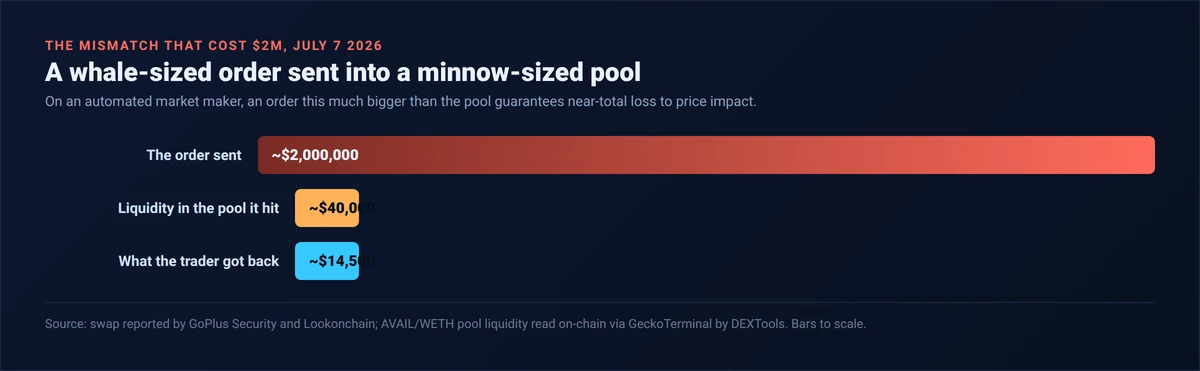
The safeguard that exists for precisely this situation is slippage tolerance, the maximum price move you will accept before a trade cancels. A sane slippage limit would have reverted this swap instead of filling it at a 99% loss. Either it was set far too high, or the routing sent the order somewhere the trader never inspected.
Where the value went: a same-block backrun
The trader's loss did not vanish, it moved. In the very same block, a searcher spotted the pool now wildly mispriced by the giant order and immediately traded against it to push the price back, pocketing the difference. This is a backrun, a form of maximal extractable value, or MEV. Reports attribute roughly $1.8 million of the extracted value to the block builder Titan Builder, which packaged the transactions. To the trader it feels like theft; on-chain it is a legal, automated arbitrage of a price they themselves created. The result is the same either way: about $1.8 million transferred from a careless order to whoever was fastest to exploit it.
How $2M became $14,500 in one block
How $2M became $14,500 in one block
How to never let a swap do this to you
The uncomfortable truth is that this was entirely avoidable, and the defenses are simple. First, always set a slippage limit, and keep it tight; a large order with a 1 to 2% cap would have cancelled rather than filled at a catastrophic price. Second, check the liquidity of the pool you are about to trade before you sign; a $2 million order belongs in a deep, multi-million-dollar pool, never a $40,000 one. Third, use a reputable DEX aggregator that simulates price impact and splits a large order across venues instead of dumping it into one thin pool. Our Token Safety Checker surfaces a token's liquidity so you can spot a thin market before you trade, our guide to slippage settings shows how to size the limit, and our MEV protection guide explains how backruns and sandwiches work. A $2 million lesson is expensive; reading the price impact warning is free.
- the AVAIL/WETH pool at the center of the reports holds only about $40,000 of liquidity
- a roughly $2M order is about 50 times the entire pool, so extreme price impact is unavoidable
- the loss was price impact plus a same-block backrun, not a smart-contract hack
- always set a slippage limit; a low cap would have reverted this trade instead of filling it
- check a pool's liquidity before you swap, a $2M order needs deep liquidity, not a $40k pool
- use a reputable aggregator that splits large orders and simulates price impact first
Methodology and disclaimer: the swap itself (about 1,126 ETH in, about $14,500 out, roughly 99.3% loss, and the estimated $1.8M same-block extraction attributed to Titan Builder) is as reported by GoPlus Security, Lookonchain and outlets including Cointelegraph and crypto.news for July 7, 2026; we did not decode the individual victim transaction and do not state its hash. We independently verified on-chain via GeckoTerminal that the AVAIL/WETH Uniswap v3 pool referenced holds about $40,000 of liquidity, which is the basis for the price-impact analysis here. Figures are approximate and change continuously. The trader and the searcher are referenced without identity. This article is for information only and is not financial advice.