The GENIUS Act Outlaws Stablecoin Yield on July 18. On-Chain, We Counted $1.57 Billion Already Legally Routing Around It
— By Tony Rabbit in News

On July 18, one year after it was signed, the GENIUS Act's ban on paying stablecoin holders any interest or yield takes force. The catch is a definition. We summed the contracts on-chain: Ethena's USDe supply is $3.94 billion, and $1.57 billion of it already sits in sUSDe collecting yield, entirely legally. Here is the loophole, measured.
On July 18, 2026, one year after it was signed, the core rules of the GENIUS Act come due. The provision the industry is watching most is short and blunt: stablecoin issuers may not pay holders interest or yield. It is meant to turn the US-regulated stablecoin into a plain, fully reserved digital dollar and nothing more. The problem is that the biggest yield-paying dollar in crypto has already been engineered to sit just outside the definition, and we can measure exactly how much value is doing so. We read the chain.
What the July 18 ban actually says
The GENIUS Act became law on July 18, 2025, and its rules must be finalized within one year, which is what makes this week a hard deadline. Section 4(a)(11) states that a permitted payment stablecoin issuer may not pay the holder of its stablecoin "any form of interest or yield." The finalization work runs through the primary federal payment stablecoin regulators and the Treasury, including FinCEN and OFAC, alongside state regulators. The intent is clean: a compliant US stablecoin should be a reserved dollar you hold to transact, not an instrument that pays you to park money in it.
The definition that swallows the rule
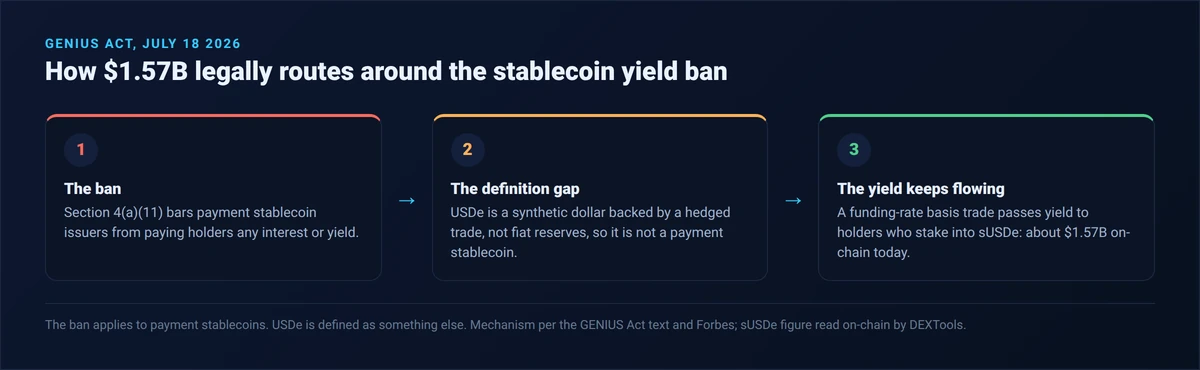
Here is the catch, and it is entirely about wording. The ban applies to a "payment stablecoin." Ethena's USDe is not built like USDC or USDT. It is a delta-neutral synthetic dollar: its peg is held by a hedged derivatives position rather than a pile of fiat reserves. Because of that structure, as Forbes has detailed, USDe does not meet the statutory definition of a payment stablecoin, so the interest ban simply does not reach it. The yield does not come from an issuer paying interest on reserves. It comes from a funding-rate basis trade, and a token passes that return through to anyone who stakes USDe into its yield-bearing wrapper, sUSDe.
What we counted on-chain
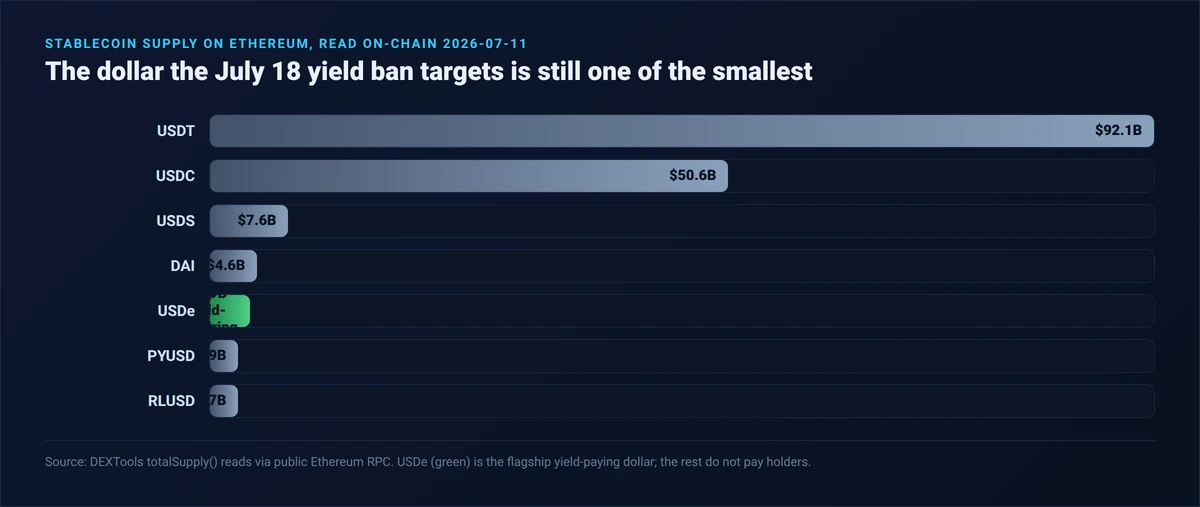
Numbers make the loophole concrete, so we summed the contracts directly. Across Ethereum, the major dollar stablecoins we read total about $161 billion on that chain alone, led by USDT at roughly $92.1 billion and USDC at $50.6 billion, and DefiLlama puts the entire cross-chain stablecoin market at about $311 billion. Against that backdrop, USDe's total supply is $3.94 billion. The piece that matters for July 18 is smaller and sharper: $1.57 billion of that USDe is currently staked inside sUSDe, actively collecting yield. That is the exact behavior the ban was written to stop, running at over a billion and a half dollars, and on July 18 it will still be perfectly legal.
- Section 4(a)(11): a permitted payment stablecoin issuer cannot pay holders any form of interest or yield
- rules must be finalized by July 18, 2026, one year after the Act was signed
- the aim is a clean, boring dollar token: fully reserved, no return for simply holding it
- USDe is a delta-neutral synthetic dollar backed by a hedged trade, not fiat reserves
- so it does not meet the statutory definition of a payment stablecoin, and the ban does not reach it
- the yield comes from a funding-rate basis trade and is passed through to those who stake into sUSDe
Small slice, big signal
It would be easy to over-dramatize this, so we will not. Yield-bearing synthetic dollars are still a small share of a $311 billion market dominated by plain USDT and USDC. But the direction of travel is the story. A law designed to remove the incentive to hold a dollar token for return arrives with its single largest target already restructured to be immune to it, and growing. If the compliant, yield-free stablecoins cannot pay you and the synthetic dollars legally can, capital that wants a return has an obvious place to flow. The rule does not fail on July 18; it just discovers the shape of the thing built to go around it.
How to watch this yourself
Every figure here is public and reproducible. Stablecoin supply is a single totalSupply call on each contract, and the yield-bearing slice is the assets held inside the sUSDe vault. You do not need a subscription or a press release to see which dollar is paying yield and how big it is getting. As the rules finalize and issuers respond, the on-chain numbers will move first, and they are the ones worth tracking. You can start by reading any token's live on-chain data with our token safety checker.
Method and disclosures: supply figures were read by DEXTools from each token's contract via a public Ethereum RPC on 2026-07-11 (totalSupply for each stablecoin; totalAssets for the sUSDe vault), with the aggregate market size taken from DefiLlama. The description of Section 4(a)(11) and of USDe's classification is attributed to the GENIUS Act text and reporting by Forbes. This article is informational, is not legal or investment advice, and on-chain values move continuously and were accurate at the time of writing.