How to Calculate Position Size in Crypto Trading
— By Tony Rabbit in Tutorials
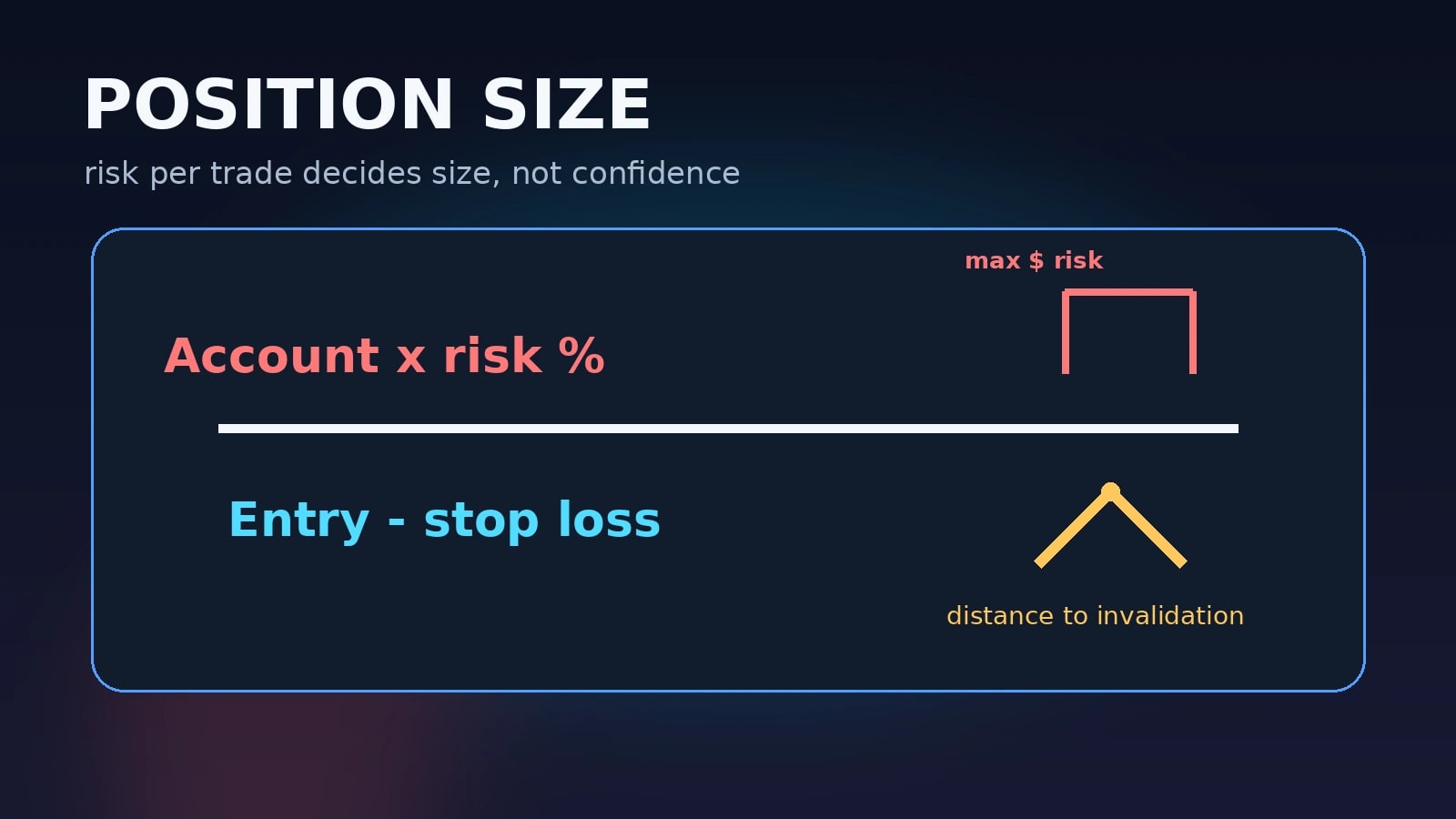
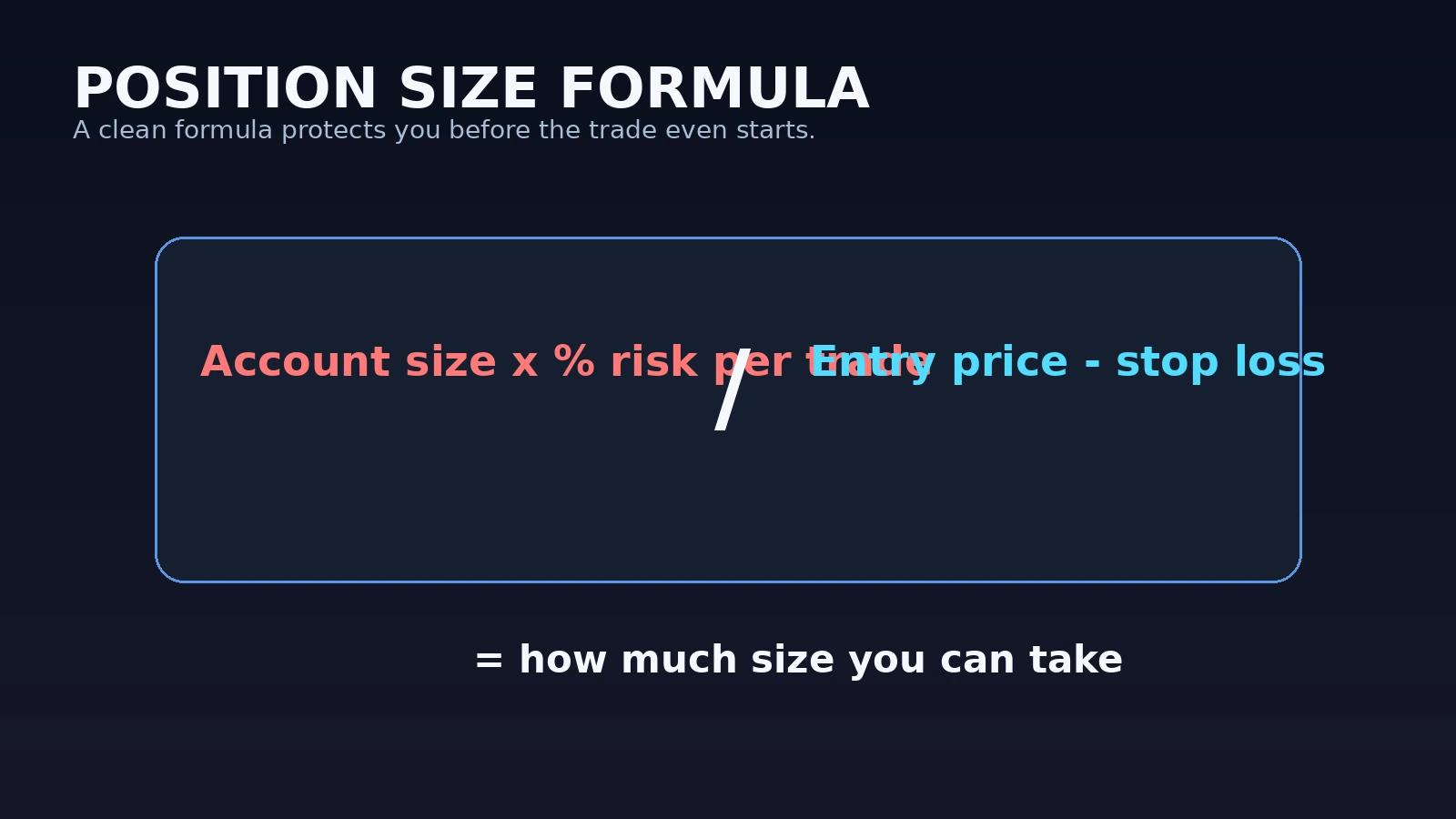
Calculate crypto position size using: Account Size x Risk Per Trade / (Entry Price - Stop Loss). This controls risk before trading.
Calculating position size in crypto trading is crucial for managing risk and protecting your capital. The core formula is: (Account Size x Risk Per Trade Percentage) / (Entry Price - Stop Loss Price). This method ensures that no single trade, even if it results in a full stop-loss hit, jeopardizes more than a predefined, small percentage of your total trading capital, making risk control systematic rather than emotional.
What Position Size Truly Means in Crypto
Position sizing is the amount of capital you allocate to a single trade. It is not just about how many units of a crypto asset you buy, but how that quantity aligns with your overall risk tolerance and account size. In the highly volatile crypto market, position sizing is arguably the most critical component of a robust trading strategy. It acts as a shield, preventing any single adverse market movement from causing catastrophic damage to your portfolio. Without proper sizing, even a series of winning trades can be wiped out by one oversized loss. It is the bridge between your trading idea and your financial survival.
The Core Formula for Crypto Position Size: A Deep Dive
The foundational formula for calculating position size in crypto is straightforward yet powerful. It prioritizes risk control above all else:
Position Size = (Account Size x Risk Per Trade Percentage) / (Entry Price - Stop Loss Price)
- Account Size: This is your total trading capital. It is crucial to use the actual capital available for trading, not just your total net worth.
- Risk Per Trade Percentage: This is the maximum percentage of your account you are willing to lose on any single trade. Common percentages range from 0.5% to 2%, rarely exceeding 5% for highly aggressive strategies.
- Entry Price: The price at which you plan to enter the trade.
- Stop Loss Price: The price at which you will exit the trade to limit losses. This must be a technically valid stop, placed at a level where your trade idea is invalidated, not an arbitrary number.
Let us break down an example: If your account is $10,000, you risk 1% per trade ($100), your entry for ETH is $3,000, and your stop loss is $2,950 (a $50 difference), then your position size would be $100 / $50 = 2 units of ETH. This means you would buy 2 ETH, knowing your maximum loss is $100 if the stop is hit.
Why Crypto Traders Mis-size Trades: Common Pitfalls
Many traders, especially in crypto, fall into common traps that lead to improper position sizing:
- Emotional Sizing (Conviction Bias): Believing a setup is a 'sure thing' and therefore sizing up. The market does not care about your conviction; it only cares about price action.
- Random Stop Placement: Setting a stop loss based on a desired position size rather than technical analysis. A stop must be logical and invalidate the trade idea.
- Ignoring Volatility: Underestimating crypto's extreme price swings. A stop that works for traditional assets might be too tight for crypto, leading to premature exits and higher effective risk.
- Chasing Returns: Overleveraging to amplify gains, forgetting that leverage also amplifies losses.
- Lack of a Trading Plan: Without a predefined risk percentage and stop-loss strategy, sizing becomes arbitrary and reactive.
How to Calculate Position Size in Crypto: A Step-by-Step Guide
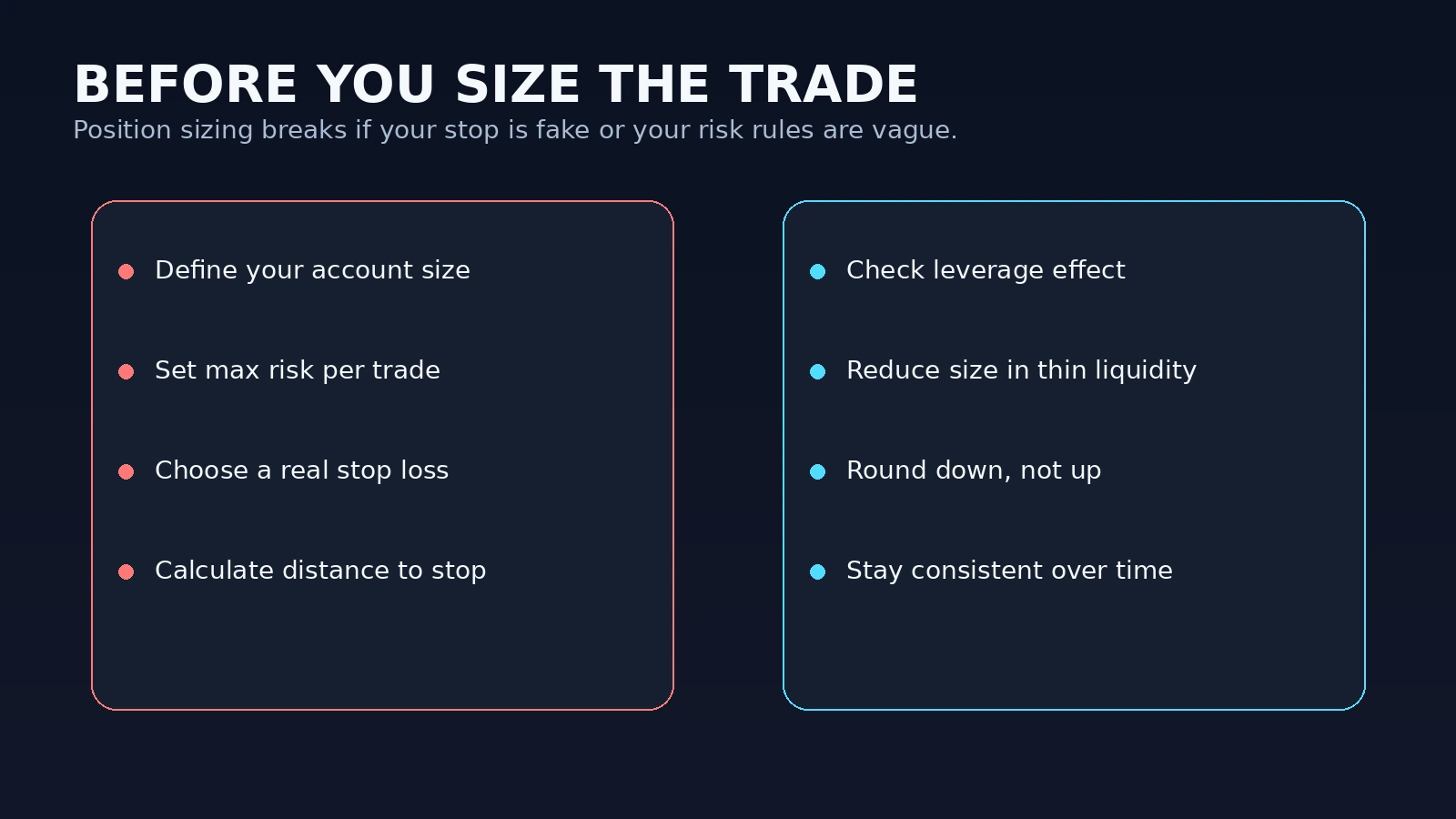
- Determine Your Total Trading Capital (Account Size): This is the starting point. Be honest about the funds you are willing to risk in the market. Example: $10,000.
- Define Your Risk Per Trade Percentage: Decide what percentage of your account you are willing to lose on any single trade. For most, 0.5% to 2% is a sensible range. Example: 1%.
- Calculate Your Maximum Dollar Risk Per Trade: Multiply your Account Size by your Risk Per Trade Percentage. Example: $10,000 x 0.01 = $100.
- Identify Your Entry Price: Based on your analysis, determine the optimal price to enter the trade. Example: ETH at $3,000.
- Establish a Technically Valid Stop Loss Price: This is critical. Your stop loss should be placed at a level where your trade hypothesis is invalidated. Use technical indicators, support/resistance, or volatility metrics to define this. Example: ETH at $2,950.
- Calculate the Risk Per Unit (Distance to Stop): Subtract your Stop Loss Price from your Entry Price (for a long trade) or vice versa (for a short trade). Example: $3,000 - $2,950 = $50.
- Calculate Your Position Size (Number of Units): Divide your Maximum Dollar Risk Per Trade by the Risk Per Unit. Example: $100 / $50 = 2 ETH.
- Verify and Adjust (Optional): Consider market liquidity, volatility, and your conviction. If liquidity is thin or volatility is extreme, you might choose to size down further than the formula suggests.
Choosing Your Risk Per Trade Percentage: Consistency Over Heroics
There is no universal 'perfect' risk percentage, but the goal is consistency and longevity. For most crypto traders, a risk of 0.5% to 2% per trade is recommended. Higher percentages, like 3-5%, should only be considered by highly experienced traders with robust strategies and significant capital. The key benefit of a small, fixed percentage is that it allows you to survive losing streaks without significant capital drawdowns, giving your edge time to play out. A 1% risk means you would need 100 consecutive losing trades to blow up your account, which is highly improbable. A 10% risk means just 10 consecutive losses, a much more realistic scenario during volatile market conditions.
When to Size Down Even More: Beyond the Formula
The position sizing formula provides a baseline, but smart traders know when to be more conservative:
- Thin Liquidity: If the asset has low trading volume, large orders can cause significant slippage, making it hard to enter or exit at desired prices. Size down to avoid this.
- Extreme Volatility: During periods of high market uncertainty (e.g., major news events, flash crashes), even technically sound stops can be hit due to wild swings. Reducing size mitigates this risk.
- High Impact News Events: Leading up to or during major economic announcements, regulatory news, or project-specific updates, price action can be unpredictable.
- Unfamiliar Assets: When trading a new or less-researched altcoin, it is prudent to start with a smaller size until you understand its typical price behavior.
- Account Drawdown: If you are in a losing streak or your account equity has significantly decreased, it is wise to reduce your risk percentage to preserve capital and regain confidence.
Leverage and Position Sizing: A Double-Edged Sword
Leverage allows traders to control a larger position with a smaller amount of capital. While it can amplify profits, it equally amplifies losses. When using leverage, your position size calculation remains the same, but the 'Account Size' in the formula should strictly refer to your margin balance or the capital you are willing to risk in that specific leveraged account. If you use 10x leverage, a 1% price move against you effectively becomes a 10% loss on your margin. This dramatically reduces the 'distance to stop' in terms of percentage of your margin, making proper position sizing even more critical to avoid rapid liquidation.
Position Sizing for Different Crypto Trading Styles
The core principles apply, but nuances exist:
- Day Trading/Scalping: Often involves tighter stops and higher frequency. Risk per trade might be smaller (e.g., 0.5%) due to the sheer number of trades.
- Swing Trading: Wider stops, longer holding periods. Risk per trade might be 1-2%, focusing on capturing larger moves.
- Long-Term Investing: While not 'trading' in the traditional sense, even investors consider allocation. This often involves dollar-cost averaging and setting a total allocation percentage for each asset rather than a per-trade risk.
Position Sizing vs. Emotional Trading: A Psychological Edge
The biggest battle in trading is often with oneself. Emotional trading leads to impulsive decisions, often resulting in oversized positions on 'high conviction' trades or undersized positions on valid setups due to fear. Position sizing removes this emotional element. By pre-determining your risk and size, you create a systematic approach that forces discipline. It allows you to accept losses as a normal part of trading, knowing that no single loss will derail your entire strategy. This psychological edge is invaluable for long-term consistency.
Comparison: Good vs. Bad Position Sizing Habits
How DEXTools Helps with Informed Position Sizing
While DEXTools does not directly calculate your position size, it provides critical data that feeds into your calculation process. Its real-time charts, liquidity metrics, and volume data allow you to:
- Identify Valid Stop Loss Levels: By analyzing historical price action, support/resistance zones, and volatility indicators on DEXTools charts, you can pinpoint more accurate and technically sound stop loss placements.
- Assess Liquidity: DEXTools provides clear indicators of an asset's liquidity and trading volume. This helps you determine if you need to size down due to potential slippage, especially for smaller cap tokens.
- Monitor Volatility: Real-time price feeds and candlestick patterns on DEXTools help you gauge current market volatility, informing whether you should reduce your standard position size.
- Track Account Performance: While external, DEXTools helps you stay informed about the market, which indirectly aids in maintaining a disciplined mindset for your overall trading account, a core input for position sizing.
By using DEXTools for thorough market analysis, you can make more informed decisions about your entry points, stop losses, and overall risk assessment, which are all integral parts of effective position sizing.
Frequently Asked Questions
What is position sizing in crypto?
Position sizing is determining the amount of capital or number of units of a crypto asset to allocate to a single trade, based on your total account size and risk tolerance.
Why is position sizing important in crypto trading?
It is crucial for risk management, protecting your capital from large losses, ensuring long-term sustainability, and preventing emotional trading decisions, especially given crypto's high volatility.
What is the basic formula for calculating position size in crypto?
Position Size = (Account Size x Risk Per Trade Percentage) / (Entry Price - Stop Loss Price).
What is a typical risk per trade percentage for crypto?
Most traders use 0.5% to 2% of their total trading capital per trade, with highly experienced traders sometimes going up to 5%.
How does stop loss affect position size?
A wider stop loss (larger distance between entry and stop) will result in a smaller position size, while a tighter stop loss allows for a larger position size, assuming the same dollar risk.
Should I adjust position size for volatility or liquidity?
Yes, it is advisable to reduce your position size when trading assets with thin liquidity or during periods of extreme market volatility to mitigate slippage and unexpected price swings.
How does leverage impact position sizing?
Leverage amplifies both gains and losses. While the formula remains the same, using leverage means your 'account size' for calculation should strictly be your margin, making precise position sizing even more critical to avoid liquidation.
What are common mistakes in crypto position sizing?
Common mistakes include sizing based on emotional conviction, placing arbitrary stop losses, ignoring market volatility, and overleveraging without proper risk assessment.
How can DEXTools help with position sizing?
DEXTools provides real-time charts, liquidity data, and volume metrics that help traders identify valid stop loss levels, assess market liquidity, and gauge volatility, all of which are crucial inputs for accurate position size calculations.