Maker vs Taker Fees in Crypto Explained (2026)
— By Tony Rabbit in Tutorials
Understand maker vs taker fees in crypto. Learn how exchanges classify orders, why fees differ, and how to optimize your trading strategy for 2026.
In the dynamic world of cryptocurrency trading, understanding maker vs taker fees is paramount for optimizing profitability and executing effective strategies. At its core, this fee structure differentiates between orders that add liquidity to the market (makers) and those that remove it (takers). Exchanges typically incentivize makers with lower fees, or even rebates, because they contribute to a healthier, more robust order book. Takers, conversely, pay higher fees for the immediate execution they demand. However, the true classification of your order often hinges on its behavior at execution, not just the initial order type you choose. This guide will meticulously break down the nuances, helping you navigate these fees like a seasoned pro in 2026.
What Maker and Taker Actually Mean
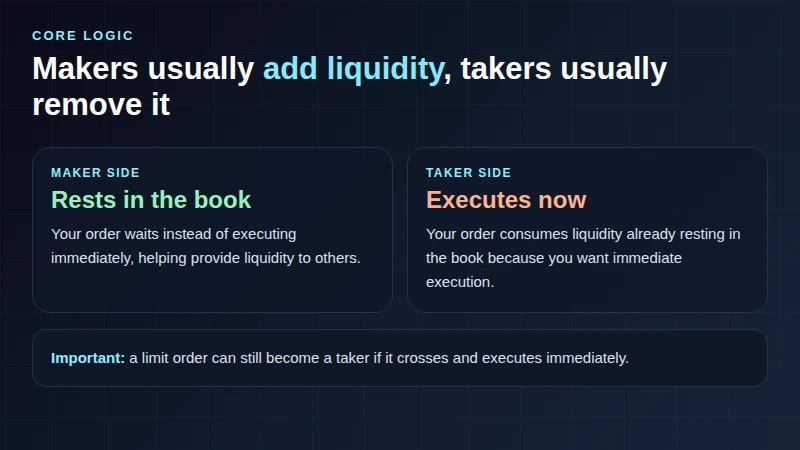
The core distinction between maker and taker fees revolves around market liquidity. Liquidity refers to the ease with which an asset can be bought or sold without significantly impacting its price. Exchanges thrive on deep liquidity, as it attracts more traders and facilitates smoother price discovery.
Maker Side: Adding Liquidity
- Orders that 'make' the market by waiting in the order book.
- These orders are not immediately matched; they rest at a specific price, adding depth to either the bid (buy) or ask (sell) side.
- Examples include limit orders placed below the current best ask or above the current best bid.
- Makers provide the inventory for takers to trade against.
Taker Side: Consuming Liquidity
- Orders that 'take' liquidity by executing immediately against existing orders in the order book.
- These orders demand immediate execution and effectively remove available volume from the market.
- Examples include market orders, or limit orders that 'cross the spread' and fill instantly.
- Takers value speed and certainty of execution over potentially lower fees.
Why Fee Schedules Differ: The Liquidity Incentive
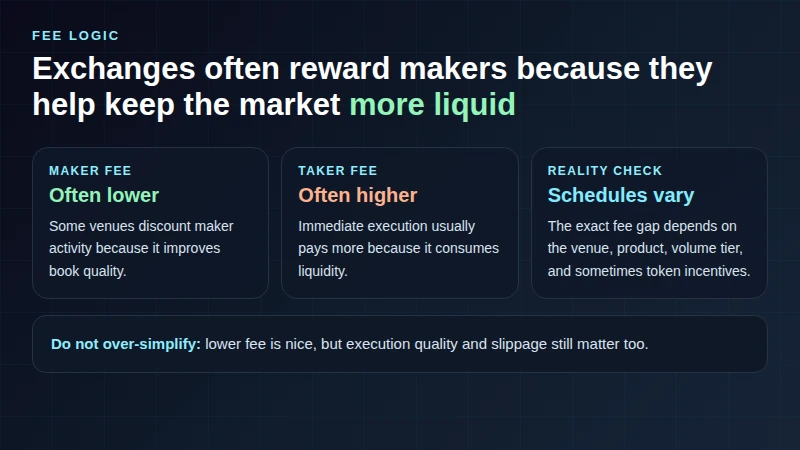
Exchanges are businesses that profit from trading volume. To attract and retain traders, they need robust, liquid markets. This is where the maker/taker fee model becomes a powerful incentive mechanism.
Exchanges want:
- Deep Order Books: More orders at various price levels.
- Tight Spreads: A small difference between the best bid and best ask, indicating efficient pricing.
- Consistent Trading Activity: A continuous flow of orders.
Makers directly contribute to the first two points by placing resting orders, improving market quality. Takers, while essential for facilitating trades, consume this valuable liquidity. Therefore, exchanges structure their fees to reward the behavior they want to encourage.
How Orders Become Maker or Taker: The Execution Rule
This is where many new traders get confused. It's not about the button you click, but the outcome of your order submission.
1. Limit Orders: The Ambiguous Case
- Maker Limit Order: If your limit order is placed at a price that does NOT immediately match with an existing order on the book, it rests and becomes a maker order. For example, a buy limit order below the current best bid, or a sell limit order above the current best ask.
- Taker Limit Order (Immediate-or-Cancel/Fill-or-Kill): If your limit order is placed at a price that crosses the spread and immediately matches with an existing order, it acts as a taker. For example, a buy limit order placed at or above the current best ask, or a sell limit order placed at or below the current best bid.
2. Market Orders: Always Taker
- Market orders are designed for immediate execution at the best available price. They always consume existing liquidity from the order book.
- Therefore, market orders are universally classified as taker orders and incur taker fees.
3. Advanced Order Types
- Stop-Limit Orders: Can be maker or taker depending on how the limit order component executes once triggered.
- Stop-Market Orders: Always taker, as they convert to market orders upon trigger.
- Post-Only Orders: These are specifically designed to ensure maker status. If a post-only order would immediately execute as a taker, it is either cancelled or adjusted to rest in the book, depending on the exchange's rules. This is a crucial tool for traders prioritizing maker fees.
When the Fee Gap Matters Most
The difference between maker and taker fees can significantly impact profitability, especially for certain trading styles and volumes.
- High-Frequency Trading (HFT) and Arbitrage: For strategies involving numerous small trades, even a tiny fee difference per trade can accumulate into substantial savings or costs over time. HFT firms often employ sophisticated algorithms to ensure maker status.
- Scalping: Traders who aim for small profits on rapid price movements will find their margins heavily eroded by taker fees. Prioritizing maker status is often key to their strategy.
- Large Volume Traders: While percentage fees might seem small, on trades involving millions of dollars, the absolute dollar amount of the fee can be considerable. Large traders often negotiate lower fees or use post-only orders to capture maker rebates.
- Market Making Strategies: Traders specifically providing liquidity (e.g., running bot strategies that constantly place bids and asks) are inherently aiming for maker status to benefit from rebates or lower fees.
- Illiquid Markets: In markets with wide spreads and thin order books, placing maker orders can be more challenging to get filled, but the fee savings are often more pronounced compared to taking liquidity at unfavorable prices.
Limits and Nuances of Maker/Taker Fees
While the concept is straightforward, real-world application has several layers:
- Tiered Fee Structures: Most exchanges offer tiered fee schedules. Your maker/taker fees decrease as your 30-day trading volume increases. High-volume traders often pay significantly less, sometimes even receiving maker rebates (negative maker fees).
- Product Specificity: Fees can vary between spot trading, futures, options, and other derivatives on the same exchange. Futures markets, for instance, often have different fee schedules due to their unique liquidity dynamics.
- Exchange Policies: Each exchange has its own specific rules and definitions. Always consult the official fee schedule of your chosen platform.
- Dynamic Fees: Some newer platforms or DEXs might experiment with dynamic fee models that adjust based on real-time market conditions or liquidity pools, though maker/taker remains a foundational concept.
- Hidden Costs: Beyond explicit fees, consider slippage (the difference between your expected price and actual execution price) and opportunity cost (missing a trade entirely due to waiting for a maker fill).
Common Mistakes to Avoid
Chasing maker status blindly can sometimes be counterproductive. Here are common pitfalls:
- Misunderstanding Limit Orders: Assuming all limit orders are maker. If your limit order is aggressive enough to cross the spread and fill immediately, it will be a taker.
- Ignoring Opportunity Cost: Waiting for a maker fill when the market is moving rapidly. The potential profit from a quick taker execution might far outweigh the fee savings.
- Excessive Slippage: In illiquid markets, placing a large market order (taker) can cause significant slippage, pushing your execution price far from the current market price. This 'hidden cost' can dwarf the taker fee.
- Not Using Post-Only: For traders who absolutely want maker status, not utilizing the 'Post-Only' option (if available) on their limit orders is a missed opportunity.
- Overlooking Tiered Fees: Not understanding how your trading volume impacts your fee tier. A higher volume might unlock significantly lower fees, making the maker/taker distinction less impactful or even offering maker rebates.
- Ignoring Withdrawal Fees: Focusing solely on trading fees while neglecting potentially high withdrawal fees, which can eat into profits, especially for smaller trades.
Optimizing Your Trading Strategy for Maker/Taker Fees (2026)
Here's a step-by-step approach to integrate maker/taker fee awareness into your trading:
- Step 1: Understand Your Exchange's Fee Schedule. Every platform is different. Locate the exact maker and taker percentages for your current trading volume tier. Pay attention to any rebates.
- Step 2: Analyze Your Trading Style. Are you a scalper, day trader, swing trader, or long-term investor? Quick, frequent trades benefit most from maker status. Infrequent, large trades might prioritize execution certainty.
- Step 3: Choose the Right Order Type.
- For Maker Status: Use limit orders placed away from the current market price. Utilize 'Post-Only' if available.
- For Taker Status: Use market orders or aggressive limit orders when immediate execution is critical.
- Step 4: Evaluate Liquidity. Before placing a large maker order, check the order book depth. Is there enough volume at your desired price to get filled? In thin markets, maker orders might take a long time or never fill.
- Step 5: Balance Fees with Execution. Always weigh the fee savings against the potential for missed trades, worse prices, or increased slippage. Sometimes, paying the taker fee is the more profitable decision.
- Step 6: Monitor Your Volume. Keep track of your 30-day trading volume. As you move into higher tiers, your fees will decrease, potentially making maker status even more attractive (or providing rebates).
- Step 7: Consider Advanced Strategies. For automated trading, developing algorithms that intelligently place maker orders while managing risk and fill rates can be highly effective.
How DEXTools Helps with Fee Awareness
While DEXTools itself doesn't directly process exchange fees, it plays a critical role in providing the market data necessary for informed fee-conscious trading decisions:
- Real-time Order Book Visualization: DEXTools offers detailed, real-time order book data for many decentralized exchanges. This allows you to visually assess liquidity depth, identify current bids and asks, and determine optimal price points for placing maker orders.
- Liquidity Pool Analysis: For DEXs, DEXTools provides insights into liquidity pool depth and health. Understanding available liquidity is crucial for estimating potential slippage and the likelihood of a maker order getting filled.
- Volume and Price Action: By monitoring live volume and price action, traders can gauge market momentum. This helps in deciding whether to patiently wait for a maker fill or take immediate action with a taker order.
- Identifying Volatility: Highly volatile markets often make securing maker fills challenging. DEXTools' charting tools help identify such conditions, prompting traders to adjust their order strategy accordingly.
The Future of Maker/Taker Fees in Crypto (2026 and Beyond)
As the crypto market matures and evolves, so too will fee structures. We can expect:
- Increased Competition: More exchanges and DEXs will likely lead to even tighter fee margins and more innovative fee models to attract liquidity.
- Sophisticated Rebate Programs: Exchanges may offer more complex maker rebate programs, potentially tied to specific tokens or trading pairs, to incentivize liquidity in niche markets.
- Hybrid Models: Some platforms might explore hybrid fee structures that blend elements of maker/taker with other models, such as gas-fee-based systems on L2s or dynamic fees based on network congestion.
- DeFi Integration: The rise of DeFi and AMMs (Automated Market Makers) introduces different fee dynamics, where 'slippage tolerance' often replaces explicit maker/taker fees. However, professional traders on hybrid DEXs will still need to understand these concepts.
Conclusion
Understanding maker vs taker fees is a fundamental skill for any serious crypto trader in 2026. It's not just about minimizing costs; it's about making informed decisions that align with your trading strategy and market conditions. By recognizing the liquidity incentive, mastering order types, and carefully balancing fee savings with execution quality, you can significantly enhance your trading efficiency and profitability. Always consult your exchange's specific fee schedule and leverage tools like DEXTools to gain a comprehensive view of market liquidity and optimize your order placement.
Frequently Asked Questions
What is the primary difference between maker and taker fees?
Maker fees are charged for orders that add liquidity to the order book (e.g., limit orders that rest), while taker fees are charged for orders that remove liquidity (e.g., market orders or limit orders that fill immediately).
Why do exchanges charge lower maker fees?
Exchanges incentivize makers with lower fees or rebates because makers contribute to a deeper, more liquid order book, which benefits all traders and the exchange itself.
Is a limit order always a maker order?
No. A limit order is only a maker order if it rests in the order book without immediately matching. If a limit order crosses the spread and executes instantly, it is classified as a taker order.
Are market orders always taker orders?
Yes, market orders are always classified as taker orders because they demand immediate execution and consume existing liquidity from the order book.
What is a 'Post-Only' order?
A 'Post-Only' order is a type of limit order that ensures it will only be placed if it will act as a maker. If it would immediately execute as a taker, it is either cancelled or modified to ensure maker status.
How do tiered fee structures affect maker/taker fees?
Most exchanges offer tiered fee structures where your maker and taker fees decrease as your trading volume increases. High-volume traders often pay significantly less and may even receive maker rebates.
When should I prioritize paying taker fees?
You should prioritize paying taker fees when immediate execution is critical, such as during highly volatile periods, when capturing a specific price is essential, or when the opportunity cost of waiting for a maker fill is too high.
Can maker/taker fees impact my overall trading profitability?
Absolutely. For frequent traders, scalpers, or those trading large volumes, even small differences in maker/taker fees can accumulate into significant savings or costs, directly impacting net profitability.
How can DEXTools help me understand maker/taker fees better?
DEXTools provides real-time order book visualization and liquidity pool analysis, allowing you to assess market depth and identify optimal price points for placing maker orders, thus informing your fee-conscious trading decisions.