Pepe Creator Matt Furie Hack Triggers Brief $8M Spike
— By Tony Rabbit in News

Posts claiming Matt Furie was hacked and used to promote a token briefly sent traders scrambling. The bigger story may be what the muted move says about Solana memecoin demand now.
Posts about Pepe creator Matt Furie spread across crypto X on Tuesday after traders claimed his account had been compromised and used to promote a token tied to his name. Social posts that circulated afterward said the token briefly reached roughly $7 million to $8 million in market cap before momentum faded fast. Screenshots also appeared to show Furie distancing himself from the promotion and warning followers to ignore any token posts.
DEXTools has not independently verified every post, wallet action, or the exact intraday peak market cap cited across social media. But even with that caveat, the market reaction became the bigger story. The main debate on crypto X was not simply that a high-profile artist appeared to get hacked. It was whether the muted response proved that memecoin demand is much weaker than it looked during the January frenzy.
Quick take
- Social posts claimed Matt Furie’s X account was hacked and used to push a token tied to his name.
- Traders on X said the token briefly reached around $7 million to $8 million before cooling off.
- The bigger market takeaway was the lack of follow-through, not just the hack itself.
- That argument fits a broader slowdown already visible in Solana revenue, Pump.fun activity, and memecoin market cap data.
What Happened in the Matt Furie Hack Story
The story took off after a widely shared post from trader @capexbt argued that the incident said more about the market than about the hack itself. The post listed a simple thesis: if even the creator of Pepe the Frog could only trigger a brief move into the single-digit millions during a hacked-account token launch, then the memecoin trade may be far less crowded and far less reflexive than it was a few months ago.
Trading memecoins on TON? Not.Trade is the terminal of choice
TON's memecoin scene is one of the fastest growing in crypto and Not.Trade is the fastest terminal on TON for catching launches early. Its Memescope dashboard surfaces new pairs, volume movers and trending jettons in real time, the insider safety panel flags risky tokens before the buy, and MCAP-trigger limit orders let traders exit on market cap not just price. Multi-wallet sniping and MEV protection ship by default.
Explore Not.Trade in depth →That framing spread quickly because it matched the visual evidence most traders were already seeing on-chain: fast launches, weaker follow-through, fewer absurd second legs, and less willingness to chase every social catalyst. Another widely circulated social summary described the move as a sharp pump and dump after early confusion over whether Furie had actually endorsed anything.
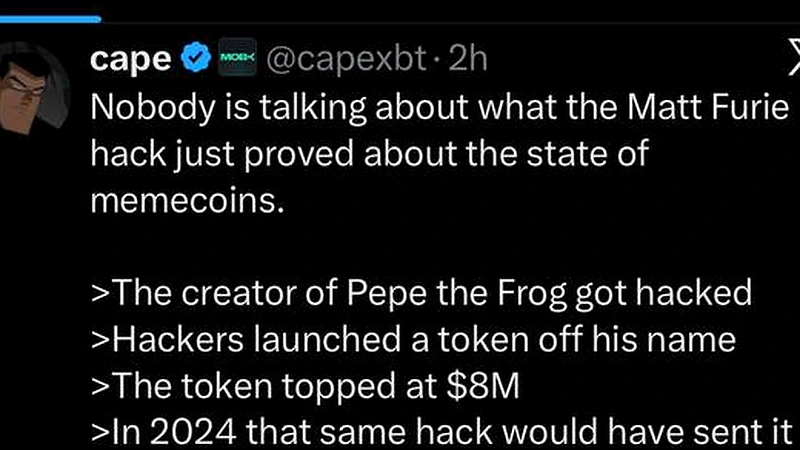
For now, the cleanest way to frame the story is cautiously: social media appears to show a hacked-account incident that briefly fueled speculative trading, then turned into a broader argument about fading memecoin demand. That is a real market narrative even if some of the minute-by-minute claims continue to rely on social posts rather than official incident reports.
Why Traders Think This Matters More Than a Normal Hack
Crypto has seen account compromises before. What made this one different was the reaction it triggered from traders watching the tape in real time. In hotter phases of the memecoin cycle, a recognizable name, a hack rumor, or a celebrity-adjacent catalyst could pull in huge amounts of fast capital almost instantly. That reflex still exists, but it looks weaker.
The argument going around X is not that memecoins are literally dead. It is that the market no longer has the same depth, energy, or willingness to aggressively reprice every narrative. In other words, a catalyst that might once have turned into a nine-figure frenzy now appears to produce a smaller spike, faster exhaustion, and much less secondary momentum.
That matters because memecoin markets are heavily driven by attention loops. If attention still arrives but the follow-through capital does not, then the whole structure gets less explosive. Traders become quicker to scalp, quicker to fade, and less willing to believe that every sudden narrative deserves another leg higher.
The Data Was Already Pointing to a Cooldown
The Matt Furie incident landed against a backdrop that was already getting weaker. In March, Cointelegraph, citing DefiLlama and Dune Analytics, reported that Solana weekly network revenue had fallen 93% from a mid-January peak of $55.3 million to roughly $4 million. The same report said Pump.fun daily revenue was down about 95% from a late-January peak of $15 million to around $800,000 on March 7.
Those numbers do not prove that a memecoin “supercycle” is permanently over. Markets can come back hard when liquidity, catalysts, and trader confidence return. But they do support the broader idea that by the time this Matt Furie incident hit the timeline, the easy mania phase was already in retreat.
What This Means for Solana Memecoin Traders
The sharpest takeaway is probably not ideological. It is structural. If memecoin trading is shifting from frenzy to thinner liquidity and shorter attention spans, then traders need to adjust. That means smaller expectations, faster risk management, and much less confidence in the idea that every viral launch will keep levitating simply because it is funny, chaotic, or socially visible.
It also means the market may reward cleaner setups over pure noise. During the busiest months of the cycle, almost any strong narrative could get instant legs. In a slower tape, traders start demanding more: better timing, better community pull, better distribution, stronger retention, or simply less obvious extraction.
The Matt Furie story hit a nerve because it condensed that whole transition into one event. A hacked-account narrative still brought attention. It still created movement. But if the social claim that the move topped out around the high single-digit millions is directionally correct, the reaction was far smaller than many traders would have expected at the top of the mania.
So Is the Memecoin Supercycle Actually Over?
Probably not in the clean, final, dramatic way social media likes to announce. Crypto almost never moves that neatly. Narratives that look dead can relight fast. New launchpads can steal attention. A single breakout token can change mood for a week.
But the burden of proof has clearly shifted. Instead of assuming every memecoin catalyst deserves euphoric upside, the market now seems more willing to ask whether there is enough real attention and enough fresh capital to sustain the move. That is a very different environment from the one that dominated the first quarter rush.
In that sense, the Matt Furie hack story mattered whether or not it becomes a lasting market marker. It gave traders a live stress test. The result, at least in the eyes of many on crypto X, looked less like unstoppable mania and more like a market that is getting tired.
Frequently Asked Questions
Was Matt Furie’s account definitely hacked?
Social posts and screenshots circulating on X said Matt Furie’s account had been compromised, but DEXTools has not independently verified every detail of the incident.
Did the token really hit $8 million?
That figure came from trader commentary on social media. It is best treated as a widely shared market claim rather than a fully independently verified final figure.
Why are traders linking this story to the end of the memecoin supercycle?
Because many traders believe a similar hacked-account catalyst would have generated far bigger follow-through during the strongest phase of the memecoin boom.
What hard data supports the cooldown argument?
Cointelegraph reported in March that Solana weekly revenue was down 93% from its January peak and Pump.fun daily revenue was down about 95% from its late-January high, citing DefiLlama and Dune Analytics.
Source basis: social posts circulating on X about the Matt Furie incident, including a widely shared commentary post from @capexbt, plus Cointelegraph’s March report on Solana revenue, Pump.fun activity, and memecoin market cap declines citing DefiLlama, Dune Analytics, and CoinMarketCap. This article should be updated if an official incident statement or directly verifiable on-chain breakdown adds new confirmed details.