Open USD vs USDC: The On-Chain Stablecoin Data Behind the 140-Company Attack on Circle
— By Tony Rabbit in News

Visa, Mastercard, Stripe, BlackRock and 140 others are backing Open USD to take on Circle. We pulled the stablecoin supply straight from Ethereum to show what is actually at stake, and why USDC is the target.
A coalition of more than 140 companies, including Visa, Mastercard, Stripe, BlackRock, Coinbase and Ripple, has unveiled Open USD (OUSD), a stablecoin built to hand reserve yield back to its partners instead of keeping it. The target is obvious: Circle, whose USDC business runs on keeping the interest earned on its reserves. Circle's stock fell sharply on the news. To see what is really at stake, we did not rely on the press releases. We read the stablecoin supply directly from the Ethereum blockchain. The picture explains exactly why USDC, not the market leader USDT, is the one in the crosshairs.
What the on-chain supply actually shows
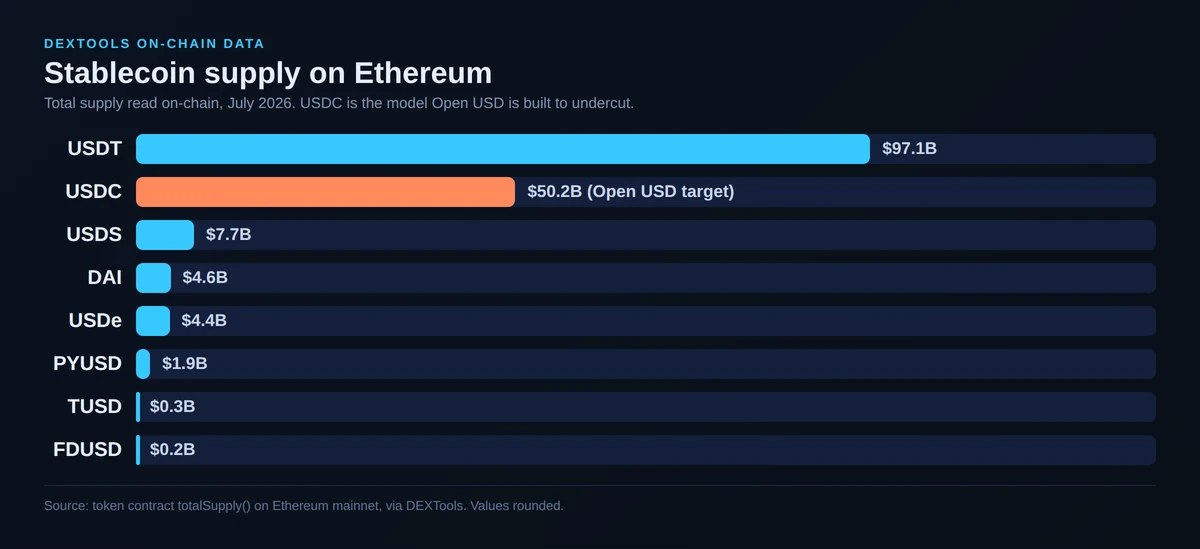
We queried the total supply of the major stablecoins directly from their token contracts on Ethereum. The result is a clear hierarchy. USDT sits far ahead at about $97 billion on Ethereum. USDC is a distant but solid second at roughly $50 billion. Everything else, from DAI and Ethena's USDe to Sky's USDS and PayPal's PYUSD, is a rounding error by comparison.
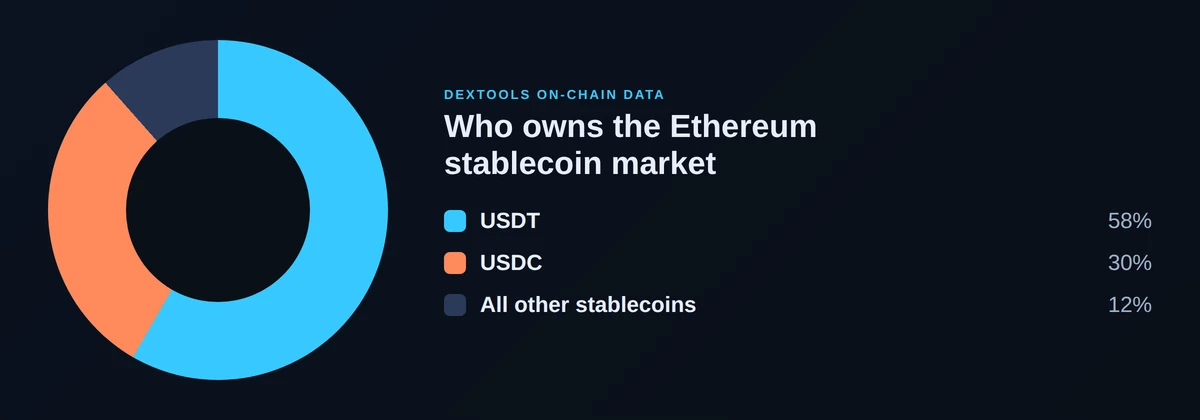
Put as market share, the two dollar tokens split the vast majority of the Ethereum stablecoin market between them. USDT commands about 58 percent of the supply we measured, USDC about 30 percent, and every other stablecoin combined makes up the remaining 12 percent. USDT is also broader by users, with more than 15 million holders on Ethereum versus roughly 8 million for USDC.
Why Open USD is aimed at USDC, not USDT
If USDT is the leader, why is the coalition targeting USDC? Because of how Circle makes money. The overwhelming majority of Circle's revenue, reported at around 96 percent, comes from the interest earned on the cash and Treasuries backing USDC. Holders get a dollar that stays a dollar; Circle keeps the yield. Open USD attacks that exact model by promising to route the reserve yield back to the businesses that distribute it, from card networks to exchanges. For a merchant or a fintech deciding which stablecoin to integrate, "we share the yield with you" is a direct shot at the issuer-keeps-everything model USDC is built on. That is why Circle's stock, not Tether's private balance sheet, took the hit, falling around 15 to 17 percent to a multi-month low on the announcement.
The on-chain data adds the part the stock market cannot see. USDC's supply has been drifting down even before Open USD had a launch date, slipping several billion dollars over recent months while the total stablecoin market, worth over $300 billion across all chains, kept growing. In other words, USDC was already ceding ground inside an expanding market. A well-funded, yield-sharing competitor arriving now lands on a token that was already on the back foot.
What it means, and what to watch
A few caveats keep this honest. Open USD is a launch announcement, not yet a deployed, liquid token you can measure on-chain, and it is planned on Solana rather than Ethereum, so its real traction is still unproven. USDT, the actual leader, is untouched by this and quietly runs a similar reserve-yield model at nearly double USDC's size. And a stablecoin's success is ultimately about distribution and trust, not just who shares the yield.
Still, the structural point stands. USDC's moat is the reserve yield, and a coalition of the largest payment and asset-management names on earth just built a product to erode it. The metric to watch from here is simple and fully on-chain: USDC's supply. If it keeps sliding as Open USD moves from announcement to live token, the pressure is real. If it holds, the moat held. To understand how these tokens keep their peg and where the risks sit, see our full guide to how stablecoins work, and before trusting any new dollar token, screen it with the Token Safety Checker and check its DEXT Score.
Methodology and disclaimer: stablecoin supply figures (USDT about $97.1B, USDC about $50.2B, and the others) were read directly from each token's contract totalSupply on Ethereum mainnet via DEXTools in July 2026, and reflect Ethereum-native supply, not global supply across all chains. Global market figures, Circle's revenue concentration, the Open USD coalition and the Circle share-price move are from company disclosures and reporting as of early July 2026. Values are rounded and change continuously. This article is for information only and is not financial or investment advice.