Pakistan's Crypto Banking Rules: Impacts on Exchanges
— By Whatsertrade in Crypto

Discover how Pakistan's crypto banking rules bring exchanges and wallet providers closer to mainstream financial access.
Pakistan has taken a significant step toward regulated crypto finance by allowing banks to open accounts for PVARA-approved virtual asset service providers (VASPs), reversing previous restrictions that kept most crypto businesses outside the formal banking system since 2018. This move brings crypto-related firms closer to mainstream finance, but only within a tightly controlled framework built around licensing, anti-money laundering checks, customer segregation, and bank-level oversight.
This change matters because it turns Pakistan's crypto policy from a grey zone into a structured market. Banks must verify PVARA authorization before onboarding a firm, maintain segregated non-interest-bearing client accounts in Pakistani rupees, continue due diligence and suspicious transaction reporting, and cannot invest in or hold virtual assets using their own balance sheet or client funds. Pakistan is not opening the door to unrestricted crypto banking; it is creating a regulated lane for approved operators.
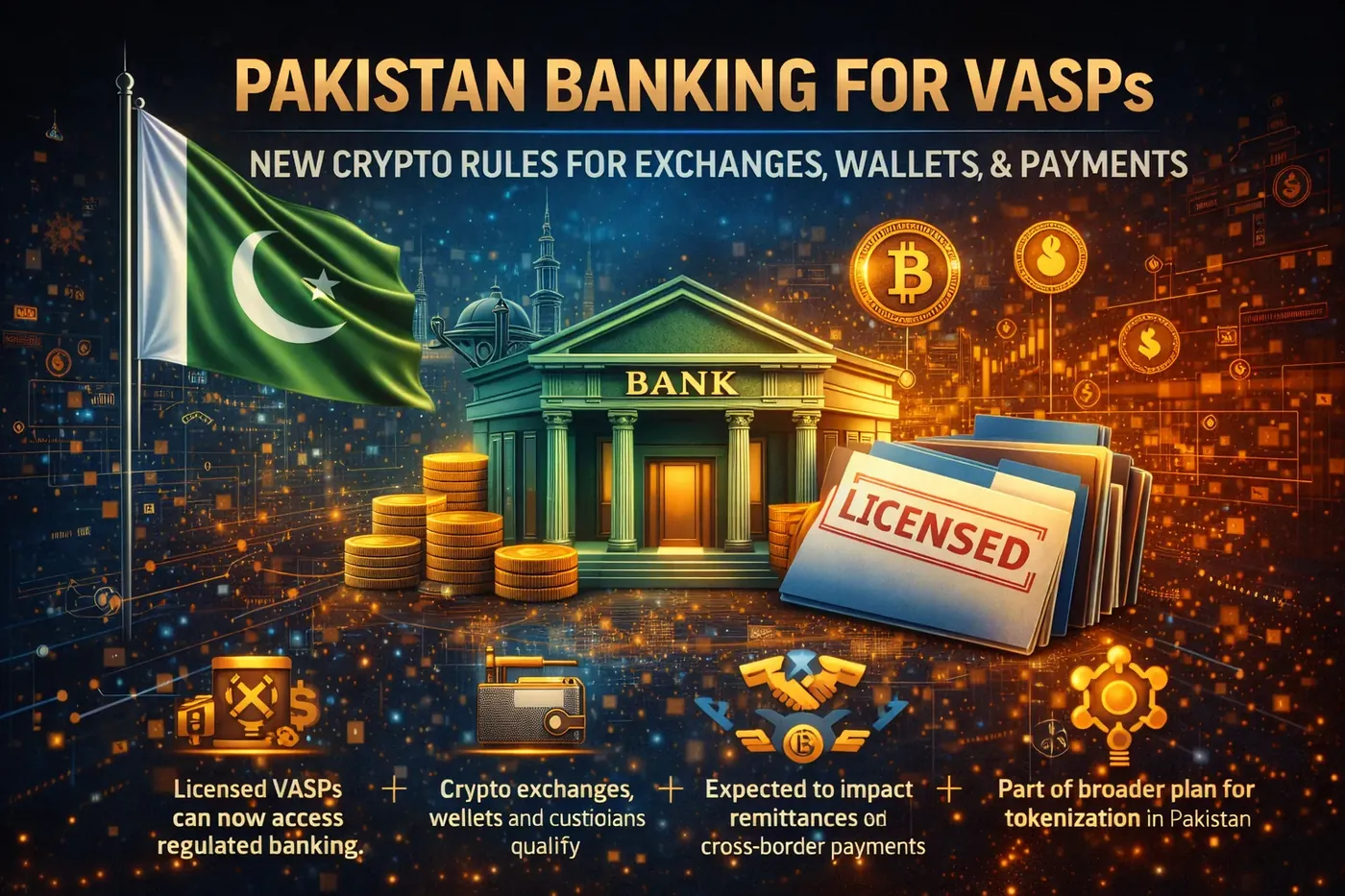
Major Shifts in Crypto Banking Policies
The most significant shift is simple: licensed or otherwise PVARA-approved VASPs can now access banking rails that were previously off-limits. This grants exchanges, wallet providers, custodians, and other approved firms a path to local bank accounts, operational payments, payroll, settlement support, and customer money handling within the formal financial system. It marks the first real banking bridge between Pakistan's banks and its newly regulated digital asset sector.
The policy implementation is staged. PVARA is currently accepting No Objection Certificate (NOC) applications as an early step toward full licensing, while the broader licensing framework continues to unfold. Official PVARA guidance indicates applicants transition from NOC application to AML registration with the Financial Monitoring Unit, local incorporation, and then final VASP licensing. Decisions on complete NOC submissions are targeted within 60 calendar days.
Beneficiaries of the New Framework
Pakistan's framework is comprehensive enough to cover market segments likely to attract substantial interest. PVARA's public licensing pages list virtual asset exchanges, custody and wallet providers, advisory and brokerage firms, token issuers, and investment platforms among those set to come under formal authorization. It also includes exchange, custody, broker-dealer, and derivative-related activities.
Banking access changes the economics of operating within Pakistan. A crypto business with a compliant banking relationship can onboard users more efficiently, manage fiat flows, and build products around local currency accounts instead of relying on informal workarounds. For users, this could eventually lead to smoother deposits and withdrawals, clearer compliance checks, and better separation between customer money and company funds.
Stricter, Essential Rules
Pakistan's model prioritizes controls over rapid expansion. PVARA says applicants will need legal registration in Pakistan, minimum capital, fit and proper checks for directors and key staff, AML and CFT systems, cybersecurity controls, and business continuity arrangements. Its regulatory framework requires customer due diligence, transaction monitoring, sanctions screening, suspicious activity reporting, and record-keeping for at least 10 years.
For banks, the responsibility remains heavy. They are liable for risk profiling and ongoing compliance, even when serving an approved crypto firm. This keeps the banking side conservative and means only VASPs with robust compliance, local incorporation, and bank-grade governance are likely to gain significant access.
Impacts on Remittances and Cross-Border Payments
Pakistan's new banking framework for VASPs is particularly crucial due to the country's reliance on cross-border money flows. Pakistan expects around $41.5 billion in remittances this fiscal year, with workers' remittances reaching about $30.3 billion during July to March of the fiscal year 2026, including approximately $3.8 billion in March alone. In such a market, any regulated crypto or stablecoin infrastructure facilitating faster or cheaper cross-border transfers becomes commercially significant.
This context explains why Pakistan started exploring stablecoin-based payment rails. Earlier this year, it signed an agreement with a World Liberty Financial affiliate to explore a dollar-linked stablecoin for cross-border payments. While the new banking opening for VASPs doesn't automatically mainstream stablecoin remittances, it lays a realistic banking foundation for pilots and regulated payment experiments.
Pakistan's Position in Tokenization
The story extends beyond crypto trading to include tokenization. In December, Pakistan signed an agreement with Binance to explore tokenizing up to $2 billion in government-related assets, such as sovereign bonds, treasury bills, and commodity reserves. Both Binance and HTX have received initial regulatory clearances to begin the local licensing process. Thus, the banking opening for VASPs fits within a broader strategy that incorporates exchanges, tokenized real-world assets, and regulated digital market infrastructure.
This makes Pakistan's VASP banking narrative more than a mere policy reversal. It suggests the country aims for an entire regulated stack: licensing, bank accounts, AML registration, local incorporation, exchange operations, tokenization, and possibly stablecoin-enabling cross-border use cases. If this stack matures, Pakistan could become one of the more closely-watched digital asset markets in South Asia.
Existing Limitations
The framework is open but not loose. Banks still can't engage in crypto speculation with personal capital or hold virtual assets for themselves or clients outside the sanctioned framework. Additional services tied directly to virtual asset activities demand full regulatory authorization, meaning not every applicant will move through the system swiftly. Banking access remains a privilege linked to compliance, not a blanket approval for the entire market.
Execution risk also remains. While a licensing framework can appear solid on paper, practical challenges like onboarding bottlenecks, reporting obligations, and bank risk appetite can hinder progress. The real test will come as more VASPs advance from application to active operation, and banks begin managing daily crypto-adjacent business under these new rules.
Anticipating the Next Steps
The next phase will likely focus on which entities navigate the approval pipeline first, which banks are willing to serve the sector and how regulated crypto banking develops around exchanges, custody, tokenization, or cross-border payment products. Early movers with strong compliance teams and local structures might gain an advantage before the market becomes crowded.
Pakistan no longer treats crypto-related businesses as outsiders to the banking system. Instead, it builds a regulated path to formal finance. For exchanges, wallet operations, tokenization projects, and stablecoin payment initiatives, this development could shape the next chapter of Pakistan's digital asset landscape.
Frequently Asked Questions
What is Pakistan Banking for VASPs?
This refers to Pakistan's new policy allowing banks to open accounts for PVARA-approved virtual asset service providers under regulated conditions, replacing earlier banking restrictions since 2018.
Which Businesses Are Covered by the New Framework?
PVARA's public framework covers exchanges, wallet providers, custodians, token issuers, advisory and brokerage firms, and other virtual asset businesses that secure the necessary regulatory approval.
Can Pakistani Banks Now Buy or Hold Crypto Themselves?
No. Banks must engage the sector within a controlled framework and cannot invest in or hold virtual assets using personal or customer funds.
Why Is This Important for Payments and Remittances?
Pakistan handles substantial remittance flows and is exploring stablecoin-based cross-border payment infrastructure. A regulated banking channel for approved VASPs makes these experiments more feasible.
Is Pakistan Also Working on Tokenization?
Yes. Pakistan has signed an agreement with Binance to explore tokenizing up to $2 billion in assets, with initial clearances granted to Binance and HTX to start the licensing process.
Understanding Crypto Travel Rule for EU Exchanges Tokenized Treasuries and RWAs: Transforming Crypto Hong Kong Stablecoin Licences to Transform Asia Goldman Sachs Bitcoin ETF: A Wall Street Crypto Shift Explained