Solana All-Time High Explained: The ATH Run
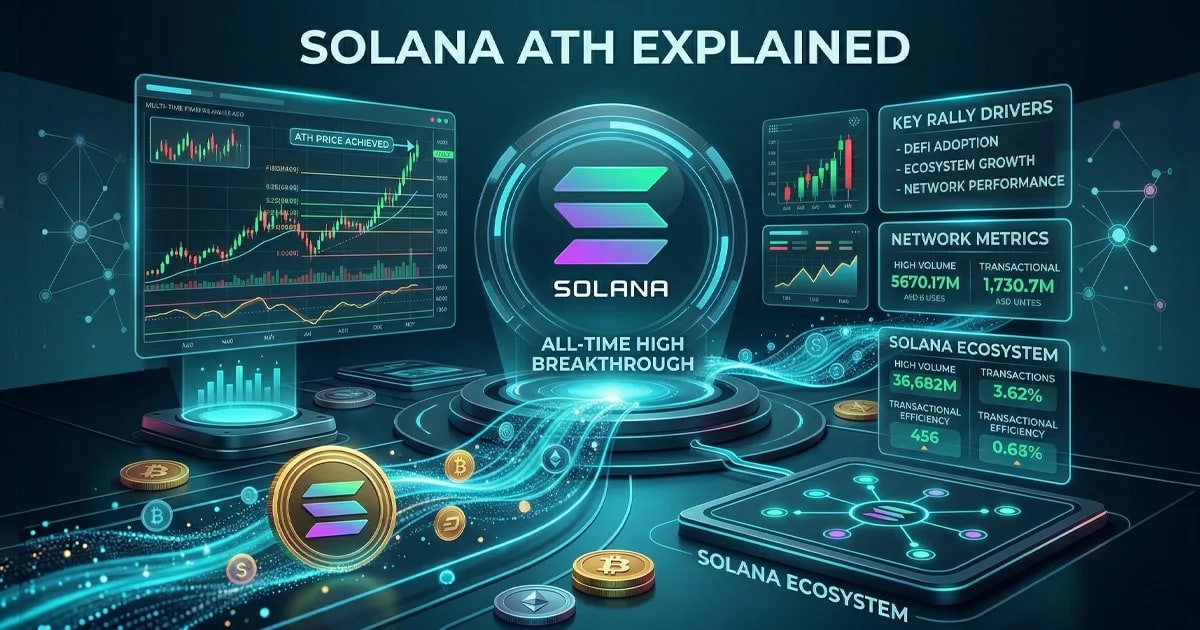
Solana's all-time high explained: discover the chain's growth in the crypto market, its path to new price highs, and what trends could come next.
Solana ATH Explained: When SOL Peaked and What Comes Next
As of March 27, 2026, Solana chain has officially transitioned from being a high-potential challenger to a foundational pillar of the global financial architecture. The journey of the SOL token has been a masterclass in resilience, technical evolution, and market dominance.
While the broader crypto market has seen its share of volatility over the past two years, Solana’s trajectory has been defined by its ability to break through previous psychological barriers and establish a new standard for blockchain performance.
The Journey to the New All-Time High
- To understand where Solana stands today, we must look back at the monumental shifts that occurred between late 2024 and early 2025. For years, the original all-time high of $260.06, set in November 2021, stood as a daunting ceiling. Skeptics often pointed to that peak as a relic of a low-interest-rate environment that might never be reclaimed. However, the narrative shifted dramatically as the network addressed its historical stability issues and became the preferred home for both retail speculators and institutional giants.
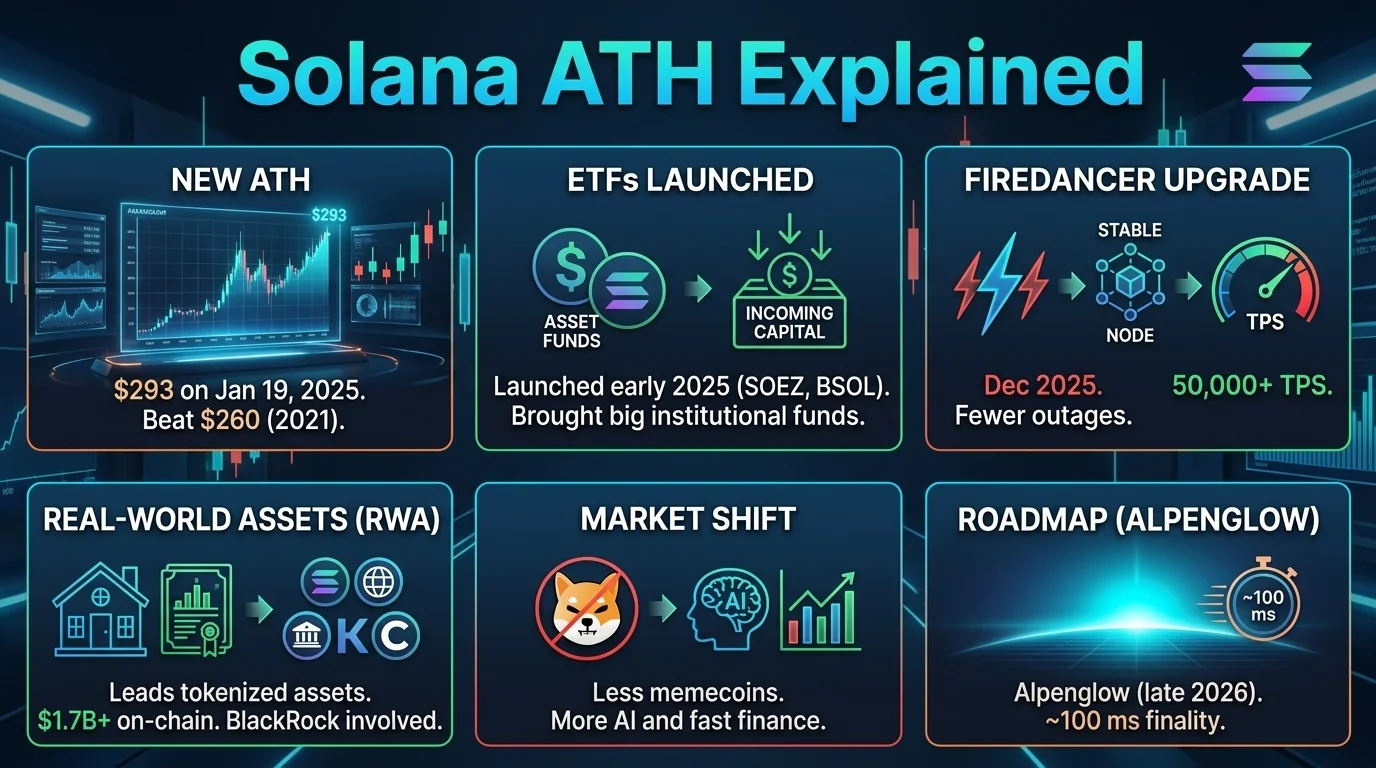
- The definitive breakthrough occurred on January 19, 2025, when SOL finally shattered its previous record, surging to a new all-time high of $293. This rally was not just a flash in the pan but the result of a perfectly timed "triple threat" of catalysts: the anticipation of spot ETFs, the massive success of its decentralized exchange ecosystem, and the imminent launch of the Firedancer validator client.
Since that peak, the market has entered a period of sophisticated consolidation, with SOL currently trading in a range that reflects a more mature, utility-driven valuation rather than pure hype.
Catalyst One: The Era of the Solana chain ETF
- One of the primary drivers behind the 2025 peak was the regulatory green light for spot Solana ETFs in the United States. Following the success of Bitcoin and Ethereum products, asset managers like VanEck, 21Shares, and Franklin Templeton paved the way for institutional capital to flow directly into SOL.
- By March 2026, we now have a robust market of eight major spot Solana ETFs, including the Franklin Solana ETF (SOEZ) and the Bitwise Solana Staking ETF (BSOL).
- The introduction of staking rewards within these ETF structures changed the game. Unlike early Bitcoin ETFs, some Solana products allow investors to capture a portion of the network’s inflationary rewards and MEV (Maximal Extractable Value) tips. This transformed SOL from a speculative asset into a yield-bearing instrument suitable for pension funds and corporate treasuries. The "ETF effect" provided the necessary liquidity and legitimacy to push the price past the $260 mark and maintain a higher floor during subsequent market corrections.
Catalyst Two: Technical Superiority and Firedancer
- A common criticism of Solana chain in its early years was its intermittent network outages. That era effectively ended on December 12, 2025, with the mainnet launch of Firedancer. Developed by Jump Crypto, this independent validator client rewritten in C++ has fundamentally changed the network’s physics. By providing a completely different software path for transactions, Firedancer eliminated the single points of failure that previously led to downtime.
- The impact on performance has been staggering. In early 2026, Solana consistently processes over 2,000 "true" transactions per second, with bursts reaching well over 50,000 during high-demand events. This technical reliability has enabled high-frequency trading applications that were previously impossible on-chain. For example, the Jupiter DEX aggregator now handles volumes that rival some of the world’s largest centralized exchanges, proving that Solana can function as a global, real-time settlement layer.
The Rise of Real-World Assets and Institutional Integration
- While the 2021 bull run was driven by NFTs and "SBF-era" DeFi, the 2025-2026 cycle has been defined by Real-World Assets (RWAs). Solana’s sub-cent fees and sub-second finality made it the logical choice for traditional financial institutions looking to tokenize private credit, treasuries, and even real estate.
- As of late February 2026, the RWA market cap on Solana chain reached a staggering $1.71 billion. A key example of this trend is BlackRock’s BUIDL fund, which expanded its presence on Solana to capture the network’s superior capital efficiency. Furthermore, partnerships with firms like DB Securities have led to the creation of tokenized markets for niche assets, such as K-POP intellectual property, bringing a entirely new demographic of investors into the ecosystem. This shift toward "boring but massive" financial products has provided SOL with a fundamental value prop that transcends the boom-and-bust cycles of retail trends.
The Cultural Engine: Memecoins and AI Agents
- Even as it matures, Solana has not lost its edge as the cultural heart of the crypto world. The "memecoin mania" of late 2024, powered by platforms like Pump.fun, acted as a powerful stress test and user acquisition tool. While many viewed these tokens as purely speculative, they drove massive revenue for the network and funded a new generation of developers.
- In 2026, this speculative energy has evolved into the "AI Agent" economy. We are now seeing autonomous AI entities that hold their own wallets, trade assets, and provide services entirely on the Solana blockchain.
- Because Solana’s fees are so low, these agents can perform thousands of micro-transactions a day without eroding their capital. This is a use case where Ethereum and its various Layer 2 solutions still struggle to compete, giving Solana a unique moat in the emerging intersection of AI and blockchain.
What Comes Next: Alpenglow and Beyond
- The question on every investor's mind on March 27, 2026, is what follows the $293 peak. The roadmap for the remainder of 2026 is focused on a massive technical upgrade codenamed "Alpenglow." This update aims to reduce block finality from the current 400 milliseconds to an industry-leading 100 to 150 milliseconds.
- This level of speed will move Solana into a category of its own, enabling "Internet Capital Markets" where the line between a traditional stock trade and an on-chain swap becomes invisible. We are also expecting the launch of several "stablecoin-native" payment rails from global fintechs, following the successful integration of PayPal’s PYUSD and Visa’s USDC settlement layers.
The goal is no longer just to have a high token price, but to become the "Visa of the 21st century."
Potential Risks to Watch
No asset exists without risk. Despite its current strength, Solana faces challenges from a shifting regulatory landscape and increasing competition from "Mega-L2s" on Ethereum. Additionally, the network must continue to prove its decentralization metrics as more institutional validators join the set. While the 2025 ATH was a triumph, the current consolidation phase requires patience as the market waits for the next "killer app" that moves beyond trading and into mainstream consumer usage.
Article Summary: Key Points
New All-Time High: Solana reached a historic peak of $293 on January 19, 2025, finally surpassing the long-standing 2021 record of $260.
ETF Approval: The launch of spot Solana ETFs (such as SOEZ and BSOL) in early 2025 provided a massive influx of institutional liquidity and a yield-bearing investment vehicle for traditional investors.
Firedancer Stability: The launch of the Firedancer client in December 2025 has virtually eliminated network outages, allowing for over 50,000 peak TPS and professional-grade reliability.
RWA Dominance: Solana has become the preferred chain for tokenized Real-World Assets, with over $1.7 billion in value currently secured on-chain, including significant participation from BlackRock.
Economic Shift: The ecosystem is moving from speculative memecoins toward AI-driven economic agents and high-frequency financial services.
Upcoming Roadmap: The "Alpenglow" upgrade in late 2026 is expected to push transaction finality down to a lightning-fast 100 milliseconds.
The Solana chain ecosystem is moving faster than ever, and staying safe while navigating these high-speed markets is essential. If you want to trade the latest tokens and keep a close eye on the most promising projects within the SOL network, we invite you to use the Solana dashboard on DEXTools. It provides the most comprehensive, real-time data to help you trade securely and stay ahead of the curve in this rapidly evolving landscape.
You can access DEXTools' Solana dashboard here and start trading today!
Disclaimer: This article is for informational purposes only and does not constitute investment advice, financial advice, trading advice, or any other kind of advice. DEXTools does not recommend buying, selling, or holding any cryptocurrency or token. Users should conduct their own research and consult with a qualified financial advisor before making any investment decisions. Cryptocurrency investments are volatile and high-risk. DEXTools is not responsible for any losses incurred.
Related Guides
- What is ETH ATH? Ethereum’s All-Time High Explained
- Biggest Crypto Hacks of All Time: Complete History (2026 Update)
- How to Send SOL from Coinbase to Phantom: Time, Fees and Safety Checks (2026)
- What is the XRP ATH? Analysis & 2026 Outlook
- What Is Aethir (ATH)? The Decentralized GPU Cloud Powering AI and Gaming in 2026
Frequently Asked Questions
What was Solana's all-time high price?
Solana's all-time high price reached $293 on January 19, 2025.
What factors contributed to Solana's new all-time high?
The new all-time high was driven by the approval of spot Solana ETFs, the success of its decentralized exchange ecosystem, and the launch of the Firedancer validator client.
How did the introduction of Solana ETFs impact its market?
The introduction of Solana ETFs provided liquidity and legitimacy, allowing institutional capital to flow into SOL and transforming it into a yield-bearing asset.
What is the Firedancer validator client?
Firedancer is an independent validator client developed by Jump Crypto that significantly improved Solana's network performance by eliminating single points of failure.
How has Solana's transaction processing changed recently?
As of early 2026, Solana consistently processes over 2,000 transactions per second, with peaks exceeding 50,000 during high-demand events.