24/7 Markets with Tokenized Cash Impact
— By Whatsertrade in Analysis

For years, crypto traders have lived in a strange split reality. Markets move all day, every day, but the cash that supports many large financial positions still moves on banking hours. That gap creates friction, delays, and hidden risk. It is exactly why tokenized cash suddenly matters.
For years, crypto traders have lived in a strange split reality. Markets move all day, every day, but the cash that supports many large financial positions still moves on banking hours. That gap creates friction, delays, and hidden risk. It is exactly why tokenized cash suddenly matters. On March 24, BMO said it plans to launch tokenized cash capabilities with CME Group and Google Cloud, aiming to let institutional clients convert U.S. dollars into tokenized cash for use in margined products on CME and move value in real time beyond traditional banking hours. Reuters said the rollout is targeted for the second half of 2026, subject to regulatory approval.
At first glance, this looks like a banking story. It is not. The real angle is market structure. If collateral starts moving with 24/7 logic, the way crypto already does, then margin, settlement, and liquidity management can start changing across the trading stack. That matters to traders because capital efficiency often decides who gets to act first, who survives volatility, and who gets forced into bad execution when markets move outside normal hours. The CME and Google Cloud initiative announced in March 2025 was explicit about that point, saying tokenization could improve collateral, margin, settlement, and fee payments as the world moves toward 24/7 trading.
Why tokenized cash matters now
The best way to understand tokenized cash is to stop thinking about it as a new asset and start thinking about it as better plumbing. In the BMO model, institutional clients would be able to turn bank money into a tokenized instrument on Google Cloud Universal Ledger and use it for margin, collateral, and settlement workflows tied to CME's network. BMO also said this lays the groundwork for tokenized deposits that could support payments, treasury activity, and programmable finance.
That is important because many markets already trade close to continuously in practice, but the money layer does not always keep up. Crypto trades nonstop. News breaks on weekends. Macro shocks happen overnight. Futures, OTC desks, and cross border trading all create pressure for faster funding and settlement. When cash remains trapped in slower systems, traders and institutions either hold excess buffers or accept more operational risk. Tokenized cash is attractive because it promises near instant settlement and easier movement of value in a world that increasingly expects markets to be always on.
What changes when collateral goes 24/7
The biggest shift is not cosmetic. It is collateral mobility.
Today, one of the most expensive problems in trading is idle capital. If firms need to keep extra cash parked in the right place just in case markets move outside banking hours, that cash is less productive. Tokenized cash changes that equation by making it easier to move collateral when it is needed instead of pre positioning so much of it in advance. Reuters described BMO's system as a way to improve capital efficiency and reduce operational friction, and CME's own messaging last year framed tokenization as infrastructure for better collateral and margin workflows.
For traders, the practical implication is simple. Faster collateral movement can reduce the penalty of being right at the wrong time. If markets reprice on a Sunday night, during a geopolitical headline, or while banks are closed, capital no longer has to wait for the old schedule to catch up. That does not remove market risk, but it can reduce funding stress and improve the ability to defend positions, meet margin calls, or rotate exposure faster. That is an analytical inference, but it follows directly from the stated goal of enabling continuous movement of value for margin and settlement.
Margin becomes more dynamic
Margin is where this gets especially interesting. In traditional market infrastructure, margin management is often constrained by timing. The asset side may move instantly, but the cash side can still be slower, especially across institutions, jurisdictions, and legacy banking systems.
BMO said its clients would be able to use tokenized cash for margined financial products on CME. That means the banking layer, clearing logic, and cloud ledger are being designed to support continuous funding and collateral operations for derivatives related activity. CME and Google Cloud described the broader effort as a way to enhance capital market efficiency through secure wholesale payments and tokenization of assets.
Why does that matter to a trader reading DEXTools? Because margin speed influences behavior. If capital can move faster, leverage can be managed more precisely. Firms may need smaller precautionary buffers. Some strategies become less expensive to run. Basis traders, derivatives desks, and market makers could operate with tighter capital loops if collateral friction drops. This does not guarantee lower systemic risk, but it does suggest a more responsive market where margin management starts to resemble the speed of execution rather than the speed of bank operations.
Settlement stops being a closing bell problem
Settlement is another hidden bottleneck that tokenized cash could reshape. Traders usually focus on price, spread, and slippage, but settlement delays also matter because they lock up capital and create uncertainty between trade execution and final value transfer.
Reuters said tokenized cash allows near instant settlement and supports continuous financial market activity. BMO and CME also framed the new infrastructure around 24/7 institutional settlement. That is a major signal because it points to a future where cash transfer is not forced to stop just because the banking day ends.
For crypto native readers, this will sound familiar. One reason onchain markets feel different is that settlement logic is much closer to trading logic. The same broad system can handle execution, collateral, and finality with fewer calendar boundaries. Tokenized cash is not the same as public crypto rails, but it points in the same direction. It suggests that traditional finance is trying to import some of the operational advantages that made onchain markets feel faster and more composable in the first place. That is an inference, but it is strongly supported by the focus on programmable finance and around the clock movement of value.
Why this could matter beyond banks
It would be a mistake to treat this as a narrow institutional experiment. BMO said the project is also meant to establish groundwork for tokenized deposits that support broader payment and treasury use cases. That expands the story from clearing and margin into a much wider question: what happens when money itself becomes more programmable across the financial system?
The first impact will likely be institutional, because CME, BMO, and Google Cloud are building for capital markets and commercial banking workflows. But the second order effects could reach much further. Better treasury movement, more flexible collateral, and faster settlement can all influence where liquidity clusters, how market makers price risk, and how easily capital crosses from one venue to another. For traders, those infrastructure changes often matter long before they become obvious headline narratives.
The real takeaway for traders
The most important insight is not that tokenized cash is trendy. It is that the time structure of finance may be changing.
Crypto forced traders to think in 24/7 terms years ago. Traditional finance is now adapting to that reality, and tokenized cash looks like one of the clearest signs yet. BMO's plan, built on CME's network and Google Cloud Universal Ledger, is designed to let value move continuously for margin, collateral, and settlement. That means the cash layer is being rebuilt to match markets that no longer want to sleep.
For DEX traders, this matters because the future edge may not come only from spotting the next hot token. It may come from understanding where financial infrastructure is getting faster, where capital becomes easier to deploy, and where liquidity can move with fewer time based constraints. When collateral starts moving with crypto logic, the market does not just get more efficient. It gets more competitive. That is why tokenized cash is a trader story, not just a bank story.
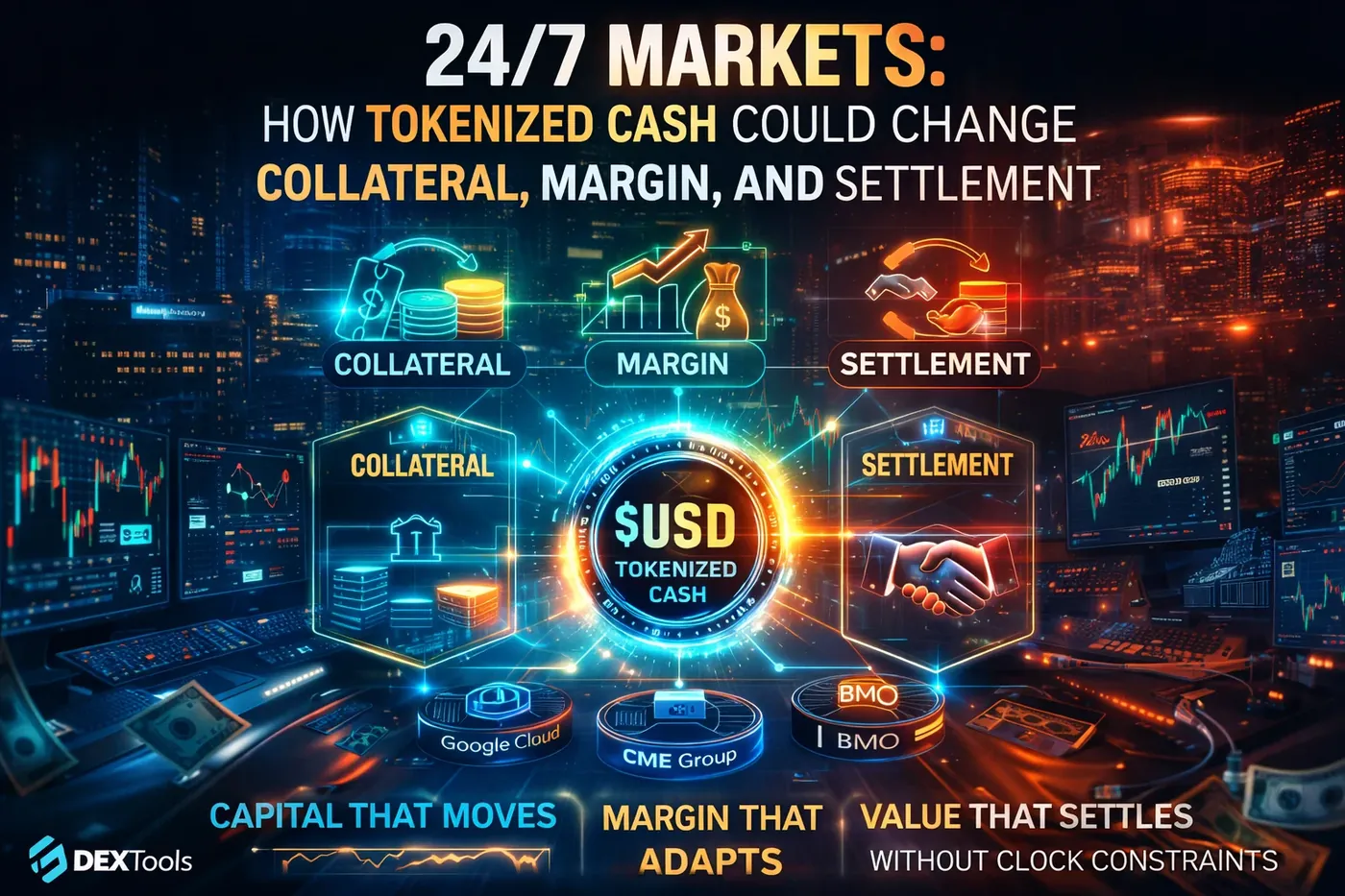
The move toward 24/7 markets is no longer only a crypto phenomenon. It is becoming a broader financial infrastructure race. BMO's March 24 announcement matters because it shows how banks, exchanges, and cloud providers are now trying to modernize the money layer itself. If tokenized cash works as intended, collateral can become more mobile, margin can become more responsive, and settlement can become less dependent on the clock.
That is the real story. Tokenized cash is not exciting because it sounds futuristic. It is exciting because it could quietly change how capital behaves when markets never close.
Tokenized Assets Impact Traders Tokenized Stocks on Blockchain Tokenized Cash: From Crypto Concept to Bank Reality Ripple Champions Stablecoins in Trade Finance Smart Money Wallet Tracking in CryptoFrequently Asked Questions
What are crypto markets?
Crypto markets are decentralized digital marketplaces where cryptocurrencies can be bought, sold, and traded. They operate continuously, unlike traditional stock markets.
How do tokenized cash impact crypto markets?
Tokenized cash can enhance liquidity and efficiency in crypto markets by providing a stable, digital representation of fiat currency for settlements and transactions.
What is the significance of 24/7 operation in crypto markets?
The 24/7 operation of crypto markets allows for continuous trading and price discovery, reflecting global demand and supply without traditional market closures.
Are crypto markets regulated?
The regulatory landscape for crypto markets varies significantly across different jurisdictions. Some countries have specific regulations, while others are still developing their frameworks.
What factors influence crypto market prices?
Crypto market prices are influenced by a variety of factors, including supply and demand, technological developments, regulatory news, macroeconomic trends, and market sentiment.