RWAs for Degens: Tokenized Assets Impact Traders
— By Whatsertrade in Analysis
Tokenized real world assets are transforming the crypto landscape, offering new opportunities and liquidity for onchain traders.
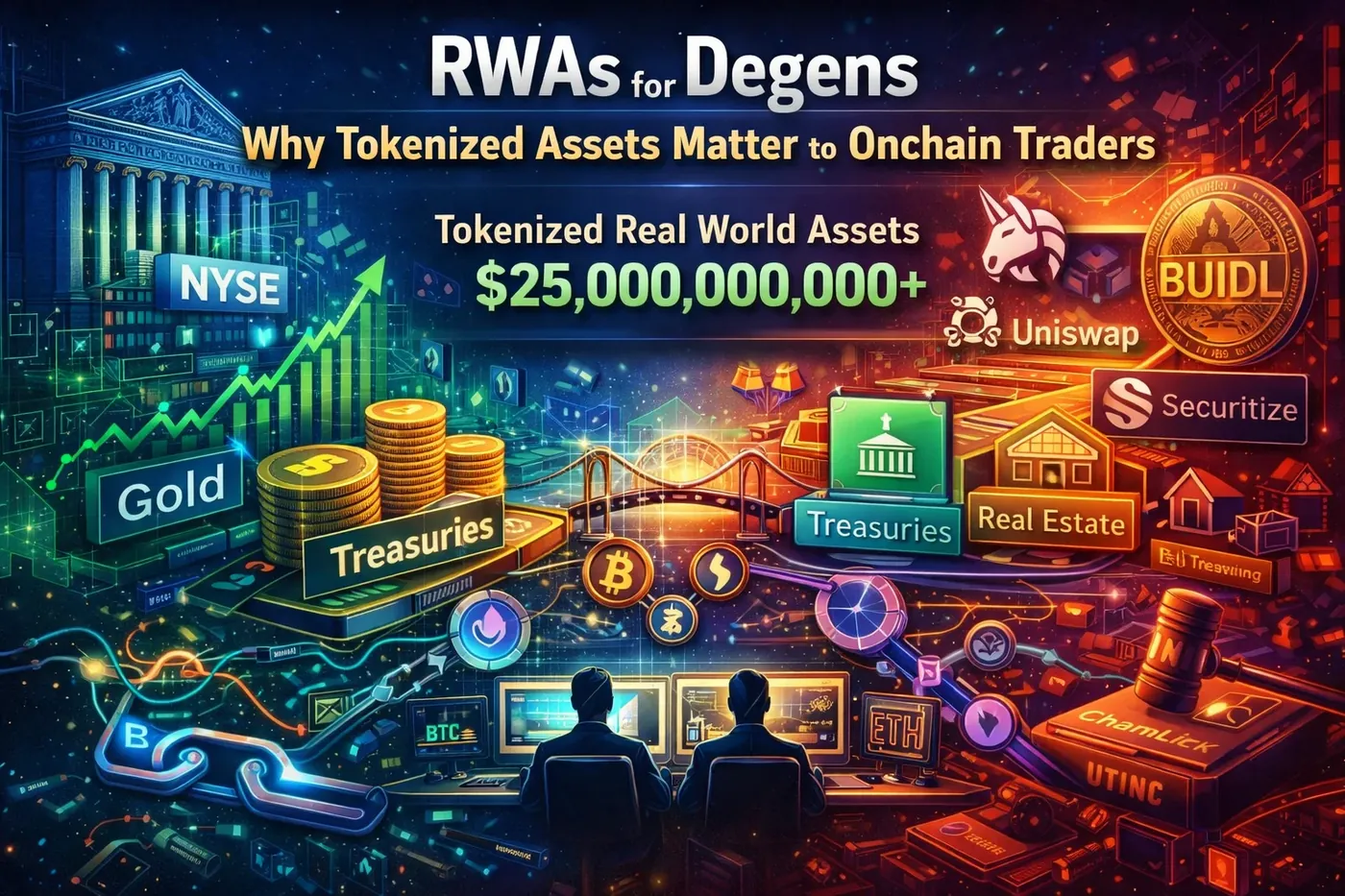
For a long time, real world assets felt like somebody else’s crypto narrative. Too institutional, too polished, too far from the fast moving reality of onchain trading. Memecoins had the attention. Perps had the action. RWAs looked like a slow corner of the market built for fund managers, not for traders watching fresh flows on DEXs. That view is now outdated. Tokenized real world assets have moved from theory to scale, with the onchain RWA market now above $25 billion, while major players like Uniswap and the New York Stock Exchange are actively building around tokenized finance infrastructure.
That is why RWAs matter now. Not because they are replacing the rest of crypto, but because they are starting to answer the question traders always ask first: where is the next durable liquidity cluster going to form? The more tokenized treasuries, funds, credit products, and securities come onchain, the more capital, collateral, and settlement activity will begin touching the same rails that DeFi traders already use every day.
The RWA story is no longer just for institutions
The biggest mistake traders can make in 2026 is thinking tokenization is still just a conference buzzword. It is already a live market. RWA.xyz currently shows distributed asset value above $26 billion, while tokenized U.S. Treasuries alone are around $10 billion. That matters because Treasuries are not a niche curiosity anymore. They are becoming a base layer for yield, collateral, and treasury management onchain.
The market structure implications are real. When more capital moves into tokenized treasuries, money market products, and blockchain based versions of familiar financial instruments, the line between crypto liquidity and traditional capital starts to blur. Instead of liquidity living in separate universes, it starts to flow through shared pipes. That is when RWAs stop being a side narrative and start becoming part of the main trading map.
Why degens should care
The simple answer is liquidity. But not just liquidity in the narrow sense of one token pair getting tighter spreads. The bigger opportunity is that RWAs can bring a different quality of liquidity onchain.
Crypto traders are used to liquidity that is hot, reactive, and often temporary. It rotates fast from one sector to another. RWAs introduce a different profile. Treasury products, tokenized funds, and institutional settlement rails are designed for size, consistency, and capital efficiency. That does not mean they are more exciting, but it does mean they can support a more durable financial base inside crypto markets.
For traders, that can show up in several ways. It can mean deeper dollar liquidity parked onchain. It can mean better collateral quality for borrowing and leverage. It can mean more predictable settlement flows around large pools of capital. And it can mean new bridges between institutional products and DeFi venues where price discovery happens faster. Even if a trader never buys a tokenized treasury directly, that trader can still benefit when the capital behind those assets starts interacting with the same ecosystem.
The Uniswap and BUIDL signal changed the conversation
One of the clearest signs that RWAs are moving closer to the trading stack came when Uniswap Labs and Securitize announced that BlackRock’s BUIDL would be accessible through UniswapX. Uniswap described the integration as a way for eligible investors to access market quotes and swap BUIDL bilaterally with whitelisted subscribers around the clock.
That is a bigger deal than it may look at first glance. It is not just another institutional headline. It is a signal that one of the most recognized DeFi brands sees value in connecting tokenized traditional assets with crypto native routing infrastructure. In other words, this is not only about putting a legacy product onchain. It is about bringing that product closer to the places where onchain liquidity is discovered, priced, and moved.
For DEX traders, this matters because once tokenized funds start appearing in the same broader execution environment as DeFi products, the market begins to change shape. Traders start looking not only at what is trending, but at what pools of capital may become active next. The opportunity is less about chasing an RWA meme and more about recognizing when financial plumbing becomes tradeable narrative.
NYSE and Securitize show where this is heading
If UniswapX and BUIDL showed that DeFi wants access to tokenized assets, the NYSE and Securitize partnership showed that traditional finance wants to build the opposite direction too. Reuters reported this week that the New York Stock Exchange teamed up with Securitize to develop a platform for tokenized securities, with Securitize becoming the first digital transfer agent authorized to create blockchain based securities for issuers of corporate and exchange traded funds on a forthcoming NYSE affiliated digital trading platform.
That is not small news. It means tokenization is now being treated less like an experimental edge case and more like a future market structure issue. When a global exchange brand starts investing in tokenized security rails, the market should pay attention. Not because tokenized stocks are about to replace everything overnight, but because the financial industry is clearly moving toward a world where blockchain based settlement, transfer, and issuance matter more.
For crypto traders, the takeaway is straightforward. The TradFi and DeFi worlds are no longer developing in total isolation. They are beginning to overlap in infrastructure, settlement logic, and asset distribution. Wherever that overlap deepens, liquidity usually follows.
Where onchain traders may actually see the impact
The immediate question is how any of this reaches the average onchain trader. The answer is not that everyone suddenly starts buying tokenized bonds on a DEX. The real impact is more indirect, but potentially more important.
First, RWAs can strengthen the dollar side of the market. Tokenized treasuries and fund products create more reasons for large pools of capital to stay onchain rather than only touching crypto at the edges. Second, they can improve collateral quality. Better collateral usually supports better lending conditions, more efficient leverage, and stronger capital loops across DeFi. Third, they can create new narrative rotations. Once traders believe real liquidity is building around tokenized products, they start hunting the infrastructure layer, meaning protocols, routes, platforms, and ecosystems that capture that activity.
This is where the RWA theme becomes useful for DEXTools readers. The point is not to romanticize tokenization. The point is to track where structural liquidity may emerge before it becomes obvious in every timeline and newsletter. If a protocol, chain, or execution layer becomes a gateway between institutional assets and onchain markets, traders will want to see that early. The edge is in spotting the rails before everyone talks about the train.
Why this is different from previous RWA hype
Crypto has talked about RWAs before, but 2026 feels different for one reason: the institutions, products, and infrastructure are finally starting to connect to live onchain systems in more concrete ways. The market is not just hearing the same story again. It is seeing larger numbers, more operational products, and more collaboration between established financial firms and crypto native infrastructure.
There is also a timing advantage. Traders have spent years focusing on the fastest narratives, and many still underestimate slow narratives until they suddenly reprice. RWAs fit that pattern perfectly. They are not loud in the same way memecoins are loud, but they may become important in a more lasting way because they sit closer to capital formation, treasury management, and settlement infrastructure. When those things move onchain, they tend to matter for longer than one social media cycle.
What traders should watch next
If RWAs are becoming a real onchain trading theme, then the smartest move is not to stare only at the asset labels. Watch the liquidity paths instead.
Watch which protocols become the access layer for tokenized funds and securities. Watch where institutional products can be swapped, used as collateral, or settled more efficiently. Watch whether Ethereum and Ethereum aligned infrastructure keep dominating RWA value, because that can influence where serious capital chooses to stay. RWA.xyz’s network data currently shows Ethereum as a major center of tokenized asset activity, including a large stablecoin base and strong RWA transfer volume.
Also watch the second order trade. The first wave is usually about the asset itself. The more interesting wave is often the picks and shovels: aggregators, DEX infrastructure, data platforms, collateral protocols, and chains that become natural homes for tokenized liquidity. Traders rarely win big by arriving when the story is fully accepted. They win by recognizing when boring infrastructure starts becoming the market’s next obsession.
RWAs are no longer just a polished institutional narrative that degens can ignore. They now matter because tokenized assets are beginning to shape where serious onchain liquidity may grow next. With the market above $25 billion, tokenized Treasuries around $10 billion, UniswapX opening access to BUIDL, and the NYSE building tokenized security infrastructure with Securitize, the crossover between TradFi and DeFi is no longer theoretical. It is already happening.
For traders, the key insight is simple. Do not think about RWAs only as products to buy. Think about them as liquidity magnets. Wherever tokenized capital starts clustering, the surrounding onchain ecosystem will likely become more relevant, more active, and more tradable. That is why RWAs matter now, even to degens.
RWA vs. AI Tokens: Which is the Real Narrative of 2026? Tokenized Assets in DeFi: RWAs Revolutionizing Finance Bitcoin and USDC Join the Housing Market with Crypto Mortgages Coinbase Launches Crypto-Backed Mortgages in Partnership With Better Franklin Templeton Partners With Ondo Finance to Bring Tokenized Stocks to the Blockchain