What Is Axelar Network? Cross-Chain Interop Guide 2026
— By Tony Rabbit in Tutorials
Axelar Network explained: PoS validators, General Message Passing, Squid Router, ITS canonical tokens, AXL staking, and how it beats LayerZero in 2026.
If you have ever tried to move assets between Ethereum, Cosmos, Solana, and a handful of Layer 2 networks, you already know that the blockchain world is a constellation of islands. Each chain has its own consensus, its own validator set, its own assets, and its own way of speaking to applications. Axelar Network is the protocol that turns those islands into a single coordinated economy by giving any contract on any chain a reliable way to call any other contract on any other chain.
Axelar is not a bridge in the narrow sense. It is a full decentralised interoperability network built as a proof-of-stake Cosmos chain, with a dynamic validator set, a generalised messaging layer called General Message Passing (GMP), and a stack of developer tools that already power dYdX, Squid, Frax, Lido, and institutional pilots with Microsoft and Mastercard. In a market where bridge hacks have erased billions, Axelar has positioned itself as the boring, validator-secured, audit-heavy alternative.
This guide is a complete walkthrough of Axelar Network in 2026. You will learn the architecture behind GMP, how AXL staking and quadratic governance work, how Squid Router and the Interchain Token Service (ITS) deliver one-click cross-chain swaps and canonical assets, how Axelar compares to LayerZero, Wormhole, and Chainlink CCIP, the institutional partnerships shaping its roadmap, and the risks every user should weigh before clicking sign.
What Is Axelar Network in Simple Terms?
Axelar Network is a decentralised interoperability protocol that lets smart contracts on different blockchains call each other, transfer assets, and pass arbitrary data through a single shared validator set. It runs as a proof-of-stake Cosmos chain that secures gateways deployed on every supported network, turning fragmented liquidity and isolated dApps into one composable environment.
Think of Axelar as the cross-chain equivalent of TCP/IP. Just as the internet stack lets any computer talk to any other computer without each app reinventing networking, Axelar lets any contract on any of the 70+ connected chains talk to any other contract through a unified message format. Developers write once, deploy anywhere, and users get smooth one-click experiences instead of juggling five bridges, six wallets, and a spreadsheet of gas tokens.
History and Background: Algorand Veterans Build the Internet of Blockchains
Axelar was founded in 2020 by Sergey Gorbunov and Georgios Vlachos, two cryptographers who previously worked at Algorand. Gorbunov was a co-founder and head of cryptography at Algorand, while Vlachos was head of mathematics there. Their thesis was simple. As blockchains proliferated, each new chain made interoperability harder, not easier. The team set out to build a base-layer interoperability network rather than a series of one-off bridges.
The project closed a seed round in 2021 backed by Binance Labs, Dragonfly, Polychain, Galaxy Digital, and North Island Ventures, followed by a Series A and a Series B that valued the network at over a billion dollars before mainnet launch. Mainnet went live in early 2022, and the AXL token was distributed shortly afterwards to validators, delegators, and ecosystem partners. By the end of 2023, Axelar had connected to more than 50 chains and was already routing real volume for dYdX, Osmosis, and Frax.
The company behind the early development, Axelar Foundation and Interop Labs, then handed progressively more control to the validator set and a token-holder governance system. In 2024 the network shipped its Interchain Token Service (ITS), which lets developers issue tokens that are canonical across many chains at once. In 2025 it announced institutional pilots with Microsoft and Mastercard targeting tokenised assets and cross-chain settlement, and in 2026 the focus has shifted to chain abstraction through the Mobius Development Stack.
How Axelar Works: PoS Cosmos Chain Plus General Message Passing
Axelar has two layers that work together. The first is the Axelar blockchain itself, a proof-of-stake chain built with the Cosmos SDK and Tendermint consensus. The second is a network of smart contracts called gateways, deployed on every connected chain, that act as the on-ramp and off-ramp for messages.
When a user on Ethereum wants to send a message or assets to Polygon, their transaction interacts with the Axelar gateway contract on Ethereum. The gateway emits an event. Axelar validators monitor every supported chain, observe that event, and run a multi-party threshold signature protocol to produce a single signed message authorising the destination action. That signature is then submitted to the gateway on Polygon, which executes the corresponding contract call or releases the corresponding tokens.
This generic mechanism is called General Message Passing, or GMP. GMP is the unifying primitive of the protocol. Instead of building a separate bridge for every asset and every chain pair, developers write contracts that send and receive structured messages, and Axelar guarantees delivery with full validator security.
The Validator Set Is Dynamic and PoS-Secured
Axelar uses a dynamic validator set chosen by AXL stake weight, similar in spirit to other Cosmos chains. Anyone holding AXL can delegate to a validator, and validators run nodes that listen to every supported chain. The set is not fixed at a small number of multisig signers like older bridges. Instead it rotates based on stake, with rewards distributed for honest signing and slashing applied for downtime or malicious behaviour. This is the same security model used by mainstream proof-of-stake chains, which is why Axelar markets itself as the validator-secured alternative to externally verified bridges.
Signatures are produced using a threshold cryptography scheme. A subset of validators weighted by stake must cooperate to sign each outbound message. No single validator can authorise a transfer, and no small subset can collude without controlling a supermajority of stake. The set rotates regularly, so even an attacker who somehow corrupts a few validators cannot keep that influence indefinitely.
Gateways: The On-Chain Endpoints
Each supported chain hosts an Axelar gateway smart contract. On EVM chains, the gateway is a Solidity contract. On Cosmos chains, it is a CosmWasm module. On non-EVM chains like Sui and Aptos, it is a Move package. The gateway is the only piece of cross-chain code that an application developer has to integrate with. The rest of the protocol (validators, relayers, fee abstraction, retries) is handled off-chain by the Axelar network itself.
Gateways expose two main functions. The first is callContract, which sends a generic message with arbitrary payload from one chain to another. The second is callContractWithToken, which sends both a message and a token transfer in the same atomic operation. This second function is what powers Squid Router and ITS.
The AXL Token: Governance, Staking, and Fees
AXL is the native token of the Axelar Network. It plays three roles. First, AXL is the staking asset. Validators bond AXL to participate in consensus, and delegators stake AXL to validators to earn a share of inflation and fees. Second, AXL is the governance token. Holders vote on parameters such as supported chains, fee structures, software upgrades, and treasury spending. Third, AXL is the unit in which validators are paid for relaying GMP traffic.
One feature that sets Axelar apart from many Cosmos chains is quadratic voting in some governance contexts. Quadratic voting reduces the disproportionate influence of single large holders by making the cost of additional votes grow quadratically. A holder spending one vote pays one credit, but spending ten votes costs one hundred credits, which encourages broad-based participation over concentrated whale dominance. Not every Axelar vote uses quadratic mechanics, but several major chain-onboarding and treasury votes have used it as a deliberate design choice.
Inflation is shared between validators, delegators, and a community pool that funds public goods, audits, and grants. Fees paid by users for cross-chain calls flow to validators and stakers, which means more usage translates directly into more rewards. Unlike many bridges where the team or a foundation captures all revenue, Axelar uses a model closer to a layer 1 blockchain, where security and revenue scale together. If you are new to staking concepts, our Rocket Pool liquid staking guide covers the broader staking economics.
Axelar Cross-Chain Assets: axlUSDC, axlETH, axlBTC, axlATOM
Before Interchain Token Service, the standard pattern was lock-and-mint wrapped assets. Axelar built a clean lineup of these wrapped tokens that are still widely used. axlUSDC is wrapped USDC backed one-to-one by native USDC held in Axelar gateway contracts. axlETH represents ETH wrapped through Axelar onto non-Ethereum chains. axlBTC represents BTC and axlATOM represents ATOM, each backed by native assets locked on their origin chain.
These wrapped variants matter because they were the bootstrap liquidity for Cosmos DeFi and for non-EVM ecosystems. Osmosis, the largest Cosmos DEX, used axlUSDC as its primary stablecoin for years before native USDC issuance became available across Cosmos. Frax bridged FRAX to Cosmos via Axelar. dYdX, when it migrated from a StarkEx-based L2 to its own Cosmos chain, chose Axelar to bridge user deposits in USDC into the dYdX chain. Without axlUSDC the dYdX migration would not have shipped.
As native issuance and ITS expand, the wrapped axl* assets are gradually being complemented or replaced by canonical tokens, but they remain a useful illustration of how Axelar bootstrapped real liquidity in chains that otherwise had no clean path to dollar-denominated stablecoins. If you want context on stablecoins more broadly, see our Tether USDT stablecoin guide.
Squid Router: The UX Layer for Cross-Chain Swaps
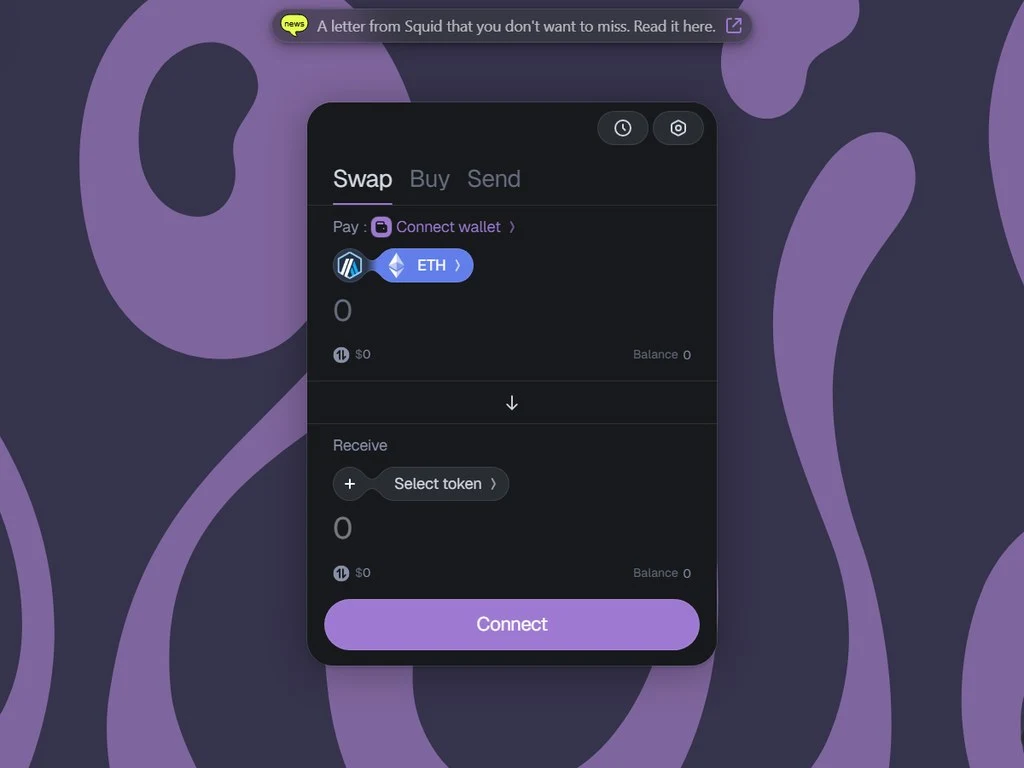
Squid Router is the consumer-facing application that exposes Axelar's GMP power as a one-click any-chain to any-chain swap interface. Where Axelar provides the messaging rails, Squid provides the routing, slippage handling, and fee abstraction so a user can simply pick a source asset on chain A, a destination asset on chain B, and hit swap.
Under the hood Squid composes three steps. First it swaps the source asset on chain A into a bridgeable asset (often axlUSDC or USDC) via a local DEX or aggregator. Second it sends that asset plus a GMP payload through Axelar to chain B. Third it swaps the bridged asset into the desired destination asset on chain B using another DEX. All three steps execute as a single user transaction, with automatic retry and refund logic if any step fails.
For end users, Squid is the closest thing the multichain world has to "click and forget" cross-chain trading. You can swap MATIC on Polygon for SUI on Sui, or USDC on Ethereum for OSMO on Osmosis, without touching a separate bridge, signing multiple transactions, or holding gas tokens on the destination chain. Squid also supports gasless destinations, where the protocol uses the bridged amount to pay gas on the destination chain so the user does not need to pre-fund a wallet there.
The Squid Token Is Not AXL
An important distinction. Axelar has its own token (AXL) for network security and governance. Squid has a separate token, SQUID, which governs the Squid application and routes fees from Squid swaps. The two are independent. Holding AXL does not give you governance over Squid, and holding SQUID does not give you control over Axelar consensus. This separation lets each product evolve on its own roadmap while still sharing infrastructure.
Interchain Token Service: Canonical Tokens Across Chains
The Interchain Token Service, or ITS, is one of the most important developments in cross-chain design over the past two years. ITS lets a token issuer deploy a single canonical token that exists natively on multiple chains at once. Instead of wrapping the token a different way on each chain (which fragments liquidity and confuses users), the issuer registers it once with ITS and gets matching contracts on every chain they choose to support.
From a user's perspective, ITS-issued tokens behave like the same asset everywhere. The supply is unified across chains, balances are accounted for through GMP messages, and any holder can move balances between chains by burning on the source and minting on the destination, all routed through Axelar's validator set. The result is one canonical token, not a forest of wrapped variants.
For new tokens, ITS is the default. Issuers can choose to deploy a fresh token that lives natively on, say, ten chains from day one. For existing tokens, ITS provides a migration path through bridging contracts that connect the legacy ERC-20 to its canonical counterparts on other chains. This pattern is especially powerful for tokenised real-world assets and stablecoins, where issuers need rigorous accounting across many chains, a topic covered further in our RWA tokenisation guide.
Mobius Development Stack: Chain Abstraction Toolkit
Mobius is Axelar's chain-abstraction framework launched in 2025 and rolled out broadly through 2026. The idea behind chain abstraction is that end users should never have to think about which chain they are on. They should just sign a transaction, and the underlying infrastructure should figure out which chain holds the relevant liquidity, which chain charges the lowest fees, and which chain the application logic lives on.
Mobius gives developers a higher-level SDK on top of GMP that handles three things. First, intent resolution: a user expresses what they want (swap, lend, mint) and Mobius computes a route across chains. Second, gas abstraction: users pay fees in a single token and Mobius converts to native gas on every chain involved. Third, signature aggregation: a single user signature authorises an entire multi-chain workflow rather than forcing the user to sign each step.
For builders, Mobius means writing one application that automatically works across 70+ chains. For users, it means a smoother experience that hides the bridge complexity behind a normal-feeling wallet flow. Combined with account abstraction wallets, this is the path Axelar is betting on for mainstream adoption.
70+ Chains Supported: The Breadth of the Network
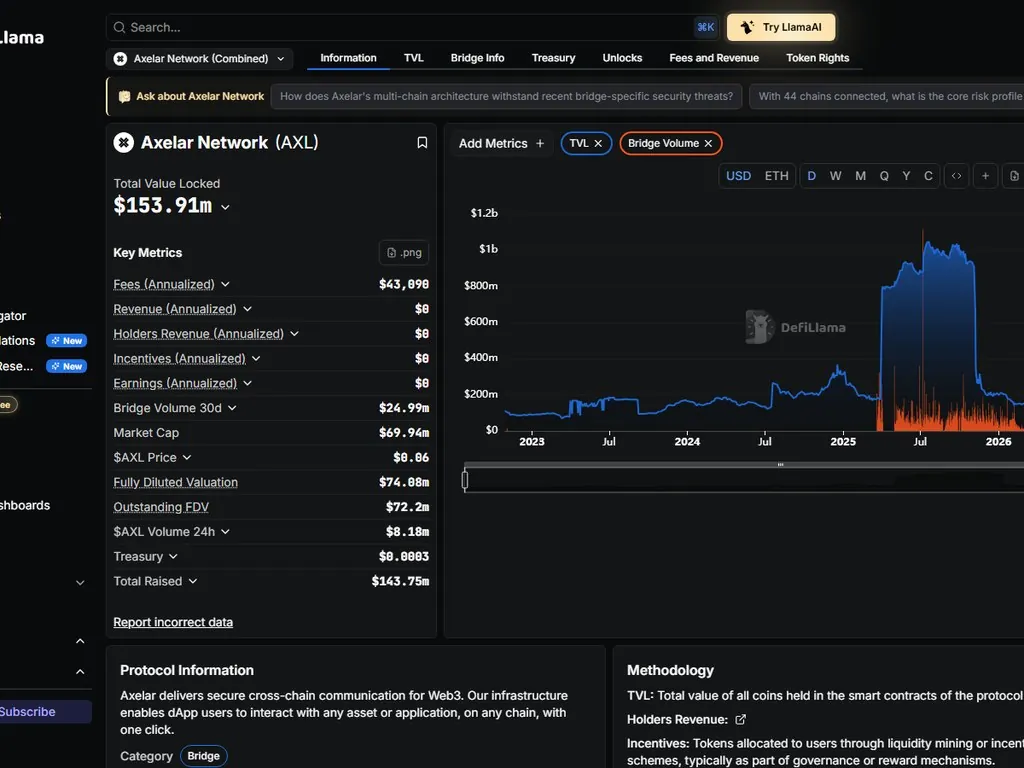
By 2026 Axelar supports more than 70 chains. The list spans every major EVM environment (Ethereum mainnet, Polygon, BNB Chain, Avalanche, Fantom, Base, Arbitrum, Optimism, Linea, Scroll, Mantle, zkSync Era, Celo, Moonbeam), every major Cosmos chain (Osmosis, Cosmos Hub, Juno, Kava, Stargaze, Stride, dYdX, Neutron, Celestia, Sei, Injective), and a growing set of non-EVM smart-contract platforms including Sui, Aptos, and selected Move and Solana-VM environments.
This breadth matters because the value of an interop network grows quadratically with the number of chains it connects. A bridge supporting two chains supports one route. A network supporting 70 chains supports nearly 5,000 directed routes. Every new chain added benefits every existing application that builds on Axelar, because their users immediately gain access to one more destination.
Axelar onboards chains through governance proposals where validators vote to support the new environment, deploy gateways, run dedicated relayers, and add the chain to fee-handling logic. This is more conservative than networks that auto-onboard any EVM, but it gives Axelar a curated list of well-audited integrations rather than an unbounded surface area. For perspective on the underlying smart-contract environments, our Sui Network guide and NEAR Protocol guide cover two prominent non-EVM destinations.
Axelar vs LayerZero vs Wormhole vs Chainlink CCIP
Cross-chain is a crowded category. The big four are Axelar, LayerZero, Wormhole, and Chainlink CCIP. Each takes a meaningfully different security approach.
Axelar vs LayerZero: LayerZero is more modular. Each application can pick its own oracle and relayer (called Decentralized Verifier Networks, or DVNs), which gives developer flexibility but pushes security configuration onto the app. Axelar, in contrast, gives every application the same shared PoS validator set, so the security model is uniform and the developer burden is lower. For most apps, that uniformity is the safer default. For projects that want to pay extra for hyper-customised security, LayerZero's modular DVN model can be appealing.
Axelar vs Wormhole: Wormhole has impressive chain coverage, especially on Solana and other non-EVM environments, but its security relies on a relatively small set of permissioned guardians. The 2022 Wormhole hack drained 120,000 ETH from its Solana bridge through a smart-contract exploit, not a guardian compromise, but the incident underlined how concentrated trust assumptions are amplified by bridge value. Axelar's PoS model with rotating validators is structurally more like a layer 1 chain than a permissioned multisig.
Axelar vs CCIP: Chainlink CCIP layers messaging on top of Chainlink's existing oracle network and adds a Risk Management Network that can pause suspicious flows. CCIP is positioned heavily at enterprise and bank customers and is the natural fit for traditional financial institutions already using Chainlink oracles. Axelar competes on the same institutional ground but is more deeply integrated with the open DeFi ecosystem on Cosmos, Sui, Aptos, and the EVM L2 cluster.
Top Apps Using Axelar
Axelar's success is best measured by the applications building on top of it. Here are the heavyweights in 2026.
The leading derivatives DEX uses Axelar to bridge USDC deposits from Ethereum into the dYdX Cosmos chain. Without Axelar, the v4 migration would not have shipped.
The flagship any-chain to any-chain swap interface, built directly on Axelar GMP. Powers cross-chain swap widgets across dozens of DeFi front-ends.
Frax uses Axelar to deploy FRAX, sFRAX, and frxETH to non-Ethereum chains, including Cosmos environments where Frax otherwise would not have presence.
Lido uses Axelar to bring wstETH across multiple chains, giving stETH stakers access to DeFi on networks beyond Ethereum mainnet.
Microsoft has partnered with Axelar on institutional GMP pilots, particularly around Azure-based blockchain workloads and cross-chain identity.
Mastercard's Multi-Token Network has piloted Axelar GMP for cross-chain settlement, focused on tokenised deposits and regulated stablecoins.
These integrations matter for two reasons. First, they validate the security model against the real economic pressure of moving billions of dollars in volume. Second, they signal Axelar's positioning as institutional-grade infrastructure rather than a retail-only bridge. Microsoft and Mastercard do not partner with weekend projects.
Step by Step: Bridge USDC From Ethereum to Polygon via Squid
The most common entry point for new users is bridging stablecoins. Here is the full flow using Squid Router as the front-end and Axelar as the rails.
Step 1. Open your wallet (MetaMask, Rabby, or any EVM-compatible wallet) on Ethereum mainnet. Make sure you hold the USDC you want to send and a small amount of ETH for gas. If you are unfamiliar with gas dynamics, our gas price and gwei guide is a useful primer.
Step 2. Open the Squid Router web app and connect your wallet. Squid will detect that you are on Ethereum and show your balances.
Step 3. In the source field, select USDC on Ethereum. In the destination field, select USDC on Polygon (or any other supported destination, including USDC on Cosmos chains via axlUSDC).
Step 4. Enter the amount you want to send. Squid will display the route it intends to use, including any DEX hops, the expected output, the Axelar bridge fee, and the estimated time. Most routes complete in under three minutes.
Step 5. Review the slippage tolerance. For stablecoin to stablecoin swaps you can typically set this very low (0.1% to 0.3%). For volatile asset swaps, leave it slightly higher. Our slippage explained guide covers this in depth.
Step 6. Click swap. Your wallet will pop up two prompts. The first is an ERC-20 approval letting the Axelar gateway pull your USDC. The second is the actual swap transaction. Approve and sign both.
Step 7. Wait for the transaction to confirm on Ethereum, for Axelar validators to observe and sign, and for the destination contract on Polygon to receive the USDC. Squid shows a live progress tracker.
Step 8. Once complete, switch your wallet network to Polygon and verify the USDC has arrived. You can also check the route on Axelarscan, Axelar's block explorer.
Step by Step: Send a Cross-Chain GMP Message as a Developer
For builders, the real superpower of Axelar is calling contracts on other chains directly from a contract on the source chain. This is the developer flow.
Step 1. Import the Axelar SDK on the source chain. For EVM, this is the @axelar-network/axelar-gmp-sdk-solidity package, which gives you the gateway interface and a base contract called AxelarExecutable.
Step 2. On the destination chain, deploy a contract that inherits from AxelarExecutable and overrides the _execute internal function. This is where your destination logic lives. The function receives the source chain, source address, and the message payload.
Step 3. On the source chain, call gateway.callContract with the destination chain identifier, the destination contract address, and the ABI-encoded payload. Pay the gas fee in the source chain's native token, which Axelar's gas service uses to fund the destination execution.
Step 4. Axelar validators observe the source event, threshold-sign the message, and a relayer submits it to the destination gateway. Within a few minutes, your destination contract's _execute function fires, processing the payload.
Step 5. Track the message lifecycle on Axelarscan. Every GMP call has a unique tx hash and a status panel showing source confirmation, validator signing, destination submission, and final execution. If anything fails, Axelar's retry logic kicks in automatically.
This pattern unlocks cross-chain lending, cross-chain governance, cross-chain NFT mints, cross-chain DAO treasury operations, and a long tail of multi-chain workflows. For a closer look at how messages encode data, the transaction simulation guide shows how to inspect arbitrary calls before signing.
2024 to 2026 Milestones
The two years between 2024 and 2026 have been transformative for Axelar.
2024: Interchain Token Service ships as the canonical-token framework. Mobius Development Stack is announced. Axelar surpasses 70 connected chains and routes its first ten billion in cumulative cross-chain volume.
2025: Microsoft partnership announced for institutional GMP, with Azure customers gaining access to managed Axelar relayers. Mastercard Multi-Token Network integration tested for regulated stablecoin settlement across permissioned and public chains. Quadratic voting pilots are run for major treasury proposals and well-received by the community.
2026: Mobius Development Stack reaches general availability, becoming the recommended way for new dApps to build cross-chain. ITS becomes the default token deployment standard for new multi-chain launches, including several large stablecoin and RWA issuers. Axelar starts to compete head-on with CCIP for enterprise mandates and continues to expand into Move-based chains.
Risks of Using Axelar
Cross-chain protocols sit on top of every chain they connect, which means every risk in the underlying chains is also a risk for users moving assets through them. On top of that, the bridge layer itself adds its own attack surface. Anyone using Axelar should hold these risks honestly in view.
Validator collusion. Axelar's PoS model is far more robust than small permissioned multisigs, but it is still a system where a supermajority of validators must remain honest. If a coordinated coalition controlling enough stake collaborated maliciously, they could in principle authorise fraudulent transfers. The economic cost would be enormous and would crash the AXL token, but the attack surface is non-zero. Slashing, social recovery, and governance interventions are the safeguards.
Smart contract bugs. Gateway contracts on each chain are critical infrastructure. A bug in a gateway, the ITS contracts, or the relayer logic could be exploited. Axelar has been heavily audited by Trail of Bits, NCC Group, OtterSec, and others, and runs a sizeable bug bounty, but no audit guarantees freedom from defects. Defence in depth means following the principle of using only as much capital as you can afford to write off in a worst-case bridge event.
Sector-wide bridge hack history. The cross-chain category has lost over two billion dollars to hacks across Ronin, Wormhole, Nomad, Multichain, and others. Axelar has not suffered a major exploit, but it operates in an industry where exploits happen regularly. Users should diversify exposure, prefer canonical native assets when available, and not park large balances in bridge-wrapped tokens long term.
Slashing and validator outages. While not a direct user risk, validator-side failures can briefly slow message delivery or, in extreme scenarios, halt cross-chain operations until enough stake is back online to reach signing thresholds. Liveness, not safety, is the typical pain point.
Regulatory uncertainty. Cross-chain bridges that hold large quantities of user assets resemble financial intermediaries from a regulatory standpoint. Frameworks vary across jurisdictions and continue to evolve. Users moving regulated tokens such as tokenised treasuries should pay attention to compliance posture and disclosure quality. Our Ondo Finance and tokenised treasuries guide covers some of these themes.
Pros and Cons of Axelar Network
- PoS validator security similar to a layer 1 chain
- Generic GMP supports any cross-chain call, not just transfers
- Interchain Token Service unifies canonical tokens
- 70+ chains supported, including major non-EVM environments
- Squid Router delivers a one-click consumer UX
- Institutional partnerships with Microsoft and Mastercard
- Adds an extra trust layer beyond the source and destination chains
- Slower than optimistic same-chain transactions
- Wrapped asl* tokens are not always the deepest liquidity
- Fee structure varies across chain pairs and can be opaque
- Smaller validator set than mainnet Ethereum
- Sector-wide regulatory uncertainty around bridges
Best Practices for Users and Builders
For users, the practical advice is to favour smaller test amounts on first use, double-check destination addresses (cross-chain address poisoning is a real attack pattern), and prefer canonical or ITS tokens where they exist over older wrapped variants. Our address poisoning guide and wallet security tips cover the operational hygiene that matters most when moving funds across chains.
For builders, the core practices are to keep destination contracts intentionally minimal, to validate msg.sender and source address inside _execute rigorously, to assume that messages might arrive out of order and design for idempotency, and to fund the Axelar gas service generously so users do not see failed destination executions. Building with the Permit2 model for token permissions is a complementary pattern when handling source-chain approvals safely.
Frequently Asked Questions
Q What is Axelar Network in one sentence?
Axelar Network is a decentralised proof-of-stake interoperability protocol that lets any smart contract on one blockchain call any other contract or transfer assets to any other blockchain through a shared validator set and a generalised messaging layer called GMP.
Q Who founded Axelar Network?
Axelar was founded in 2020 by Sergey Gorbunov and Georgios Vlachos. Both were senior contributors at Algorand before starting Axelar, with Gorbunov leading cryptography research and Vlachos heading mathematics. The team is backed by Binance Labs, Dragonfly, Polychain, and Galaxy Digital among others.
Q What is the AXL token used for?
AXL is the native token of Axelar. It is used for proof-of-stake validator bonding and delegation, for governance voting (including quadratic voting on certain proposals), and as the unit in which validators are paid for relaying General Message Passing traffic. AXL accrues rewards from inflation and protocol fees.
Q How is Axelar different from LayerZero?
Axelar uses a single shared PoS validator set to secure every cross-chain message uniformly. LayerZero uses a modular oracle plus relayer model (DVNs) where each application configures its own security stack. Axelar is simpler and more uniform for developers, while LayerZero is more configurable for apps willing to pay for custom verifier setups.
Q What is General Message Passing (GMP)?
General Message Passing is Axelar's core primitive that lets a smart contract on one chain trigger an arbitrary function call on another chain. GMP supports both pure messages and messages that include token transfers in the same atomic operation, and it is what powers Squid Router, ITS, and most apps building on Axelar.
Q What is Squid Router and is it part of Axelar?
Squid Router is a one-click any-chain to any-chain swap application built on top of Axelar GMP. It is closely tied to the Axelar ecosystem but governed by its own SQUID token. AXL secures the underlying messaging layer, while SQUID governs Squid itself, including its routing rules and fee parameters.
Q What is the Interchain Token Service?
The Interchain Token Service (ITS) is an Axelar framework that lets a token issuer deploy one canonical token that exists natively on many chains at the same time. Instead of fragmenting liquidity through separately wrapped versions, ITS uses GMP to keep balances synchronised so the token is treated as a single asset across the multichain world.
Q How many chains does Axelar support?
Axelar supports more than 70 chains in 2026, including Ethereum, all major EVM Layer 2s (Arbitrum, Optimism, Base, Linea, Scroll, zkSync Era, Mantle), BNB Chain, Polygon, Avalanche, Sui, Aptos, and the major Cosmos chains such as Osmosis, Cosmos Hub, dYdX, and Celestia. New chains are added by validator governance.
Q Is Axelar safe to use?
Axelar is among the more conservative interop designs in the market thanks to its PoS validator set, threshold signatures, repeated audits, and bug bounty. It has not suffered a major exploit. That said, all cross-chain bridges share elevated systemic risk, so users should still avoid parking large long-term balances in wrapped bridge assets and prefer canonical ITS tokens when available.
Q Which big apps actually use Axelar today?
dYdX uses Axelar to bridge USDC into its Cosmos chain. Squid Router is built directly on Axelar GMP. Frax uses Axelar to deploy its stablecoins and frxETH across chains. Lido brings wstETH to non-Ethereum networks through Axelar. Microsoft and Mastercard have run institutional pilots on Axelar for cross-chain settlement and identity.
Q What is the Mobius Development Stack?
Mobius is Axelar's chain-abstraction toolkit. It sits on top of GMP and gives developers higher-level primitives for intent resolution, gas abstraction, and signature aggregation across many chains. The goal is to let users interact with multichain apps without ever choosing a network or holding multiple gas tokens, while developers write one application that targets all supported chains.
Q How does Axelar handle gas on the destination chain?
Axelar runs a gas service that lets a sender pay a single fee in the source chain's native token. That fee covers validator signing, relaying, and execution on the destination chain. Squid Router and Mobius take this further by abstracting gas entirely, so the user never needs to hold the destination chain's native token to receive funds.
Conclusion: Why Axelar Matters in 2026
Cross-chain is no longer a frontier experiment. It is the substrate of the modern crypto economy. Every serious DeFi protocol, every tokenised real-world asset issuer, every wallet vendor, every L2 ecosystem, and every institutional pilot has to answer one question: how do my users move value and intent across chains safely. Axelar Network is one of a handful of credible answers, and its combination of PoS validator security, General Message Passing, Interchain Token Service, Squid Router UX, and the Mobius chain-abstraction stack make it arguably the most complete in 2026.
For users, the immediate value is being able to swap any asset on any chain in one click through Squid, with the assurance that the rails underneath are secured by a stake-weighted validator set rather than a small permissioned multisig. For builders, the value is shipping one application that automatically works across 70+ networks, without writing custom bridge integrations for each. For institutions, the value is partnering with infrastructure that has already run Microsoft and Mastercard pilots and that publishes its governance and audits in the open.
None of this makes Axelar risk-free. The cross-chain category remains the most heavily exploited part of crypto, and even the best designs deserve scepticism and small initial test amounts. But within the realistic landscape of trade-offs, Axelar has carved out a strong position as the validator-secured, developer-friendly, institutional-ready interoperability layer of the 2026 multichain world. If you are exploring DeFi seriously, you will almost certainly use it, knowingly or otherwise, on a regular basis. The next time you bridge USDC for a perp trade on dYdX, route through Squid, or hold wstETH on a chain that is not Ethereum, take a moment to notice the rails. They are probably Axelar's.
Related Guides
- What Is Axelar: Cross-Chain Messaging, Interoperability and Token Transfers (2026)
- Wormhole vs LayerZero: Cross-Chain Messaging Compared 2026
- What Is THORChain: RUNE Cross-Chain Bitcoin DEX Guide 2026
- What is Chainlink CCIP? Cross-Chain Protocol Guide 2026
- What Is Biconomy: Account Abstraction, Gasless UX and Cross-Chain Execution (2026)