What Is Helium Mobile? The DePIN Cellular Network That Pays You in Crypto (2026 Guide)
— By Whatsertrade in Tutorials
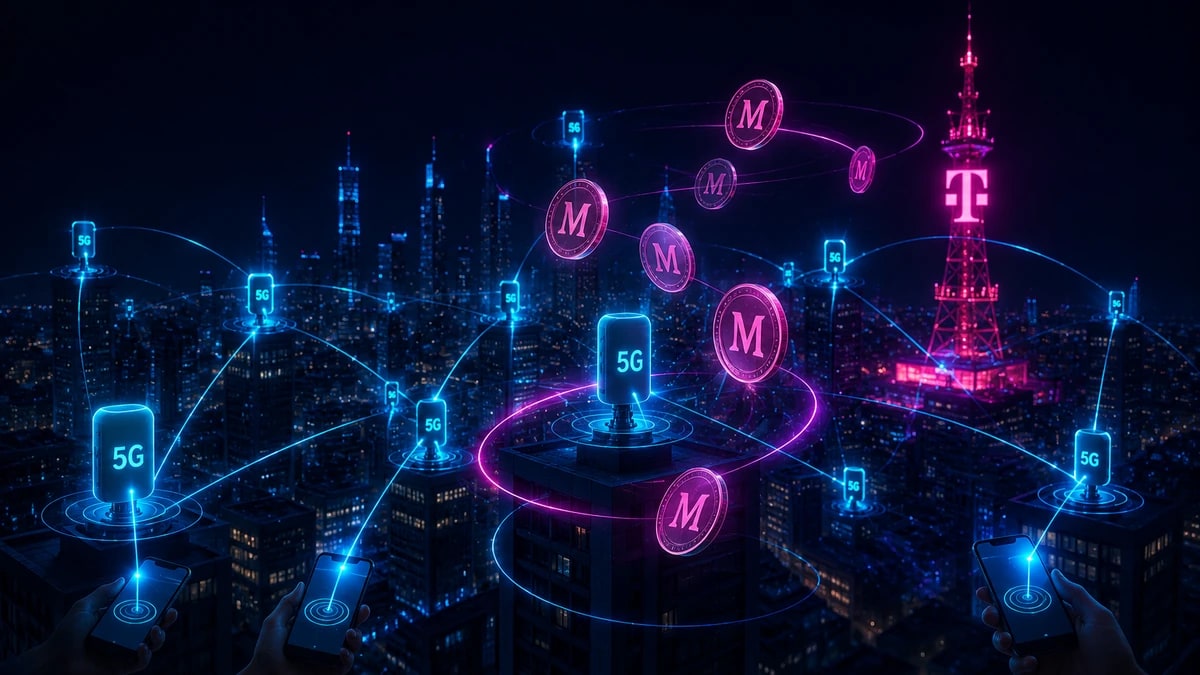
Helium Mobile fuses a $20 unlimited US plan, T-Mobile roaming, citizen-deployed 5G hotspots, and the MOBILE token on Solana into the first crypto-incentivized cellular carrier. Here is how it really works in 2026.
What Is Helium Mobile? The DePIN Cellular Network That Pays You in Crypto Explained in 2026
For decades, the US cellular market has been a quiet oligopoly. Verizon, AT&T, and T-Mobile collectively sell wireless service to more than 300 million Americans, raise prices roughly in lockstep, and bury subscribers under jargon-laden plans that hide the true cost of unlimited data. Helium Mobile, the consumer carrier brand operated by Nova Labs and built on the Solana blockchain, is the first credible attempt to crack that oligopoly using cryptoeconomic incentives instead of capital expenditure. It sells a $20 per month unlimited US plan, roams on T-Mobile’s nationwide 5G network, and lets anyone deploy a $400 hotspot to expand coverage and earn MOBILE tokens for the data their radio serves.
The pitch sounds almost too neat: cheap unlimited service, real LTE/5G speeds, no contract, and a token reward layer that turns customers and bystanders into a distributed workforce of micro carriers. But behind the slogan sits a complex stack of DePIN economics, hardware standards, regulatory carveouts (CBRS spectrum), and on-chain governance decisions, most notably HIP 138, the January 2025 vote that reverted the network’s rewards back to HNT as the primary emission token. Helium Mobile is not a toy and it is not a scam. It is a working consumer telecom product with hundreds of thousands of paying subscribers and a token economy that has already survived three full reward halvings and one full L1 migration.
This guide walks through every layer of the Helium Mobile stack the way a serious 2026 reader needs to see it. We will cover the founding story going back to Helium Inc. in 2013, the architecture that lets a hotspot in Brooklyn cooperate with a T-Mobile tower in New Jersey, the MOBILE tokenomics post-HIP 138, the realistic earnings for hotspot operators, the customer experience on the $20 unlimited plan, and the honest tradeoffs against incumbent carriers. By the end you will know whether to subscribe, whether to deploy hardware, and how to think about the MOBILE token as a speculative asset versus a coverage incentive.
FEATURED SNIPPET
Helium Mobile is a US cellular carrier operated by Nova Labs that combines T-Mobile nationwide 5G roaming with a decentralized network of citizen-owned Helium 5G hotspots, all coordinated on the Solana blockchain. Subscribers pay $20 per month for unlimited talk, text, and data, while hotspot operators earn MOBILE tokens (and, after HIP 138, HNT) as rewards for providing verified coverage and transferring data. It is the consumer-facing application of the Helium Network, a DePIN protocol that turns wireless infrastructure into an open, tokenized commons.
What Is Helium Mobile in Plain English
Strip away the crypto vocabulary for a moment and Helium Mobile is just a US cell phone carrier. You buy a SIM card or eSIM, you port your number, you pay $20 a month, and you get unlimited calls, texts, and high speed data on a network that looks identical to T-Mobile’s in most coverage maps. There is no contract, no credit check beyond the standard fraud screen, and no surprise fee creep at month nine. From the user’s perspective it is a discount MVNO (mobile virtual network operator) with an unusually aggressive price point and a slick app.
The crypto part lives one layer down. Helium Mobile is the retail brand sitting on top of the Helium Network, a DePIN protocol that uses token rewards to bootstrap physical wireless infrastructure. When you walk past a participating Helium 5G hotspot, your phone can offload traffic from T-Mobile’s expensive macro towers onto that hotspot’s much cheaper CBRS small cell. The hotspot operator gets paid in MOBILE tokens, Nova Labs avoids paying a T-Mobile roaming fee for that gigabyte, and the savings ultimately fund the $20 plan. Every transaction, every coverage proof, and every reward distribution settles on the Solana blockchain in seconds.
That dual layer architecture, a normal carrier on top, a token-incentivized infrastructure layer underneath, is what makes Helium Mobile a textbook DePIN case study. It also makes it the only consumer telecom service in the world where opting in lets you participate in the supply side. You can be a customer, a coverage provider, a token holder, and a governance voter simultaneously, with all four roles cohabiting in a single app.
The Cellular Industry Problem It Solves
To understand why Helium Mobile exists you have to look at the dirty economics of building a cellular network. A single macro tower costs between $150,000 and $300,000 to deploy, plus annual lease, fiber backhaul, and power costs that easily exceed $50,000. Operators justify those costs by serving thousands of devices per tower, but coverage is brutally non-linear: the last 5 percent of geographic coverage often costs more than the first 80 percent. That is why rural America still has dead zones, why dense urban hotspots like stadium concourses crawl during peak hours, and why every major carrier loves to publish a coverage map that is 90 percent accurate at best.
The traditional answer is to spend more capex, raise prices, and bundle services to lock subscribers into longer contracts. The DePIN answer flips the equation. Instead of one company paying for every radio, you let thousands of individuals deploy small radios where they already have power, internet, and a vested interest in local coverage. The protocol pays them in tokens proportional to how much real, verified traffic their radio carries. The result is a coverage map that organically grows where demand actually lives, at a fraction of the capital cost.
Helium Mobile is the first time this model has been applied to consumer cellular at meaningful scale. Earlier DePIN telecom experiments existed for LoRaWAN (the original Helium IoT network launched in 2019) and for niche enterprise use cases, but none reached the price-and-speed point where a normal American would switch off Verizon to save money. The $20 unlimited plan changed that calculation in 2023, and the addition of AT&T as a secondary roaming partner in 2024 closed enough remaining coverage gaps to make the offering credible nationwide.
Nova Labs and the Founding Story
Helium did not start as a crypto project. The company was founded in 2013 by Amir Haleem, Shawn Fanning (of Napster fame), and Sean Carey as Helium Inc., with the goal of building a low-power wireless network for the Internet of Things. For five years it functioned as a conventional Silicon Valley hardware startup, shipping enterprise IoT gateways with limited adoption. By 2018 the team realized that the slow growth was a chicken and egg problem: enterprises would not pay for IoT connectivity until there was coverage, and coverage would not exist until someone paid to deploy radios.
The pivot to a tokenized model came in 2019 with the launch of the original Helium blockchain, a custom Layer 1 designed around a consensus mechanism called Proof of Coverage. Hotspot operators were paid in HNT tokens for proving they were broadcasting where they claimed to be broadcasting, and enterprises paid for IoT data credits denominated in HNT. The network grew explosively to nearly one million hotspots by 2022, became one of the most cited DePIN success stories of the cycle, but also revealed serious limits in the custom L1: high gas during congestion, poor wallet UX, and a small developer ecosystem.
In 2022 the corporate brand renamed to Nova Labs, and the team announced HIP 70, the proposal to migrate the entire Helium Network onto Solana. The migration completed in April 2023 and almost immediately unlocked the cellular expansion. Solana’s throughput, sub-cent fees, and large developer ecosystem made it feasible to settle hundreds of thousands of micro reward transactions per day, which was the only way a consumer cellular product with continuous data offload could ever work on-chain. Helium Mobile launched its public US service later that same year.
Helium and Helium Mobile Timeline
Helium Inc. founded by Amir Haleem, Shawn Fanning, and Sean Carey to build long range IoT wireless infrastructure for enterprise customers.
Public launch of the Helium blockchain with Proof of Coverage consensus and HNT rewards for IoT hotspot operators. The People’s Network is born.
Corporate rebrand to Nova Labs. The 5G subnetwork and MOBILE token launch as a separate reward layer for CBRS cellular hotspots, setting the stage for consumer telecom.
HIP 70 executes: full migration of the Helium Network from its custom L1 to Solana. Helium Mobile launches the $5 introductory and $20 unlimited consumer plans in the United States with T-Mobile as the roaming partner.
Nova Labs announces an additional roaming partnership with AT&T, dramatically improving coverage in regions where T-Mobile signal was weak and signaling that Helium Mobile is being treated as a real competitor by incumbents.
HIP 138 passes governance in January 2025. The proposal reverts the primary reward token across all Helium subnetworks back to HNT, consolidating the tokenomics and reducing fragmentation between MOBILE, IOT, and HNT incentives.
Helium Mobile operates with hybrid AT&T plus T-Mobile roaming, post-HIP 138 unified emissions, mature Discovery Mapping rewards, and growing third party device support beyond the original Solana Saga phone bundle.

How the Decentralized Cellular Network Actually Works
The Helium Mobile architecture has three logical layers and they need to be understood separately before they make sense together. The bottom layer is the radio access network, the actual physical hotspots that broadcast 5G signal on CBRS spectrum. The middle layer is the roaming partnership stack with T-Mobile and AT&T that provides nationwide fallback whenever a Helium hotspot is not in range. The top layer is the Solana-settled token and governance system that pays hotspot operators, accounts for data transfer, and routes Discovery Mapping rewards to subscribers who help map coverage.
When you make a call or open a streaming app on a Helium Mobile SIM, your phone first checks whether a participating Helium 5G hotspot is within range. If yes, and if the hotspot has sufficient signal quality, your traffic flows through that hotspot, into the operator’s home broadband, into Nova Labs’ core network, and out to the public internet. The hotspot operator earns MOBILE rewards (now post HIP 138, denominated in HNT as the primary unit) proportional to the bytes served and the verified quality of coverage. If no Helium hotspot is available, the phone falls back transparently to T-Mobile or AT&T macro coverage, and Nova Labs pays a wholesale per gigabyte rate to the carrier just like any MVNO would.
Critically, the user never has to think about any of this. The SIM logic is automated and invisible. From the customer’s point of view it is one continuous signal. From the protocol’s point of view, every offload event is an on-chain micro transaction that proves coverage, accounts for data, and emits tokens. Solana’s low fees and one-second confirmation times are what make this economically viable. On a higher-fee chain the rewards would be eaten alive by transaction costs and the entire model would collapse.
T-Mobile and AT&T Hybrid Architecture
The roaming partnerships are the unglamorous but most important pieces of the architecture. Without them, Helium Mobile would be a coverage island, useful only inside a few square blocks of dense urban hotspot deployment. The original T-Mobile deal, struck in 2022 and operationalized at the 2023 consumer launch, gave Nova Labs access to T-Mobile’s full 5G and LTE footprint at MVNO wholesale rates. The 2024 AT&T addition added a second nationwide failover, which is particularly meaningful in the Midwest and Southeast where T-Mobile coverage historically lagged.
These partnerships are also why incumbent carriers should not feel threatened in the short term. Helium Mobile pays them per gigabyte. Every subscriber that signs up actually generates roaming revenue for T-Mobile and AT&T, at least until enough hotspot coverage exists to offload a large fraction of usage. The strategy is intentionally non confrontational at the macro level and competitive at the retail level. Nova Labs undercuts retail prices, the wholesale partners get paid anyway, and over time the hotspot network grows to reduce roaming dependency.
The honest truth is that in 2026 the vast majority of Helium Mobile traffic still rides on T-Mobile or AT&T radios, not on citizen-deployed hotspots. The hotspot network is concentrated in urban corridors, college towns, and tech hubs. Outside of those, you are functionally on a T-Mobile MVNO with a crypto rewards app attached. That is not a failure, it is the expected trajectory of any DePIN deployment, and the offload percentage is rising every quarter as more hotspots come online.
Plans, Pricing, and Real Customer Experience
Helium Mobile’s consumer pricing is intentionally simple. The headline plan is $20 per month for unlimited talk, text, and high speed data in the United States, with no contract, no autopay penalty, and no data cap. There is also a Hybrid tier around $30 that bundles additional features such as larger international allowances and priority data, and a free experimental tier that some users qualify for in select markets in exchange for participating in Discovery Mapping rewards. The free tier varies by market and is best understood as a marketing acquisition channel rather than a long term product.
Reviews from independent outlets in 2024 and 2025 consistently described the customer experience as solid for the price but inconsistent in fringe coverage areas. Streaming, browsing, and calls work well in any T-Mobile or AT&T friendly metro. International roaming exists but is limited and not the reason to choose this carrier. Customer support is app first, chat heavy, with limited phone support, which is typical for digital native MVNOs. The app itself is polished, with clear data usage, plan controls, eSIM provisioning, and a wallet section showing earned MOBILE and HNT rewards.
Number portability works as expected through the standard US LNP process. You request your account number and PIN from your current carrier, you enter them in the Helium Mobile app or sign up flow, and the switch typically completes within a few hours. eSIM provisioning is supported on all modern iPhones (XS and later) and most Android flagships, which means you do not even need to wait for a physical SIM to arrive if your device is compatible.

Hotspot Hardware and Deployment Flow
If you want to participate as a coverage provider you need to deploy a Helium 5G hotspot. These are not the same units as the original IoT LoRaWAN hotspots from the 2019 to 2022 cycle. The 5G hardware uses CBRS spectrum (3.55 to 3.7 GHz, lightly licensed in the US under a tier called General Authorized Access), and is sold by approved manufacturers including FreedomFi, Bobcat, and a handful of others. Indoor units typically cost $400 to $600 and serve a single room or floor; outdoor units run $1,500 to $3,000 and cover a city block or small commercial property.
The deployment flow is straightforward but unforgiving of bad placement, which is why earnings vary dramatically by location.
STEP 1
Buy approved 5G hotspot
Choose between FreedomFi, Bobcat, and other approved CBRS units. Indoor models are cheapest, outdoor models earn more in dense areas.
STEP 2
Install and onboard
Connect to home broadband, register the hotspot on Solana via the Helium app, complete CBRS spectrum registration, point antenna toward likely traffic.
STEP 3
Earn tokens for coverage and data
Rewards flow daily based on verified coverage area and bytes transferred. Withdraw to a Solana wallet or hold inside the Helium app.
The crucial thing to understand about hotspot economics is that emissions reward two distinct activities: coverage and data transfer. Coverage rewards are paid for proving that you exist as a usable radio in a given location, regardless of whether anyone is currently using you. Data transfer rewards are paid for actually offloading bytes from the wholesale roaming carriers. In the early years of the network, coverage rewards dominated. Post HIP 138 and as subscriber growth accelerates, data transfer rewards are catching up, and well placed hotspots in dense urban areas can earn significantly more than poorly placed rural units.
MOBILE Tokenomics and the HIP 138 HNT Pivot
Until early 2025, the Helium Network ran a tri-token economy: HNT was the primary network token, IOT was the reward token for the IoT subnetwork, and MOBILE was the reward token for the 5G cellular subnetwork. Hotspot operators earned MOBILE or IOT depending on which radio they ran, and they could optionally convert those subnetwork tokens to HNT through a bonding curve. The design was elegant in theory but caused fragmentation in practice: three tokens meant three liquidity pools, three sets of speculators, three governance constituencies, and three confusing UX flows for new users.
HIP 138, ratified by the Helium DAO in January 2025, addressed that fragmentation by reverting all subnetwork rewards to HNT as the primary emission token. In practice this means that hotspot operators today earn HNT directly for coverage and data transfer, rather than earning MOBILE or IOT and then converting. MOBILE and IOT still exist as governance and utility tokens within their respective subnetwork DAOs (Mobile Network DAO and IoT Network DAO), but the inflationary emissions side of the equation has been unified.
From an investor or speculator standpoint, MOBILE in 2026 is best understood as a subnetwork governance and utility token with reduced inflationary pressure, since new MOBILE is no longer being minted as reward emissions in the same way it was pre-2025. Existing supply still trades on Solana DEXs and on centralized exchanges like Bitget, Coinbase, and Binance, and is used inside the Mobile Network DAO for proposals affecting cellular specific policies such as hotspot approval, spectrum decisions, and data credit pricing.
Anyone evaluating MOBILE as an asset should pay close attention to the post HIP 138 emission schedule, the size of the Mobile Network DAO treasury, and the fraction of Helium Mobile usage that actually offloads through hotspots versus T-Mobile or AT&T roaming. The token’s long term value is tied to whether the citizen radio network grows into a meaningful share of total traffic. As with most DePIN tokens, the worst case is a network that remains a marketing layer on top of MVNO economics; the best case is a network that systematically displaces incumbent infrastructure capex.
Discovery Mapping and Proof of Coverage
One of the most distinctive Helium Mobile features is Discovery Mapping, a system that pays subscribers small rewards for traveling around and helping map cellular coverage gaps and qualities. When you opt in via the app, your phone periodically uploads anonymized signal samples (cell ID, signal strength, location, timestamp) to a coverage map that helps Nova Labs and the DAO understand where additional hotspots are most needed. In return you earn small amounts of tokens, which accumulate to the wallet attached to your account.
Discovery Mapping is conceptually similar to Hivemapper’s decentralized street map approach, where citizen sensors contribute data to a shared geographic dataset in exchange for tokens. The difference is that Helium Mobile’s mapping is a passive add-on to a service you are already paying for, rather than a dedicated activity requiring extra hardware. Most subscribers who enable it earn between a few cents and a few dollars per month in token value, which is functionally a small loyalty rebate rather than a serious income stream.
Proof of Coverage is the on-chain mechanic that validates hotspot honesty. The protocol regularly asks hotspots to prove they are broadcasting where they claim to be, by issuing challenges that other nearby hotspots and subscribers must witness. A hotspot claiming to be in Times Square but actually plugged in 50 miles away will fail these challenges and have its coverage rewards slashed or zeroed out. PoC is what prevents trivial gaming of the reward system, although sophisticated attackers have historically found and exploited edge cases, leading to ongoing protocol upgrades.

Helium Mobile vs Traditional Carriers vs DePIN Peers
Against incumbent carriers, Helium Mobile competes mostly on price. The $20 unlimited tier is materially cheaper than equivalent unlimited plans from Verizon, AT&T, or T-Mobile retail, even after promotional bundle discounts. The tradeoff is that Helium Mobile does not offer the same premium 5G prioritization, family bundle deals, or device subsidies. Subscribers bringing their own unlocked phone get the best value; subscribers wanting a new iPhone financed over 36 months will get better terms from a postpaid incumbent. Coverage is roughly comparable in metro areas thanks to the T-Mobile plus AT&T fallback, and meaningfully better than any single carrier in cities with dense Helium hotspot deployment.
Against other MVNOs like Mint Mobile, Visible, or Cricket, Helium Mobile’s differentiator is the token rewards layer and the optional supply side participation. A subscriber on Mint Mobile is purely a customer. A subscriber on Helium Mobile can also enable Discovery Mapping rewards, run a hotspot, hold MOBILE or HNT, and participate in governance. For users who do not care about any of that, Helium Mobile is just a competitive MVNO. For users who care about crypto and DeFi participation, it stacks economic exposure on top of a service they were going to buy anyway.
Against other DePIN networks, Helium Mobile is the most mature consumer facing example. Compute-focused DePIN projects like Aethir, io.net, and Akash Network serve enterprise GPU and cloud demand rather than consumer telecom. Hivemapper covers decentralized mapping. Helium Mobile is the closest thing the DePIN sector has to a B2C product with mass market unit economics, which is part of why it gets cited so heavily in DePIN narratives and is often the on-ramp story that converts skeptics.
Risks and Honest Tradeoffs
No analysis of Helium Mobile would be complete without an honest list of risks. The first and most underappreciated is concentration of wholesale dependency. Even with two roaming partners, Nova Labs is fundamentally dependent on T-Mobile and AT&T continuing to honor their MVNO agreements at favorable rates. If one or both carriers decided to terminate or hike wholesale pricing, the $20 unlimited plan would not survive. Helium Mobile’s defense is that those carriers earn revenue from the partnership and that the hotspot network reduces dependency over time, but the structural risk is real.
The second risk is token economy stability. The HIP 138 transition unified emissions but also introduced complexity around legacy MOBILE holders, treasury management, and DAO governance under the new structure. Hotspot operators who bought hardware expecting MOBILE rewards under the old schedule are now earning HNT under new ratios. The transition was handled relatively gracefully but it is a reminder that DePIN tokenomics can change via governance vote and that hardware ROI projections from year one can be invalidated by year three.
The third risk is the persistent gap between marketing maps and reality in citizen deployed coverage. Some hotspots have always been mis located, mis configured, or operated with subpar antennas. Proof of Coverage catches the worst offenders but the network still includes a long tail of underperforming radios. Subscribers in promised coverage areas occasionally find that the only working signal is the T-Mobile or AT&T fallback, which is fine for service quality but reduces the unique value proposition of the DePIN layer.
The fourth risk is the broader regulatory environment around CBRS spectrum and decentralized telecom in general. Helium Mobile operates under General Authorized Access tier rules that allow lightly licensed use of mid-band spectrum. Any future tightening of those rules, any FCC action that reclassifies how citizen radios must register, or any state-level consumer protection investigation could create headwinds. So far the regulatory posture has been neutral to favorable, but that should not be assumed permanent.
The fifth risk applies to anyone trading MOBILE or HNT speculatively rather than holding them as governance or utility tokens. The price action of both has been extremely volatile across the 2022 to 2026 window, driven by broader crypto cycles, network milestones, and emission schedule debates. Treating MOBILE as a directional investment requires the same risk management as any other altcoin. Treating it as a side benefit of being a Helium Mobile subscriber or hotspot operator is a much sounder framing.
PROS and CONS at a Glance
Pros
- $20 unlimited US plan undercuts every major carrier
- T-Mobile plus AT&T roaming gives real nationwide footprint
- Built on Solana for sub-cent fees and instant settlement
- Optional supply side participation via hotspots and Discovery Mapping
- HIP 138 consolidated emissions back to HNT, reducing token fragmentation
- Number portability, eSIM, and no contract make switching painless
- The only mainstream consumer DePIN product at meaningful US scale
Cons
- Most traffic still flows via T-Mobile or AT&T, not citizen hotspots
- Hotspot hardware ROI depends heavily on micro-location and traffic
- Limited international roaming versus tier one postpaid plans
- MOBILE token utility was reduced by HIP 138 emission changes
- Customer support is app first with limited phone support
- Regulatory risk around CBRS spectrum and decentralized telecom rules
- Wholesale dependency creates a structural negotiating risk with carriers
Best Practices for Subscribers and Hotspot Operators
If you are evaluating Helium Mobile primarily as a subscriber, the simplest path is to port a single line on a 30 day trial basis to a phone that supports eSIM. Use the line for a full month in your normal commute, home, and work zones. Observe whether you ever hit a dead zone that your previous carrier handled. If yes, decide whether the $20 savings versus your previous bill is worth that occasional friction. For most US metro residents the math works strongly in Helium Mobile’s favor; for rural users the math is mixed.
If you are evaluating Helium Mobile as a hotspot operator, the first rule is do not buy hardware unless you have a deployment location with strong line of sight to outdoor pedestrian or vehicle traffic, reliable home broadband upstream, and a willingness to leave a radio powered for years. ROI projections for Helium 5G hotspots are sensitive to local subscriber density, competing nearby hotspots, and the ongoing emission schedule. Start with one indoor unit at the best location you control, observe earnings for two to three months, and only scale up if the data supports it. Treat the hardware as a multi year commitment, not a quick flip.
Token storage best practices apply just as they do for any other Solana ecosystem asset. Use a hardware wallet for serious balances, separate hot wallets from cold storage, and watch out for address poisoning attacks that target Solana wallets exactly as they target other chains. If you are unfamiliar with that attack class, read our explainer on how to avoid crypto address poisoning scams before moving any MOBILE or HNT off exchanges. Self custody is the right default, but only if you handle the operational security correctly.
For users curious about earning more on top of token rewards, Helium tokens can be deployed into staking and DeFi strategies within the Solana ecosystem, though doing so adds smart contract risk on top of base token risk. The cleanest approach for non-power users is to keep tokens in the Helium app wallet, monitor governance, and only move them out when you have a specific reason.
For active traders, MOBILE and HNT trade on Solana DEXs (Jupiter aggregating routes through Raydium, Orca, and others) and on major centralized exchanges. Liquidity is reasonable but not infinite. Use DexTools to monitor pair liquidity, recent swaps, and contract verification before executing larger trades. The MOBILE contract on Solana is well documented and there are no legitimate copies; any token claiming to be MOBILE outside the official Solana mint address is a scam.
Frequently Asked Questions
What is Helium Mobile in one sentence?
Helium Mobile is a US cellular carrier from Nova Labs that combines T-Mobile and AT&T roaming with citizen-deployed 5G hotspots, coordinated on the Solana blockchain and incentivized by HNT and MOBILE token rewards.
Is Helium Mobile a real cell phone carrier?
Yes. It is a fully licensed MVNO operating in the United States with eSIM and physical SIM support, number portability, and unlimited voice, text, and data plans. From a regulatory standpoint it is treated as any other US mobile carrier.
How does Helium Mobile combine T-Mobile with crypto?
When you are in range of a Helium 5G hotspot, your traffic offloads onto that radio and the operator earns tokens. When you are out of range, your phone falls back transparently to T-Mobile or AT&T macro towers. The hybrid is invisible to the user.
What is the MOBILE token used for in 2026?
Post HIP 138, MOBILE is primarily a governance and utility token for the Mobile Network DAO subnetwork. Core hotspot emissions now flow as HNT, but MOBILE still controls subnetwork-specific decisions around hotspot policies, spectrum, and data credit configuration.
What happened with HIP 138 and HNT consolidation?
HIP 138 was ratified in January 2025 and reverted primary reward emissions across all Helium subnetworks back to HNT. This unified the previously fragmented HNT, MOBILE, and IOT emissions, simplifying the economy and reducing the dilution pressure on subnetwork tokens.
How much can I earn running a Helium 5G hotspot?
Earnings vary enormously by micro-location. A well placed urban outdoor hotspot in a high traffic area can earn tens to low hundreds of dollars per month in token value. A poorly placed indoor unit in a low traffic area may earn only a few dollars. Always model conservative scenarios before buying.
What does the $20 unlimited Helium Mobile plan include?
Unlimited talk, text, and high speed data in the United States, with no contract, no autopay penalty, and no data cap. Mobile hotspot tethering, basic international features, and Discovery Mapping rewards are included to varying degrees depending on plan tier.
Is Helium Mobile coverage good in the US?
In metro areas served by T-Mobile and AT&T, coverage is essentially indistinguishable from those carriers. In rural areas, coverage matches whichever underlying carrier is stronger locally. In dense hotspot deployment zones, performance can actually exceed incumbent carriers in specific micro locations.
Can I keep my phone number when switching to Helium Mobile?
Yes. Helium Mobile supports standard US local number portability. You request your account number and transfer PIN from your existing carrier, enter them during sign up, and the port typically completes within a few hours with no service interruption.
How is Helium Mobile different from regular carriers?
The customer experience is similar to an MVNO, but the supply side is decentralized. Anyone can deploy a hotspot and earn tokens for serving traffic, governance is conducted on Solana, and subscribers can earn small rewards through Discovery Mapping. None of that is possible with a traditional carrier.
What are the main risks of MOBILE or running a hotspot?
Token price volatility, hardware ROI depending on placement, regulatory uncertainty around CBRS spectrum, dependency on T-Mobile and AT&T wholesale pricing, and the possibility of further governance changes to emission schedules. None are fatal, but all should be modeled before committing meaningful capital.
Where can I buy MOBILE token?
MOBILE trades on major Solana DEXs (Jupiter, Raydium, Orca) and on centralized exchanges including Bitget, Coinbase, Binance, and others. Always verify the official Solana mint address before swapping to avoid impostor tokens.
Closing Thoughts
Helium Mobile is the most interesting consumer telecom experiment of the decade not because it is perfect, but because it is real. Hundreds of thousands of Americans are paying $20 a month for cellular service that works, while a smaller cohort of hotspot operators is earning tokens for extending coverage in their neighborhoods. The mechanics are not theoretical. The hardware ships, the SIMs port, the calls connect, the rewards distribute on Solana every few seconds. Everything that DePIN evangelists have promised for years is, in this single narrow domain, actually happening.
That said, Helium Mobile in 2026 is still a hybrid. Most traffic still rides T-Mobile or AT&T macro towers under wholesale contracts. The citizen-deployed hotspot layer is a real but minority share of total bytes served. The MOBILE token has been substantively reshaped by HIP 138 and now plays a more limited role than its original design implied. Hotspot ROI varies wildly by location, and hardware buyers chasing 2021 era earnings projections will be disappointed by 2026 reality. None of these are deal breakers, but all should temper expectations.
For the average American smartphone user, the bottom line is simple. If you live in a metro area, port a line on a 30 day trial. If the coverage and speed meet your needs, switch your other lines and pocket the savings. Skip the hotspot purchase unless you have a high traffic location and a multi-year horizon. Treat any MOBILE token exposure as a bonus to a service you would have bought anyway, not as an investment thesis on its own. That framing turns Helium Mobile from a confusing crypto experiment into one of the rare crypto products with obvious, immediate utility for non crypto users, which is exactly the bridge the entire DePIN sector has been trying to build for half a decade.
Whether or not you ever buy a single MOBILE token, the existence of Helium Mobile proves that decentralized incentives can underwrite physical infrastructure that competes with incumbent carriers on price and approximates them on quality. That is a result with implications well beyond cellular, and worth following closely as DePIN’s consumer flagship continues to mature.
Related Guides
- DePIN Tokens Compared: Helium, IoTeX, Render and More 2026
- What Is Render Network (RNDR/RENDER)? Decentralized GPU DePIN Guide 2026
- What Is io.net? The Decentralized GPU Network Powering AI on Solana in 2026
- What Is Hivemapper (HONEY)? DePIN Mapping Network and Bee Dashcam Guide 2026
- What Is Grass Crypto? The DePIN Network Turning Unused Bandwidth Into AI Training Data Explained in 2026