What Is OG500? The First Index-Style Meme Token on Ethereum
— By Tony Rabbit in News

OG500 is pitching an index-style meme token on Ethereum that uses trading taxes to buy a curated basket of OG memes and distribute it to eligible holders.
OG500 is pitching itself as an index-style meme token on Ethereum, a token designed to collect trading taxes, buy a curated basket of OG memes, and distribute those assets back to eligible holders automatically. That makes it one of the more interesting attempts to turn memecoin culture into a reusable product thesis instead of a one-chart gamble.
According to the OG500 technical paper and the project's live dashboard at og500.tech, the model is simple on paper. Buys and sells generate protocol revenue, that revenue accumulates in a vault, and each cycle the vault is used to buy a basket of legacy Ethereum meme assets that are pushed to eligible holders. No staking, no claiming, no deposits, no extra wallet actions.
Quick take
- OG500 is an Ethereum memecoin project with an index-style basket thesis.
- The public model uses a 3% buy tax and 5% sell tax to fund recurring basket purchases.
- The basket is framed as OG Ethereum memes only, not a generic altcoin index.
- Its technical paper describes a $200 minimum eligibility threshold at snapshot time, while the live portal should be treated as the source of truth for the current cycle rules.
- The big idea is not yield farming. It is automatic cultural exposure to a rotating or curated basket of legacy Ethereum memes.
What OG500 Actually Is
OG500 is best understood as a meme basket protocol wrapped inside a memecoin shell. Instead of asking traders to pick one Ethereum meme and hope it becomes the winner, the project is trying to turn trading volume into automatic exposure to several so-called OG memes at once.
That is where the S&P 500 analogy comes from, but the comparison should be used carefully. OG500 is not a regulated equity index, not an ETF, and not a passive benchmark product in the traditional finance sense. It is a memecoin project applying index logic to meme culture. That distinction matters because it explains both the upside of the idea and the risk profile.
Current public status from the OG500 dashboard
How the OG500 Model Works
The mechanism is easy to explain, which is one reason it could resonate. Each buy and sell generates fee revenue. That revenue is routed into a vault. On the distribution cycle, the vault is used to purchase the active basket and the purchased assets are pushed out to eligible OG500 holders on a pro-rata basis.
In other words, the token is trying to create a flywheel where volume funds basket demand, basket demand creates holder rewards, and holder rewards reinforce the reason to hold the base token. For a memecoin crowd, that is a cleaner and more legible story than a generic emissions schedule.
The OG500 flow
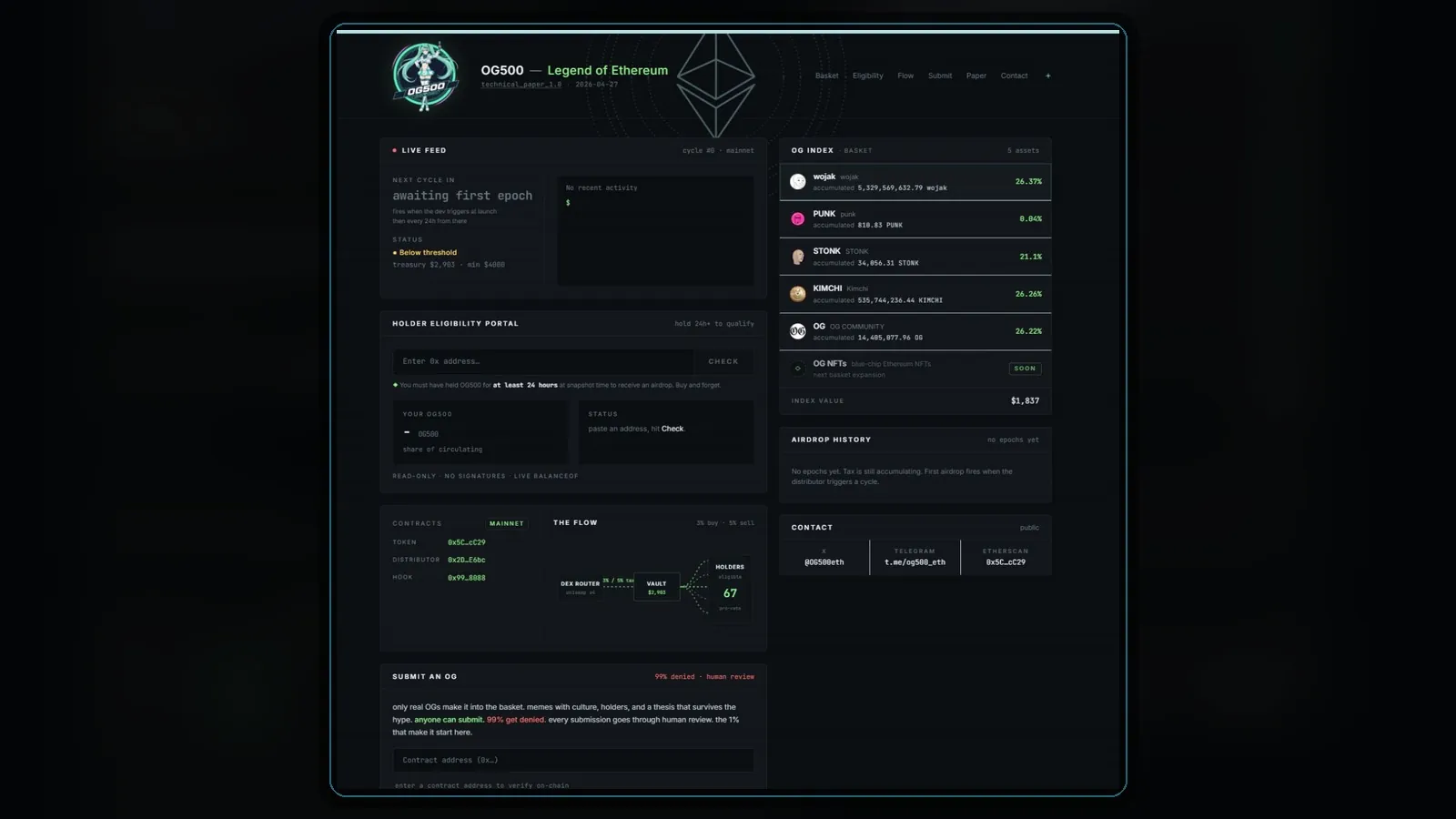
The public dashboard is part of the pitch. It makes the basket, eligibility logic, contract endpoints, and distribution cycle feel legible to retail users instead of buried in contract lore.
Why the Idea Matters
Most meme tokens ask traders to underwrite a single narrative. OG500 is trying to sell a different product: meme beta through a curated basket. That matters because it turns the conversation away from “which one meme wins?” and toward “what if holding one token gave you rotating exposure to the class?”
That can be compelling on Ethereum specifically because the chain has a long memory. Some memes become cultural monuments even when their short-term price action cools off. OG500 is trying to financialize that cultural layer by making “legend status” itself the investable theme.
Why this thesis is stronger than a generic meme launch
The OG Basket Thesis
The live homepage currently highlights a basket including Wojak, PUNK, STONK, KIMCHI, and OG, with an “OG NFTs” expansion marked as coming soon. That is important because it shows OG500 is not trying to mimic a market-cap weighted crypto index. It is building a curated mythology basket.
The submission system reinforces that message. The site says anyone can submit an OG candidate, but 99% get denied and every accepted asset goes through human review. That makes the basket less decentralized at the selection layer, but it also makes the brand proposition sharper. This is not supposed to be a list of trending tickers. It is supposed to be a gatekept basket of memes that survived their era.
OG500 vs a normal meme token vs a traditional index product
The Mechanics Traders Need to Understand
There are several details in the technical paper that make OG500 more interesting than a vague “community token” story. The paper describes the project as an ERC-20 on Ethereum mainnet with a fixed, non-mintable supply, wallet-to-wallet fees set at 0%, and a hard fee ceiling capped in bytecode. It also says the contract does not include blacklist or freeze powers and that ownership is intended to be renounced once the protocol is stable.
Another detail that stands out is the naming layer. The paper says OG INDEX, OG500, and the on-chain symbol OG all refer to the same protocol token. That is a branding choice worth understanding early because traders may see multiple labels across the site, dashboard, and contract references.
- Read the live holder portal for the current snapshot timing and eligibility wording.
- Check the contract pages linked on the homepage and compare them with the technical paper.
- Watch whether cycle reporting becomes consistent and transparent after launch.
- Track whether the basket stays true to the OG-only Ethereum thesis instead of drifting into opportunistic additions.
From a tokenomics perspective, the concept is easy to map onto broader crypto topics like tokenomics, price impact, and liquidity in memecoin markets. If the base token becomes illiquid or if volume slows down, the distribution engine weakens. So the whole product depends on more than just brand appeal.
Risks and Open Questions
The first risk is obvious: this is still a memecoin. The basket concept does not remove volatility, social reflexivity, or liquidity risk. It simply packages them differently. If traders treat OG500 as a low-effort path to OG meme exposure, the token may gain attention. If they decide the fee drag is too high or the basket is too subjective, the thesis can lose momentum quickly.
The second risk is that human review is a feature and a centralization point at the same time. It helps preserve the OG-only brand. It also means basket construction is not purely trustless. That is not necessarily fatal, but it is a real design tradeoff.
The third risk is execution. At the time of review, the public dashboard still showed an early cycle state with threshold language and no completed airdrop history yet. That means the market is still evaluating the concept as a live machine, not just as a clever pitch deck.
Key risks to keep in view
Final Verdict
OG500 is interesting because it is not trying to outdo every memecoin on pure hype. It is trying to out-structure them. The pitch is that holding one base token can become a proxy for holding a curated slice of Ethereum meme history, with volume financing the distribution loop.
If the team executes cleanly, keeps the basket credible, and proves the cycle distributions transparently, OG500 could become one of the better examples of a meme token with an actual product wrapper. If execution slips, then the “first index-style meme token” narrative will not matter. The market will judge it as just another taxed meme coin. That is why the next thing to watch is not the slogan. It is whether the machine works.
For readers trying to contextualize the idea, it sits somewhere between meme coin culture, self-custody, and a tokenized basket thesis built for crypto-native attention spans. That alone makes it worth watching.
Frequently Asked Questions
What is OG500?
OG500 is an Ethereum ERC-20 project that presents itself as an index-style meme token. Its public materials say trading taxes are accumulated, converted into a basket of OG Ethereum memecoins, and distributed to eligible holders.
How does OG500 reward holders?
According to the project, a 3% buy tax and 5% sell tax flow into a protocol vault. On each cycle, that vault is used to buy the active OG meme basket and push it out pro-rata to eligible wallets.
Is OG500 a real ETF or S&P 500 equivalent?
No. OG500 is not a regulated ETF or stock-market index fund. It is a memecoin project using an index-style basket idea inside the Ethereum meme economy.
What makes a token eligible for the OG500 basket?
The homepage and technical paper describe a curated OG-only basket with human review, where only a small fraction of submissions make it through.
What is the main risk with OG500?
The main risks are standard memecoin risks plus execution risk, fee drag, basket-selection subjectivity, and the fact that the concept depends on continued volume and successful distributions.
Related DEXTools articles
- What Is a Meme Coin: Complete Beginner Guide to Memecoins in Crypto (2026)
- What Is Tokenomics: Complete Guide to Token Economics (2026)
- What Is Price Impact in Crypto? Complete Beginner Guide (2026)
- What is liquidity in crypto? A Memecoin Trading Guide
- What Is Self-Custody in Crypto? Complete Beginner Guide (2026)
Disclaimer: This article is for educational purposes only and does not constitute investment or financial advice. OG500 is still a memecoin project, and memecoin risk management still applies.