What Is a Meme Coin? Complete Beginner's Guide (2026)
— By Tony Rabbit in Tutorials
What is a meme coin and how do they work? A beginner's guide for 2026: how they launch, why they pump, the risks and how to trade them safely.
If you have spent any time in crypto, you have probably seen coins with names like Dogecoin, PEPE, or Bonk trending on social media. These are meme coins, and they represent one of the most volatile, controversial, and wildly profitable corners of the cryptocurrency market. But what is a meme coin exactly, and why do people keep throwing money at tokens inspired by internet jokes?
This guide covers everything you need to know about memecoins in 2026. Whether you are a complete beginner trying to understand the hype, or a curious trader looking to learn the mechanics behind memecoin trading, this article will walk you through the history, the technology, the risks, and the strategies that define this unique crypto niche.
By the end, you will understand how meme coins work, how to evaluate them, how to avoid rug pulls, and whether they deserve a place in your portfolio. Let us start with the basics.
What Is a Meme Coin?
A meme coin is a cryptocurrency that derives its identity, branding, and community from internet memes, jokes, or viral cultural moments. Unlike Bitcoin, which was created to be a decentralized currency, or Ethereum, which powers smart contracts and decentralized applications, meme coins typically have no inherent utility or technological innovation. Their value comes almost entirely from community enthusiasm, social media momentum, and speculative trading.
The term "memecoin" is a combination of "meme" (a cultural unit that spreads virally online) and "coin" (a cryptocurrency token). The concept started as a joke in 2013 when Dogecoin was created as a parody of the Bitcoin craze. Since then, the memecoin market has grown into a multi-billion dollar segment of the crypto industry.
What makes meme coins different from other cryptocurrencies? Here are the defining characteristics:
- No fundamental utility: Most meme coins do not power any application, protocol, or service. They exist purely as tradable tokens.
- Community-driven value: The price is determined almost entirely by hype, social media attention, and the strength of the community behind the token.
- High volatility: Meme coins can gain 1,000% in a day and lose 90% the next. The price swings are extreme compared to established cryptocurrencies.
- Low barrier to entry: Many meme coins launch with extremely low prices (fractions of a cent), making them accessible to anyone with a few dollars.
- Cultural relevance: The branding almost always references a popular meme, animal, celebrity, or trending internet joke.
If you are new to cryptocurrency entirely, we recommend starting with our Cryptocurrency for Beginners Complete Guide before diving into the memecoin world.
"Meme coins are the internet's way of saying that attention has value, and in crypto, attention can be tokenized and traded."
It is important to understand that "meme coin" is not a technical classification. From a blockchain perspective, a memecoin is just a token like any other. It follows the same token standards (ERC-20 on Ethereum, SPL on Solana, BEP-20 on BNB Chain) and trades on the same decentralized exchanges. The difference is entirely in purpose and perception. A meme coin is defined by its culture, not its code.

The History of Meme Coins
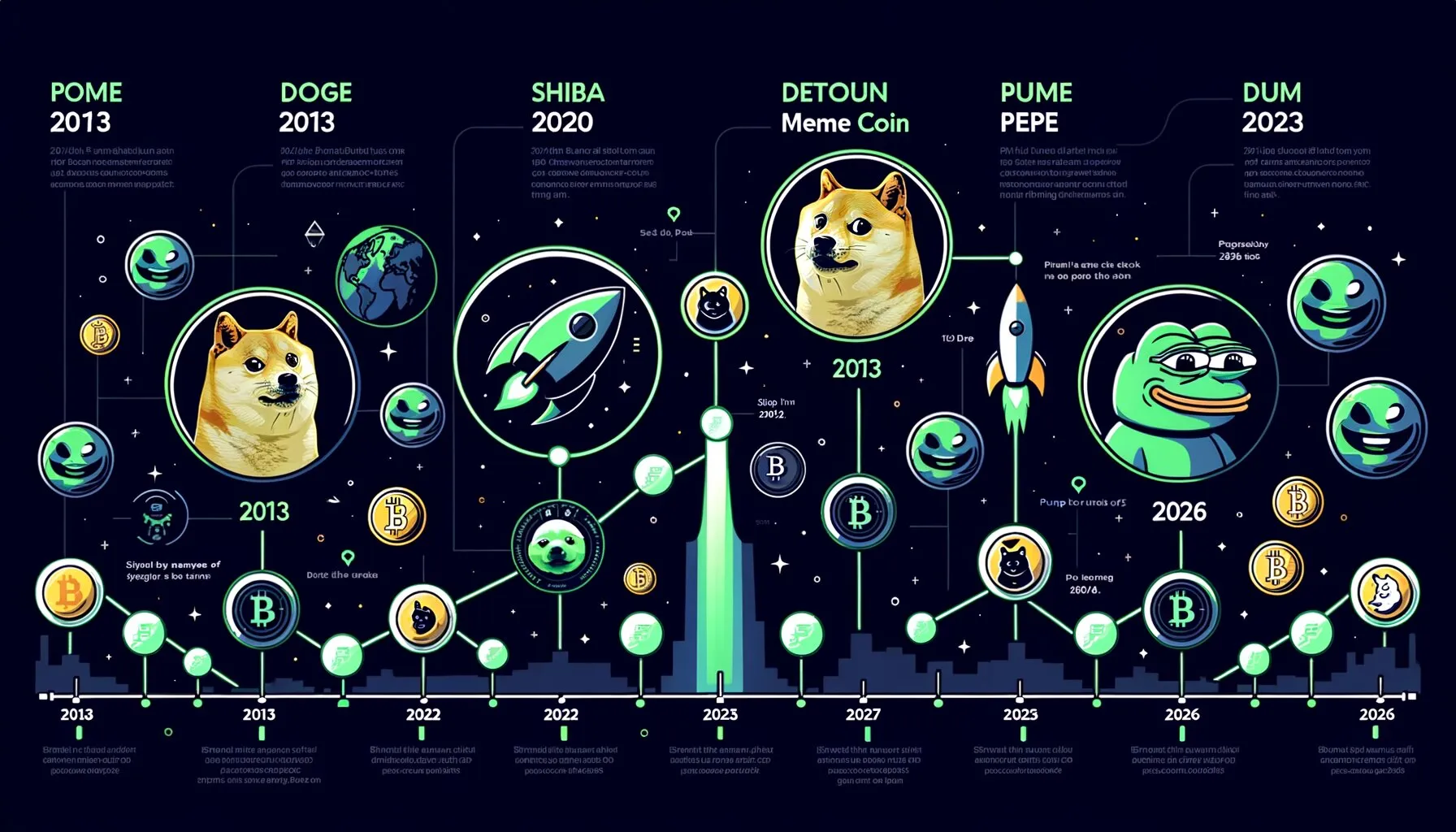
The history of meme coins is a wild ride through internet culture, speculative mania, and the democratization of token creation. Understanding where memecoins came from helps explain why they continue to dominate crypto conversations in 2026.
2013: Dogecoin, the Original Meme Coin
It all started in December 2013 when software engineers Billy Markus and Jackson Palmer created Dogecoin (DOGE) as a lighthearted alternative to Bitcoin. The coin featured the Shiba Inu dog from the "Doge" meme as its mascot and was intended to be a fun, approachable cryptocurrency that could reach a broader audience than the more serious Bitcoin community.
Dogecoin was built as a fork of Litecoin, using a proof-of-work consensus mechanism. Unlike Bitcoin's capped supply of 21 million coins, Dogecoin has no maximum supply, with about 5 billion new DOGE entering circulation every year. This inflationary design was intentional, meant to keep the coin cheap and encourage spending rather than hoarding.
Despite being created as a joke, Dogecoin quickly developed a passionate community. The r/dogecoin subreddit became known for charitable fundraising, including sponsoring a NASCAR driver and funding the Jamaican bobsled team's trip to the 2014 Winter Olympics. By early 2014, Dogecoin had already reached a market cap of $60 million.
2020-2021: The Shiba Inu Explosion and the Meme Coin Boom
The meme coin market remained relatively quiet until 2020, when an anonymous developer known as "Ryoshi" launched Shiba Inu (SHIB). Marketed as the "Dogecoin killer," SHIB was an ERC-20 token on Ethereum that took a different approach: instead of mining, SHIB had a fixed supply of 1 quadrillion tokens, with half sent to Ethereum co-founder Vitalik Buterin's wallet (who later burned most of them and donated the rest).
The real meme coin explosion came in 2021, fueled by several converging factors: pandemic-era retail trading mania, Elon Musk's tweets about Dogecoin, and the GameStop/WallStreetBets movement that proved internet communities could move markets. DOGE reached an all-time high of $0.74 in May 2021, giving it a market cap over $80 billion. SHIB followed suit, turning early holders of $100 investments into millionaires.
"The 2021 meme coin mania proved that in crypto, narrative and community can be more powerful than technology, at least in the short term."
2023: PEPE and the Return of Meme Coins
After the crypto bear market of 2022, meme coins made a dramatic comeback in April 2023 with the launch of PEPE, a token based on the iconic Pepe the Frog meme. PEPE launched with zero presale, zero taxes, and a completely fair launch, and it captured the imagination of the crypto community almost overnight.
Within three weeks of launch, PEPE reached a market cap of $1.6 billion. The token proved that the appetite for meme coins had not disappeared during the bear market; it had simply been waiting for the right catalyst. PEPE's success spawned hundreds of copycat frog-themed tokens and reignited the memecoin meta across the industry.
2024-2026: The Pump.fun Era and Memecoin Infrastructure
The most transformative development in the meme coin space came in early 2024 with the launch of Pump.fun on Solana. This platform made it possible for anyone to create and launch a memecoin in under two minutes, with no coding knowledge, for less than $2 in fees. The result was an absolute explosion in token creation.
By mid-2024, Pump.fun was seeing over 20,000 new tokens created per day. The platform introduced the concept of bonding curves, where a token starts with no liquidity and gradually builds a liquidity pool as buyers purchase tokens. Once a threshold is reached (typically around $69,000 in market cap), the liquidity is automatically migrated to Raydium, Solana's primary decentralized exchange.
The Pump.fun model fundamentally changed memecoin culture. It shifted the meta from large-cap meme coins like DOGE and SHIB to micro-cap "casino style" tokens where traders aim to catch new launches early and ride them for quick profits. For a deep dive into this platform, check out our Complete Pump.fun Tutorial.
In 2025 and into 2026, the memecoin landscape has continued evolving. We have seen political meme coins, AI-themed meme coins, celebrity-launched tokens, and an increasing convergence between meme culture and decentralized finance. The sector has matured in some ways (better tools, more sophisticated traders) while remaining fundamentally chaotic and unpredictable.
How Meme Coins Work
From a technical perspective, meme coins work the same way as any other cryptocurrency token. However, there are some specific mechanics and concepts that are particularly important to understand in the context of memecoins.
Token Creation and Standards
Most meme coins are created using established token standards on existing blockchains. The most common platforms for memecoin launches include:
- Solana (SPL tokens): The dominant chain for new meme coin launches in 2025-2026, thanks to low fees, fast transactions, and platforms like Pump.fun.
- Ethereum (ERC-20 tokens): The original home of many meme coins including SHIB and PEPE, though high gas fees have pushed much of the activity to other chains.
- Base (ERC-20 tokens): Coinbase's Layer 2 has become a popular alternative for memecoin launches, offering Ethereum security with lower fees.
- BNB Chain (BEP-20 tokens): Still active for meme coin launches, particularly popular in Asian markets.
Creating a meme coin does not require writing complex smart contracts from scratch. Platforms like Pump.fun provide no-code interfaces where you simply choose a name, ticker symbol, upload an image, and the token is deployed automatically. This extreme ease of creation is both the strength and the danger of the memecoin ecosystem.
Tokenomics of Meme Coins
Tokenomics refers to the economic design of a cryptocurrency, including supply, distribution, and any built-in mechanisms. Meme coin tokenomics tend to follow certain patterns. To learn more about tokenomics in general, see our Complete Guide to Tokenomics.
Common memecoin tokenomics characteristics include:
- Large total supply: Many meme coins have supplies in the billions or trillions, keeping the per-token price extremely low. This is a psychological tactic; people prefer owning millions of tokens rather than 0.001 of something.
- No vesting or lock-ups (sometimes): Unlike venture-backed projects, many memecoins distribute all tokens at launch with no lock-up period. This can be good (no future unlock dumps) or bad (insiders can sell immediately).
- Transaction taxes (older model): Some older meme coins like early SHIB clones included buy/sell taxes (2-5%) that funded liquidity, marketing, or token burns. This model has fallen out of favor in 2025-2026.
- Zero tax (current meta): Most successful meme coins launched in 2024-2026 use a zero-tax model. No fees on buying or selling, making them simpler and more attractive to traders.
"Good tokenomics in a meme coin means simple: no hidden taxes, no team allocations, no mint authority. The fewer moving parts, the less there is to exploit."
Bonding Curves and Liquidity
One of the most important concepts in modern memecoin trading is the bonding curve, popularized by Pump.fun. A bonding curve is a mathematical formula that determines the price of a token based on its supply. As more tokens are purchased, the price increases along a predetermined curve. As tokens are sold, the price decreases.
Here is how the typical Pump.fun bonding curve works:
- A creator launches a new token on Pump.fun. No initial liquidity is needed.
- The first buyers purchase tokens at the lowest point of the curve, essentially creating liquidity with their purchases.
- As more people buy, the price moves up the curve. Each subsequent purchase costs slightly more per token.
- When the total market cap reaches approximately $69,000, the bonding curve "graduates" and the liquidity is migrated to Raydium as a standard AMM pool.
- After graduation, the token trades like any other token on a decentralized exchange.
This system means that the earliest buyers get the cheapest prices, and the risk of losing money increases as you buy higher on the curve. It also means that most tokens never graduate, as they fail to attract enough buyers to reach the threshold. Out of the thousands of tokens launched daily on Pump.fun, only a small percentage ever graduate to Raydium.
Community-Driven Value
Perhaps the most important thing to understand about how meme coins work is that their value is entirely driven by collective belief and attention. There is no revenue, no product, no earnings report, and no fundamentals to analyze. The "fundamentals" of a meme coin are its meme quality, its community size, its social media presence, and the narratives surrounding it.
This makes memecoin trading more similar to trading culture and attention than trading technology. The coins that succeed are the ones that capture the zeitgeist, create strong community identity, and generate enough viral momentum to attract new buyers. It is a reflexive cycle: price goes up because people are excited, and people get excited because the price is going up.
Top Meme Coins in 2026
While thousands of new meme coins launch every day, only a handful have achieved lasting significance. Here are the most notable memecoins that have stood the test of time (or at least survived more than one market cycle).
| Coin | Ticker | Blockchain | Launch Year | Notable Feature |
|---|---|---|---|---|
| Dogecoin | DOGE | Own Chain (PoW) | 2013 | The original meme coin, backed by Elon Musk |
| Shiba Inu | SHIB | Ethereum | 2020 | Self-proclaimed Dogecoin killer, building Shibarium L2 |
| PEPE | PEPE | Ethereum | 2023 | Fair launch, zero taxes, iconic Pepe the Frog meme |
| Bonk | BONK | Solana | 2022 | First major Solana memecoin, community airdrop |
| dogwifhat | WIF | Solana | 2023 | Dog with a hat meme, massive Solana rally catalyst |
| FLOKI | FLOKI | Ethereum / BNB | 2021 | Named after Elon Musk's dog, building utility products |
Dogecoin (DOGE)
Dogecoin remains the undisputed king of meme coins by market cap and cultural significance. Despite having no formal development team for years, DOGE has survived multiple bear markets and continues to trade with billions in daily volume. Its biggest catalyst has been Elon Musk, who has repeatedly endorsed DOGE on social media and even accepted it as payment for Tesla merchandise. Dogecoin's proof-of-work mining and lack of a supply cap make it unique among meme coins, most of which are simple tokens on other chains.
Shiba Inu (SHIB)
Shiba Inu has evolved beyond its meme coin origins more than almost any other project in this category. The SHIB ecosystem now includes Shibarium (a Layer 2 blockchain), BONE (a governance token), LEASH (a limited-supply token), and various DeFi applications. While purists argue that adding utility makes SHIB less of a "pure" meme coin, the project demonstrates how a strong community can push a meme coin toward legitimacy over time.
PEPE
PEPE is the memecoin that proved fair launches still work. With no presale, no team allocation, and no transaction taxes, PEPE captured the crypto community's attention through pure meme power. It has maintained a top-tier position among meme coins and is widely available on major centralized exchanges. PEPE represents the "purist" approach to meme coins: no utility, no roadmap, just meme.
Bonk (BONK) and dogwifhat (WIF)
BONK and WIF are the two most important Solana-native meme coins. BONK launched via a massive community airdrop to Solana users and NFT holders in late 2022, helping revive interest in the Solana ecosystem during a difficult time. WIF, launched in late 2023, became one of the defining memecoins of the Solana meme coin season, reaching a market cap of over $4 billion at its peak. Both tokens are heavily traded on Jupiter, Solana's leading DEX aggregator.
Where to Buy Meme Coins
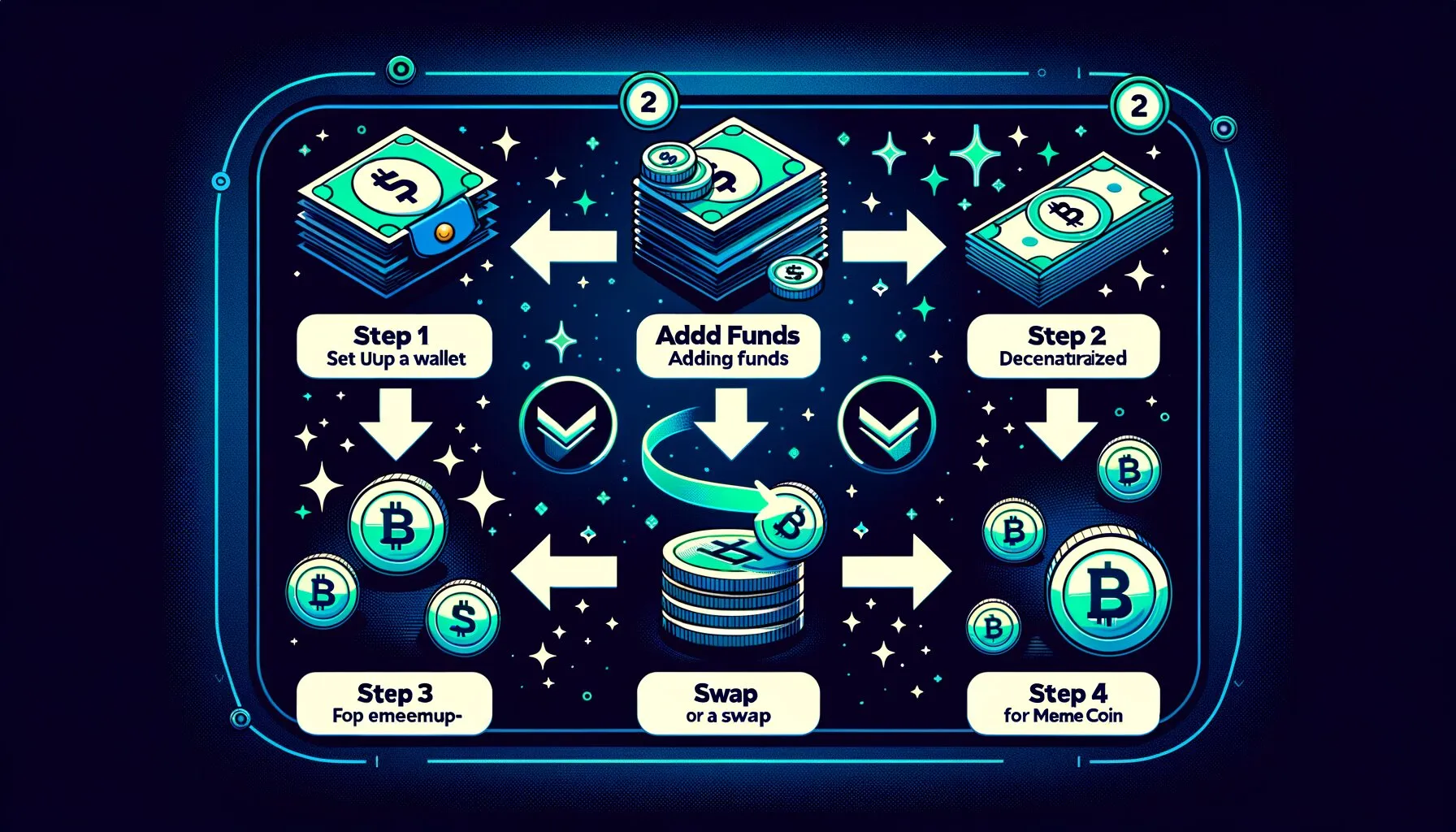
Buying meme coins can range from extremely easy (for established coins like DOGE) to technically complex (for newly launched micro-cap tokens). The method you use depends on which memecoin you want and how early you want to get in.
Centralized Exchanges (CEX)
For established meme coins with significant market caps, centralized exchanges like Coinbase, Binance, Kraken, and OKX are the easiest option. You can buy DOGE, SHIB, PEPE, BONK, WIF, and FLOKI directly with fiat currency or other crypto on these platforms. The advantages are simplicity, fiat on-ramps, and familiar interfaces. The disadvantage is that by the time a memecoin gets listed on a major CEX, most of the explosive early gains are already gone.
Decentralized Exchanges (DEX)
To trade newer and smaller meme coins, you will need to use decentralized exchanges. The specific DEX depends on which blockchain the token is on:
- Solana: Jupiter (jup.ag) is the primary DEX aggregator. Raydium and Orca are the underlying liquidity sources. For a step-by-step walkthrough, see our guide on How to Buy Memecoins on Solana.
- Ethereum: Uniswap remains the dominant DEX for ERC-20 meme coins.
- Base: Uniswap (Base version) and Aerodrome handle most memecoin trading on Coinbase's L2.
- BNB Chain: PancakeSwap is the primary DEX.
Trading on a DEX requires a self-custody wallet (like Phantom for Solana or MetaMask for Ethereum), some of the chain's native token for gas fees, and the ability to identify the correct contract address for the token you want to buy. This last point is crucial, as scammers frequently create fake tokens with the same name as popular meme coins.
Pump.fun and Launchpads
If you want to buy meme coins at the absolute earliest stage, Pump.fun is the primary launchpad for Solana-based memecoins. Tokens on Pump.fun are in their bonding curve phase, meaning they have not yet graduated to a DEX. Buying at this stage means potentially getting the lowest prices, but it also means the highest risk, as the vast majority of Pump.fun tokens go to zero.
Our complete Pump.fun tutorial walks you through the entire process of finding, evaluating, and buying tokens on the platform.
"The earlier you buy a meme coin, the higher the potential reward, but also the higher the chance you are buying something that will be worthless in 24 hours. This is the fundamental tradeoff of memecoin trading."
Important Safety Note on Buying Meme Coins
Regardless of where you buy meme coins, always verify the contract address. The safest way to do this is:
- Find the token on CoinGecko or CoinMarketCap (for established coins).
- Copy the contract address directly from the official source.
- Paste it into the DEX search bar rather than searching by name.
- For brand new tokens, verify the contract address through the project's official Twitter/X account or Telegram group.
Buying the wrong token (a fake with the same name) is one of the most common ways people lose money in the memecoin space. Understanding slippage settings is also critical when trading on DEXs, as meme coins often have thin liquidity that can result in significant price impact on your trades.
How to Evaluate a Meme Coin Before Buying
Even though meme coins lack traditional fundamentals, there is still a structured way to evaluate them before putting your money at risk. This due diligence process will not guarantee profits, but it will help you avoid the worst scams and identify tokens with genuine community traction. For a complete research methodology, see our DYOR Crypto Research Guide.
The Memecoin Due Diligence Checklist
Before buying any meme coin, run through this checklist:
1. Contract and Ownership
- Is the contract verified and open source? You can check this on the blockchain's explorer (Solscan for Solana, Etherscan for Ethereum).
- Has the mint authority been revoked? If the creator can still mint new tokens, they can inflate the supply and crash the price.
- Has the contract been renounced? This means the creator has given up the ability to modify the token's code.
- Are there any hidden functions in the contract (like a blacklist function or ability to pause trading)?
2. Liquidity
- Is the liquidity locked or burned? Locked liquidity means the creator cannot pull it out and run (a rug pull). Burned liquidity is even better, as it is permanently locked.
- How much liquidity exists? Tokens with very thin liquidity (under $10,000) are extremely risky because even small sells can crash the price.
- What is the liquidity-to-market-cap ratio? A healthy ratio is at least 5-10%. If a token has a $1 million market cap but only $10,000 in liquidity, that is a major red flag.
3. Holder Distribution
- Check the top holders using the blockchain explorer. If one wallet (other than the DEX liquidity pool) holds more than 5-10% of supply, that is a concentration risk.
- How many unique holders does the token have? More holders generally means better distribution and less manipulation risk.
- Are the top wallets "fresh" wallets created right before launch? This could indicate insider or developer wallets disguised to look like separate holders.
4. Community and Social Signals
- Does the token have an active Twitter/X presence? Check the engagement quality, not just follower counts (which can be bought).
- Is there a Telegram or Discord community? How active is the conversation? Are real people talking, or is it all bot messages?
- Are credible crypto influencers or analysts discussing the token organically (not paid promotions)?
5. Trading Activity
- What does the trading volume look like? Healthy tokens have consistent buy and sell activity, not just one-sided buying.
- Is the buy/sell ratio balanced? A token with 95% buys and 5% sells might be artificially pumped.
- Check the token on DEXTools or DEXScreener for detailed trading analytics.
For a deeper look at the tools you can use for this analysis, check out our guide on the Best Memecoin Trading Tools in 2026.
Meme Coin Red Flags and Rug Pulls
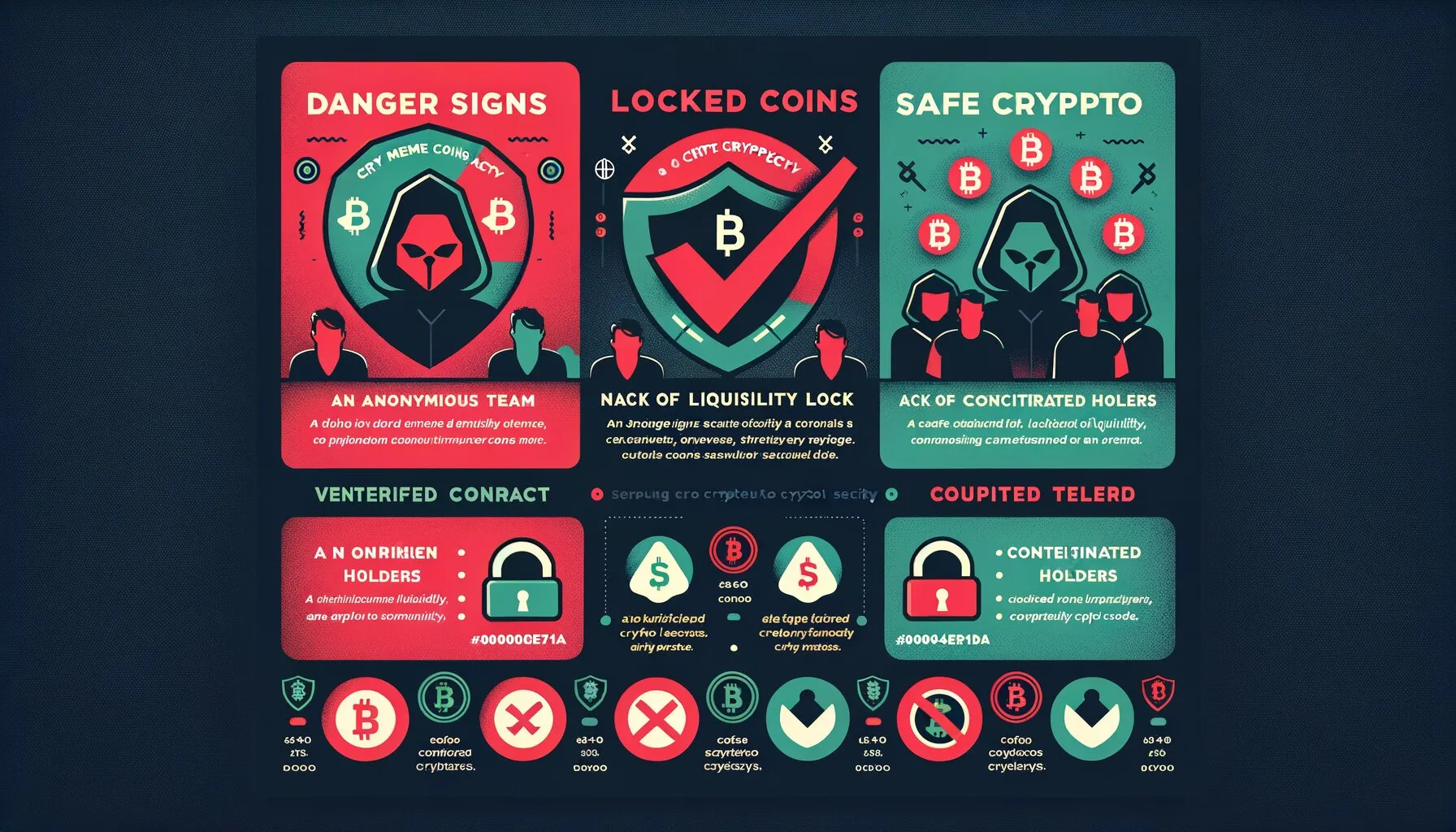
The memecoin market is rife with scams. Understanding the common tactics used by bad actors is essential for protecting your capital. A "rug pull" is when a token creator or insider drains the liquidity or dumps their holdings, leaving other buyers with worthless tokens. For an in-depth breakdown of every type of rug pull and how to detect them, see our How to Spot a Rug Pull checklist.
Common Rug Pull Methods
Liquidity Pull: The creator adds liquidity to the DEX, waits for people to buy, then removes all the liquidity. This crashes the price to zero because there is nothing left in the pool for sellers to trade against. This is why checking if liquidity is locked or burned is so important.
Mint and Dump: The creator retains the ability to mint new tokens. After the price rises, they mint millions of new tokens and sell them into the market, crashing the price. Always verify that mint authority has been revoked.
Honeypot: The smart contract is coded so that buyers can purchase the token but cannot sell it. The only wallet that can sell is the creator's. This is more common on Ethereum and BNB Chain than on Solana (where Pump.fun's standardized contracts prevent this).
Slow Rug: Rather than one dramatic event, the team slowly sells their holdings over days or weeks while keeping up the appearance of an active project. This is harder to detect but can be identified by watching large wallet movements on chain.
Coordinated Pump and Dump: A group of insiders buys a token at low prices, coordinates a marketing blitz (paid influencers, Telegram call groups, fake news), then dumps their bags on the FOMO buyers.
Red Flags to Watch For
- Anonymous team with no history: While many legitimate meme coins are anonymous, a complete lack of developer history combined with other red flags should make you cautious.
- Promises of guaranteed returns: No one can guarantee profits in crypto, let alone with meme coins.
- Aggressive marketing before product: If all the money is going to paid shills and influencer promotions rather than community building, be suspicious.
- Copy-paste website: Many rug pulls use templated websites with no original content. Check if the website design is unique and if the linked social accounts are real.
- Locked or hidden social media comments: Projects that disable comments or delete criticism in their Telegram are often hiding something.
- Unrealistic tokenomics: Massive team allocations (over 10%), high transaction taxes that funnel to the team, or unclear token distribution are all warning signs.
- Pressure to buy immediately: Phrases like "last chance," "launching in 5 minutes," or "whale just bought" are classic manipulation tactics.
"In the memecoin market, if something seems too good to be true, it almost certainly is. The scammers are sophisticated, well-funded, and they operate at scale. Your best defense is education and patience."
Meme Coin Trading Strategies
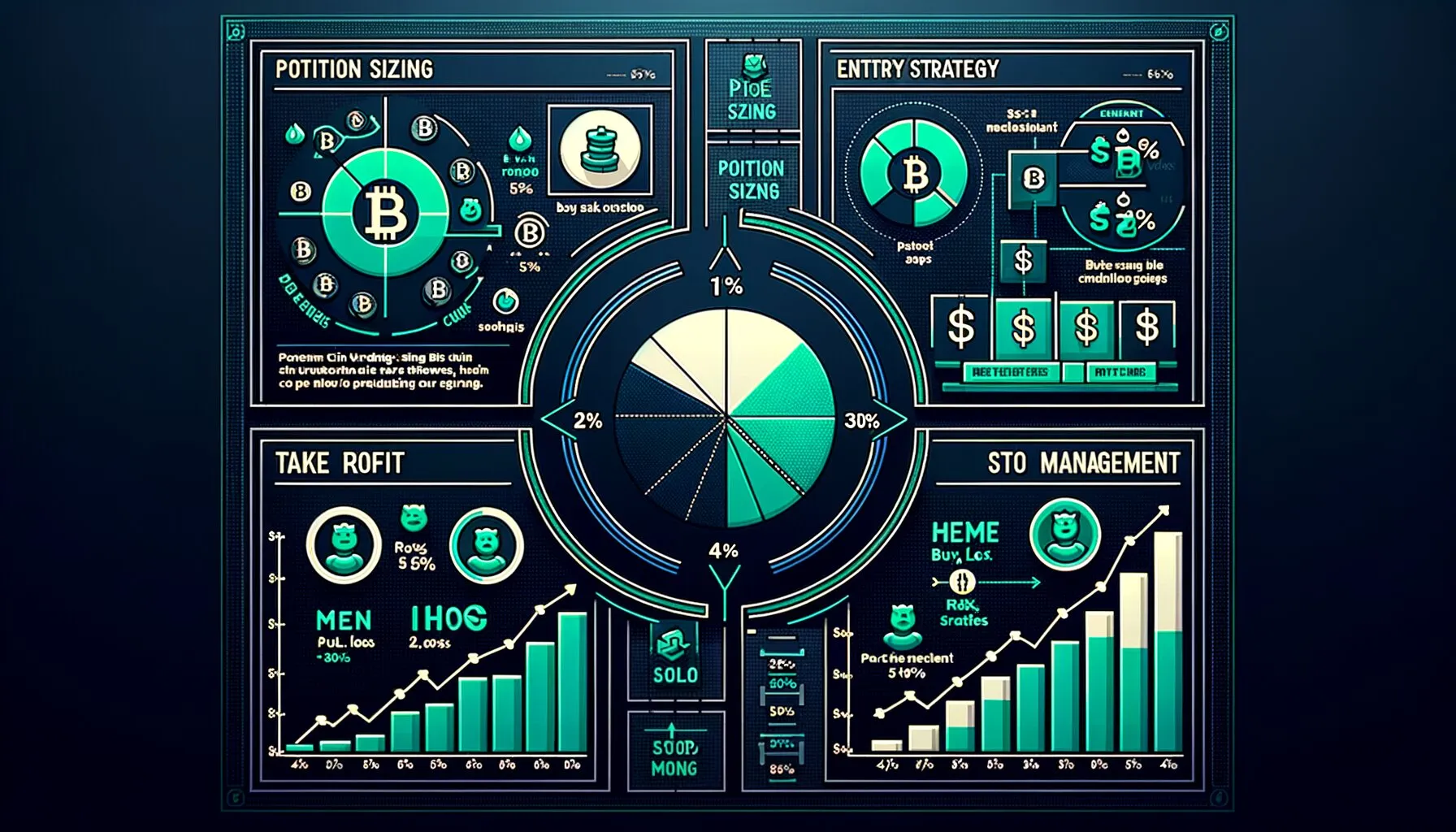
If you decide to trade meme coins (and accept the substantial risks involved), having a clear strategy is the difference between gambling and calculated speculation. Here are the most common approaches used by successful memecoin traders.
Strategy 1: Early Launch Sniping
This strategy involves buying tokens immediately after launch on platforms like Pump.fun, aiming to catch them before they gain traction. The potential returns are enormous (100x or more), but the failure rate is extremely high. Most early-stage tokens go to zero.
Key principles for early sniping:
- Use very small position sizes (0.1-0.5 SOL per trade). You should expect most of these trades to lose money.
- Look for tokens with original concepts, not copies of already-trending tokens.
- Check the developer's wallet history. Have they launched tokens before? Did those tokens rug?
- Set a mental stop-loss. If the token drops 50% from your entry, consider cutting your losses.
- Take profits on the way up. Do not wait for "the top" because you will never time it perfectly.
Strategy 2: Trending Token Momentum
Instead of buying at launch, this strategy waits for tokens to show traction first. You buy once a token is trending on DEXScreener, has graduated from Pump.fun, or is gaining social media attention. You pay a higher price, but you are buying something that has already demonstrated some market validation.
Key principles for momentum trading:
- Wait for the token to graduate from the bonding curve before buying.
- Look for tokens with growing holder counts and increasing volume.
- Entry when the price pulls back after an initial spike, not when it is at the top of a green candle.
- Use DEXTools or DEXScreener to verify that the buying and selling is organic, not manipulated.
Strategy 3: Large-Cap Meme Coin Swing Trading
This approach focuses on established meme coins (DOGE, SHIB, PEPE, BONK, WIF) that have already proven their staying power. You trade the swings in these tokens, buying on dips and selling on rallies. The percentage gains are smaller than micro-cap trading, but the risk of a complete rug pull is effectively zero for these established tokens.
| Strategy | Typical Position Size | Risk Level | Expected Win Rate | Potential Return |
|---|---|---|---|---|
| Early Launch Sniping | 0.1-0.5 SOL | Extreme | 5-15% | 10x-1000x |
| Trending Momentum | 1-5 SOL | High | 20-35% | 2x-20x |
| Large-Cap Swing Trading | Varies (% of portfolio) | Medium-High | 40-55% | 20%-200% |
Position Sizing and Risk Management
The single most important rule in memecoin trading is position sizing. Never risk more than you can afford to lose entirely. Here are some guidelines that experienced traders follow:
- The 1-5% rule: Never allocate more than 1-5% of your total crypto portfolio to any single meme coin. Many traders cap their total memecoin exposure at 10-20% of their overall portfolio.
- Take profits in stages: When a trade goes your way, sell portions at predetermined levels. A common approach is to sell 25% at 2x, another 25% at 5x, and let the remaining 50% ride as a "free" position (since you have already recovered your initial investment).
- Accept losses quickly: If a meme coin drops 50-70% from your entry and the narrative has broken, cut the loss. Do not hold hoping for a recovery. In the memecoin world, most tokens that drop 70% never come back.
- Track everything: Keep a spreadsheet or use portfolio tracking tools to log every memecoin trade. This helps you analyze your performance and avoid repeating mistakes.
Meme Coins vs Utility Tokens
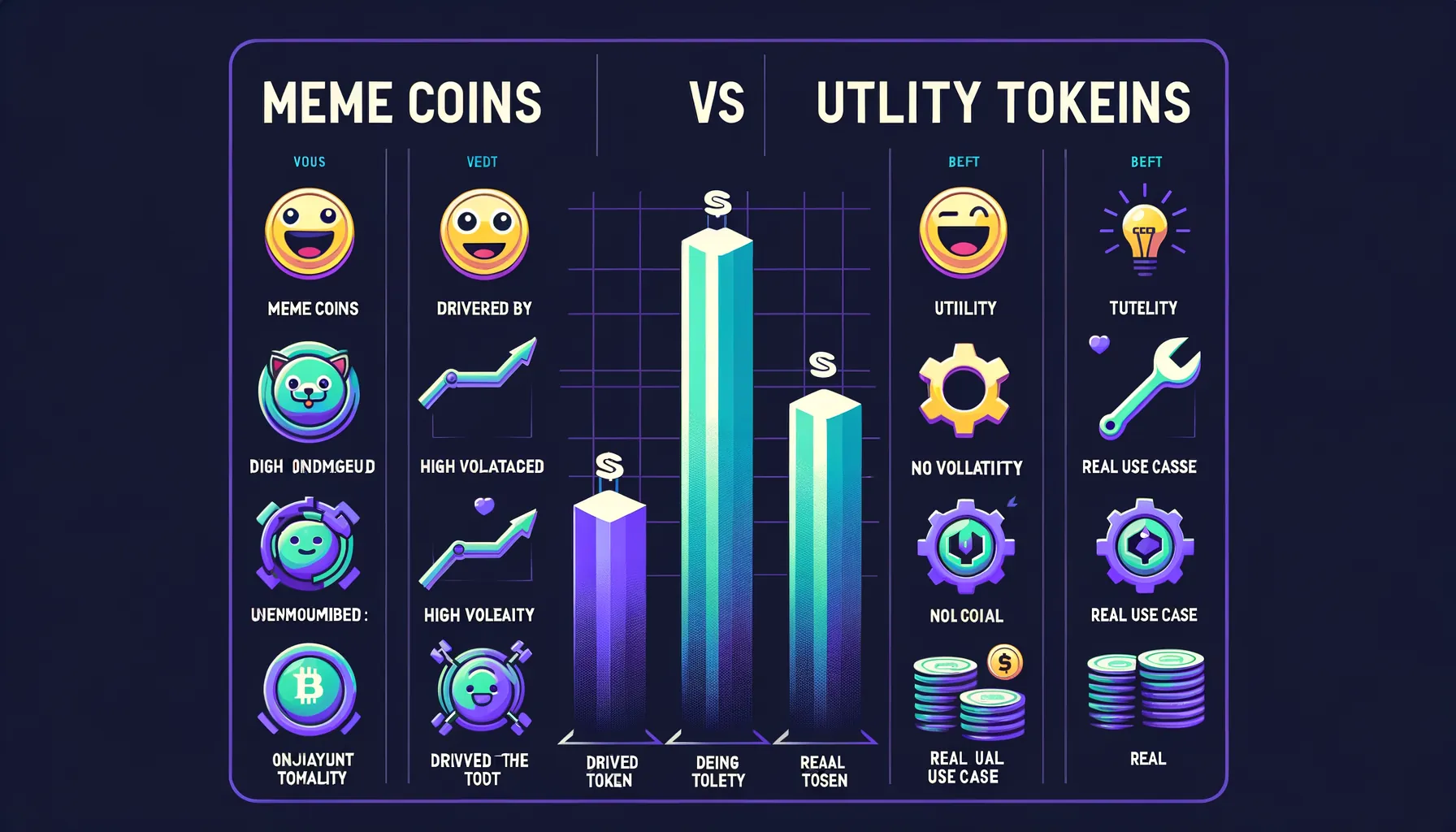
One of the most common questions beginners ask is how meme coins differ from "real" or utility-based cryptocurrencies. The table below provides a clear comparison across the most important dimensions.
| Attribute | Meme Coins | Utility Tokens |
|---|---|---|
| Purpose | Entertainment, community, speculation | Power a protocol, application, or service |
| Value Driver | Hype, community, social media attention | Usage, revenue, adoption, technology |
| Development Team | Often anonymous, minimal ongoing development | Professional team, ongoing updates |
| Roadmap | Usually none or vague "community-driven" | Detailed technical roadmap with milestones |
| Volatility | Extreme (10-100%+ daily swings) | High but generally more stable |
| Lifespan | Most die within days/weeks; few survive | Longer lifespan tied to product development |
| Analysis Method | Social sentiment, holder analysis, narrative | Fundamental analysis, metrics, code review |
| Risk of Total Loss | Very high | Lower (but still exists) |
It is worth noting that the line between meme coins and utility tokens is blurring. Projects like SHIB have built out entire ecosystems including their own blockchain (Shibarium), DeFi protocols, and NFT marketplaces. FLOKI has launched an NFT gaming platform and a DeFi product suite. Some argue that when a meme coin adds utility, it stops being a meme coin. Others argue that a token's origin and primary community identity define it, regardless of what utilities are added later.
For a beginner, the practical difference comes down to this: utility tokens give you something to analyze beyond price action and social sentiment. Meme coins, by contrast, are primarily a bet on culture, attention, and timing. Both can make you money, and both can lose you money, but the analytical frameworks are completely different.
Tax Implications of Meme Coin Trading
This is the section nobody wants to read, but everyone needs to. Meme coin trading creates tax obligations in most jurisdictions, and the high-frequency nature of memecoin trading can make tax reporting especially complicated.
Important disclaimer: This section provides general educational information only. Tax laws vary by country and change frequently. Always consult a qualified tax professional for advice specific to your situation.
General Tax Principles for Meme Coins
In most countries, including the United States, cryptocurrencies (including meme coins) are treated as property for tax purposes. This means:
- Every sale or swap is a taxable event: When you sell a meme coin for another token, stablecoin, or fiat currency, you realize either a capital gain or a capital loss.
- Short-term vs. long-term rates apply: In the US, assets held for less than one year are taxed at your ordinary income rate (which can be as high as 37%). Assets held for more than one year qualify for lower long-term capital gains rates (0%, 15%, or 20% depending on your income).
- Every trade needs to be recorded: If you make 500 memecoin trades in a month (which is not unusual for active traders), you need cost basis and sale price for every single one.
- Token-to-token swaps count: Swapping SOL for a meme coin, or swapping one memecoin for another, is a taxable event. This catches many beginners off guard.
Practical Tips for Meme Coin Tax Management
- Use crypto tax software: Tools like Koinly, CoinTracker, or TokenTax can import your wallet transactions and DEX trades automatically. This is almost essential for anyone doing active memecoin trading.
- Export transaction histories regularly: Do not wait until tax season. Export your Phantom or MetaMask transaction history monthly.
- Track your cost basis: When you buy a meme coin in multiple transactions, you need to track the cost basis for each purchase. Most tax software handles this automatically using methods like FIFO (First In, First Out) or specific identification.
- Do not forget about losses: Meme coin losses can offset your gains. If you lost money on rug pulls or failed trades, those losses are valuable at tax time. In the US, you can use up to $3,000 in net capital losses per year to offset ordinary income, and excess losses can be carried forward.
- Consider tax-loss harvesting: If you hold meme coins that have dropped significantly, selling them to realize the loss (and potentially rebuying later if you still believe in the project) can be a valid tax strategy. However, be aware of wash sale rules if they apply in your jurisdiction.
"The IRS does not care if you made your money from Bitcoin or from a meme coin named after a cartoon frog. Gains are gains, and they expect their share. Plan accordingly."
The Future of Meme Coins in 2026 and Beyond
What does the future hold for meme coins? While nobody can predict markets with certainty, several trends are clearly shaping the memecoin landscape as we move through 2026.
Trend 1: AI and Meme Coin Convergence
The intersection of artificial intelligence and meme coins has become one of the most active sectors in crypto. We are seeing AI-generated meme coins (where the concept, artwork, and even marketing are created by AI agents), as well as AI-powered trading bots specifically designed for memecoin sniping. The "AI agent" meta, where autonomous AI characters launch and promote their own tokens, was one of the defining trends of late 2024 and early 2025, and its influence continues to shape the space.
Trend 2: Increasing Institutional Awareness
While institutional investors are not buying micro-cap Pump.fun tokens, they have started acknowledging meme coins as a legitimate market segment. Dogecoin is held by several publicly traded companies, and DOGE futures are available on regulated exchanges. Some crypto funds have created "culture" or "attention" baskets that include blue-chip meme coins alongside other social tokens. This institutional framing is slowly destigmatizing memecoins, even if the micro-cap gambling side remains wild.
Trend 3: Regulation and Consumer Protection
Regulatory attention on meme coins is increasing globally. While no major jurisdiction has specifically banned meme coins, regulators in the US, EU, and Asia have started scrutinizing memecoin promotion by influencers, the platforms that enable token creation, and the exchanges that list speculative tokens. We are likely to see more enforcement actions against pump-and-dump schemes and fraudulent meme coin projects. This regulation could ultimately be positive for the space, weeding out the worst actors while allowing legitimate meme coin communities to thrive.
Trend 4: Cross-Chain and Multi-Chain Memecoins
The memecoin market is becoming increasingly multi-chain. While Solana currently dominates for new launches, successful meme coins are bridging to multiple chains to reach wider audiences. Tools for cross-chain token deployment are becoming simpler, and we may soon see meme coins that launch simultaneously on multiple blockchains from day one.
Trend 5: The Professionalization of Memecoin Trading
Memecoin trading has gone from a casual activity to a professional pursuit for many. Advanced analytics tools, real-time wallet tracking, sniper bots, copy-trading platforms, and dedicated research communities have created an ecosystem of professional memecoin traders. This professionalization means that casual traders face increasingly sophisticated competition, making education and tool mastery more important than ever.
The memecoin market is not going away. It may evolve, it may get regulated, and the platforms and chains may change, but the fundamental human desire to participate in viral cultural moments, combined with the ability to tokenize that participation, ensures that meme coins will remain a part of the crypto landscape for the foreseeable future.

Frequently Asked Questions
What is a meme coin in simple terms?
A meme coin is a cryptocurrency that is based on an internet meme, joke, or viral cultural reference. Unlike Bitcoin or Ethereum, which have specific technological purposes, meme coins get their value from community hype and social media attention. Think of them as the crypto equivalent of a viral trend that you can buy and sell. Dogecoin, the first meme coin, was literally created as a joke based on the "Doge" Shiba Inu dog meme, and it is now worth billions of dollars.
Are meme coins a good investment?
Meme coins are extremely high-risk, speculative assets. They are not traditional "investments" in the way that stocks or bonds are. While some people have made life-changing money from meme coins (early Dogecoin, SHIB, and PEPE holders, for example), the vast majority of meme coins go to zero. If you do decide to trade memecoins, only use money you can afford to lose completely, keep position sizes small, and never put your savings or emergency funds into meme coins.
How do I buy meme coins?
For established meme coins like DOGE, SHIB, or PEPE, you can buy them on major exchanges like Coinbase, Binance, or Kraken using your credit card or bank transfer. For newer, smaller meme coins, you need a self-custody wallet (like Phantom for Solana or MetaMask for Ethereum) and you buy them on decentralized exchanges like Jupiter or Uniswap. Our step-by-step guide to buying memecoins on Solana walks you through the entire process.
What is a rug pull in crypto?
A rug pull is a type of scam where the creators of a cryptocurrency token drain the liquidity or dump their token holdings, leaving other holders with worthless coins. The term comes from the idiom "pulling the rug out from under someone." Common methods include removing the liquidity pool on a DEX, minting millions of new tokens and selling them, or coding the smart contract so that only the creator can sell. Rug pulls are extremely common in the meme coin space, which is why due diligence is critical. Our rug pull checklist can help you identify the warning signs.
What is Pump.fun and how does it work?
Pump.fun is a platform on the Solana blockchain that allows anyone to create and launch a meme coin in under two minutes with no coding required. The platform uses a bonding curve model where the token's price automatically increases as more people buy. When the total market cap reaches approximately $69,000, the token "graduates" and its liquidity is migrated to Raydium, a Solana DEX. Pump.fun has become the primary launchpad for new memecoins, with thousands of tokens created daily. For a complete walkthrough, read our Pump.fun tutorial.
Can you make money with meme coins?
Yes, some people make significant money trading meme coins, but the majority of memecoin traders lose money overall. The tokens that produce 100x returns get all the attention, but for every 100x winner, there are hundreds of tokens that went to zero. Professional memecoin traders succeed by having strict risk management (small position sizes, predetermined take-profit levels), deep knowledge of the ecosystem and its tools, and the discipline to cut losses quickly. If you approach meme coins expecting easy money, you are far more likely to be the exit liquidity for someone else's profit.
Do I have to pay taxes on meme coin profits?
In most countries, yes. Meme coin profits are treated the same as profits from any other cryptocurrency trade. In the United States, every time you sell a memecoin for another token, a stablecoin, or fiat currency, you create a taxable event. Short-term gains (assets held less than one year) are taxed at your ordinary income rate, and long-term gains get preferential rates. Even swapping one meme coin for another is taxable. Use crypto tax software like Koinly or CoinTracker to track your transactions automatically, and consult a tax professional for advice specific to your jurisdiction.
What is the difference between a meme coin and a regular cryptocurrency?
The main difference is purpose and value proposition. Regular cryptocurrencies like Ethereum, Solana, or Chainlink are built to serve specific functions: running smart contracts, powering decentralized applications, providing oracle data, and so on. Their value is tied (at least in theory) to the usage and adoption of the technology they support. Meme coins, on the other hand, exist primarily as cultural tokens. They do not power any application or protocol. Their value comes from community enthusiasm, social media virality, and speculation. From a technical standpoint, both use the same blockchain infrastructure, the difference is entirely in what drives their value.
Which meme coins are the safest to buy?
No meme coin is truly "safe" because they are all speculative assets with extreme volatility. However, established meme coins with large market caps, high liquidity, and listings on major exchanges carry less risk than newly launched micro-cap tokens. Dogecoin (DOGE), Shiba Inu (SHIB), and PEPE are generally considered the "blue chip" memecoins because they have survived multiple market cycles, have massive communities, and are too liquid for any single entity to rug pull. That said, even these established meme coins can lose 50-80% of their value in a bear market, so "safest" is a relative term in this context.
How do I know if a meme coin is a scam?
Look for these warning signs: the creator has not revoked mint authority (they can create unlimited new tokens), liquidity is not locked or burned (they can drain the pool), a small number of wallets hold a large percentage of the supply (insiders ready to dump), the project uses aggressive "buy now" urgency tactics, there is no organic community discussion (only bot messages), the website is a generic template, and the token has hidden functions in its smart contract (like a blacklist or trading pause). Use tools like DEXTools, DEXScreener, RugCheck, and blockchain explorers to verify these factors before buying. Our DYOR research guide teaches you how to check all of these systematically.