Pendle Finance Explained: Yield Tokenization, PT, YT and Fixed-Rate DeFi (2026)
— By AliceOnChain in Tutorials

Learn what Pendle Finance is, how yield tokenization works, why PT and YT exist, and where Pendle fits in fixed-rate and rate-speculation strategies.
Intent check: This page is the protocol explainer for Pendle and yield tokenization. If you want the beginner walkthrough, read How to Use Pendle Finance. If you want the strategy-focused PT versus YT piece, read Pendle PT vs YT Strategies.
What is Pendle Finance? The Complete Yield Tokenization Guide
The Emergence of On-Chain Fixed Income Markets
The development of decentralized finance historically mirrored the evolution of legacy financial systems, moving from basic spot token swaps to complex collateralized debt markets. However, a major structural limitation persisted for years: the absence of a fluid, capital-efficient interest rate derivative market. Understanding what is Pendle Finance requires analyzing how this protocol solved that exact challenge by establishing a system for decentralized yield tokenization. Instead of forcing participants to passively accept highly volatile, variable staking or lending yields, the architecture allows users to dissect, package, and trade those cash flows independently.
For the advanced on-chain analyst, navigating this ecosystem is essential for capital optimization. Controlling more than half of the decentralized rate derivative market, the system acts as an institutional bridge between traditional fixed-income strategies and permissionless blockchain networks. By converting variable yield-bearing assets into distinct tradable components, the protocol enables market participants to either lock in guaranteed fixed returns or speculate on interest rate fluctuations with significant capital efficiency. This tutorial explores the protocol's underlying token mechanics and demonstrates how to monitor these dynamic rate markets using professional analytical tools.
Dissecting the Architecture: Standardized Yield, PT, and YT
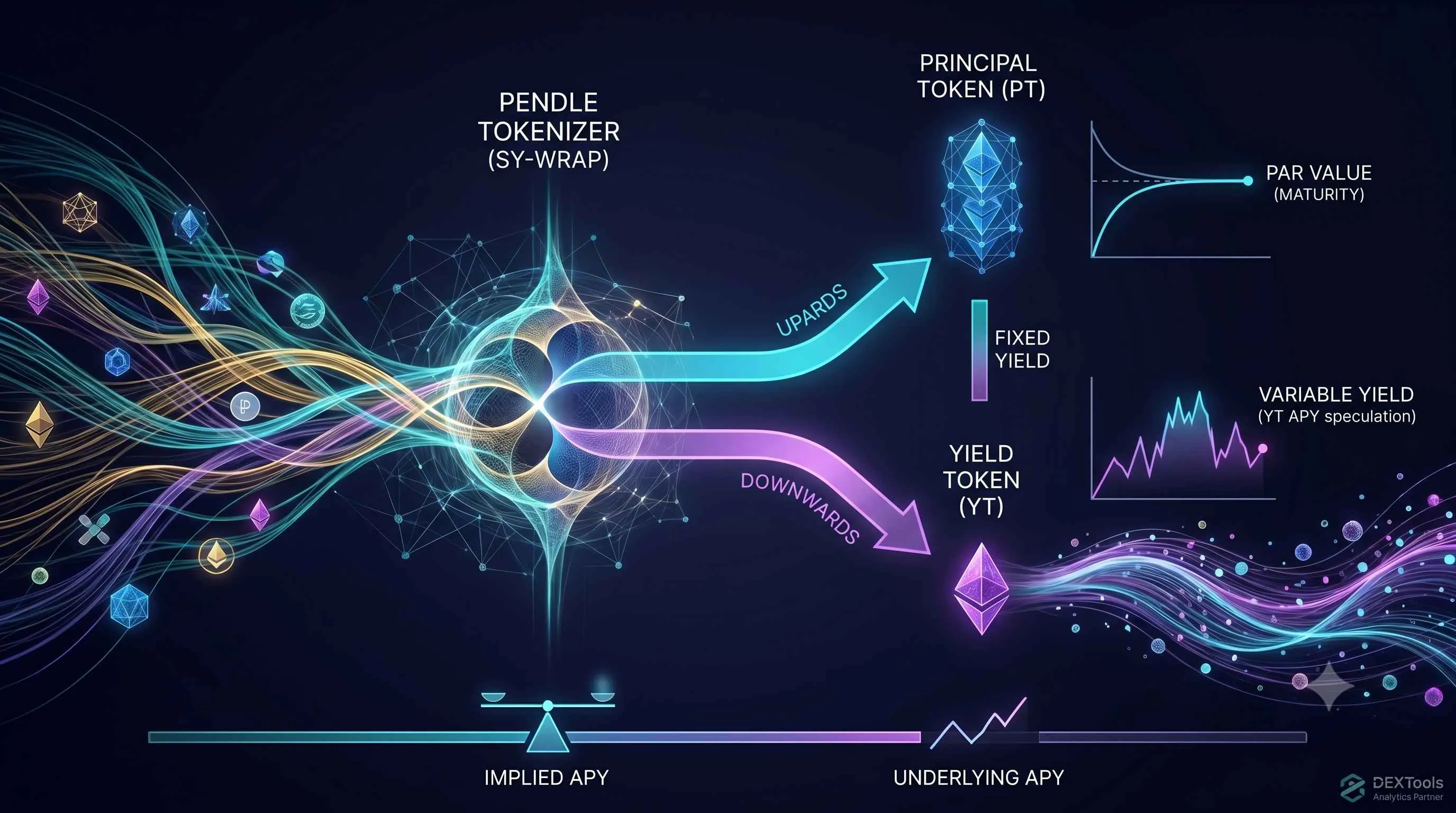
To understand what is Pendle Finance at a mechanical level, you must examine its three-token architecture. The protocol functions similarly to traditional bond-stripping components in legacy finance, where a bond’s principal repayment is decoupled from its periodic interest coupons.
The initial step in the tokenization pipeline involves wrapping a variable yield-bearing asset-such as Lido’s stETH, Aave’s aUSDC, or liquid staking derivatives-into a common smart contract format known as Standardized Yield (SY). This wrapping layer creates a unified structural interface across the protocol, allowing the core engine to interact with diverse yield sources using an identical programmatic framework.
Once an asset is wrapped into the SY standard, the protocol splits it into two distinct tokens with a predefined maturity date. The first component is the Principal Token (PT). PT represents the ownership right to the underlying base asset at the exact moment of maturity. Because the future yield component has been entirely stripped away, a PT always trades at a discount relative to its underlying asset in the secondary market. As the maturity date approaches, the price of the PT naturally converges toward par value, which establishes a completely predictable, fixed-rate annualized percentage yield (Fixed APY), functioning precisely like a traditional zero-coupon bond.
The secondary component generated by the split is the Yield Token (YT). YT grants the holder full exposure to all variable interest payments, fee distributions, and native protocol rewards generated by the underlying principal asset until the maturity date is reached. Because a YT represents a temporary streaming claim, its intrinsic value decays linearly over time, eventually reaching zero precisely at maturity. However, because a YT can be purchased for a tiny fraction of the total underlying asset price, buying YT allows a trader to establish highly leveraged positions on interest rate expansions without risking equivalent spot principal capital.
The Mathematical Engine: Implied APY vs. Underlying APY
Operating a yield tokenization protocol requires a specialized exchange mechanism, as traditional automated market makers (AMMs) are mathematically unsuited for assets undergoing predictable time decay. The system relies on a customized execution engine that dynamically shifts its internal pricing curve as time passes.
Traders evaluate these tokenized pools using two primary metrics. The first is the Underlying APY, which represents the real-time, variable interest rate generated by the base protocol, such as the actual staking rewards distributed by Lido. The second metric is the Implied APY, which reflects the market-driven price of the interest rate derivative itself, representing what the market collectively believes the variable yield will average from the present moment until the pool matures.
When the market experiences heightened demand for a specific strategy-such as aggressive yield farming or points accumulation campaigns-the price of the YT surges. This upward price pressure causes the Implied APY to climb significantly higher than the actual Underlying APY. This dislocation sets up clear directional trading opportunities: buying YT represents a long position on interest rates, while purchasing the discounted PT represents a short position on variable yields, effectively locking in a fixed return that outpaces current market assumptions.
Using DEXTools to Evaluate Yield Liquidity and Pool Stability
For professional market participants, trading these rate derivatives requires constant monitoring of decentralized pool health. The DEXTools Pair Explorer provides critical on-chain metrics necessary to gauge execution safety and slippage overhead.
When investigating specific PT or YT pairs on DEXTools, analysts should look closely at the ratio between total locked liquidity and daily trading volume. Because PT and SY tokens are derived from the same underlying collateral, the impermanent loss profile within these AMM pools is structurally compressed compared to standard volatile crypto pairs. However, if trading volume escalates rapidly without a parallel deep capital cushion, large block swaps executed near maturity can trigger temporary price distortions, impacting a trader's realized yield exit.
Significant shifts in transactional volume on DEXTools often signal institutional positioning. For instance, a sudden surge in PT accumulation pairs typically points to risk-averse funds rotating out of volatile yield pools to secure fixed, predictable yields during broader market downturns. Conversely, aggressive buying volume on YT pairs implies that sophisticated actors are positioning for an expansion in protocol distribution rates or upcoming governance snapshot incentives.
Furthermore, using the DEXTools Bubblemaps integration allows traders to run diagnostics on token centralization. Highly concentrated wallet clusters around specific automated yield optimizers or institutional treasuries indicate systemic dependency. If a single connected cluster controls an oversized share of the circulating YT supply for a particular maturity pool, a sudden liquidation or strategic rebalancing by that entity could trigger rapid volatility in the Implied APY, directly shifting the profitability of unhedged retail positions.
Multi-Chain Expansion and the Boros Funding Market
A comprehensive look at what is Pendle Finance must extend beyond basic spot asset staking. The protocol's tokenization logic has expanded globally across multiple high-throughput networks, including Arbitrum, BNB Chain, and Solana, optimizing micro-fee transaction execution.
A massive structural milestone achieved by the platform is its expansion into the perpetual futures funding rate ecosystem through its Boros deployment. Perpetual swap funding rates represent a massive daily financial market, yet they are notoriously volatile and unpredictable for institutional hedgers.
By applying its core tokenization architecture to these funding streams, Boros allows perpetual traders to tokenize variable funding rates. This mechanism enables market makers to lock in fixed funding costs or speculate on funding rate volatility across major decentralized perpetual exchanges, opening a massive, previously unhedged capital market to sophisticated fixed-income strategies.
Strategic Frameworks for the Modern Yield Trader
The split nature of tokenized positions permits the deployment of advanced, delta-neutral strategies that are impossible within standard lending environments.
When speculative market behavior drives the Implied APY of a pool significantly below the conservative Underlying APY, a low-risk arbitrage condition emerges. A trader can purchase the undervalued PT at a significant discount via the DEXTools interface, securing a guaranteed fixed return. Because the fixed return is locked at a discount, the trader effectively secures an insulated yield profile that remains completely immune to downward adjustments in the base protocol's variable rate.
Institutional participants also frequently run delta-neutral operations by pairing an asset's spot position with an opposing derivative leg. By purchasing a variable yield-bearing asset and simultaneously selling its corresponding future yield via YT tokens, a fund can completely lock in its financial return profile today. This strategy eliminates cash-flow variance, allowing treasury managers to project exact earnings metrics across quarterly horizons regardless of mid-cycle market contractions.
The Analytical Outlook for On-Chain Yield Derivatives
When evaluating what is Pendle Finance, analysts must recognize it as the foundational credit infrastructure for decentralized fixed-income markets. The protocol’s dual-token framework successfully isolates principal value from interest rate volatility, creating specialized tools for both conservative yield seekers and aggressive speculators.
By maintaining constant vigilance over pool depth with the DEXTools Pair Explorer, tracking large-scale wallet concentration via Bubblemaps, and calculating the premium spread between Implied and Underlying APYs, professional traders can navigate these advanced financial structures with high precision, minimal slippage, and optimal capital deployment.
How to Bridge Crypto Between Chains: Complete Cross-Chain Tutorial 2026How to Use 1inch for Swaps: Classic, Fusion and Limit Orders (2026)
How to Use OKX Web3 Wallet: Multi-Chain DeFi Hub Guide (2026)
Disclaimer: This article is for informational purposes only and does not constitute investment advice, financial advice, trading advice, or any other kind of advice. DEXTools does not recommend buying, selling, or holding any cryptocurrency or token. Users should conduct their own research and consult with a qualified financial advisor before making any investment decisions. Cryptocurrency investments are volatile and high-risk. DEXTools is not responsible for any losses incurred.
Related Guides
- Pendle PT vs YT Strategies: Fixed Yield, Rate Views and Risk Setup (2026)
- How to Use Notional Finance Fixed Rate in 2026
- How to Use Pendle Finance: Complete Yield Trading Tutorial (2026)
- Utilization Rate vs TVL: The DeFi Metric That Matters
- What is Yearn Finance? V3 Vaults Yield Aggregator Guide 2026
Frequently Asked Questions
What is Pendle Finance and what does it do?
Pendle is a DeFi protocol that lets users tokenize and trade the future yield of yield-bearing assets. It splits a yield-bearing token into separate components representing principal and future yield.
What is the difference between PT and YT on Pendle?
PT represents the principal portion of a yield-bearing asset and can typically be redeemed for the underlying at maturity, while YT represents the right to the yield generated until maturity. Separating them lets users trade fixed-style returns and yield exposure independently.
How does yield tokenization work?
Yield tokenization splits a yield-bearing asset into a principal token and a yield token so each can be priced and traded on its own. This enables strategies such as locking in a fixed-style return or speculating on future yield.
What does fixed-rate yield mean in DeFi?
Fixed-rate yield refers to earning a predictable return that is set in advance rather than one that floats with market conditions. Tokenizing principal separately from yield is one way protocols can offer fixed-style returns.