Are Memecoins Dead in 2026? What the On-Chain Data Really Says
— By Tony Rabbit in Tutorials

The memecoin mania is down roughly 75% from its 2024 peak, yet about 68,000 new tokens still launch every day. We pulled the on-chain data to answer honestly whether memecoins are dead, and the truth is in the survival rate.
Ask crypto Twitter and you will hear that memecoins are dead, buried by the collapse of the 2024 hype. Ask the blockchain and you get a very different answer. About 68,000 brand-new tokens still launch every single day, yet the total memecoin market cap has fallen roughly 75% from its peak, and barely 1% of new launches are still trading a week later. So which is it? We pulled the on-chain data, ours and the wider market data, to answer honestly. The short version: memecoins are not dead, but the easy-money mania that defined them is, and the difference is written in the survival rate.
First, the honest part: the mania really did deflate
If your definition of a live memecoin market is the frenzy of late 2024, then yes, that market is gone. The numbers are not close. Total memecoin market cap peaked near 150 billion dollars at the end of 2024, powered by the US election and the TRUMP token, and had fallen to somewhere in the 30 to 38 billion dollar range by 2026, a drop of around 75% according to CoinGecko and CoinDesk data. Trading volume tells the same story: memecoins made up about 67% of Solana decentralized exchange volume at the peak and slid to roughly 10% by late 2025, with most flow rotating into stablecoin pairs, according to SolanaFloor.
The launch engine cooled too. Pump.fun, the launchpad that industrialized the memecoin, saw daily token creations fall around 80% from a peak near 72,000 a day in January 2025, and daily new-user sign-ups drop from about 183,000 to roughly 33,000, an 82% decline. We tracked the same cooling in our own report on the collapse in Pump.fun graduations and Solana fees. Some analysts have written the obituary outright: ETF Institute founder Nate Geraci argued that as real institutional money enters crypto, "scams, celebrity coins, etc simply aren't going to fly anymore." By every mania metric, the 2024 casino peak is over.
But the launch factory never actually stopped
Here is the part that does not fit the obituary. We read the DEXTools new-token tracker across 18 chains, and the raw creation rate is still enormous: about 2,841 new tokens per hour, which annualizes to roughly 68,000 per day. One network does almost all of it. Solana alone spits out an estimated 2,232 new tokens every hour, with Base and BNB Chain a distant second and third and Ethereum a rounding error by comparison.
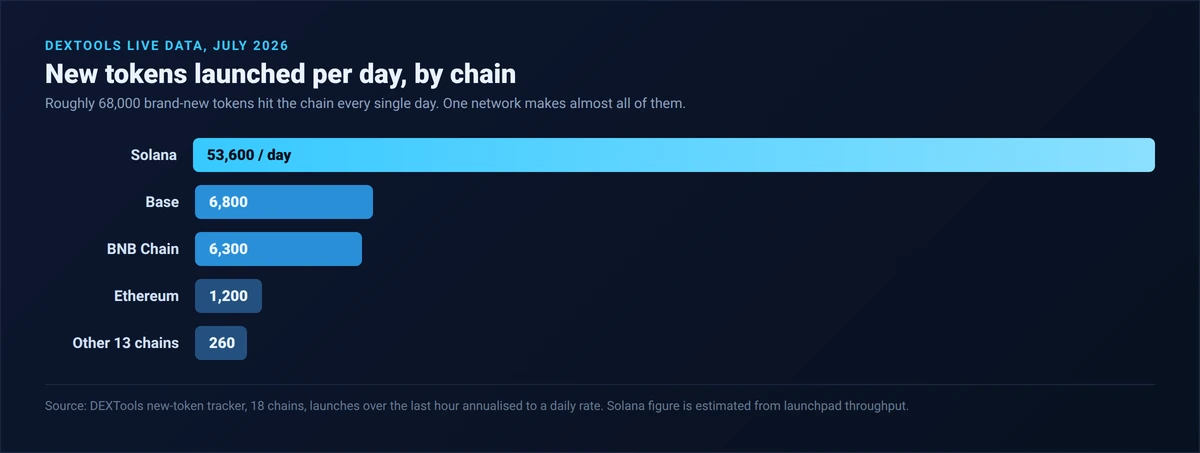
A market that mints 68,000 of anything a day is not dead. It is deflated in price and attention, but the machinery that produces memecoins is running at a scale that would have looked insane in any previous cycle. If you want to watch it in real time, our live new-token tracker counts launches across every major chain. The supply side of memecoins is the last thing you would call dead.
The catch has always been survival, not supply
So why does it feel dead? Because almost none of those 68,000 daily tokens are real, and now that the hype tide has gone out, that has become impossible to ignore. Our new-token risk index, sampling fresh launches across six major chains, found that 72% arrive with negligible liquidity and a median new-token liquidity of about zero dollars. Only around 7% reach viable liquidity and just 2% qualify as strong. Our token-survival index is even blunter: roughly 31% of new tokens are still traded 24 hours after launch, and only about 1% are still trading after a week.
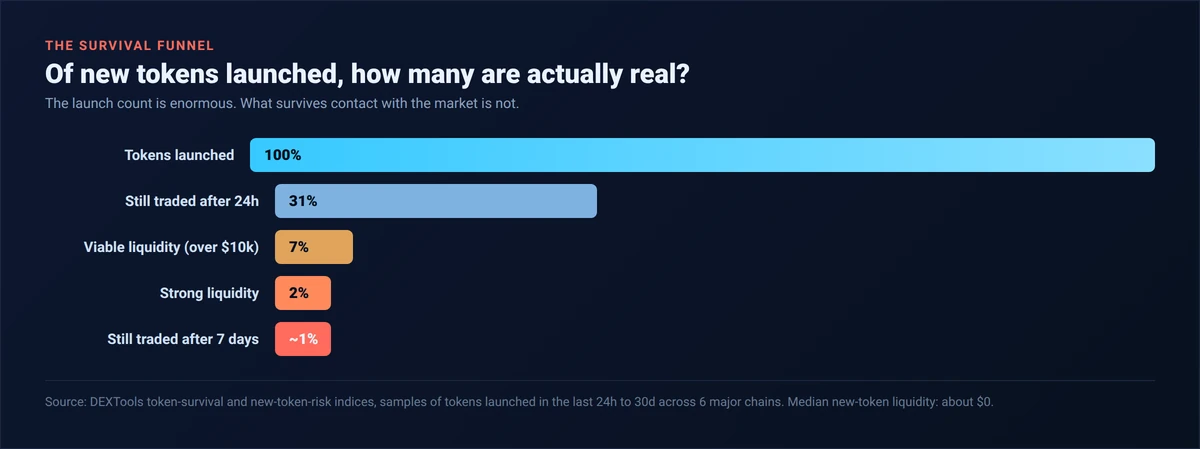
This is not new, it is just newly visible. Security firm Solidus Labs reported in 2025 that 98.6% of tokens on Pump.fun were rug pulls or pump-and-dumps, and that of more than 7 million tokens deployed, only about 97,000 ever held even 1,000 dollars of liquidity (Pump.fun disputed the figure). During the mania, enough greater fools showed up that the survivorship math did not matter. In 2026, with the crowd thinner, the graveyard is simply in plain sight. You can measure it yourself with our token survival index and new-token risk index.
It rotated, it did not vanish
The capital that left pure memecoins did not leave crypto, it moved. Three rotations stand out in 2026. First, into AI-agent memecoins, tokens tied to autonomous AI characters like GOAT and PIPPIN, which gave the meme trade a fresh narrative. Second, into perpetuals and stablecoin pairs, with venues like Hyperliquid capturing record derivatives share while spot meme volume faded. Third, into the ETF conversation: Canary Capital and others have filed for memecoin ETFs, which, as one founder put it, makes a token feel "investable" in a way a Telegram call never did.
Even the bears have a contrarian on the other side. On-chain analytics firm Santiment framed the widespread "end of the meme era" consensus as a classic capitulation signal, noting that the sectors the crowd leaves for dead are often the ones that mark a bottom. Whether or not that call ages well, the point stands: the meta shifted, chains reshuffled with Solana still dominant and Base rising, and the category kept evolving rather than disappearing.
So, are memecoins dead?
The honest, data-backed answer is no, but they are decisively deflated and reset. The mania, the market cap and the share of volume are all down 70% or more from the top. The launch factory and the casino are very much alive. And the brutal survival rate that was always true, that the vast majority go to zero, is now the defining feature rather than a footnote. Here is the split, on-chain:
- a launch machine still minting around 68,000 tokens a day
- a rotating meta that moved into AI-agent coins, perps and ETF bets
- a casino that never fully closes on Solana, Base and BNB Chain
- the 2024 to 2025 supercycle and its 150 billion dollar market cap
- an easy-money trade, with barely 1% of launches surviving a week
- the majority of on-chain volume, down from about 67% to roughly 10% on Solana
If you still trade them, trade the reset market, not the memory of the 2024 one. Screen every launch with the Token Safety Checker, respect the 1% survival math, read our full guide to what memecoins are and our memecoin risk management playbook, and remember that a market minting 68,000 tokens a day where 1% survive is not dead. It is exactly as dangerous as it always was, just with fewer people left to catch you.
Methodology and sources: launch, liquidity and survival figures were read on-chain via the DEXTools new-token tracker, token-survival index and new-token risk index across up to 18 chains on July 5, 2026, and change continuously. Market cap and volume-share figures are from CoinGecko and CoinDesk (State of Memecoins 2025) and SolanaFloor; launch and sign-up declines from CoinMarketCap Academy and MEXC reporting; the 98.6% figure from Solidus Labs (2025, disputed by Pump.fun). This article is for information only and is not financial advice. Newly launched tokens carry a very high risk of total loss.