Chainlink CCIP vs. LayerZero vs. Wormhole Comparison

Selecting the wrong cross-chain transport layer can expose a Web3 protocol to catastrophic bridge hacks. We compare the decentralized verifiers, guardian nodes, and risk networks of the big three.
The Interoperability Trilemma: Security vs. Customization vs. Speed
- The expansion of the decentralized web has shattered the monolithic blockchain model. Capital, applications, and user bases are distributed across an array of Layer 1 ecosystems, Ethereum Layer 2 rollups, app-chains, and private enterprise ledgers. However, shifting data and capital between these distinct networks safely remains the most fragile problem in Web3.
- Legacy cross-chain bridges (hampered by fragile code and centralized token-wrapping pools) have suffered catastrophic exploits, leaking over $3 billion in stolen user funds.
- To secure this fragmented landscape, the industry relies on three primary generalized interoperability backbones: Chainlink CCIP, LayerZero (V2), and Wormhole. While all three cross-chain protocols are designed to transmit arbitrary data and move assets natively across chain boundaries, they resolve the interoperability puzzle through completely distinct design philosophies. Choosing the correct transport layer requires analyzing their core trust topologies, gas costs, ecosystem coverages, and execution latencies.
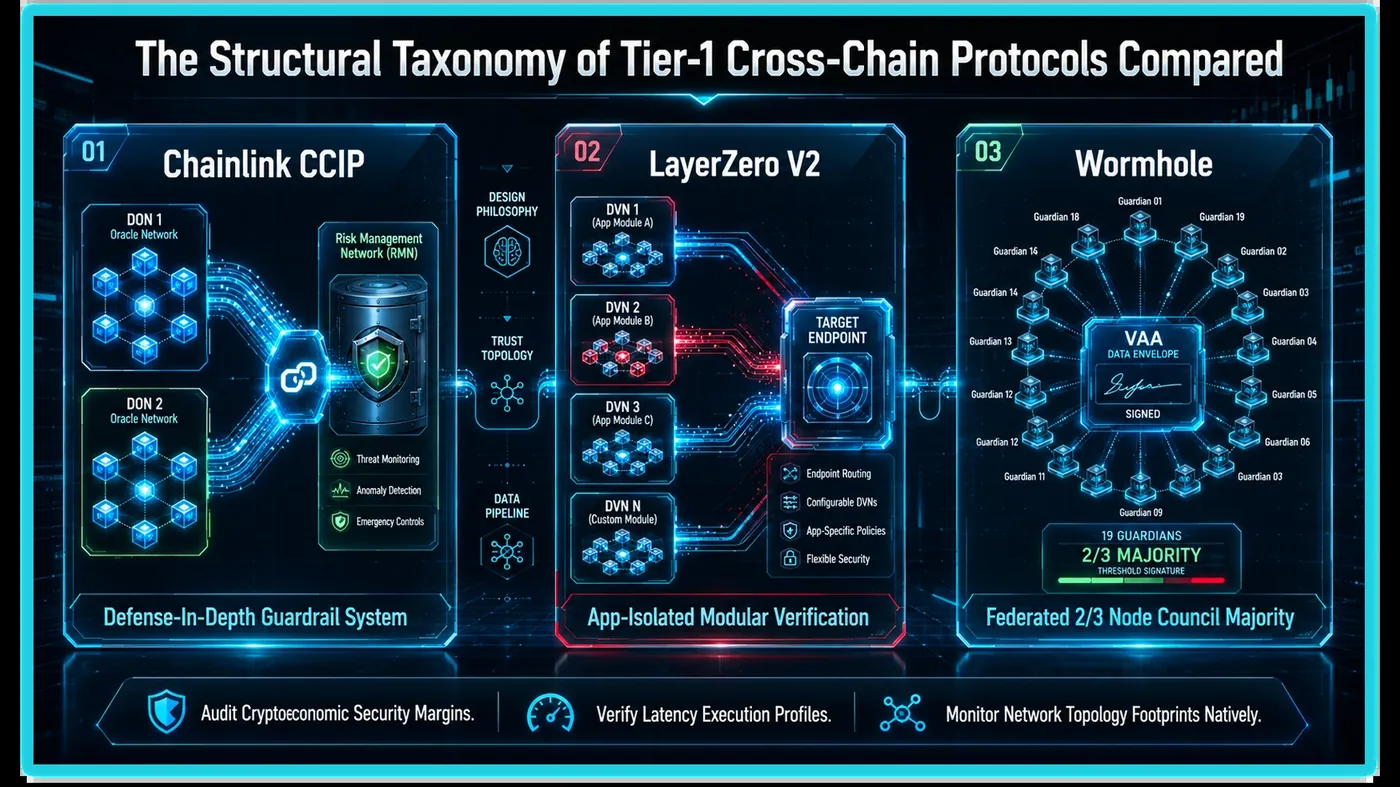
1. Trust Models & Security Architecture
The fundamental differentiator separating these protocols is their Trust Topology: the cryptographic and operational mechanism used to guarantee that a message on the source chain is authentic before triggering code execution on the destination chain.
Chainlink CCIP: Deep Defense-in-Depth
Chainlink CCIP approaches cross-chain architecture with an opinionated, highly regulated, and non-negotiable security framework. Built on top of the battle-tested Decentralized Oracle Network (DON) infrastructure that secures tens of billions in total value locked (TVL), CCIP implements a strict Defense-in-Depth model:
The Dual-DON Engine: Messages are processed sequentially by two separate node arrays: a Committing DON that observes source-chain transactions and signs state reports, and an Executing DON that delivers those verified bundles to the destination chain.
The Risk Management Network (RMN): Serving as an independent, secondary watchdog layer, the RMN runs completely separate hardware and node clients from the primary DONs. The RMN constantly double-checks every cross-chain transfer for anomalies or signature exploits. If the RMN detects a balance drift or a malicious event, it triggers a protocol-level circuit breaker to instantly freeze all bridge traffic, preventing exploits before they settle on-chain.
LayerZero V2: Modular, App-Isolated Security
Rejecting protocol-level defaults, LayerZero V2 operates on a philosophy of complete developer sovereignty. The network isolates security risks down to the individual application layer (OApp) using a customizable combination of Decentralized Verifier Networks (DVNs) and Executors:
Custom Security Configurations: OApp developers select their own preferred security stack. An application can choose to route messages through a single DVN or build a multi-sig framework requiring a cryptographic quorum split across independent verification providers (e.g., demanding a 2-of-3 signature pattern from Google Cloud, Animoca Brands, and Nethermind).
Isolation of Risk: If a single DVN is compromised or suffers a code exploit, the vulnerability is fully contained. Only the specific applications utilizing that compromised DVN are impacted, leaving the rest of LayerZero's global endpoint grid entirely unaffected.
Wormhole: The Federated Institutional Council
Wormhole establishes security using a highly structured, decentralized node council known as the Guardian Network.
The 19 Guardians: The network relies on a fixed set of 19 top-tier, institutional infrastructure operators and staking complexes: including names like Jump Crypto, Figment, and Everstake. Each Guardian monitors supported networks, verifying and attesting to source-chain states independently.
The 2/3 Consensus Rule: To authorize a cross-chain action, Wormhole requires a strict cryptographic supermajority: at least 13 out of the 19 Guardians must sign the message payload. This collective signature generates a Verifiable Action Approval (VAA), a highly compact, un-falsifiable data packet that relayers deliver forward to trigger atomic destination execution.
2. Cost Efficiency & Gas Dynamics
The engineering weight of a protocol's security framework dictates its underlying transaction execution cost profile.
Chainlink CCIP Premium: Due to its rigorous dual-DON structure, active RWA compliance checkers, and the continuous background verifications performed by the Risk Management Network, CCIP features a heavier gas profile. To streamline operations, Chainlink implements a Universal Gas / Payment Abstraction mechanism. While node operators are compensated exclusively in native LINK, users can pay transaction fees using convenient alternatives like USDC or ETH; the protocol handles the token conversion behind the scenes.
LayerZero V2 Optimization: LayerZero features an ultra-lightweight contract footprint on destination chains, translating to high gas efficiency for basic transfers and contract messages. Its Executor network completely abstracts gas management: users pay for the entire multi-chain transaction up-front on the source chain using that network's native gas asset, and the selected Executor automatically provisions the appropriate destination gas to finalize the trade.
Wormhole Market Routing: Wormhole minimizes on-chain overhead by packing its consensus signatures into a single, highly compressed VAA envelope. The platform runs a competitive, open relayer marketplace, allowing developers to either utilize public relayers or host their own automated relay scripts to reduce transaction costs to absolute raw network parameters.
3. Network Coverage & Ecosystem Saturation
A protocol's market share is defined by its ability to cross asset silos and connect disparate execution tracks.
4. Latency & Time-to-Finality
Execution latency is bound by the source chain's block finality constraints combined with the internal confirmation speeds of the chosen interoperability protocol.
LayerZero V2 (Low Latency): LayerZero is engineered for speed, enabling message delivery in 3 to 10 seconds across fast L1s and L2s. Because the application developer defines the confirmation parameters inside their chosen DVN settings, they can fine-tune the protocol to prioritize maximum speed for low-risk transactions.
Wormhole (High Velocity): Wormhole is built for fast execution. The 19 Guardian nodes constantly stream signature updates. The exact millisecond a source transaction achieves local consensus finality, the Guardians emit the corresponding VAA packet instantly, allowing relayers to trigger immediate destination actions.
Chainlink CCIP (Deterministic Delay): CCIP intentionally prioritizes safety over raw execution speed, resulting in higher latency. The protocol enforces fixed, conservative block confirmation thresholds on the source chain to completely immunize the system against block reorganization risks, passing the transactions through both DON networks and the RMN watchdog before authorizing destination delivery.
The Cross-Chain Interoperability Matrix
| Feature Matrix | Chainlink CCIP | LayerZero V2 | Wormhole Protocol |
| Trust Topology | Dual-DON + Independent RMN Watchdog | App-Isolated Modular DVN Clusters | Federated 19 Guardian Council |
| Security Configuration | Opinionated / Standardized | 100% Developer Customizable | Consensus Multi-Sig (13/19) |
| Asset Standard | Cross-Chain Token (CCT) | Omnichain Fungible Token (OFT) | Native Token Transfers (NTT) |
| Network Coverage | 70+ Chains (Deep Bank / RWA Focus) | 135+ Chains (EVM, Solana, Move) | 40+ Chains (EVM, Solana, Cosmos) |
| Execution Latency | High (Prioritizes Deterministic Finality) | Low (Optimized 3–10s on L2s) | Low (Instant Post-Finality VAAs) |
| Fee Settlement | Universal Gas (Auto-converted to LINK) | Native Source Gas (Executor Managed) | Variable / Open Relayer Marketplace |
Monitoring Interoperability Flow via DEXTools Telemetry
- As cross-chain architectures scale, keeping constant track of localized liquidity pool depths, transfer volumes, and smart contract health scores is a vital analytical requirement. Sourcing analytics through advanced decentralized charting architectures like DEXTools gives market participants an essential universal platform to monitor live token behaviors, evaluate pool depths, and inspect contract parameters across all public execution networks.
- By leveraging core features like the Pair Explorer, Live New Pairs dashboard, and the integrated Trade Story or Top Traders diagnostic tools, technical traders can seamlessly audit localized volume trends, track large whale wallet capital reallocations via the Big Swap Explorer, and check automated contract safety scores before initiating any on-chain interactions, ensuring your hardened hardware setup interacts safely with verified market venues.
Disclaimer: This article is for informational purposes only and does not constitute investment advice, financial advice, trading advice, or any other kind of advice. DEXTools does not recommend buying, selling, or holding any cryptocurrency or token. Users should conduct their own research and consult with a qualified financial advisor before making any investment decisions. Cryptocurrency investments are volatile and high-risk. DEXTools is not responsible for any losses incurred.