Comparison of ERC-20, ERC-721, ERC-1155, and ERC-404
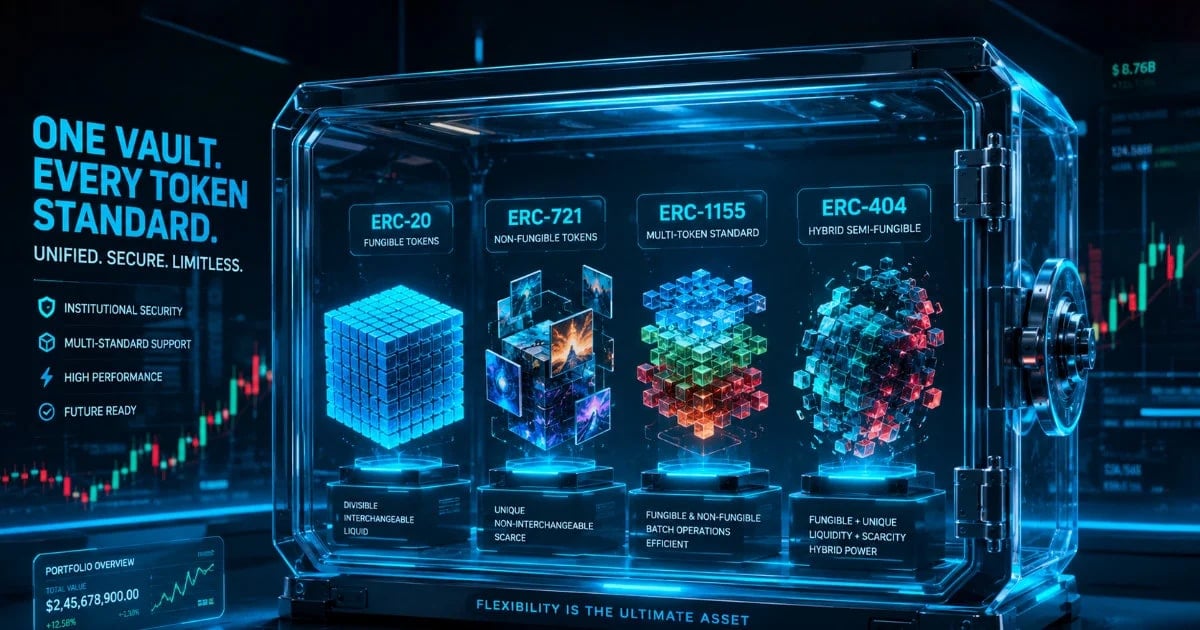
Choosing the incorrect asset architecture can lock a Web3 project out of key DeFi integrations. We break down the gas fees, code complexities, and native liquidities of top token standards.
The Smart Contract Canvas: Blueprinting Value on the EVM
- On the Ethereum Virtual Machine (EVM), digital assets do not exist as loose file attachments floating across a network path. Every token, whether it represents a fraction of a stablecoin, an immutable piece of digital fine art, a web3 gaming weapon, or a complex financial derivative: is simply a specialized ledger account managed by a deployed smart contract. To ensure these programs can talk to decentralized exchanges, non-custodial wallets, and lending protocols seamlessly, the developer community relies on standardized application programming interfaces (APIs) known as Ethereum Request for Comments (ERC) frameworks.
- Selecting the wrong token architecture during the initial design phase can paralyze a decentralized application. It can saddle users with exorbitant gas costs, create integration barriers with existing protocols, or open critical smart contract vulnerability vectors. This comparative guide breaks down the core architecture, gas execution profiles, code complexities, and use cases separating standard token frameworks from emerging semi-fungible hybrid token technologies.
1. ERC-20 vs. ERC-721: The Binary Divide of On-Chain Liquidity
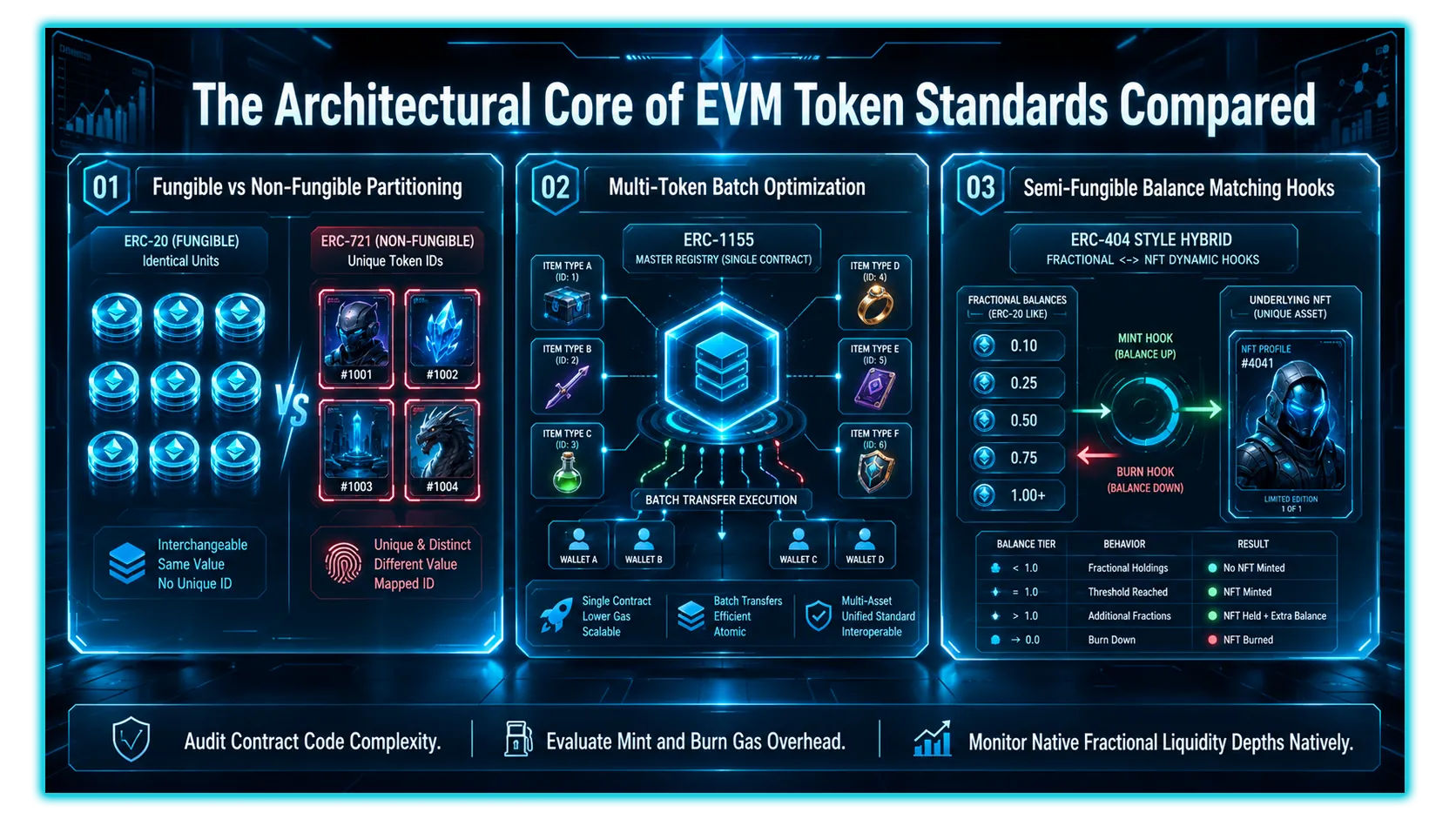
The foundational pillars of decentralized tokenization divide assets into a strict binary classification: completely identical or completely unique.
ERC-20: The Fungible Workhorse
The ERC-20 standard is engineered for absolute fungibility. Every token unit is mathematically identical and interchangeable with any other unit, mimicking traditional fiat currencies or raw commodities.
Code Simplicity: The internal architecture is remarkably lean, relying primarily on a central lookup mapping table (
mapping(address => uint256) balances) that tracks tracking account coordinates against their corresponding numeric balances.Gas Profile: Because modifying states requires updating basic integer variables, standard ERC-20 operations (like a basic
transfer) are highly cost-optimized, demanding a minimal baseline gas expenditure.
ERC-721: The Non-Fungible Anchor
The ERC-721 standard introduces absolute, unalterable uniqueness to the ledger. Instead of managing a collective supply pool, an ERC-721 contract tracks discrete, individual assets defined by a unique tokenId.
Code Complexity: Complexity scales significantly. The contract must maintain rigorous dual-mapping tables (
mapping(uint256 => address) _owners) to link every distinct asset ID directly to its active owner, alongside optionaltokenURIfields pointing to external metadata packages.Gas Friction: Every individual token mint, transfer, or approval modifies separate state lines on the blockchain ledger, rendering ERC-721 transactions significantly more expensive than fungible transfers.
2. ERC-1155: The Multi-Token Engine and Gas Optimizer
- When Web3 applications (particularly multiplayer blockchain games) scaled their on-chain requirements, the strict separation between ERC-20 and ERC-721 created massive infrastructure bloat. If a game required 50 unique weapon skins, 10 types of consumable health potions, and a native gold currency, developers were forced to deploy dozens of separate smart contracts, forcing players to execute multiple expensive transaction loops just to set up a basic item inventory.
The ERC-1155 standard natively solves this multi-contract overhead. Often described as a "meta-token" or "multi-token" framework, a single deployed ERC-1155 contract can simultaneously manage an infinite combination of fungible, non-fungible, and semi-fungible tokens within a unified codebase.
The Batch Optimization Value: By replacing single-asset transaction loops with native batching functions like
safeBatchTransferFrom, an ERC-1155 contract allows a user to send an entire collection of diverse fungible currencies and unique gear items across the network inside a single block confirmation, slashing user gas costs by over 70%.
3. ERC-404: The Semi-Fungible Hybrid and Native Fractionalization Era
- The historic barrier dividing high-value NFTs from mainstream DeFi markets was a chronic lack of native liquidity. If a collector owned an elite digital profile-picture asset valued at 50 ETH, they could not instantly sell 1% of it to cover immediate capital needs; they had to list the asset on a marketplace and wait for a single counterparty to purchase the item whole.
- ERC-404 (alongside its heavily optimized open-source counterpart, DN404) completely re-engineers this liquidity bottleneck. Operating as an experimental, unofficial hybrid standard, ERC-404 fuses the programmatic capabilities of ERC-20 and ERC-721 directly inside a single master contract.
The Mint-and-Burn Equilibrium Hook
ERC-404 achieves native semi-fungibility through automated balance-matching state hooks:
Fractional Accumulation: If an investor buys a fractional unit (e.g., 0.4 tokens) of an ERC-404 project on a standard decentralized exchange, the contract handles the asset as a standard liquid ERC-20 token. However, the moment that user accumulates enough fractional pieces to equal 1 full, whole token, the smart contract's internal hook triggers an automated action: it instantly mints a unique ERC-721 NFT directly into the user's wallet.
Fractional Liquidation: Conversely, if the user sells a fraction of their holdings (e.g., dropping their balance down to 0.9 tokens), the contract automatically triggers a burn hook, instantly deleting the associated NFT from existence. This allows collectors to trade high-tier collections with the instant, continuous liquidity profiles of standard ERC-20 pools.
EVM Token Standard Architecture Matrix
| Metric | ERC-20 | ERC-721 | ERC-1155 | ERC-404 / DN404 |
| Fungibility Profile | 100% Fungible | 100% Non-Fungible | Highly Configurable | Semi-Fungible Hybrid |
| Contract Structure | Single Registry | Single Asset Map | Multi-Token Matrix | Integrated Dual Logic |
| Code Complexity | Low / Standard | Intermediate | High / Modular | Very High / Experimental |
| Gas Efficiency | Highly Optimized | High Cost Per Unit | Elite Batch Efficiency | Very High / Heavy State Changes |
| Primary Use Cases | DeFi, Stablecoins | Digital Art, Deeds | Web3 Gaming Items | Fractional Liquidity Pools |
Analyzing Token Infrastructure Markets via DEXTools Telemetry
- As experimental hybrid frameworks and multi-token utility ecosystems scale across Layer 1 and scaling environments, tracking live token metrics, liquidity pool tracking, and smart contract health scores across decentralized venues is critical for risk management. Sourcing analytics through advanced decentralized charting architectures like DEXTools gives market participants an essential universal platform to monitor live token behaviors, evaluate pool depths, and inspect contract parameters across all public execution networks.
- By leveraging core features like the Pair Explorer, Live New Pairs dashboard, and the integrated Trade Story or Top Traders diagnostic tools, technical traders can seamlessly audit localized volume trends, track large whale wallet capital reallocations via the Big Swap Explorer, and check automated contract safety scores before initiating any on-chain interactions, ensuring your hardened hardware setup interacts safely with verified market venues.
You can access DEXTools here and start trading today!
Disclaimer: This article is for informational purposes only and does not constitute investment advice, financial advice, trading advice, or any other kind of advice. DEXTools does not recommend buying, selling, or holding any cryptocurrency or token. Users should conduct their own research and consult with a qualified financial advisor before making any investment decisions. Cryptocurrency investments are volatile and high-risk. DEXTools is not responsible for any losses incurred.