How to Set Up Shamir Backup (SLIP-39) for Your Seed Phrase

A single piece of paper holding 24 words is a security disaster waiting to happen. Enter Shamir Backup, the crypto standard that shatters your recovery risk.
How to Set Up Shamir Backup
- The non-custodial ownership of digital wealth brings unparalleled financial freedom, but it demands uncompromising personal operational security. For nearly a decade, the global crypto economy has relied on the industry-standard BIP-39 framework to secure private keys. Under this model, your entire financial sovereignty is compressed into a single list of 12 or 24 sequential words.
Let's be completely candid: a single backup phrase introduces a catastrophic single point of failure.
- If a malicious actor uncovers your backup slip, your entire treasury is drained instantly. Symmetrically, if that single piece of paper is destroyed in a household fire or lost during a relocation, your access to the ledger is permanently terminated. To eliminate this existential risk, sophisticated asset allocators are migrating to Shamir Backup (SLIP-39). Developed by SatoshiLabs, this framework allows you to shatter your master recovery setup into multiple independent, cryptographically secure word lists. This technical manual provides the operational blueprint required to configure a Shamir Backup structure for your hardware wallet.
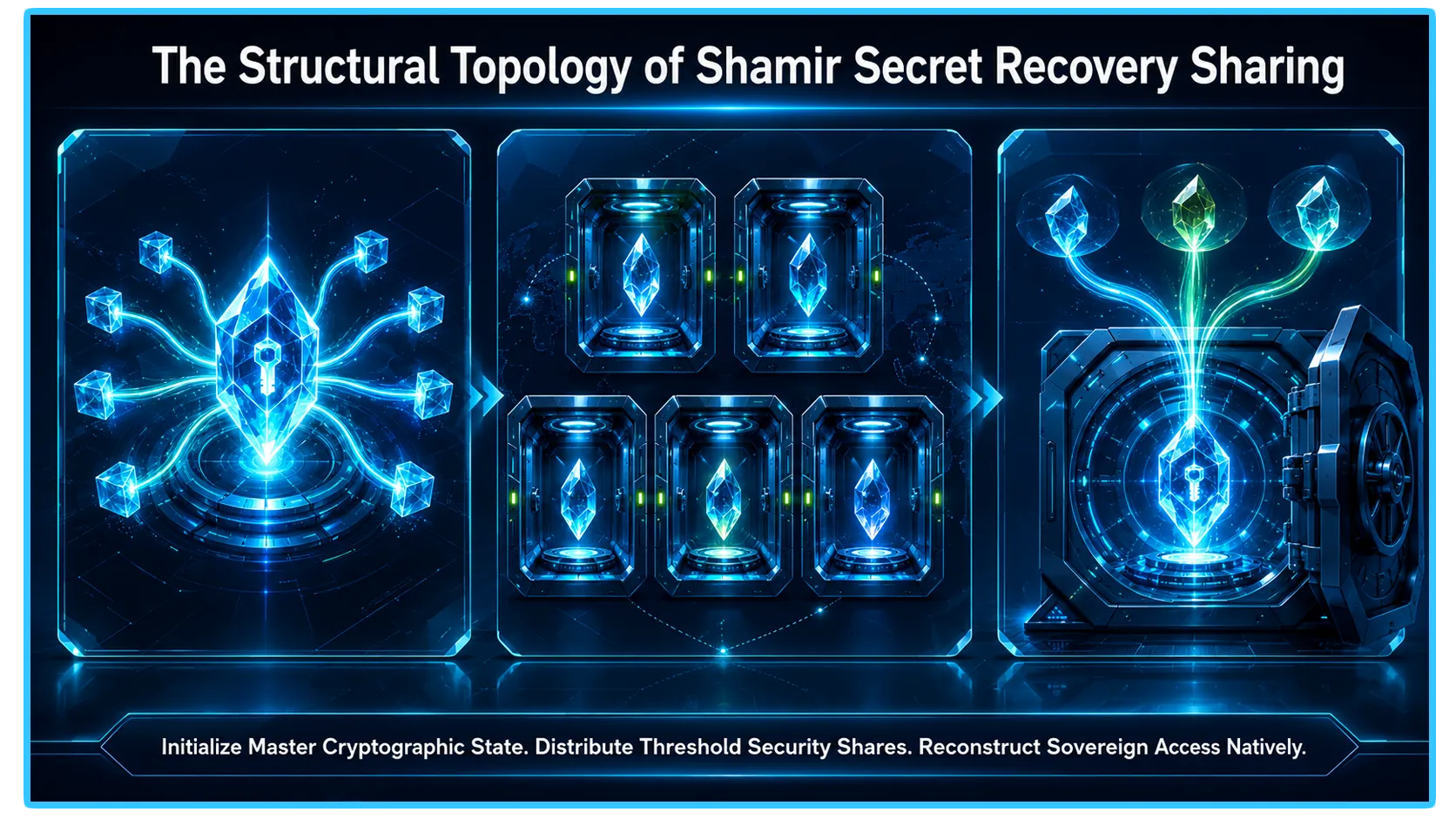
1. The Cryptographic Core: Explaining Threshold Security
- To implement a Shamir Backup with professional engineering precision, you must look past basic product marketing terms and understand the underlying logic of secret sharing. SLIP-39 does not simply cut your traditional 24-word seed phrase into literal fractional pieces (e.g., cutting a paper slip into three physical strips). If you cut a standard BIP-39 phrase into pieces, an attacker who steals just one strip acquires a massive chunk of your actual private key words, radically compromising your remaining cryptographic entropy.
- Instead, Shamir Backup uses advanced mathematical secret-sharing parameters to generate entirely unique, mathematically independent sets of recovery words, known as Shares.
- When initializing the architecture, you configure a specialized multi-share matrix defined by a strict Threshold Rule (often referred to as an M-of-N configuration). For example, you can choose to generate a total of five independent shares (N), but dictate that any three of those shares (M) must be combined concurrently to successfully reconstruct your master private key.
- An attacker who compromises one or two isolated shares acquires absolute zero information regarding your actual ledger state. The independent shares look like random, unlinked word blocks until the minimum threshold condition is satisfied.
2. The Security Grid: Backup Standard Comparison
To maintain a clean structural overview of how different cryptographic backup configurations protect your long-term storage loops, evaluate the execution parameters organized inside this optimized layout:
| Backup Standard & Architecture | Primary Risk Mitigation Profile |
| BIP-39 Single Phrase | Simple execution but introduces an immediate single point of physical theft or loss failure. |
| SLIP-39 Shamir Matrix | Eliminates single-point risk by distributing recovery access across isolated threshold shares. |
3. Step-by-Step Playbook: Setting Up SLIP-39
Step 1: Secure a Fully Compatible Hardware Enclave
Because Shamir Backup requires advanced mathematical computations to generate and decode shares, it cannot be safely generated on a standard desktop or smartphone keyboard interface exposed to keyloggers. You must execute this setup natively inside a hardware wallet enclave that explicitly supports the SLIP-39 standard standard (such as the Trezor Safe 5, Trezor Model T, or specialized open-source multi-share hardware suites).
Step 2: Initialize the Shamir Creation Path
Connect your clean hardware wallet to its native desktop interface and initiate a standard device factory reset or initial device configuration sequence.
When prompted by the system software to select your desired backup configuration framework, bypass the traditional "Standard Single Seed" option and explicitly select Shamir Backup.
Confirm the configuration selection directly on your hardware device's physical touchscreen or secure button interface.
Step 3: Calibrate the Share and Threshold Boundaries
The setup wizard will prompt you to define your specific security matrix boundaries. For optimal long-term treasury management, a 3-of-5 setup provides an exceptional balance of resilience and operational redundancy:
Set the Target Share Count parameter to five. This means the device will generate five distinct, unique word lists.
Set the Threshold Target parameter to three. This dictates that you will need to input any three of those five lists to recover your wallet in the future.
Step 4: Record the Cryptographic Share Arrays Meticulously
The hardware wallet's screen will begin populating the words for Share 1. Every individual SLIP-39 share is typically formatted as a unique 20-word list.
Write down the words sequentially onto a dedicated, high-durability physical medium (such as a stainless steel matrix slate or specialized archival card sets).
The device will force you to complete an on-screen validation check, verifying multiple words from the list to ensure zero transcription errors occurred.
Repeat this exact recording and verification sequence for Share 2, Share 3, Share 4, and Share 5. Once complete, clear the device memory cache, store your physical slates in entirely separate geographical locations, and your multi-share treasury backup is active.
4. The Crucial Warning: The Compatibility Bottleneck
- While Shamir Backup delivers an unmatched layer of structural insulation for your digital wealth, you must account for a significant technical constraint: SLIP-39 is structurally incompatible with traditional BIP-39 recovery inputs.
- If your hardware device breaks five years down the road, you cannot take three of your 20-word Shamir shares and type them into a legacy wallet extension that only accepts basic 12 or 24-word inputs. Attempting to force these words into an unsupported application will return a continuous derivation path error.
- To restore your sovereign wallet access during an emergency, you must explicit locate a hardware device or verified open-source developer tool that natively supports the SLIP-39 protocol decoding rules. Understanding this compatibility boundary ensures you never panic during a hardware migration scenario.
5. Real-Time Telemetry and Infrastructure Security via DEXTools
- Successfully engineering a bulletproof multi-share backup matrix protects your long-term generational wealth from physical theft and structural degradation. However, securing your storage layout is only half the battle; managing your deployed capital effectively requires continuous validation of live ecosystem conditions.
- If you maintain deep liquidity allocations across high-yield decentralized pools or automated market makers, checking real-time capital velocity and pool depth is the only way to insulate your wealth from market anomalies.
- DEXTools provides the critical analytical data infrastructure needed to perform these diagnostic checks in real-time. By utilizing advanced multi-chain pair trackers, live transaction logs, and look-through wallet telemetry, market participants can instantly verify the structural health of any asset pool.
- Cross-referencing your hardware security layers with live market telemetry ensures your active portfolio parameters remain completely optimized, keeping your digital wealth securely protected from hidden pool contractions or systemic liquidity issues across alternative layers.
Disclaimer: This article is for informational purposes only and does not constitute investment advice, financial advice, trading advice, or any other kind of advice. DEXTools does not recommend buying, selling, or holding any cryptocurrency or token. Users should conduct their own research and consult with a qualified financial advisor before making any investment decisions. Cryptocurrency investments are volatile and high-risk. DEXTools is not responsible for any losses incurred.