Privacy Architectures and the Compliance Landscape
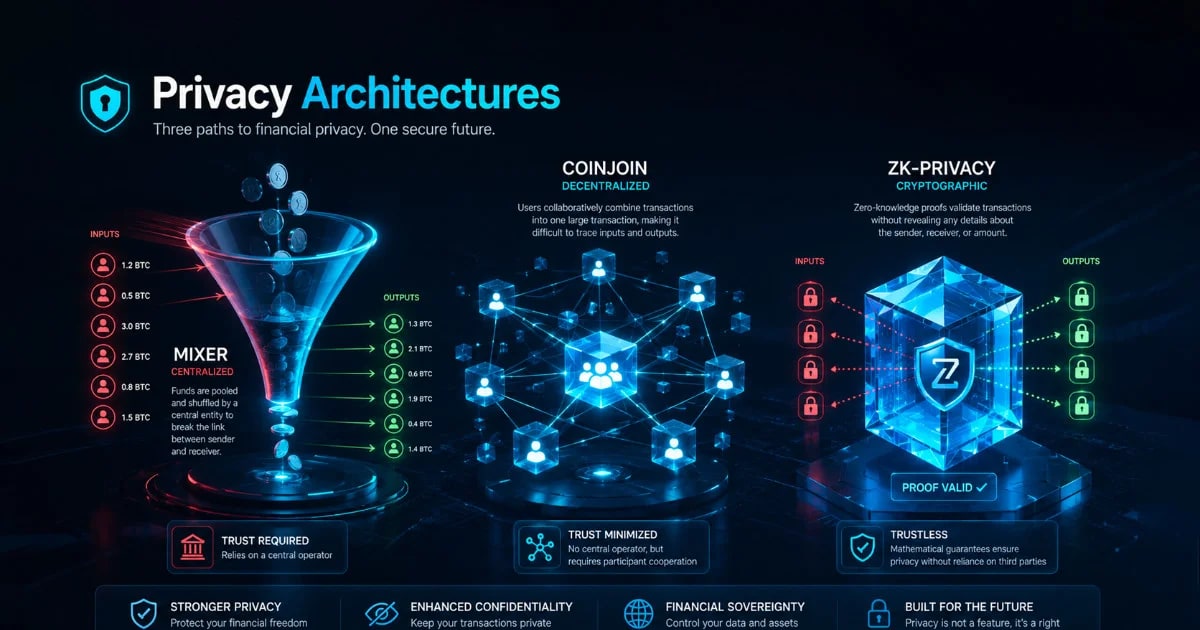
Digital privacy is not a monolith. We dissect the mechanical and legal differences between custodial mixers, decentralized CoinJoin, and zero-knowledge architectures.
Deconstructing the Compliance Landscape
- As the digital asset industry matures, the debate surrounding user confidentiality has intensified. Protecting financial privacy is a legitimate pursuit, yet different Privacy Architectures face drastically different levels of regulatory scrutiny.
- Understanding the structural differences between custodial mixers, decentralized CoinJoin, and zero-knowledge (zk) implementations is essential for anyone navigating the current compliance environment.
Mechanical Divergence: Three Models of Privacy
While all three technologies aim to break the link between sender and receiver, they achieve this through fundamentally different mechanisms.
1. Custodial Mixers: The Centralized Funnel
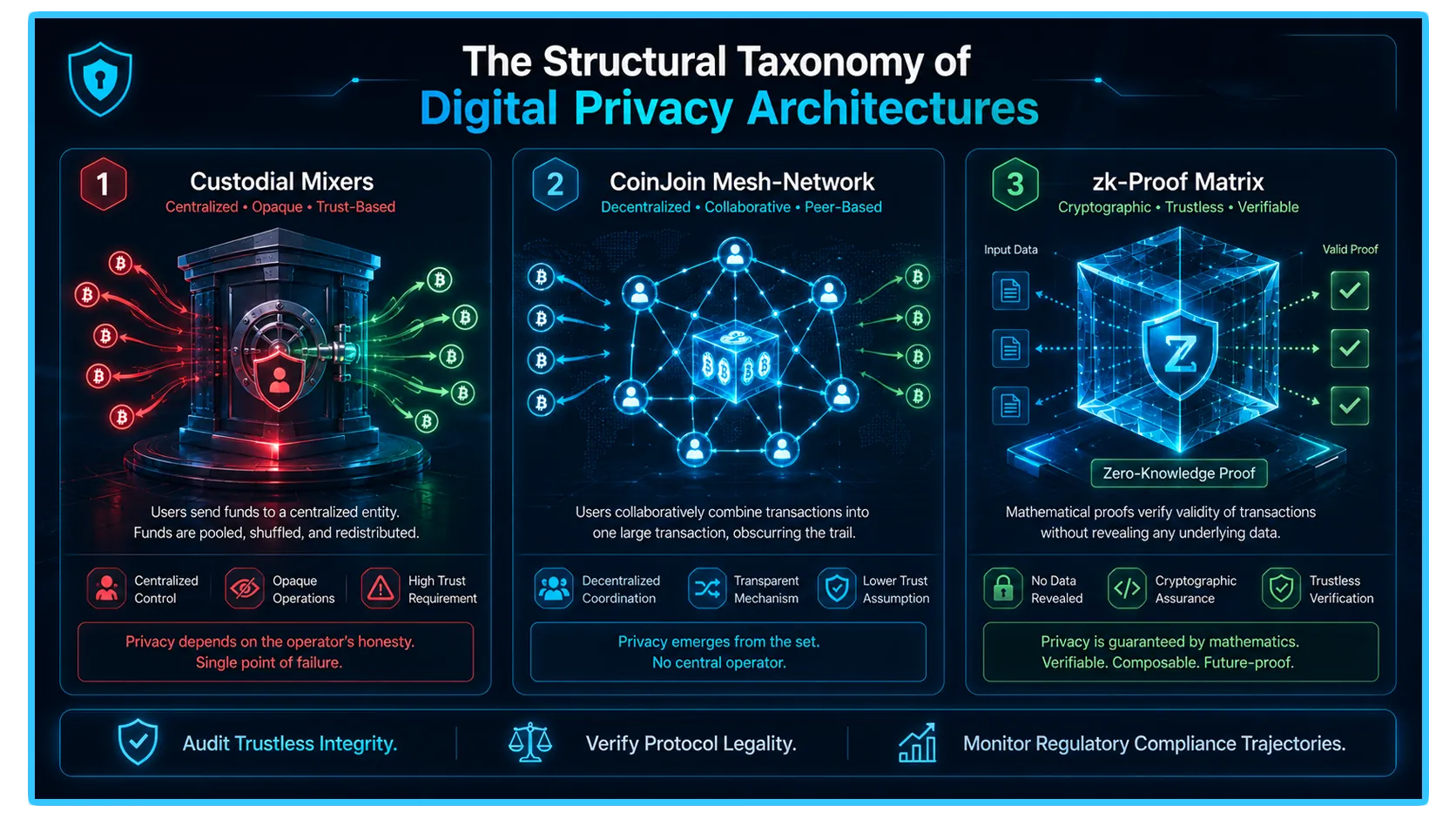
- Custodial mixers operate as a centralized service. Users send their assets to a vault managed by the service provider, which then mixes these funds with those of other users before sending them out to new addresses.
- The primary issue here is custody. Because the service provider takes temporary possession of the funds, they become a high-value target for regulators. These entities act as "money transmitters," and their centralized nature makes them legally vulnerable to anti-money laundering (AML) mandates.
2. CoinJoin: The Decentralized Mesh
- CoinJoin is not a service; it is a transaction protocol. It allows multiple users to combine their inputs into a single, massive transaction. The protocol ensures that the outputs cannot be mapped back to the original inputs by an external observer.
- Because CoinJoin does not require a central party to hold funds, it is inherently trustless. The protocol functions as a decentralized mesh-network. From a legal perspective, this is significantly different from mixers, as there is no central entity to "regulate" or serve with a subpoena.
3. zk-Privacy: The Mathematical Shield
- Zero-knowledge architectures, such as those found in Zcash or Monero, approach privacy as a native protocol feature rather than an aftermarket add-on. By utilizing advanced cryptography (like zk-SNARKs), the network validates that a transaction is valid without revealing any metadata.
- This is the most robust form of Privacy Architectures because privacy is inherent to the ledger's state. It is not an "action" taken by the user, but rather a standard property of the asset itself.
The Legal Lens: Navigating Regulatory Scrutiny
Regulatory agencies treat these models differently based on the level of "intermediation" involved.
Mixers: Often viewed with extreme hostility by regulators. Because they involve a central intermediary holding funds, they are frequently characterized as hubs for illicit activity. Law enforcement actions against major mixer protocols highlight the high risk associated with custodial privacy tools.
CoinJoin: Exists in a legal grey area. Because it is a voluntary, peer-to-peer protocol layer, it is often argued that it is merely a method of transacting, not a service. However, regulators have begun to focus on developers and infrastructure providers to see if they can be held liable for the "facilitation" of anonymous transactions.
zk-Privacy: Generally considered the most "legally defensible" architecture. Because privacy is a native feature of the blockchain protocol, attempting to regulate it is akin to regulating the underlying mathematics of the system. Proponents argue that these privacy-first blockchains are essential for institutional compliance, as they provide "selective disclosure" mechanisms (view keys) that allow users to share data with authorities if and when required.
Operational Security and Telemetry
- Regardless of the privacy protocol used, verification of market depth and liquidity is the only way to ensure your assets are tradeable and stable. DEXTools allows users to monitor the health of these assets by tracking liquidity pool distribution and order book dynamics in real-time.
- Even for privacy-focused protocols, having visibility into the broader market telemetry is a critical risk management step. DEXTools provides the transparency needed to ensure your chosen asset remains functional and liquid within the global financial system.
You can access DEXTools here and start trading today!
Zero-Knowledge Privacy Layer 1 Blockchain Privacy-First Layer-1 Blockchain Top 5 Crypto Privacy Tools Monero vs Zcash: Privacy Coins ComparedDisclaimer: This article is for informational purposes only and does not constitute investment advice, financial advice, trading advice, or any other kind of advice. DEXTools does not recommend buying, selling, or holding any cryptocurrency or token. Users should conduct their own research and consult with a qualified financial advisor before making any investment decisions. Cryptocurrency investments are volatile and high-risk. DEXTools is not responsible for any losses incurred.