The Swap Quality Index: Why Not All Crypto Volume Deserves Trust
— By Whatsertrade in Tutorials
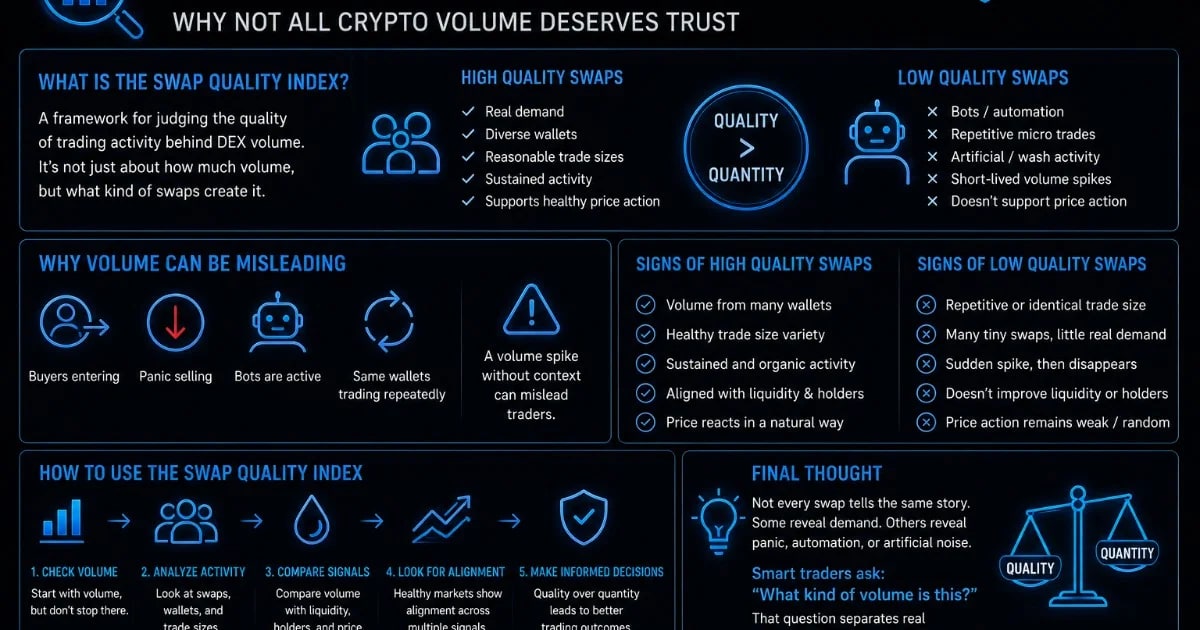
Discover the Swap Quality Index, a vital tool for evaluating the authenticity of trading activity on decentralized exchanges.
Volume is one of the most watched metrics in crypto trading.
But on DEX markets, not all volume deserves the same level of trust.
A token can show rising volume while the real quality of trading activity remains weak. Some swaps represent genuine demand. Others may come from bots, repeated micro trades, artificial activity, panic exits, or short lived speculation.
This is why traders need a better way to think about volume.
That idea can be called the Swap Quality Index.
What Is the Swap Quality Index?
The Swap Quality Index is a framework for judging the quality of trading activity behind DEX volume.
It is not only about how much volume a token has. It is about what kind of swaps create that volume.
High quality swaps suggest real market interest. They come from diverse wallets, reasonable trade sizes, repeated participation, and activity that supports healthy price action.
Low quality swaps may create impressive numbers but weak signals. They can come from mechanical activity, tiny repeated trades, wash style behavior, or sudden bursts that disappear quickly.
Why Volume Can Be Misleading
Many traders treat volume as proof of demand. If volume is rising, they assume the market is strong.
But volume can rise for many reasons. It can rise because buyers are entering. It can also rise because holders are panic selling. It can rise because bots are active. It can rise because a few wallets are trading repeatedly.
A volume spike without context can mislead traders.
That is why swap quality matters. Traders should ask what the volume is made of, not just how large it is.
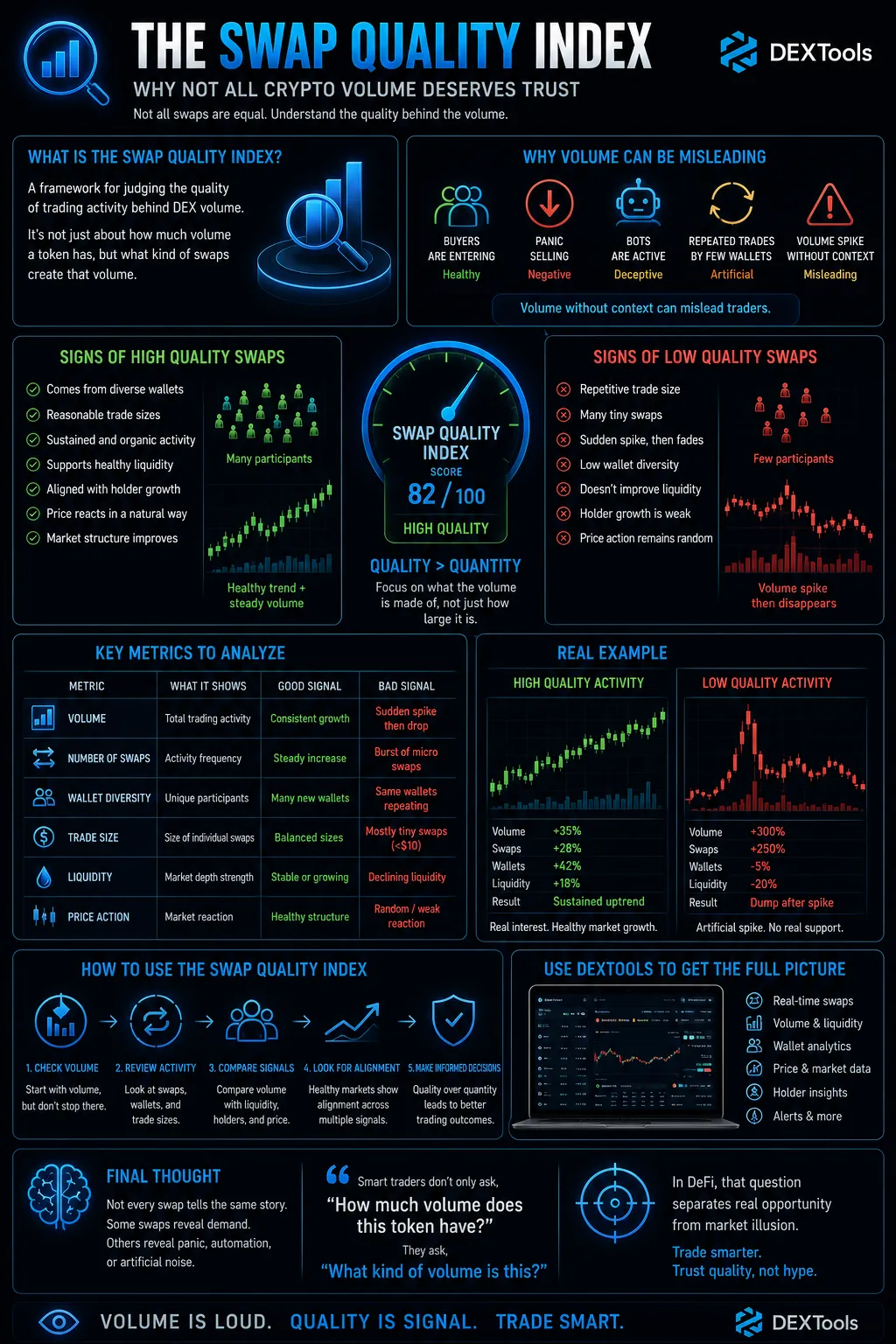
Signs of High Quality Swaps
High quality swap activity often has several traits.
It appears across multiple wallets. It supports consistent market structure. It does not vanish after one short burst. It often aligns with healthy liquidity, stronger holder behavior, and price action that reacts naturally.
High quality volume usually feels like a market forming.
It shows participation, not just movement.
DEXTools can help traders review swaps, volume, liquidity, holders, and price behavior together, which makes it easier to understand whether activity is meaningful.
Signs of Low Quality Swaps
Low quality swaps may look active at first, but they often fail deeper inspection.
One sign is repetitive trade size. Another sign is many tiny swaps that create volume without meaningful demand. A third warning sign is volume that spikes suddenly, then disappears.
Low quality swaps may also fail to improve market structure. If volume rises but liquidity remains weak, holders do not grow meaningfully, and price action remains random, traders should be careful.
Volume should create information. If it only creates noise, its value is limited.
Why Swap Quality Matters for DEX Traders
DEX traders operate in markets where liquidity can be thin and behavior can change quickly.
In these conditions, raw volume can be especially deceptive. A small group of wallets can make a token appear more active than it really is. Bots can make a chart look alive. Panic exits can make volume look exciting while the market is actually weakening.
Swap quality helps traders avoid mistaking activity for strength.
The goal is not to ignore volume. The goal is to understand its source and meaning.
How to Use the Swap Quality Index
When analyzing a token, start with volume, but do not stop there.
Look at the number of swaps. Look at wallet diversity. Look at trade size. Compare volume with liquidity. Check whether price action improves after volume appears. Watch whether the activity continues or fades.
A healthy market usually shows volume that connects with other signals.
A weak market often shows volume that stands alone.
Final Thoughts
The Swap Quality Index gives traders a more intelligent way to read DEX volume.
Not every swap tells the same story. Some swaps reveal demand. Others reveal panic, automation, or artificial noise.
Smart traders do not only ask, “How much volume does this token have?”
They ask, “What kind of volume is this?”
In DeFi, that question can separate real opportunity from market illusion.
Fake Volume vs Real Demand: How to Spot Artificial Momentum in DeFi Trading Healthy vs Toxic DEX Volume Explained High Volume, Low Conviction: Detecting Inflated DEX Activity Dark AMMs and Hidden Liquidity: Why Some DEX Activity Is Harder to Read