Fake Volume vs Real Demand: How to Spot Artificial Momentum in DeFi Trading
— By Whatsertrade in Tutorials

Volume is one of the first things traders look at when analyzing a token. High volume can make a new pair look active, exciting and full of opportunity. But vol
Volume is one of the first things traders look at when analyzing a token. High volume can make a new pair look active, exciting and full of opportunity. But volume alone can be misleading.
In DeFi, not all trading activity represents real demand. Some tokens show artificial momentum created by bots, repetitive microtransactions, wash trading or coordinated attempts to make a pair look more popular than it really is.
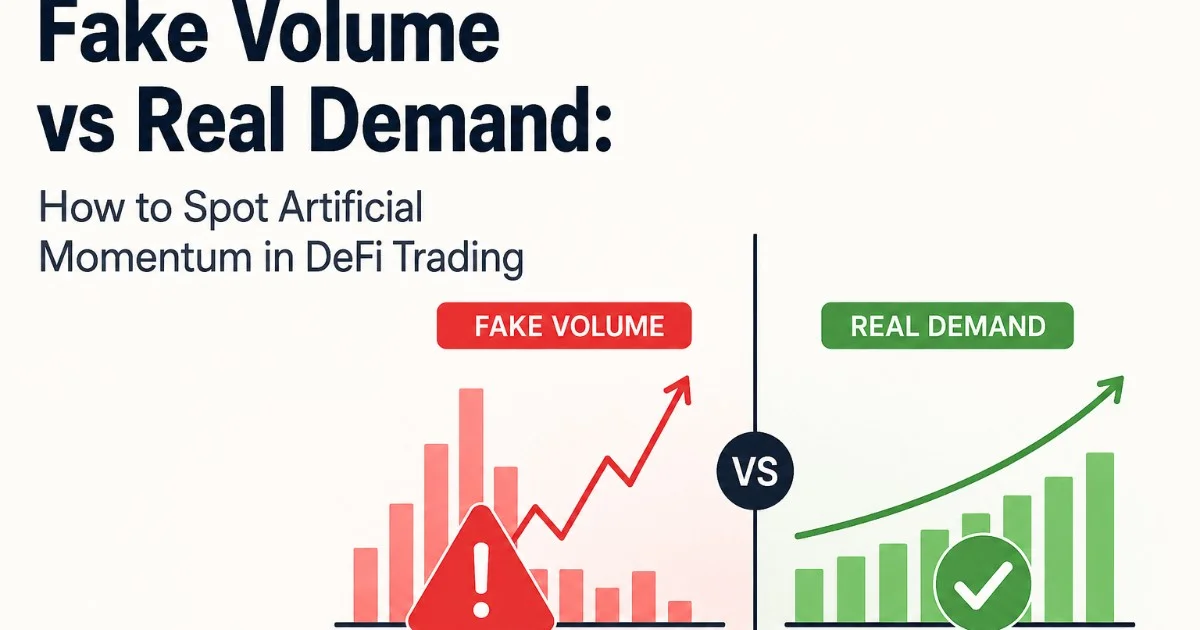
For traders, the key question is simple: is this token attracting real buyers, or is the activity being manufactured?
Understanding the difference between fake volume and real demand can help traders avoid weak setups, reduce emotional entries and make better decisions before buying into hype.
Why Volume Alone Is Not Enough
A token with rising volume may look strong at first glance. However, volume only tells you that transactions are happening. It does not tell you whether those transactions come from real market interest, healthy liquidity or sustainable buying pressure.
Fake or low-quality volume can create the illusion of momentum. This can attract traders who fear missing out, only for the price to reverse once the artificial activity stops.
Instead of asking, "Is there volume?", traders should ask better questions:
Is the volume coming from many different wallets?
Are buy and sell sizes natural?
Is liquidity strong enough to support the activity?
Are holders increasing in a healthy way?
Is the chart moving with structure, or only with sudden spikes?
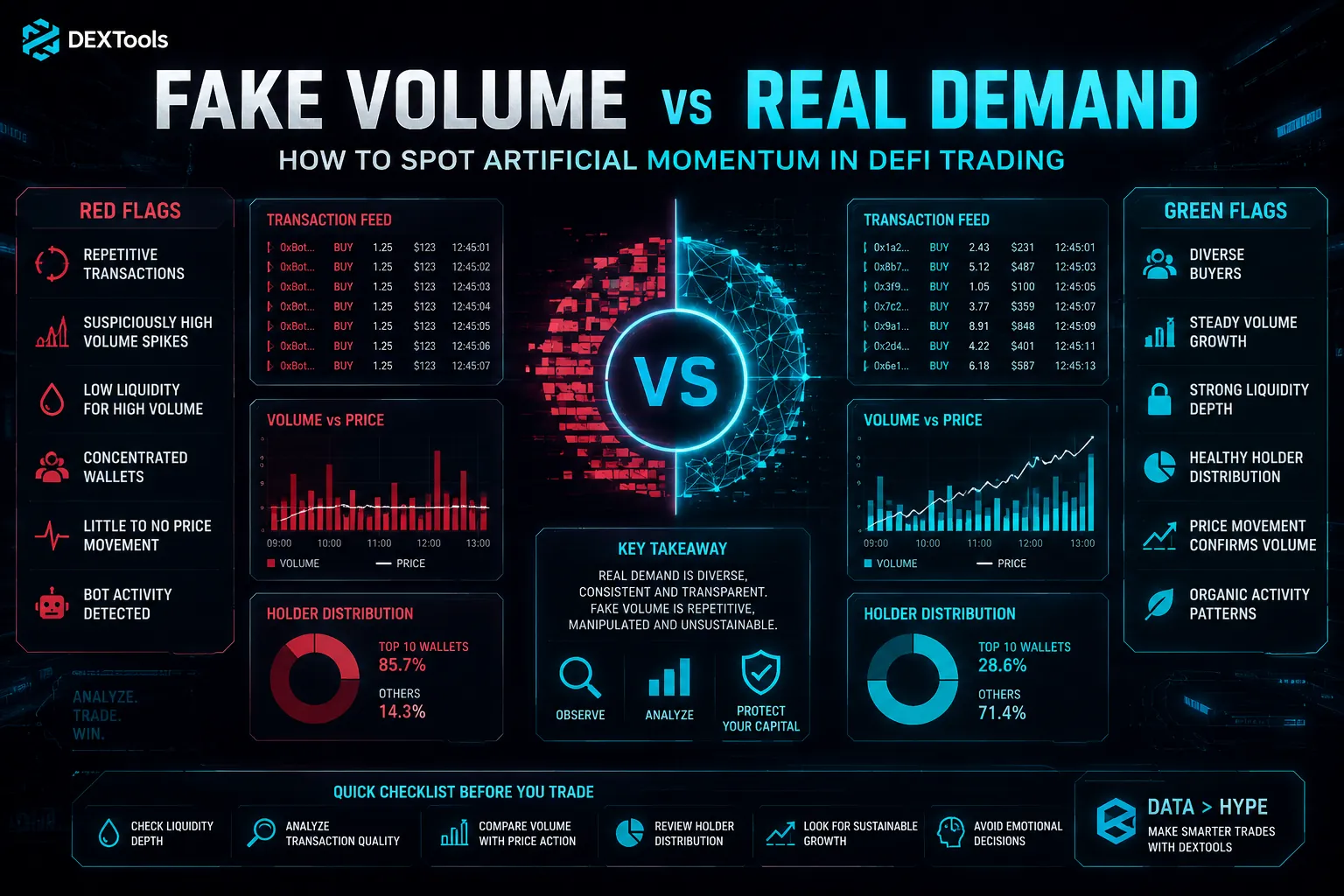
Real demand usually leaves a broader footprint. Fake volume often looks repetitive, mechanical or disconnected from other market signals.
Signs of Artificial Volume
Artificial volume is not always obvious, but there are patterns traders can look for.
1. Repeated Transactions With Similar Sizes
If many transactions appear with almost identical amounts, it may indicate bot activity. Real traders usually buy and sell different sizes based on their budget, strategy and timing.
A transaction feed filled with repeated buys of similar value can suggest that activity is being generated to simulate interest.
This does not automatically mean a token is unsafe, but it is a warning sign that deserves deeper analysis.
2. High Volume With Weak Price Movement
Healthy demand often creates visible price movement, especially in smaller pairs. If volume is high but price barely moves, traders should investigate why.
Possible explanations include:
Heavy sell pressure absorbing buys
Wash trading between wallets
Low-quality volume
Large holders distributing into new buyers
Market makers creating activity without organic demand
The relationship between volume and price action matters. Strong volume with no progress can be a sign of hidden weakness.
3. Sudden Volume Spikes With No Follow-Through
A sharp spike in volume can attract attention. But what happens next is more important.
Real demand usually creates follow-through: more wallets, stronger liquidity, continued transactions and cleaner chart structure.
Artificial momentum often appears as a sudden burst followed by silence. If a pair shows one huge volume spike and then activity disappears, it may have been a short-lived push rather than real market interest.
4. Too Many New Wallets With No History
A growing holder count can be positive, but not all holders are equal. If many wallets look newly created or only interact with one token, the activity may not represent a real community.
Traders should be cautious when a token has many small wallets but little evidence of genuine market participation.
Healthy demand usually includes a mix of wallet types, transaction sizes and behavior patterns.
5. Liquidity Does Not Match the Volume
Volume should be evaluated alongside liquidity. If a token reports large volume but has shallow liquidity, price can move violently with small trades.
Low liquidity also makes it easier to manipulate charts and create artificial momentum.
A token with high volume and weak liquidity may be risky because entries and exits can suffer from slippage, sudden reversals or liquidity removal.
What Real Demand Looks Like
Real demand tends to look more organic. It usually appears across several signals at the same time.
Diverse Buyer Activity
Healthy tokens often attract different wallets buying different amounts at different times. The transaction feed looks less mechanical and more natural.
Growing Liquidity
If volume increases while liquidity also improves, the market may be becoming more stable. This can show that the pair is gaining deeper support.
Better Holder Distribution
Real demand is stronger when ownership becomes more distributed over time. If only a few wallets control most of the supply, the token may still be vulnerable to large sells.
Consistent Social and On-Chain Alignment
Strong social attention should be confirmed on-chain. If social hype is high but on-chain demand is weak, the excitement may not be translating into real buying.
The opposite can also be interesting: quiet social activity with steady on-chain accumulation may suggest early organic growth.
Price Structure With Pullbacks and Recovery
Real demand rarely moves in a straight line. Healthy charts often show impulses, pullbacks and recovery. This structure is more reliable than vertical candles created by sudden bursts of activity.
A Simple Fake Volume Checklist
Before trading a token with rising volume, ask:
Are transactions varied or repetitive?
Is volume leading to real price progress?
Are buyers diverse?
Is liquidity strong enough for the volume?
Are holders increasing in a healthy way?
Are sells being absorbed naturally?
Is the token active after the initial spike?
Does social interest match on-chain behavior?
Are there signs of bots or repeated microtransactions?
Would I still be interested if the volume number were hidden?
This final question is powerful. If the only attractive thing about a token is the volume number, the setup may not be strong enough.
Common Mistakes Traders Make
Buying Only Because Volume Is High
High volume can attract attention, but it should never be the only reason to enter. Volume needs context.
Ignoring Sell Pressure
A token can have many buys and still move down if sellers are stronger. Always look at both sides of the market.
Confusing Activity With Conviction
Lots of transactions do not always mean real belief in a project. Bots can create activity, but they do not create sustainable community.
Entering During the Spike
Many traders buy at the most emotional moment, when volume is peaking and price is extended. Waiting for confirmation can reduce poor entries.
Final Thoughts
Fake volume is designed to create urgency. Real demand creates structure.
The difference matters because traders who chase artificial momentum often enter late, ignore risk and become exit liquidity for stronger players.
A smarter approach is to look beyond the volume number. Study transaction quality, liquidity, holders, wallet behavior and price structure. When multiple signals align, the setup becomes more reliable.
In DeFi trading, attention is easy to manufacture. Real demand is harder to fake.
FAQ
What is fake volume in DeFi?
Fake volume refers to trading activity that may be artificially created to make a token look more active or popular than it really is.
How can traders spot fake volume?
Traders can look for repetitive transaction sizes, weak price movement despite high volume, low liquidity, sudden spikes without follow-through and unnatural wallet activity.
Does high volume always mean strong demand?
No. High volume can come from real buyers, bots, wash trading or heavy selling. Traders should always analyze volume in context.
What is real demand in crypto trading?
Real demand usually includes diverse buyers, improving liquidity, healthy holder growth, consistent activity and price action that shows structure.
Why is fake volume risky?
Fake volume can create false confidence, attract late buyers and disappear quickly, leaving traders exposed to sharp reversals.
How to Check Buy and Sell Tax Before Buying a Token (2026) Community vs Hype: Spot Real Token Support Holder Count vs Holder Quality: Key Factors in Token Analysis How to Read Liquidity Pool Data Before Buying a Token (2026)The Scent of a Bot: Dissecting Automated Volume
While the previous sections touched upon the symptoms of artificial volume, understanding the underlying mechanisms of bot-driven activity provides a deeper analytical edge. Bots are not inherently malicious; many perform legitimate market-making functions. However, when deployed to create an illusion of demand or suppress price action, they become a significant factor in misleading traders. Their patterns, though sophisticated, often leave tell-tale signs for the discerning eye.
The goal of a bot creating fake volume is rarely to make a profit from each individual trade, but rather to influence market perception. This can be to attract genuine liquidity, facilitate a pump and dump, or even to create a false sense of stability during a token's initial launch. Recognizing these patterns allows traders to look beyond the surface level of high activity and question the true intentions behind the trades.
Behavioral Signatures of Bot Activity
- Repeated Order Sizes: Bots often place and cancel orders in exact, recurring amounts, such as 0.01 ETH or 0.1 BNB, sometimes across multiple pairs.
- Rapid Bid/Ask Flipping: Observing an order book where the same addresses rapidly place and cancel buy and sell orders at very close prices, creating a "flickering" effect without significant price movement.
- Wash Trading Cycles: A sequence of trades where the same entity or group of entities buys and sells a token to themselves, inflating volume without changing ownership or market price.
- Lack of Price Impact from Volume: Significant reported volume that fails to move the price in a direction commensurate with the buying or selling pressure, suggesting the trades are not impacting the actual supply-demand equilibrium.
- Consistent Timing Intervals: Trades occurring at perfectly regular intervals, for example, every 15 seconds, which is highly uncharacteristic of organic human trading behavior.
Related Guides
- Deposit Growth vs Borrow Growth in DeFi: Guide
- Spot Real Demand vs Hype: On-Chain Metrics Guide
- Wash Trading in Crypto: Red Flags Explained
- How to Detect Fake Volume in Crypto: Memecoin Red Flags (2026)
- How to Use Crypto Bubbles: Spot Market Rotation (2026)
- What Is On
- The Attention Volume Gap
- How to Spot Fake Crypto Communities
Frequently Asked Questions
What is fake volume in crypto trading?
Fake volume is trading activity that is artificially generated to make a token look more active than it really is. It can be created through techniques like wash trading where the same party trades with itself.
Why do people create artificial volume?
Artificial volume can make a new pair appear popular and exciting to attract unsuspecting buyers. It is often used to create a false sense of demand and momentum.
How can you spot fake volume?
Warning signs include volume that does not match the number of unique participants, repetitive trade patterns, and price moves that lack genuine order book depth. Comparing volume with holder activity and liquidity can reveal inconsistencies.
What is the difference between fake volume and real demand?
Real demand comes from many distinct buyers and sellers acting on genuine interest, while fake volume is manufactured and does not reflect organic interest. Checking on chain activity helps tell them apart.