Top Token Security Tools in 2026: Scam Checks, Audits and Risk Reviews
Discover the best token security tools for 2026, covering honeypot detection, smart contract audits, risk scoring, and real-time scam checks.
In 2026, navigating the complex world of decentralized finance (DeFi) demands robust token security. The best token security tools are an indispensable shield against evolving threats like honeypots, rug pulls, and sophisticated smart contract exploits. These tools empower both seasoned traders and developers to perform comprehensive scam checks, initiate thorough audits, and conduct real-time risk reviews, ensuring the integrity and safety of their digital assets and projects.
Understanding the Evolving Threat Landscape in 2026
By 2026, token ecosystems are thriving, but so are the threats. Scams, rug pulls, and malicious code still siphon billions from unsuspecting users every year. Smart traders and developers turn to specialized tools to assess contract risks, flag honeypots, and validate audits. Whether you're safeguarding your portfolio or analyzing a new crypto gem, understanding how these tools work is non-negotiable. Let's break down the essential categories and their impact.
For specific rug pull checker tools, read Top 5 Rug Pull Checker Tools in 2026. For free smart contract analyzers, read Best Free Tools to Analyze Smart Contracts for Scams. This page targets the broader token security stack.
Token Honeypot Checkers: Unmasking the Traps
Honeypots are the bait-and-trap scams of the crypto world. You buy a token, and it might seem fine... until you can't sell it. These contracts lock liquidity, cripple trades with sky-high fees, or block addresses altogether. Worse, some contract creators whitelist scanner addresses, making the trap invisible during standard testing. You think you're safe... until you're not.
How Honeypot Checkers Work
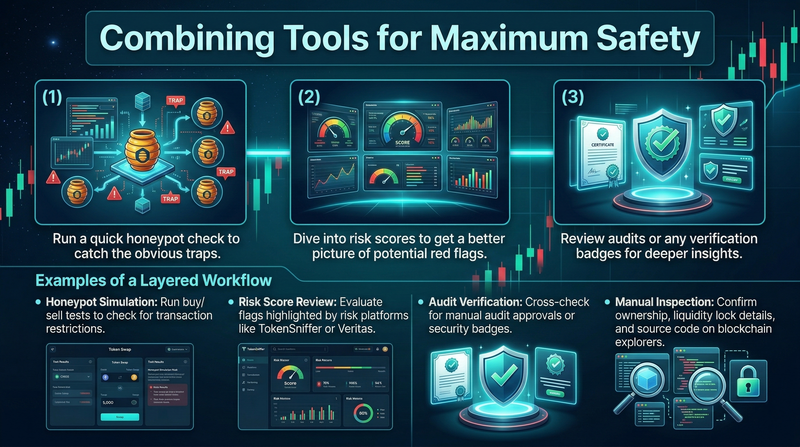
These tools simulate transactions (buys and sells) on a blockchain without actually executing them. They interact with the token's smart contract to identify specific functions or conditions that prevent selling, impose exorbitant taxes, or allow the contract owner to manipulate trades.
Popular Honeypot Checkers in 2026
- Honeypot.is: This industry favorite simulates token buys and sells on compatible chains like Ethereum and BNB Chain. If a token imposes sell restrictions, this tool will call it out. It's known for its straightforward interface and reliable detection.
- GoPlus Security API: Offering more than just honeypot detection, the GoPlus API scans contracts for blacklists, backdoors, and sneaky admin controls. It's embedded in many wallets and dashboards for real-time security checks, providing a comprehensive security layer.
- StaySafu.org: StaySafu simplifies the process by providing readable threat levels. It's especially popular among traders on chains like Binance Smart Chain, offering quick visual indicators of potential risks.
- RugDoc IO: RugDoc takes it a notch higher with detailed human annotations on contracts, helping you spot not just honeypots but a range of traps across multiple blockchains. Their community-driven insights add a valuable layer of scrutiny.
Crypto's bad actors evolve constantly. So, pairing these tools often makes the difference between a safe trade and a devastating loss. While nothing is foolproof, layering multiple scanners minimizes exposure to scams.
Risk Scoring Tools: Quantifying Contract Vulnerabilities
Why Risk Scores Matter
Risk scoring platforms distill the chaos of smart contract mechanics into simple ratings. Whether it's suspicious minting functions, exploitable owner privileges, or liquidity red flags, these tools arm you with a snapshot of potential fraud. If you're navigating fast-paced markets, a solid risk score is indispensable for filtering out dangerously bad contracts.
Leading Risk Scoring Platforms in 2026
Several platforms now offer comprehensive risk scoring systems that assign a numerical rating to smart contracts, often based on factors such as high trading taxes, unlocked liquidity, or administrative privileges. These scores provide a convenient way for traders to screen tokens quickly, while deeper inspection of flagged issues ensures a more accurate assessment.
Other solutions use artificial intelligence and real-time scanning to identify potential exploits, unusual trading behaviors, or liquidity manipulations in seconds. This enables traders to receive live, actionable insights and make faster, more informed decisions.
In addition, there are dashboards that combine multiple risk metrics with broader security analyses. These are particularly useful for detecting subtler vulnerabilities, including modifiable fees, hidden contract functions, or admin controls that could be abused.
Smart Contract Audits: The Gold Standard of Verification
A smart contract audit is a meticulous, professional examination of a contract's code to identify vulnerabilities, errors, and potential exploits. Performed by specialized blockchain security firms, audits are crucial for establishing trust and ensuring the long-term viability of a token or DeFi project.
Why Audits are Essential
- Security Assurance: Audits uncover critical flaws like reentrancy attacks, integer overflows, access control issues, and logic errors that could lead to loss of funds.
- Trust and Credibility: A publicly available, reputable audit report signals to investors and users that a project is committed to security and transparency.
- Compliance: For institutional adoption and regulatory clarity, audited contracts are becoming a baseline requirement.
Key Audit Providers in 2026
- CertiK: A leading name in blockchain security, CertiK offers comprehensive audits, KYC services, and real-time security monitoring (Skynet). Their reports are highly respected within the industry.
- PeckShield: Known for its rapid response to exploits and in-depth analysis, PeckShield provides security audits, threat intelligence, and digital asset protection services.
- SlowMist: A prominent Asian blockchain security firm, SlowMist offers security audits, bug bounties, and anti-money laundering (AML) solutions, catering to a global client base.
- Halborn: Specializing in advanced blockchain security, Halborn provides penetration testing, smart contract audits, and cybersecurity advisory services for high-profile DeFi projects.
Real-time Scam Checkers and Alert Systems
The speed of crypto markets means that traditional, static security checks are often insufficient. Real-time scam checkers and alert systems continuously monitor blockchain transactions, contract deployments, and social media for suspicious activity, providing immediate warnings.
Features of Real-time Systems
- Transaction Monitoring: Flagging unusual transaction patterns, large token transfers to unknown wallets, or sudden liquidity removals.
- Contract Deployment Analysis: Instantly scanning newly deployed contracts for known malicious patterns or suspicious code.
- Social Sentiment Analysis: Monitoring social platforms for coordinated FUD (Fear, Uncertainty, Doubt) campaigns or pump-and-dump signals related to specific tokens.
- Wallet Blacklists: Maintaining and updating lists of known scammer wallets to prevent interaction.
Liquidity Lock & Burn Trackers
One of the most critical indicators of a token's legitimacy is its liquidity status. Rug pulls often occur when developers remove liquidity, leaving investors with worthless tokens. Liquidity lock and burn trackers verify if a project's liquidity is genuinely secured.
Key Aspects to Track
- Liquidity Pool (LP) Locked: Verifying that the LP tokens are locked in a time-bound smart contract, preventing developers from withdrawing them.
- Liquidity Pool Burned: Confirming that LP tokens have been sent to a burn address, effectively removing them from circulation and making them inaccessible.
- Lock Duration: Assessing the length of the liquidity lock. Longer locks generally indicate a stronger commitment from the project team.
Owner Privilege & Admin Control Scanners
Many smart contracts grant special privileges to the contract owner or specific admin addresses. While some are necessary for contract management, others can be exploited for malicious purposes. These scanners identify and highlight such controls.
What to Look For
- Minting Functions: The ability for the owner to create unlimited new tokens, leading to inflation and devaluation.
- Blacklisting/Whitelisting: The power to prevent certain addresses from buying or selling, or to allow only specific addresses to interact.
- Fee Modification: The ability to arbitrarily change transaction taxes, potentially increasing them to 100% to trap funds.
- Proxy Contracts: Identifying if a contract is upgradeable via a proxy, and who controls the upgrade mechanism.
How to Use Token Security Tools Effectively: A Step-by-Step Guide
Integrating these tools into your due diligence process is crucial for minimizing risk.
- Step 1: Initial Screening with Risk Scoring Tools. Before diving deep, use a reputable risk scoring platform to get an immediate overview. Filter out tokens with dangerously low scores or critical red flags.
- Step 2: Honeypot Check. For any token you consider trading, run a honeypot check using at least two different tools (e.g., Honeypot.is and StaySafu.org). This confirms you can buy and sell freely.
- Step 3: Verify Liquidity. Use liquidity lock/burn trackers to confirm that the project's liquidity is secured for a reasonable period. Avoid tokens with unlocked or short-term locked liquidity.
- Step 4: Review Smart Contract Audits. If an audit exists, carefully read the full report, not just the summary. Understand the scope, identified vulnerabilities, and whether they have been remediated. Check the auditor's reputation.
- Step 5: Examine Owner Privileges. Use owner privilege scanners to identify any centralized control points that could be abused. Be wary of contracts with excessive owner powers.
- Step 6: Cross-Reference with Community Sentiment. While not a security tool itself, check social media, forums, and DEXTools' community pages for discussions, red flags, or positive sentiment that might corroborate your findings.
- Step 7: Stay Updated with Real-time Alerts. For tokens you hold, subscribe to real-time alert systems that monitor for suspicious activities related to your assets.
Comparison of Token Security Tool Categories
The Role of DEXTools in Token Security
DEXTools integrates several layers of token security directly into its platform, providing users with a streamlined experience for risk assessment. By displaying key security metrics, audit links, and community sentiment alongside real-time price charts and trading data, DEXTools empowers traders to make informed decisions. Its comprehensive interface often incorporates data from leading security APIs, making it a central hub for initial token security checks.
Future Trends in Token Security (2026 and Beyond)
The field of token security is rapidly advancing. Expect to see:
- AI and Machine Learning Integration: More sophisticated AI models will predict novel attack vectors and identify subtle anomalies in contract behavior.
- Formal Verification: Increased adoption of formal verification methods for critical smart contracts, offering mathematical proof of correctness.
- Cross-Chain Security Solutions: Tools designed to address the unique security challenges of multi-chain and cross-chain environments.
- Decentralized Security Audits: Community-driven audit platforms and bug bounty programs gaining more prominence.
- Real-time Threat Intelligence Networks: Enhanced collaboration among security firms to share threat intelligence and blacklists instantly.
Conclusion
In the high-stakes world of decentralized finance, token security tools are not a luxury but a necessity. By leveraging honeypot detectors, risk scoring platforms, professional audits, and real-time monitoring systems, traders and developers can significantly reduce their exposure to scams and exploits. A multi-layered approach, combined with continuous vigilance, is the most effective strategy to navigate the complexities of the crypto market safely in 2026 and beyond.
Frequently Asked Questions
What are the best token security tools in 2026?
The best token security tools in 2026 include honeypot detectors (e.g., Honeypot.is, StaySafu.org), risk scoring platforms (often integrated into dashboards), professional smart contract auditors (e.g., CertiK, PeckShield), real-time scam checkers, liquidity lock/burn trackers, and owner privilege scanners.
How do honeypot detectors work?
Honeypot detectors simulate token buy and sell transactions on a blockchain without actually executing them. They analyze the smart contract's response to these simulated trades to identify any restrictions, excessively high fees, or blacklisting mechanisms that would prevent a user from selling their tokens.
Why are smart contract audits important?
Smart contract audits are crucial because they involve a meticulous, professional review of a contract's code by security experts to identify vulnerabilities, errors, and potential exploits. They provide security assurance, build trust for investors, and are increasingly a baseline for compliance.
What is a 'rug pull' and how can security tools help prevent it?
A 'rug pull' is a type of crypto scam where developers suddenly withdraw all liquidity from a token's trading pool, rendering the token worthless. Liquidity lock and burn trackers help prevent rug pulls by verifying if a project's liquidity is genuinely secured (locked in a contract or burned) for a specified duration.
Can token security tools guarantee 100% safety?
No, no token security tool can guarantee 100% safety. The crypto landscape is constantly evolving, and new scam techniques emerge regularly. These tools significantly mitigate risk, but users should always exercise caution, conduct their own research (DYOR), and use a multi-layered approach to security.
What should I look for in a token's liquidity status?
When assessing a token's liquidity, look for evidence that the Liquidity Pool (LP) tokens are either locked in a time-bound smart contract or have been sent to a burn address. A longer lock duration (e.g., 6 months to several years) generally indicates a stronger commitment from the project team and reduces rug pull risk.
How does DEXTools contribute to token security?
DEXTools integrates several layers of token security directly into its platform. It displays key security metrics, links to audit reports, and community sentiment alongside real-time trading data. This allows users to perform initial risk assessments and make more informed decisions within a single interface.
What are the future trends in token security?
Future trends in token security include increased integration of AI and machine learning for predictive threat analysis, wider adoption of formal verification methods, development of cross-chain security solutions, growth of decentralized security audits and bug bounty programs, and enhanced real-time threat intelligence networks.
What are owner privilege scanners and why are they important?
Owner privilege scanners identify and highlight special powers granted to a smart contract's owner or specific admin addresses. They are important because excessive owner privileges (like the ability to mint unlimited tokens, blacklist users, or arbitrarily change fees) can be exploited for malicious purposes, leading to scams or contract manipulation.