What is Across? Intent-Based Bridge Explained

Traditional cross-chain bridges fragment liquidity and trap users in slow multi-sig validation checks. We break down the competitive relayers and optimistic oracles powering Across.
The Declarative Paradigm: Decoupling Execution from Verification
- Traditional cross-chain bridges are transaction-centric and inherently rigid. Under an "imperative" bridging design (such as classic lock-and-mint or message-relaying channels), a user must explicitly specify the technical instructions of the journey: instructing smart contracts on Chain A to lock capital, waiting minutes or hours for multi-signature or validation layers to sync, and paying gas overhead across multiple networks. This creates slow execution times, high slippage, and significant risk: if a bridge validator set is compromised, the entire locked liquidity pool is exposed to catastrophic failure.
- Across Protocol completely upends this architecture. Operating as a premier interoperability platform, Across relies on an intent-based framework. Instead of telling the network how to process a transfer, users simply broadcast a signed message declaring their desired outcome (e.g., "I want 1,000 USDC on Base, and I will pay a nominal fee to get it"). Across cleanly decouples message execution from on-chain verification, enabling ultra-fast, low-cost asset routing that outperforms traditional message-passing networks.
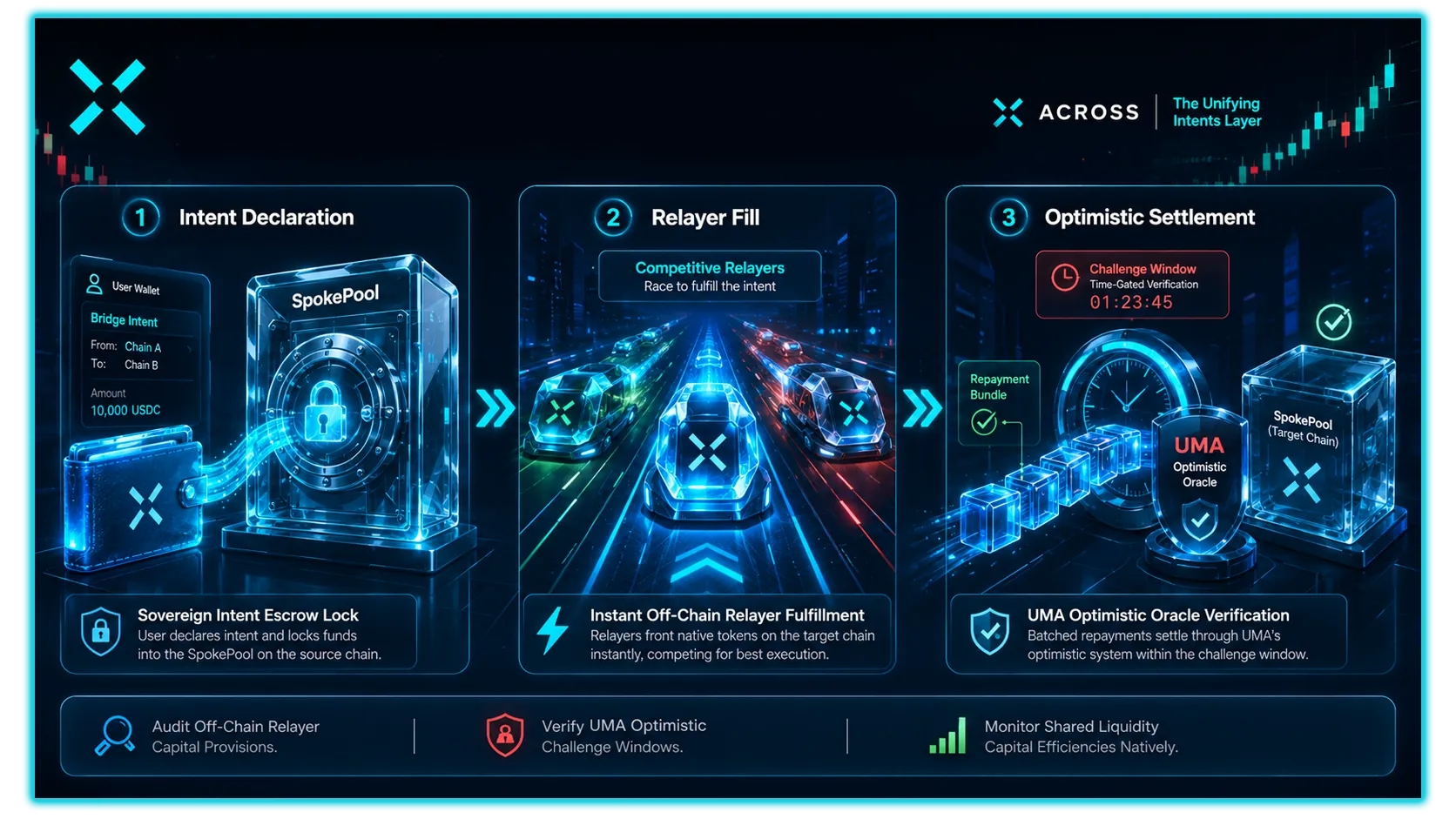
1. The Core Engine on Across: Intent Architecture and Spoke Pools
Across processes value through an asynchronous design powered by decentralized smart contracts called Spoke Pools, which are deployed natively across all supported networks.
The transactional workflow functions through systematic isolation:
The Escrow Deposit: When you initiate a cross-chain transfer, your assets are locked securely inside the origin chain’s SpokePool contract. This acts as an open Request for Quote (RFQ), publicizing your intent to the network.
The Execution Split: Traditional bridges force users to wait for the message to slowly pass through verification checkpoints before unlocking capital. Across bypasses this delay entirely. The user's escrowed funds stay locked on the origin network, while a competitive market of independent actors handles the immediate fulfillment on the destination side.
2. The Velocity Layer: The Decentralized Relayer Network
The extreme speed of Across (frequently delivering finality to users in under 3 seconds) is driven by its permissionless Relayer Network.
Relayers are professional, heavily capitalized market makers and off-chain software bots that continuously monitor Across intent pools.
The Liquidity Race: Once a user's intent is broadcast, relayers compete in an open market to fulfill the order. The winning relayer fronts their own native capital on the destination chain, transferring the requested assets straight to the user's wallet.
Short-Term Capital Loans: In essence, the relayer issues a near-instant, risk-free loan to the user. Relayers absorb the localized gas fees, short-term volatility, and block finality risks. In return, they charge the user a nominal relayer fee, unlocking a highly optimized arbitrage environment that drives transaction friction down to near-zero margins.
3. The Safeguard: UMA Optimistic Oracle Settlement
- Because relayers constantly spend their own capital to fulfill user requests on destination networks, they must eventually be reimbursed from the protocol's master liquidity hub on Ethereum Mainnet. Across manages these payouts safely through UMA’s Optimistic Oracle (OO).
- Instead of verifying every single transfer individually on-chain (which would incur massive gas fees), Across bundles hundreds of fulfilled intents into a unified repayment package. A specialized data worker submits this batched assertion to UMA’s oracle, posting a financial bond as collateral.
The Escalation Game and 1-of-N Security
The verification framework operates on an optimistic assumption: all proposed repayment bundles are treated as true and valid unless explicitly challenged.
The Challenge Window: Once a bundle is proposed, a strict time-gated window (typically 1 to 2 hours) opens. Independent watchers and competing bots continuously audit the batch against public data logs.
The Dispute Resolution Loop: If a watcher uncovers an error or a fraudulent claim, they challenge the assertion, posting a matching bond. The dispute is instantly escalated to UMA’s Data Verification Mechanism (DVM), where independent UMA token holders vote on the data's validity. If the challenger is correct, the fraudulent relayer's bond is slashed and awarded to the challenger.
4. The Core Network Utility: The ACX Governance Token
The economic and operational alignment of the Across network centers entirely around the ACX token. With a hard-capped maximum supply of 1 billion tokens, ACX functions as the native governance and incentive asset for the Across DAO.
Holding ACX grants direct steering capabilities over the protocol's parameters:
Liquidity Optimization: Voting on yield parameters and fee-reward weights for the shared single-sided liquidity pools.
Ecosystem Expansion: Directing treasury reserves and token emissions to incentivize relayers on newly supported networks.
The Intent Standard Frontier: ACX governs the deployment tracks of ERC-7683, an open intent-standard co-authored alongside Uniswap Labs. ERC-7683 establishes a unified cross-chain mempool, allowing independent relayers to service order flow from multiple decentralized applications simultaneously without fragmentation.
Interoperability Architecture Comparison Matrix
| Feature Matrix | Message-Passing Bridges (e.g., Wormhole) | Across Intent Protocol |
| Execution Speed | Tied to native block finality loops | Near-instant (Under 3 seconds via Relayers) |
| Security Model | Active validation (Multi-sigs / Guard) | Passive validation (Optimistic 1-of-N Oracle) |
| Liquidity Structure | Fragmented multi-chain pools | Single-sided shared hub on Ethereum |
| Standardization | Proprietary SDKs / Frameworks | Open ERC-7683 Cross-Chain Mempool |
Auditing Cross-Chain Order Flows via DEXTools Telemetry
- As intent-driven bridging frameworks and standardized cross-chain mempools scale across alternative execution tracks, tracking the resulting token capitalizations, pool depths, and market performance parameters becomes an essential risk management practice. Sourcing analytics through advanced decentralized charting architectures like DEXTools gives market participants an essential universal platform to monitor live token behaviors, evaluate pool depths, and inspect contract parameters across all public execution networks.
- By leveraging core features like the Pair Explorer, Live New Pairs dashboard, and the integrated Trade Story or Top Traders diagnostic tools, technical traders can seamlessly audit localized volume trends, track large whale wallet capital reallocations via the Big Swap Explorer, and check automated contract safety scores before initiating any on-chain interactions, ensuring your hardened hardware setup interacts safely with verified market venues.
You can access DEXTools here and start trading today!
Disclaimer: This article is for informational purposes only and does not constitute investment advice, financial advice, trading advice, or any other kind of advice. DEXTools does not recommend buying, selling, or holding any cryptocurrency or token. Users should conduct their own research and consult with a qualified financial advisor before making any investment decisions. Cryptocurrency investments are volatile and high-risk. DEXTools is not responsible for any losses incurred.
How to Check a Liquidity Pool Before Buying a Token 2026 How to Bridge USDC to Base Safely in 2026 Bridge Inflows vs Local DEX Volume: Does Capital Stay on the Chain? How to Check Liquidity Lock Before Buying a Token: Unlock Risk and Locker Verification (2026)