Bridge Inflows vs Local DEX Volume: Does Capital Stay on the Chain?
— By Whatsertrade in Tutorials

Cross chain bridges help capital move between blockchain ecosystems. When bridge inflows rise, a chain may look like it is attracting new users, liquidity and m
Cross chain bridges help capital move between blockchain ecosystems. When bridge inflows rise, a chain may look like it is attracting new users, liquidity and market attention.
But capital entering a chain does not always stay there.
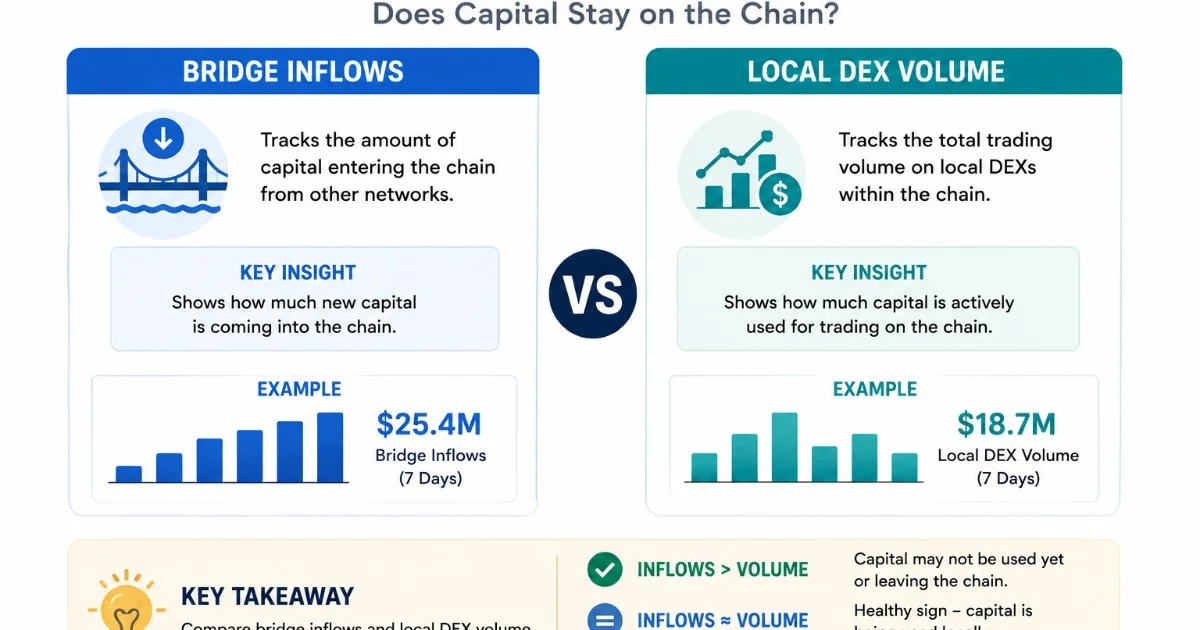
Some users bridge funds only to claim rewards, farm points, mint assets or move capital elsewhere. If local DEX volume does not grow, bridge inflows may not reflect real ecosystem activity.
This is why traders should compare bridge inflows vs local DEX volume.
This comparison helps answer a key question: does capital stay on the chain and become productive?
What Are Bridge Inflows?
Bridge inflows measure the value of assets entering a blockchain through bridges.
This can include stablecoins, ETH, wrapped BTC, ecosystem tokens or other assets.
High bridge inflows can suggest that users are moving capital into an ecosystem. This may be positive for liquidity, DeFi growth and network adoption.
However, inflows alone do not prove that users are active after arriving.
What Is Local DEX Volume?
Local DEX volume measures trading activity on decentralized exchanges within a specific blockchain ecosystem.
If users bridge assets into a chain and then trade, provide liquidity or rotate capital locally, DEX volume may increase.
Local DEX volume shows whether capital is being used inside the ecosystem.
This makes it a useful signal of on chain market activity.
Bridge Inflows vs Local DEX Volume: The Key Difference
The key difference is arrival vs activity.
Bridge inflows show that capital entered the chain. Local DEX volume shows whether that capital is being traded and used.
A chain can have large inflows but weak local DEX volume. This may mean users are not engaging deeply with the ecosystem.
A chain with rising inflows and rising local DEX volume may be seeing stronger DeFi adoption.
Why Bridge Inflows Can Be Misleading
Bridge inflows can rise during short term campaigns.
Users may bridge assets to qualify for airdrops, collect rewards or test applications. Some may quickly bridge out after completing the action.
Capital may also pass through a chain without staying.
This can make inflows look bullish even when local activity remains weak.
Why Local DEX Volume Matters
Local DEX volume shows whether capital is participating in the ecosystem.
If users bridge funds and then trade local tokens, swap stablecoins, provide liquidity or interact with DeFi protocols, volume should reflect that.
Strong local DEX volume can support liquidity, price discovery and ecosystem token demand.
It shows that capital is not only entering. It is working.
What It Means When Inflows Rise but DEX Volume Does Not
If bridge inflows rise but local DEX volume stays flat, traders should be cautious.
This may suggest that capital is passive, temporary or farming focused.
Users may be bridging only to complete tasks or hold assets without interacting with local markets.
In this case, the chain may not be converting inflows into real DeFi activity.
What It Means When Both Rise Together
If bridge inflows and local DEX volume rise together, the signal is stronger.
It suggests that new capital is entering and being used.
This can support trading activity, liquidity growth, token launches and ecosystem narratives.
A chain that converts inflows into local volume may have stronger user engagement.
What Happens When DEX Volume Rises Without Inflows
Sometimes local DEX volume rises without strong bridge inflows.
This may mean capital already inside the ecosystem is rotating between assets. That can still be useful, but it may not show new external demand.
Internal rotation can create activity, but fresh inflows may be needed for stronger expansion.
Traders should distinguish between new capital and recycled capital.
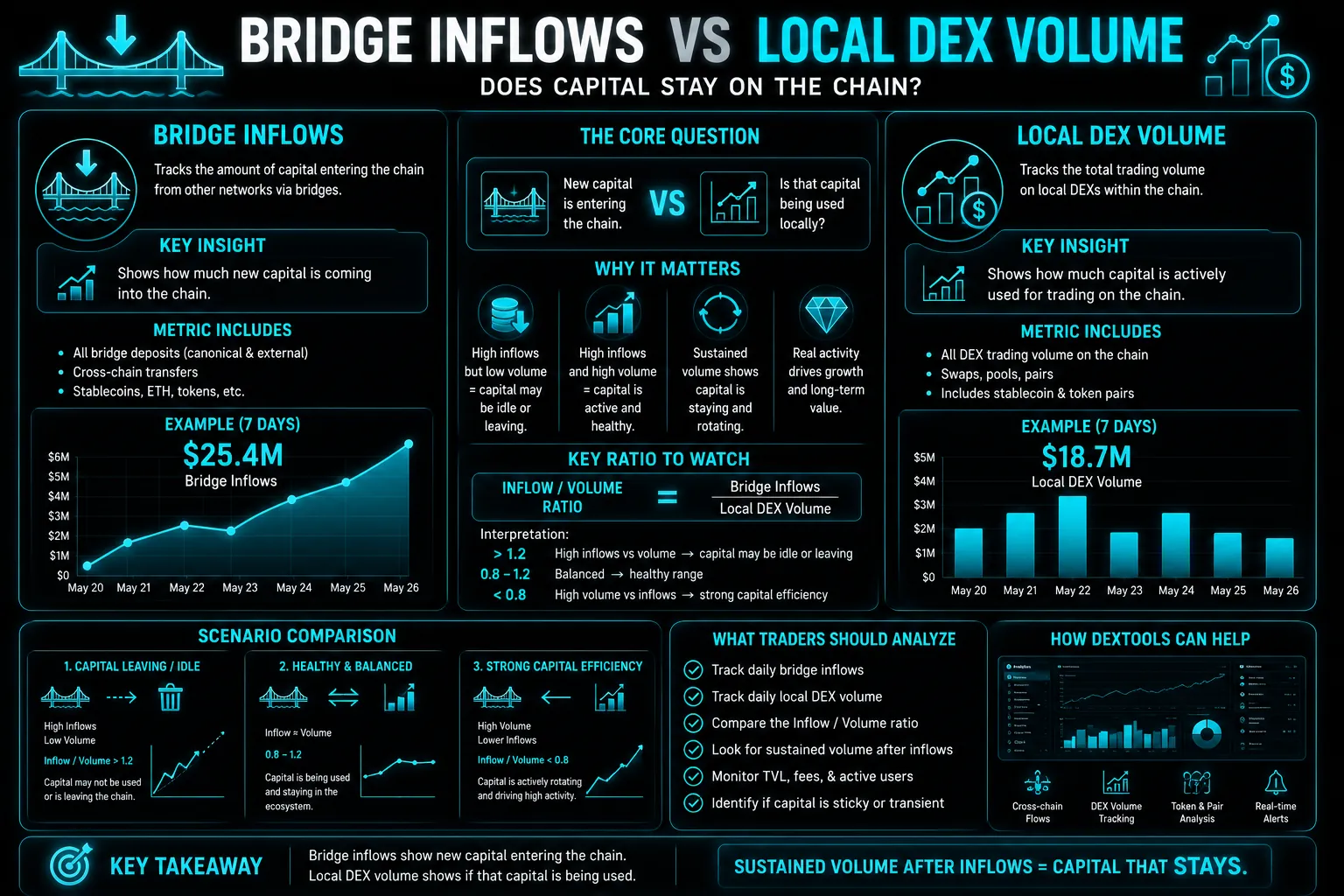
What Traders Should Analyze
Traders should ask:
Are bridge inflows increasing?
Is local DEX volume increasing too?
Are users bridging out quickly?
Which assets are entering the chain?
Is stablecoin liquidity growing?
Are local tokens gaining volume?
Is activity concentrated in one campaign?
Are liquidity pools becoming deeper?
Do users remain after incentives end?
These questions help traders understand whether the ecosystem is attracting durable capital.
Why This Matters for Ecosystem Tokens
Bridge inflows can create bullish narratives for chain tokens and local ecosystem tokens.
But if the capital does not stay or trade locally, the narrative may weaken.
Local DEX volume can show whether inflows translate into real market demand.
A chain with strong inflows and weak local activity may be overhyped. A chain with growing inflows and strong DEX volume may show healthier adoption.
How DEXTools Can Help
DEXTools can help traders monitor local DEX activity, token pairs, liquidity, volume and price action.
When bridge inflows increase, traders can use DEXTools to see whether that capital is showing up in actual markets.
This helps identify whether a chain is gaining real DeFi traction or only temporary bridge activity.
Final Thoughts
Bridge inflows and local DEX volume measure different parts of ecosystem growth.
Bridge inflows show that capital enters a chain. Local DEX volume shows whether that capital becomes active.
For traders, the strongest signal comes when both grow together.
In cross chain markets, capital arrival is only the first step. Real adoption begins when that capital stays, trades and supports the local ecosystem.
How to Bridge Crypto Between Chains: Complete Cross-Chain Tutorial 2026 How to Use 1inch for Swaps: Classic, Fusion and Limit Orders (2026) OKX Web3 Wallet Tutorial 2026: Multi-Chain Setup GuideThe Nuance of Sticky Capital: Beyond Initial Inflows
While the initial surge of bridge inflows might paint a picture of a flourishing ecosystem, the true measure of a chain's health lies in its ability to retain and productively deploy that capital. "Sticky capital" refers to funds that, once bridged, remain within the new ecosystem, actively participating in its DeFi protocols, NFTs, or other applications, rather than quickly re-bridging out. A high inflow number alone, without corresponding local DEX volume or protocol TVL growth, can indicate a transient "tourist" capital that explores briefly before departing.
Understanding the stickiness of capital requires a deeper look into user behavior post-bridge. Are new users engaging with native applications, staking, providing liquidity, or minting NFTs? Or are they simply arbitraging price differences and moving on? The longevity of capital on a chain is a critical indicator of its long-term viability and the strength of its value proposition.
Cultivating Retention: Strategies for Sticky Capital
Building an ecosystem that encourages capital to stay is a multi-faceted endeavor. It involves more than just attracting initial liquidity; it requires fostering a vibrant, secure, and rewarding environment for users and developers alike.
- Robust DeFi Infrastructure: Offer diverse and high-quality decentralized applications for lending, borrowing, and swapping.
- Compelling Incentives: Implement sustainable liquidity mining programs or yield farming opportunities that reward long-term participation.
- Strong Community and Development: Foster an active developer community and a supportive user base that drives innovation and adoption.
- Security and Reliability: Prioritize robust security measures and a stable network to build user trust and confidence.
- Seamless User Experience: Ensure intuitive interfaces and low transaction costs to reduce friction for new users.
- Unique Value Proposition: Develop distinct features or applications that are not easily replicated on other chains, providing a reason to stay.
Related Guides
- DEX Net Inflows vs. Trading Volume: Capital Rotation?
- Healthy vs Toxic DEX Volume Explained
- DEX Volume Race 2026: Solana, Ethereum, BNB, and Base
- Settlement Volume vs Transfer Count: Which Better Shows Real On Chain Value Movement?
- Top 5 Crypto Bridge Tools in 2026: Best Cross-Chain Options Compared
Frequently Asked Questions
What are bridge inflows in crypto?
Bridge inflows refer to capital moving from one blockchain to another through a cross-chain bridge. Rising inflows can suggest a chain is attracting new liquidity and users.
What is local DEX volume?
Local DEX volume is the trading activity happening on decentralized exchanges within a specific chain. It reflects how actively capital is being used on that chain rather than just arriving.
Why compare bridge inflows with DEX volume?
Comparing the two helps reveal whether incoming capital actually stays and gets used or simply passes through. Inflows without matching on-chain activity may indicate capital is not sticking.
Does high bridge inflow mean a chain is growing?
Not necessarily, because inflows can be temporary or driven by incentives rather than lasting adoption. Sustained on-chain usage is a stronger signal that a chain is genuinely growing.