What Is a Block Zero Sniper at Token Launch?
— By AliceOnChain in Tutorials

Token launches on decentralized exchanges are highly competitive events. Understanding how a block zero sniper operates allows retail traders to better analyze liquidity deployment, holder distribution, and subsequent price action using advanced on-chain tools.
What Is a Block Zero Sniper at Token Launch?
The launch of a new token on a decentralized exchange (DEX) is one of the most volatile events in the decentralized finance (DeFi) ecosystem. Within seconds of liquidity being provisioned, millions of dollars in volume can execute, dramatically shifting the asset's price action. For intermediate retail traders observing these events on-chain, one phenomenon frequently stands out: immediate buys executing in the exact same block as the liquidity addition.
This mechanism is driven by a specialized infrastructure known as a block zero sniper crypto bot. Understanding how these automated actors operate, how they impact market structure, and how to analyze their presence using on-chain metrics is essential for navigating modern token launches safely.
The Mechanics of Block Zero Sniping
To understand a block zero sniper, one must first understand how smart contract platforms queue transactions. When a token developer deploys a smart contract and creates a liquidity pool on a DEX (such as Uniswap or PancakeSwap), the event occurs within a specific blockchain block.
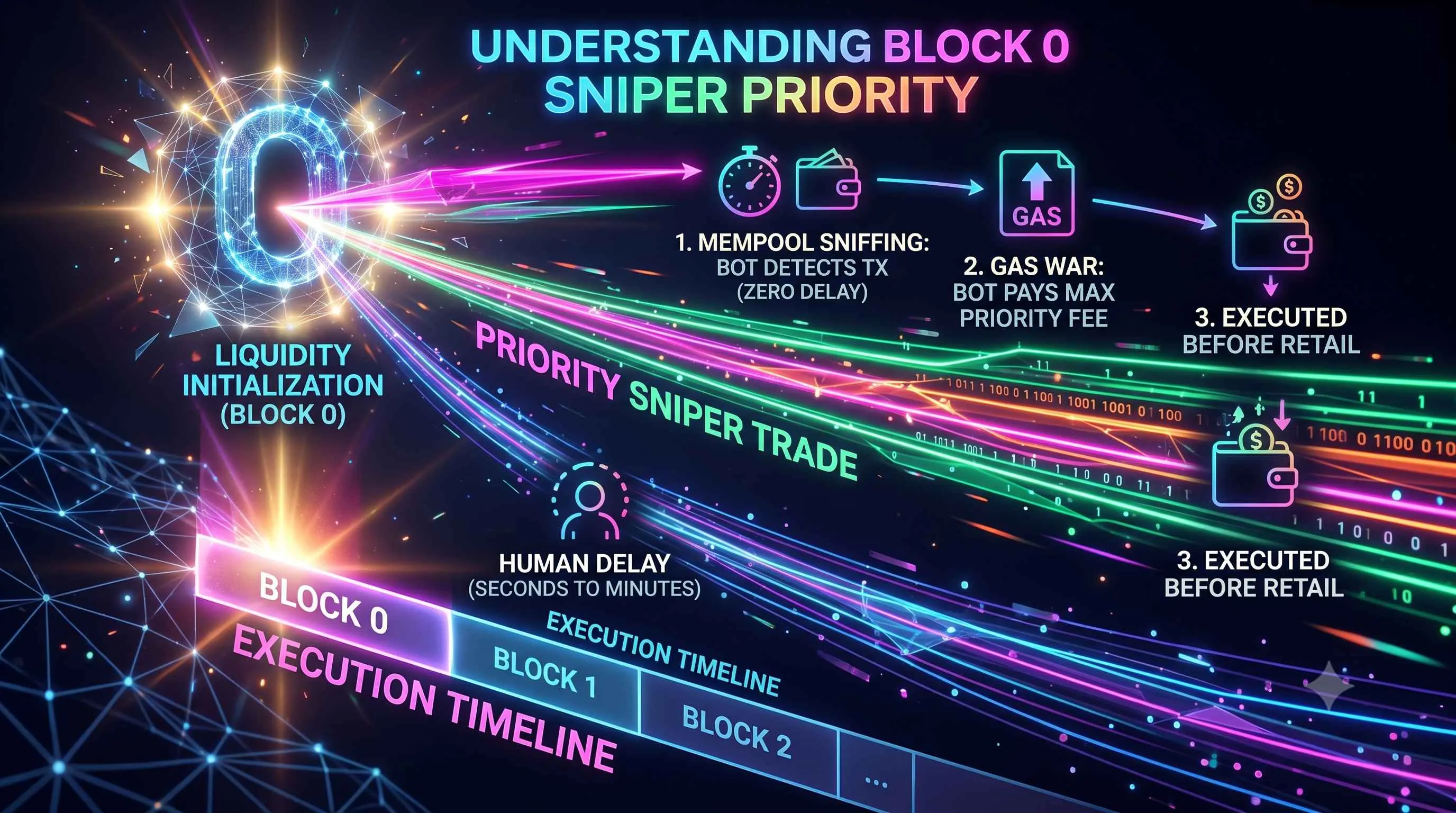
A block zero sniper is an automated trading script or Maximal Extractable Value (MEV) bot programmed to detect this exact liquidity initialization transaction in the mempool—the holding area for unconfirmed transactions.
Mempool Monitoring and Priority Gas Auctions
Sniper bots monitor the mempool continuously for specific function calls, such as addLiquidity or openTrading. Once the bot detects the developer’s transaction to initialize the pool, it instantly submits its own buy order.
To ensure its buy order executes immediately after the liquidity is added within the very same block (hence "block zero"), the bot employs two primary strategies:
Priority Gas Fees: The bot pays an exceptionally high gas fee directly to the validator or miner to ensure its transaction is positioned at the top of the block.
Private RPC Networks: Many advanced snipers bypass the public mempool entirely, utilizing private communication networks like Flashbots or builder endpoints. This allows them to bundle their buy transaction directly with the developer’s liquidity transaction, leaving zero room for human execution ahead of them.
The Impact on Initial Price Action
Because the block zero sniper buys at the absolute lowest possible price point before any other market participant can react, the initial price action of the token experiences an immediate, vertical spike. The automated buy pressure alters the mathematical ratio of the liquidity pool, driving up the asset's price significantly before the next block is even minted.
How Snipers Shape Token Market Structure
The presence of one or multiple sniper bots in the opening blocks of a token launch fundamentally alters the asset's market structure. For retail traders looking to manage risk, analyzing these initial blocks reveals critical insights into holder distribution and market sentiment.
Artificial Volume and Liquidity Concentration
In the minutes following a launch, a token may show massive trading volume. However, a significant portion of this volume can often be attributed to sniper bots entering and subsequently managing their positions. This concentrated liquidity can create a false sense of organic market demand.
If a single wallet or a coordinated cluster of sniper bots acquires a large percentage of the circulating supply in block zero, the holder distribution becomes highly centralized. This centralization introduces structural vulnerability to the asset’s price sustainability.
The Risk of Liquidity Imbalance
When sniper bots control a vast portion of the initial supply, subsequent price action depends heavily on their behavior. If these automated actors choose to exit their positions rapidly to capture short-term profits, they can drain the available liquidity from the pool, causing severe downward volatility. This underscores why tracking initial holder concentration is just as critical as tracking nominal liquidity depth.
Step-by-Step Guide: Identifying Sniper Activity on DEXTools
Detecting block zero snipers requires real-time monitoring of on-chain data. By utilizing the advanced analytics suite on DEXTools, traders can dissect a token launch to determine if automated snipers have dominated the initial supply distribution.
Step 1: Analyze Early Transactions via Pair Explorer
When a new token pair is created, open the DEXTools Pair Explorer for that specific asset. Scroll down to the real-time transaction history ledger.
Look closely at the timestamp and the block number of the earliest transactions. If you observe multiple buy orders executing within the exact same second or block as the liquidity provision, you are looking at block zero sniper activity. Take note of the transaction sizes and the wallet addresses involved.
Step 2: Evaluate Supply Centralization with Holder Analysis
Once you have identified early buy transactions, navigate to the Holder Analysis tool on DEXTools. This feature provides a clear breakdown of how the token supply is distributed among unique addresses.
Look for Clusters: Pay attention to whether the top holders (excluding known exchange or contract addresses) mirror the wallets that executed the block zero buys.
Assess the Percentage: If the top 10 individual wallets hold a disproportionately large percentage of the circulating supply, it may indicate that snipers possess significant market power over the token's future price action.
Step 3: Map Wallet Relationships via Bubblemaps
To determine if seemingly separate sniper wallets are actually controlled by a single entity, use the Bubblemaps integration on DEXTools. This visual tool displays the transfers of tokens and capital between wallets.
If multiple block zero sniper wallets are connected by lines representing direct token transfers or shared funding sources, it signals a coordinated sybil attack. A single actor controlling multiple top-holder wallets increases the structural risk for subsequent market participants.
Step 4: Monitor Real-Time Liquidity Tracking and Volatility
As the launch progresses past the opening hours, continuously inspect the Liquidity Tracking data on DEXTools. A healthy token launch generally features a steady increase in locked or burned liquidity alongside a broadening distribution of holders. Conversely, if liquidity remains unlocked and the block zero snipers maintain their large positions, the potential for sudden, adverse volatility remains elevated.
Developing a Risk-Mitigated Trading Strategy
Navigating a market ecosystem influenced by block zero snipers requires a disciplined, technical approach that eschews emotional decision-making. Retail traders can utilize traditional technical analysis combined with on-chain data to protect their capital.
Avoiding the Initial Chasing Trap
Because block zero snipers cause the price to escalate vertically within seconds, attempting to manually buy a token during the opening minutes often results in purchasing the absolute peak of the initial spike. This leaves the trader vulnerable to the inevitable profit-taking from the very bots that entered at block zero.
Waiting for Support/Resistance and RSI Stabilization
Rather than chasing the launch, disciplined traders often allow the market structure to mature over several hours or days.
Establish Support/Resistance: Wait for the price action to settle and establish recognizable horizontal support and resistance levels on the chart.
Monitor RSI Divergence: Utilize the Relative Strength Index (RSI) on DEXTools interactive charts. Look for instances where the price action attempts to make a new high, but the RSI exhibits a bearish divergence, which can signal that the sniper-driven momentum is fading. Conversely, an RSI stabilization in oversold territory near a strong on-chain support level may indicate a more calculated entry point once sniper dominance has abated.
Utilizing Price Alerts for Execution
Instead of glued to the screen during periods of extreme opening volatility, traders can set custom Price Alerts on DEXTools. By establishing alerts near key structural support zones or at a price level representing a significant retracement from the sniper-induced peak, you can ensure you only engage with the market under calculated, favorable risk-to-reward parameters.
Conclusion
The presence of a block zero sniper crypto bot is a structural reality of modern decentralized token launches. These automated systems leverage advanced infrastructure, private RPC networks, and high gas fees to secure the earliest possible entries, often resulting in hyper-inflated initial valuations and concentrated holder distributions.
For retail DeFi users, success does not come from attempting to beat these automated scripts at their own game. Instead, it relies on rigorous on-chain verification. By utilizing tools like the DEXTools Pair Explorer, Holder Analysis, and Bubblemaps, traders can look past the initial volume spikes to see the true distribution of supply. Managing risk through patience, relying on established technical indicators, and waiting for market stabilization remains the most sustainable methodology when interacting with newly launched crypto assets.
- The Zero to Liquidity Window: When a New DEX Pair Becomes Actually Tradable
- Best Crypto Sniper Tools in 2026: Platforms for Token Launch Entries
- Pump.fun Bot Activity Index: How Many New Tokens Get a Bot Launch Burst
- Healthy vs Unstable Token Launch Patterns: Key Insights
Disclaimer: This article is for informational purposes only and does not constitute investment advice, financial advice, trading advice, or any other kind of advice. DEXTools does not recommend buying, selling, or holding any cryptocurrency or token. Users should conduct their own research and consult with a qualified financial advisor before making any investment decisions. Cryptocurrency investments are volatile and high-risk. DEXTools is not responsible for any losses incurred.