What Is DePIN? Top DePIN Infrastructure Projects Explained

Real-world hardware meets decentralized coordination. We pull back the curtain on the multi-billion-dollar infrastructure networks breaking traditional monopolies.
DePIN Infrastructure. What Is DePIN?
- The structural composition of global physical infrastructure has historically been the exclusive domain of multi-billion-dollar corporate monopolies. Telecom conglomerates, massive cloud computing cartels, and centralized mapping enterprises operate under an asset-heavy, capital-intensive deployment model. To build a cellular network, launch a cloud data center, or map every public road on Earth, traditional Web2 enterprises must deploy astronomical amounts of upfront capital to purchase hardware, secure real estate, and navigate localized bureaucratic regulatory frameworks. This high barrier to entry isolates the market, resulting in rent extraction, localized service monopolies, and single points of failure across critical hardware backbones.
- The emergence of DePIN Infrastructure represents one of the most structurally disruptive architectural paradigm shifts in the history of web networks. By substituting centralized corporate treasuries with open-source cryptographic token incentives, these networks crowd-source the deployment and maintenance of physical hardware. Instead of a single enterprise owning the entire stack, a global, permissionless matrix of independent operators purchase, install, and run physical devices out of their homes, vehicles, or commercial spaces. This guide provides an exhaustive analysis of the underlying token-economic flywheels, physical-to-digital resource taxonomies, and top-tier protocols currently pioneering the decentralized infrastructure landscape.
1. The Token-Economic Engine: Designing the Flywheel
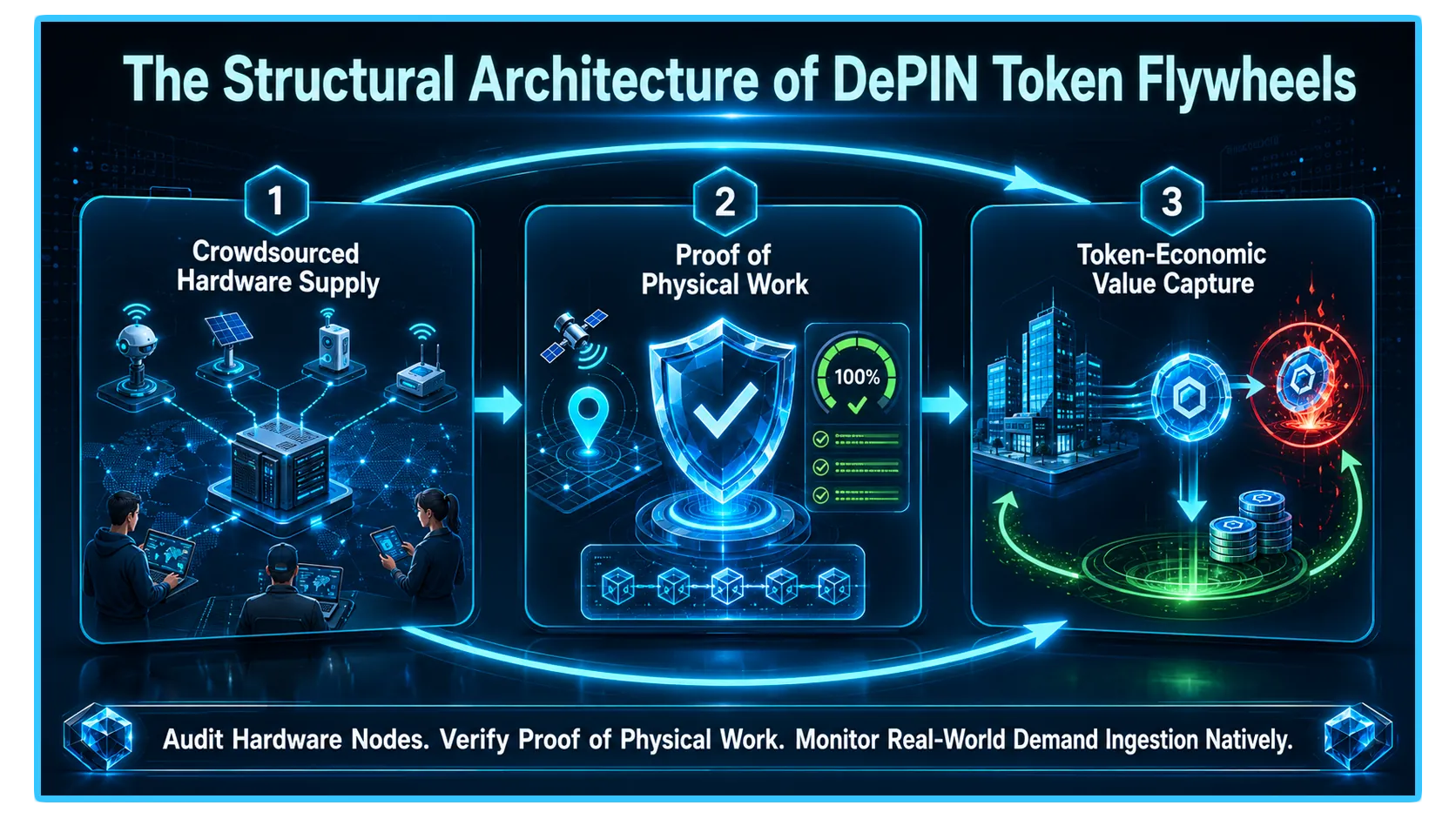
- To evaluate decentralized hardware networks with institutional rigor, you must first master the game-theoretic mechanism known as the "DePIN Flywheel." The primary challenge facing any new physical infrastructure network is the classic cold-start problem: how do you convince thousands of individuals globally to purchase expensive hardware devices before there is any real-world consumer demand to generate operational revenue?
- Cryptographic tokenomics elegantly resolve this structural bottleneck by shifting capital deployment to the future. During the nascent phase of the network, the protocol utilizes programmatic token emissions to heavily subsidize the supply side. Independent operators are paid in native protocol tokens simply for connecting their hardware, providing verified uptime, and establishing regional coverage baselines. This initial reward structure underwrites the operator's hardware procurement and electricity costs, turning a capital-intensive deployment into a profitable venture from day one.
- As the supply side scales and achieves a critical mass of physical density, the network's utility emerges. Because the protocol does not carry corporate overhead, real estate debt, or massive administrative salaries, it can offer infrastructure services (such as elastic GPU compute, permanent data storage, or hyper-local wireless data transmission) at a fraction of the cost charged by centralized cloud or telecom giants.
- This dramatic cost reduction systematically pulls real-world demand into the ecosystem. Enterprise clients and retail consumers purchase the network's utility using fiat or stablecoins, which the protocol automatically routes into token-burning mechanics or direct buybacks. This demand-side inflow reduces circulating token supply and strengthens market dynamics, which increases the value of the ongoing emissions distributed to operators, further accelerating hardware expansion.
2. Technical Taxonomy: Physical vs. Digital Resources
When analyzing the technical taxonomy of modern DePIN Infrastructure networks, projects are generally bifurcated into two independent macro categories based on the operational nature of the assets they coordinate: Physical Resource Networks (PRNs) and Digital Resource Networks (DRNs).
Physical Resource Networks (PRNs)
PRNs coordinate location-dependent, hardware-specific assets that provide a localized utility to consumers within a precise geographic boundary. These resources cannot be easily shifted or virtualized; their economic value is intrinsically bound to their physical placement.
Wireless Networks (DeWi): Community-installed cellular hotspots, LoRaWAN antennas, and Wi-Fi repeaters that provide decentralized data coverage for smartphones and Internet of Things (IoT) devices.
Sensors and Mobility: Fleet-deployed dashcams, environmental monitors, and weather telemetry devices that gather granular, high-fidelity real-world data points linked directly to localized GPS coordinates.
Energy Grids: Decentralized solar panel arrays, household battery storage systems, and local micro-grids that trade excess power over peer-to-peer electronic ledgers.
Digital Resource Networks (DRNs)
DRNs optimize fungible, location-independent digital assets that can be aggregated and redistributed globally across cloud networks. The physical location of the hardware node is secondary to its computational throughput and bandwidth capacity.
Compute Clusters: High-performance GPU and CPU processing networks used to train machine learning models, execute artificial intelligence rendering, or render complex cinematic graphics.
Storage Arrays: Encrypted, distributed data repositories that slice, replicate, and store institutional data sets across thousands of independent hard drives globally, achieving absolute resistance to censorship and physical data loss.
3. Top Decentralized Compute & AI Networks
The explosive expansion of artificial intelligence, deep learning models, and large language model training has created an unprecedented global shortage of high-end graphics processing units. Centralized cloud data centers are severely supply-constrained, forcing developers to contend with long waiting lists and exorbitant pricing structures. DePIN infrastructure compute networks resolve this crisis by unlocking massive pools of underutilized global silicon.
IO.net: The GPU Aggregator Matrix
- IO.net functions as a high-performance decentralized compute cluster specifically engineered to handle machine learning and AI execution workloads. The protocol’s core innovation is its ability to pool together GPUs from disparate, independent sources—including underutilized enterprise data centers, crypto-mining farms that became obsolete after network upgrades, and high-end consumer gaming rigs.
- The primary technical challenge of decentralized compute is communication latency; training an AI model requires massive amounts of data to pass between individual chips instantaneously. IO.net resolves this by implementing advanced Ray clustering algorithms and virtual network overlay topologies that mimic the high-speed InfiniBand connections found inside localized supercomputers.
- By clustering thousands of independent GPUs into a single, cohesive virtual machine, the platform allows AI developers to secure immense computing power dynamically for up to 90% less cost than traditional cloud providers.
Render Network (RNDR): Decentralized Digital Canvas
- Render Network pioneered the application of decentralized GPU clustering for the digital creation and rendering sectors. Animators, architectural designers, and spatial computing developers require intense rendering capacity to transform raw code into complex cinematic graphics.
- Render allows these creators to offload their heavy processing queues to a global network of node operators who stake their idle GPU capacity. The protocol utilizes a strict validation system to audit rendering accuracy, distributing native token rewards to nodes only after they provide verified cryptographic proof of completed rendering work.
4. Top Decentralized Wireless (DeWi) Networks
Decentralized Wireless networks completely reimagine the economics of cellular and telecommunication coverage. By transforming everyday citizens into telecom station operators, these protocols construct massive, overlapping data footprints without relying on corporate cell tower real estate.
Helium (HNT): The Pioneer of Crowdsourced Coverage
- Helium stands as the foundational proof-of-concept for the entire decentralized physical infrastructure movement. The network launched by distributing low-power LoRaWAN hotspots designed to provide long-range, minimal-bandwidth data connectivity for IoT devices like tracking sensors, smart agricultural monitors, and city utility systems.
- To ensure the structural integrity of its coverage map, Helium engineered a custom consensus mechanism known as Proof of Coverage (PoC). Hotspots continuously transmit localized radio frequency beacons to cryptographically prove their physical location and signal strength to neighboring nodes.
- Following its initial success in IoT, Helium expanded into cellular infrastructure via Helium Mobile, distributing 5G hotspots that allow users to offload data traffic from major national carriers, creating a community-owned, carrier-grade mobile network layer.
5. Top Decentralized Sensor & Mapping Networks
Centralized mapping services like Google Maps or Apple Maps require massive capital expenditures to maintain data fidelity. They rely on dedicated corporate fleets of specialized camera cars that can take months or years to re-map changes in global road infrastructure, leading to static, outdated geographic data sets.
Hivemapper (HONEY): Real-Time Global Mapping
- Hivemapper addresses this challenge by crowdsourcing real-world mapping data using consumer-grade, high-definition dashcams. Everyday drivers, rideshare operators, and commercial logistics fleets install a specialized Hivemapper dashcam inside their vehicles. As they navigate their standard daily routines, the camera automatically captures high-resolution street-level imagery and processes the data locally.
- The device utilizes edge-processing algorithms to automatically anonymize sensitive information, blurring out license plates and human faces before uploading the imagery to the protocol's centralized data pipeline. The protocol validates the imagery using transaction hashes and precise GPS telemetry, distributing HONEY token rewards directly to the driver's wallet.
- Because thousands of independent drivers are constantly traversing the same metropolitan centers daily, Hivemapper refreshes its global mapping layers at a velocity that traditional centralized enterprises cannot mathematically or financially match, creating a live, hyper-current mapping product for logistics, autonomous driving, and urban planning clients.
6. Top Decentralized Storage Networks
Centralized cloud storage platforms require absolute trust in a single entity to maintain data privacy and structural accessibility. If a centralized cloud provider experiences a physical server facility outage or executes a corporate policy shift, access to your critical data sets can be instantly compromised.
Filecoin (FIL): The Decentralized Hard Drive Matrix
- Filecoin serves as an open-source, decentralized layer built directly on top of the InterPlanetary File System (IPFS). The protocol creates a hyper-competitive global marketplace where independent data center operators and individual storage providers bid against each other to host encrypted data sets.
- To guarantee that a storage provider is genuinely guarding the data they were hired to host, Filecoin mandates continuous cryptographic validation through Proof of Spacetime (PoSt) and Proof of Replication (PoRep). These continuous cryptographic challenges prove to the blockchain ledger that the unique data set remains fully intact, completely unread by the host, and physically accessible inside the provider's hard drives at all times, delivering a state-of-the-art data storage network.
7. Systemic Risks and Operational Bottlenecks
An institutional-grade deployment of capital into decentralized infrastructure networks requires a balanced, look-through risk assessment. While DePIN offers unparalleled cost-efficiency and scaling velocity, the intersection of physical hardware and cryptographic tokens introduces highly specific risk parameters.
Data Spoofing and GPS Manipulation Attacks
- Because these networks automate reward distributions based on data inputs, they are primary targets for sophisticated spoofing attacks. In mapping networks, malicious actors utilize specialized software to forge GPS telemetry, attempting to convince the protocol that a static device is actively mapping roads to farm token rewards.
- Compute networks face simulated uptime attacks, where nodes pretend to offer high-end computing power while executing empty cycles. Protocols must expend immense engineering resources to build robust cryptographic validation matrices capable of detecting and isolating fraudulent data injections.
Supply-Demand Imbalances and Hardware Obsolescence
- The sustainability of the infrastructure model hinges on the seamless transition from token-subsidized supply to organic, user-driven demand. If a project successfully boards tens of thousands of hardware nodes but fails to secure enterprise clients to buy and utilize that specific service, the programmatic token emissions will ultimately dilute the asset's market value.
- When token values compress significantly, the operator's yield drops below their local electricity and maintenance costs, triggering mass node disconnections that can permanently collapse the network's underlying utility before it reaches long-term equilibrium.
8. On-Chain Diagnostics and Verification via DEXTools
- Navigating a highly volatile sector where cryptographic assets are structurally bound to real-world physical devices requires advanced look-through visibility into live secondary market liquidity data. While a project’s internal marketing dashboard may display exceptional growth in total node connections or global hardware footprints, tracking the live transaction volume, liquidity pool distribution, and aggregate order book trends across decentralized venues is the only method to audit genuine market health and isolate real economic velocity from speculative wash-trading noise.
- DEXTools provides the critical analytical infrastructure needed to monitor these external dynamics, allowing investors to track live spot pair volume, audit the liquidity depth of underlying collateral assets across automated market makers, verify transaction trends, and trace large-scale institutional wallet deposits or redemptions across multiple layer-1 and layer-2 networks. Ultimately, the long-term capitalization of the DePIN Infrastructure market relies on real-world adoption, and monitoring these metrics allows allocators to ensure their hardware deployments are backed by sustainable economic substance.
Disclaimer: This article is for informational purposes only and does not constitute investment advice, financial advice, trading advice, or any other kind of advice. DEXTools does not recommend buying, selling, or holding any cryptocurrency or token. Users should conduct their own research and consult with a qualified financial advisor before making any investment decisions. Cryptocurrency investments are volatile and high-risk. DEXTools is not responsible for any losses incurred.