What is a Hash Function? SHA-256 and Keccak Explained
— By AliceOnChain in Tutorials

Demystify the backbone of blockchain security. Learn how cryptographic hash functions transform raw data into immutable strings, explore the differences between SHA-256 and Keccak-256, and understand how hashing impacts on-chain trading and smart contract execution.
What is a Hash Function? SHA-256 and Keccak Explained
Every second, millions of users engage with decentralized finance (DeFi) protocols, execute swaps, and track market movements. When monitoring price action or analyzing volume spikes on tools like the DEXTools Pair Explorer, it is easy to focus entirely on the visual representations of liquidity and momentum. However, beneath every candle, automated market maker (AMM) pool, and smart contract interaction lies a fundamental cryptographic pillar that ensures the integrity of the entire ecosystem. To truly understand how this structural integrity works, one must answer a foundational question: what is hash crypto and how does it safeguard assets?
For retail traders and on-chain analysts with intermediate knowledge, understanding the mechanics of cryptographic hashing is not merely an academic exercise. It is a practical necessity for comprehending how transaction IDs are generated, how smart contract code is verified, and how the underlying networks maintain security against malicious actors. Exploring this fundamental concept unlocks a deeper comprehension of structural security, ensuring you can audit data validity during periods of heightened market volatility.
Understanding Cryptographic Hash Functions in Crypto
To define the core mechanics of ledger security, one must look at it as a mathematical machine. A cryptographic hash function is an algorithm that takes an input of any size (a single number, a text string, or an entire smart contract file) and transforms it into a fixed-size string of characters. This output is known as a hash value, hash digest, or simply a text string string.
The primary utility of this system relies on a property known as the avalanche effect. This means that even a microscopic change in the input text results in a completely unrecognizable and distinct digest output. If you modify a single character in a massive smart contract, the resulting cryptographic fingerprint changes entirely.
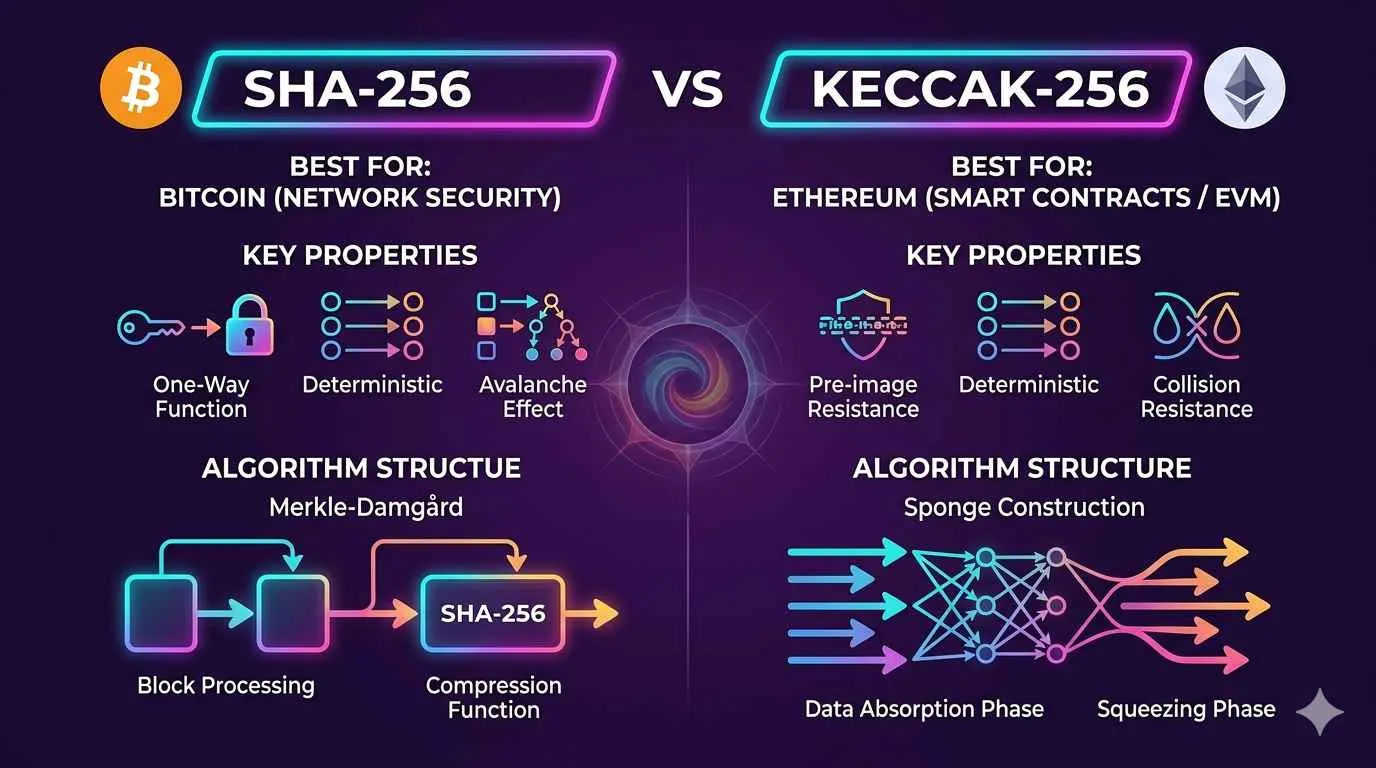
These functions operate on a strict set of deterministic principles that make them indispensable for decentralized ledgers. First, they provide a deterministic output, meaning the exact same input will always produce the identical output string, without exception. This consistency is the core reason why learning the rules of on-chain cryptography is essential for validating accurate, historical blockchain transactions. Second, they feature pre-image resistance, which is a technical way of saying they function as a one-way street; it is computationally infeasible to reverse-engineer the original input data simply by looking at its output. Furthermore, they offer collision resistance, making it statistically improbable for two different inputs to produce the exact same result.
In practical terms, whenever a protocol processes trading volume or updates holder distribution data, a blockchain hashing algorithm validates that the state of the ledger has changed legitimately. This mechanism ensures that historical price action and liquidity states remain immutable, creating a verifiable paper trail that analytical platforms can parse for real-time tracking.
SHA-256: The Backbone of Bitcoin and Network Consensus
Developed by the National Security Agency (NSA) and published in 2001, SHA-256 (Secure Hash Algorithm 256-bit) is perhaps the most widely recognized implementation of data validation in the digital asset space. It produces a fixed 256-bit output, which always displays as a 64-character hexadecimal string regardless of the input file size.
Role in Proof of Work (PoW)
SHA-256 serves as the core engine for Bitcoin’s consensus mechanism. Miners compete globally to solve a cryptographic puzzle by repeatedly processing the block header data combined with a random number called a nonce. The goal is to discover a calculation that falls below a specific target difficulty. When miners perform this task, they are engaging directly with the operational architecture of network math to confirm block validity and secure the ledger.
Security Implications
The computational power required to alter a historical block processed with SHA-256 is immense. Because each block contains the identifier of the previous block, modifying a single past transaction requires a malicious actor to re-mine every subsequent block. This structural interdependence provides the on-chain data security that traders rely on, giving market participants confidence that historical support and resistance levels are rooted in unalterable ledger entries.
Keccak-256: Fueling the Ethereum Virtual Machine (EVM)
As the industry evolved toward programmable smart contracts, scalability and specific architectural needs led to new implementations of Web3 cryptography. Enter Keccak-256, the specific algorithm selected to anchor the Ethereum network and its subsequent EVM-compatible ecosystems.
The Standard vs. SHA-3
A common point of confusion when researching asset security is the relationship between Keccak-256 and SHA-3. During the NIST (National Institute of Standards and Technology) selection process for the official SHA-3 standard, Keccak was chosen as the winning algorithm. However, NIST made slight parameter modifications to the final version of SHA-3. Ethereum’s developers had already integrated the original Keccak-256 variant into the EVM. Consequently, while similar in architecture, Ethereum’s Keccak-256 is distinct from the finalized official SHA-3 standard.
Smart Contract Execution and Event Logs
In EVM networks, Keccak-256 is critical for smart contract execution, deriving contract addresses, generating transaction identifiers, and computing signature selectors for contract functions. Whenever a swap occurs in a liquidity pool, the event logs generated by the smart contract are indexed using Keccak-256 algorithms. This systematic indexing allows developers and data aggregation platforms to accurately read and display crucial variables like whale activity, shifting market sentiment, and sudden fluctuations in token volatility.
SHA-256 vs. Keccak-256: Technical Breakdown
While both algorithms yield a 256-bit output and provide extreme levels of security, comparing SHA-256 vs Keccak-256 highlights how their internal architectures differ significantly to serve distinct network goals.
Structural Differences
SHA-256 relies on the Merkle-Damgård construction, a method where the input message is broken into fixed-size blocks and processed sequentially through a compression function. Keccak-256 utilizes a sponge construction. This architecture permits data to be absorbed into the state and then squeezed out to produce the final calculation, offering robust resilience against specific types of cryptographic attacks like length extension attacks.
Application Differences
SHA-256 remains heavily utilized for network-level consensus and base security, particularly within PoW networks like Bitcoin. Conversely, Keccak-256 is optimized for the internal logic, state storage, and dynamic contract executions inherent to the Ethereum Virtual Machine and DeFi applications. Both represent distinct philosophies of modern data structures, balancing raw computational simplicity against advanced feature sets for smart contracts.
Why Hashing Matters for On-Chain Analysis and Trading
For a retail participant evaluating a token on DEXTools, these unique data strings are the invisible fabric tying data together. Every metric displayed on the dashboard—from basic price metrics to complex structural indicators—relies on the precision of automated mathematics functioning flawlessly in the background.
1. Transaction Verifiability and Market Sentiment
When observing a sudden breakout or breakdown at key support or resistance zones, traders look for confirmation via volume spikes. Every transaction contributing to that volume possesses a unique string, often referred to as a TxID. By pasting this text identifier into a block explorer, an investor can verify the exact time, wallet addresses, and gas fees associated with the move. This transparency prevents the manipulation of data and confirms that the observed volume is legitimate rather than artificial.
2. Auditing Liquidity and Smart Contract Code
Malicious contract deployments often exploit hidden functions to drain liquidity pools. When analyzing a pool via DEXTools Holder Analysis or studying Bubblemaps to detect hidden developer wallets, the contract address itself is derived via a Keccak-256 operation. Verifying that a contract's source code matches its deployed bytecode string ensures that the protocol is running the exact logic audited by security firms, reducing the probability of interacting with compromised contracts or rug pulls.
3. Monitoring Volatility Management and Whale Activity
Whales can significantly alter market sentiment through large, coordinated allocations. Advanced analytical frameworks utilize the power of automated text logs to map out transaction histories, flagging and tracking significant capital movements across decentralized venues. When unexpected volatility triggers DEXTools Price Alerts, tracking the underlying data strings allows users to observe whether a price movement is a localized cascading liquidation or a broader trend shift dictated by large-scale distributions.
The Broader Impact on Risk Management
A granular understanding of what is hash crypto shifts a trader's perspective from a reactive posture to a probabilistic, analytical framework. Recognizing that every piece of data—whether it is an RSI divergence on a chart or a shifting holder distribution metric—is anchored by mathematical certainty at the cryptographic layer provides a firm foundation for building risk management strategies.
In a market defined by rapid innovation and inherent volatility, relying on verified, on-chain metrics is critical. Cryptographic hash functions like SHA-256 and Keccak-256 eliminate the need for centralized trust, ensuring that the raw data feeding your analytical toolset remains resilient, objective, and accurate.
Smart Contract Audit Guide: How to Read an Audit ReportHow to Verify a Smart Contract Onchain: Step-by-Step 2026
Best Free Smart Contract Analysis Tools in 2026
What Is Tenderly: Smart Contract Simulation, Debugging and Web3 Monitoring (2026)
Disclaimer: This article is for informational purposes only and does not constitute investment advice, financial advice, trading advice, or any other kind of advice. DEXTools does not recommend buying, selling, or holding any cryptocurrency or token. Users should conduct their own research and consult with a qualified financial advisor before making any investment decisions. Cryptocurrency investments are volatile and high-risk. DEXTools is not responsible for any losses incurred.